
AI Trading in 2026: Does It Actually Work? The Honest Guide
Three categories of AI trading tools exist in 2026. Two of them either don't work or can't see the market. The third one is where real edge lives — here's how to tell them apart.

Search "ai trading" in 2026 and you get three completely different kinds of results in the first page. One is a set of black-box bots claiming hands-off wealth. Another is a wave of ChatGPT-for-trading threads. The third is a thin crop of purpose-built research tools that do not promise automation at all. These are three different products with three different truths — and most traders lump them together and draw the wrong conclusion about whether AI trading works.
This guide does the unglamorous work of separating them. What each category actually is, where the data says it fails, where it succeeds, and where ChartSnipe sits on the map — because the answer to "does AI trading work" depends entirely on which category you are asking about.
Key Takeaways
- →"AI trading" covers three distinct product categories — signal / execution bots, general-purpose LLM helpers, and purpose-built research AI. Their track records are not comparable.
- →Fully automated bots that promise hands-off returns have a near-universal record of failure, regulatory action, or outright fraud. "Quantum AI trading" ads are not a real product.
- →ChatGPT and Claude are useful research assistants but cannot see live prices, do not know the economic calendar, and hallucinate chart levels. They are idea generators, not trading tools.
- →The third category — AI built specifically for trading research — does work because it augments decisions with live data: chart reading, currency strength, and daily news impact scoring.
- →ChartSnipe is purpose-built research AI: 28 live FX pairs, a currency strength index, daily AI news impact, five screenshot analysis modes, and a custom mode builder — no bots, no "fully passive" promises.
1. What “AI trading” actually means in 2026
The phrase is used for three completely different products and it is worth stating that clearly before anything else.
Bots & auto-trading
Systems that claim to trade hands-off. “Quantum AI”, “Qumas AI”, MT4 EAs, copy-trading rooms. Track record: very bad.
LLM helpers
ChatGPT, Claude, Gemini used for trading research. Good for concepts, blind to live data, hallucinate levels.
Research AI
AI that reads your chart and today's news with live data wired in. Decision support, not automation.
The three are wildly different businesses with wildly different user outcomes. When somebody says “AI trading doesn't work”, they usually mean category one. When somebody says “AI trading changed my workflow”, they almost always mean category three. The rest of this guide walks through each.
2. Category 1 — Signal and execution bots
Every search result with a promise of fixed daily returns lives here. Quantum AI Trading, Qumas AI, Bitsoft360, Immediate Edge, and the rolling cast of Elon-Musk-endorsed deepfake ads all sit under the same umbrella: funnels for unregulated brokers. The brand names change every few months but the mechanic is identical — deposit $250, the bot “trades”, the balance grows on-screen, and the money disappears when you try to withdraw. The UK FCA, Australia's ASIC, and Canada's CSA have all issued warnings about these brands by name. They are not AI trading products. They are affiliate fraud with an AI skin on the landing page.
Legitimate automated trading does exist — but it is not what retail buyers get sold
Goldman Sachs, Renaissance, Jane Street and Citadel run algorithmic trading at a scale that would collapse any retail execution stack. They use AI, but the AI is a risk model or a feature engineer — the trading itself is driven by market-making, statistical arbitrage, and order-flow inference built on tens of petabytes of proprietary data and co-located exchange access. None of that is for sale. No $49 / month “AI auto-trader” subscription replicates it.
The honest take on signal bots
Services like Trade Ideas Holly, Tickeron, and Tradytics in US equities, or the various Cryptohopper / 3Commas bots in crypto, occupy a grey middle ground. They are not scams. They are genuine software with transparent strategies. But the published performance you see in marketing material is almost never the experience retail users get, and the strategies break regularly as market regimes shift. Most serious users end up treating them as idea generators, not execution systems — which is exactly what category three handles better.
3. Category 2 — LLM helpers like ChatGPT and Claude
The second-biggest share of “AI trading” traffic is searches for ChatGPT and Claude — "chatgpt trading", "chatgpt day trading", "openai trading", "chat gpt for trading stocks". Millions of retail traders have tried pasting a chart into ChatGPT and asking it for a trade idea. The results are mixed for reasons that are easy to understand once you know what an LLM can and cannot see.
What LLMs actually are
ChatGPT, Claude and Gemini are general-purpose language models. They are trained on a snapshot of the internet and cut off months to years before today. Out of the box they do not know the current EUR/USD price, they do not know yesterday's FOMC outcome, and they cannot load today's economic calendar. When you upload a chart screenshot, they describe what they see in pixels — not what it means in the context of today's session, Friday's NFP print, or the current DXY reading.
The three silent failure modes
- Hallucinated price levels. Asked for support and resistance, a generic LLM cheerfully invents clean round numbers — even when the chart axis clearly shows non-round values. It has no feedback loop against live data.
- No session or correlation context. It will call a GBP/JPY setup without knowing whether the Tokyo session has already closed, or whether USD is bid across the board (which would kill the long JPY leg).
- No news awareness. It does not know that the Fed speaks in four hours, that OPEC+ is meeting tomorrow, or that today is CPI day. Price levels in a macro vacuum are just geometry.
We cover this in depth in Does ChatGPT work for trading charts? and How to use ChatGPT to analyse a forex chart — short version: great for learning, wrong tool for live decisions.
Where LLMs genuinely add value
Concept explanation ("walk me through how an inverse head-and-shoulders invalidates"), plan drafting, journal review, and turning a Fed statement into a five-bullet summary. These are the tasks where a general-purpose LLM earns its keep. For everything that needs a current number, you need category three.
4. Category 3 — Purpose-built trading research AI
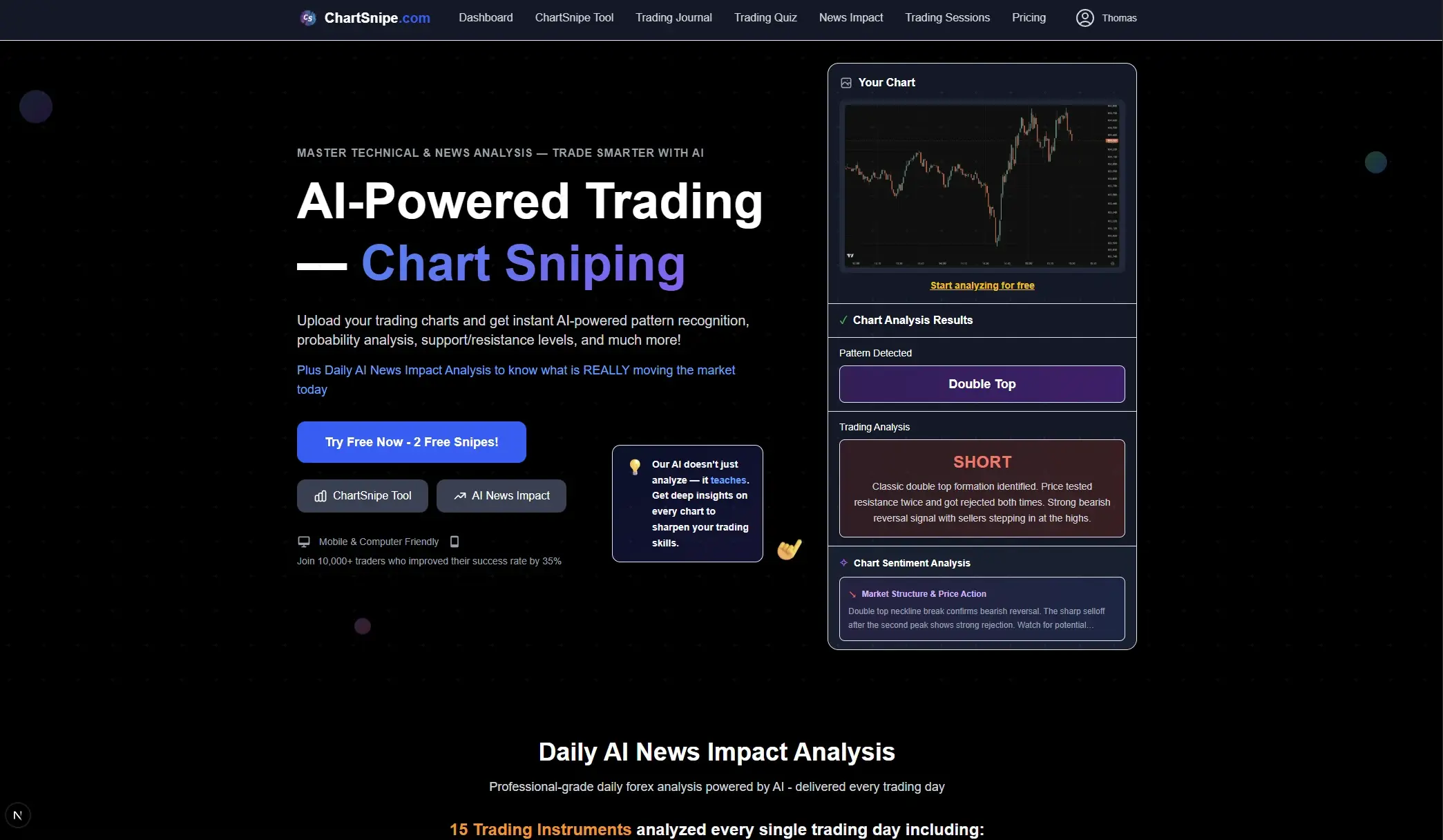
The third category is the smallest by traffic and the only one with a defensible answer to "does AI trading work". Trading-native AI is built from the chart up around three inputs a general model cannot see — a live market feed, a structured news layer, and a domain-specific visual model for chart reading. It does not trade for you. It reads faster than you do, covers more pairs than you do, and keeps the news scored in real time so you do not have to.
ChartSnipe is in this category. The feature surface looks like this:

Screenshot chart analysis
Upload a TradingView or MT4 chart and get a pattern label, direction, entry zone, stop, target, and the reasoning — in under ten seconds.
Daily AI News Impact
Every trading day the AI assembles a macro briefing — central banks, releases, geopolitics, commodities — and scores the impact on 12 instruments.
Live Currency Strength
USD, EUR, GBP, JPY, CHF, AUD, CAD and NZD strength aggregated across 28 pairs in real time. The fastest way to see which pair to even look at.
Five analysis modes
Quick Snipe, S&R Levels, Full Snipe, Liquidity Snipe and Beat Another — one AI, different readouts for scalpers, swing traders and SMC readers.
The distinction from category two is direct: ChartSnipe knows the current price of EUR/USD because it fetches it live from an institutional feed. It knows what is on the calendar because the calendar is loaded. It knows USD is strong today because it computed the currency strength index five seconds ago across 28 pairs. Every output is anchored to a real number.
5. Chart reading: what a trading-native AI actually sees
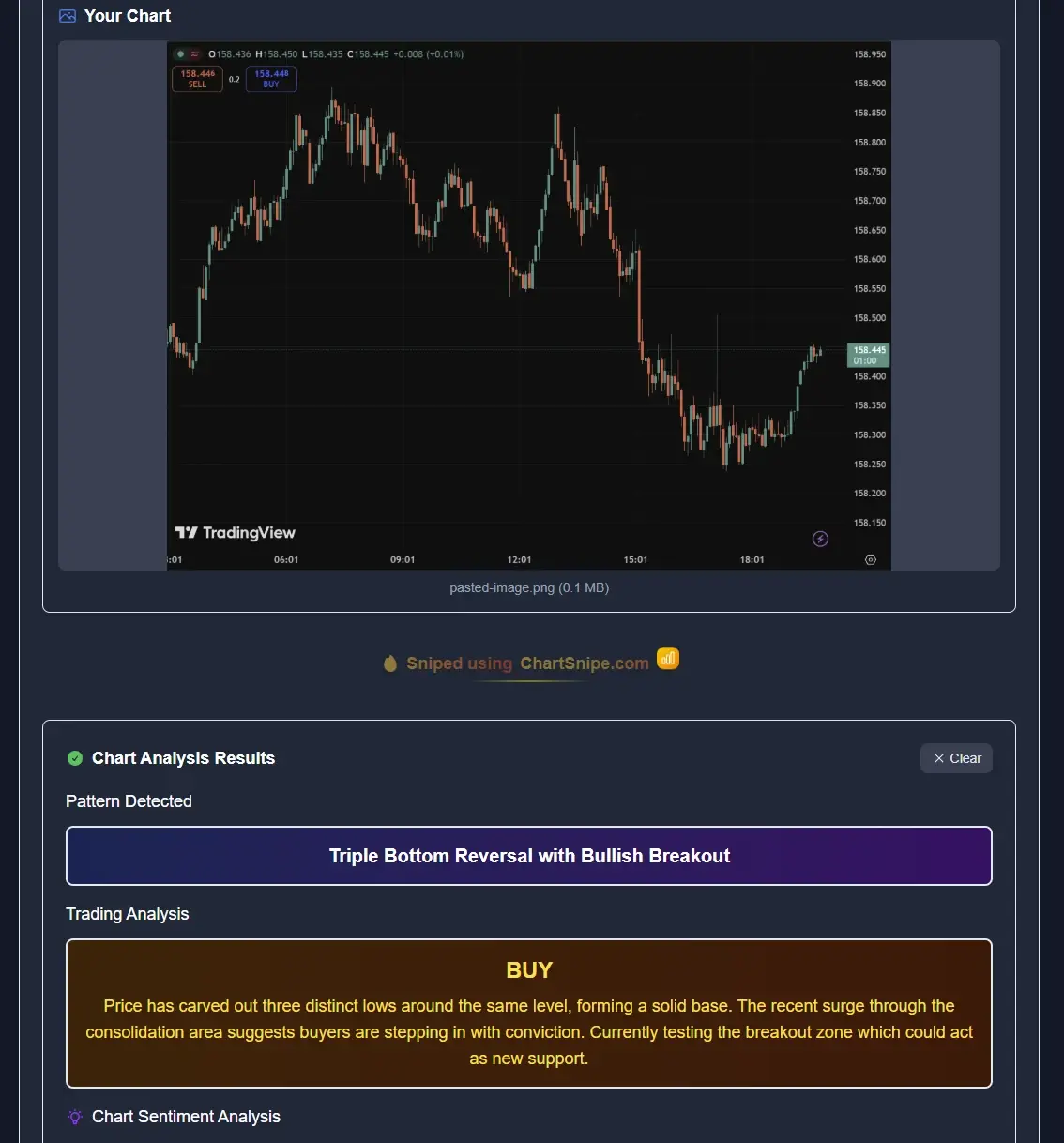
The upload-a-screenshot experience has been commoditised since 2023 — what separates the useful from the useless is what happens after the image hits the server. A general LLM describes what it sees. A trading-native model labels patterns from a closed taxonomy, anchors levels to visible pixels, and cross-checks the read against the current session and macro bias.
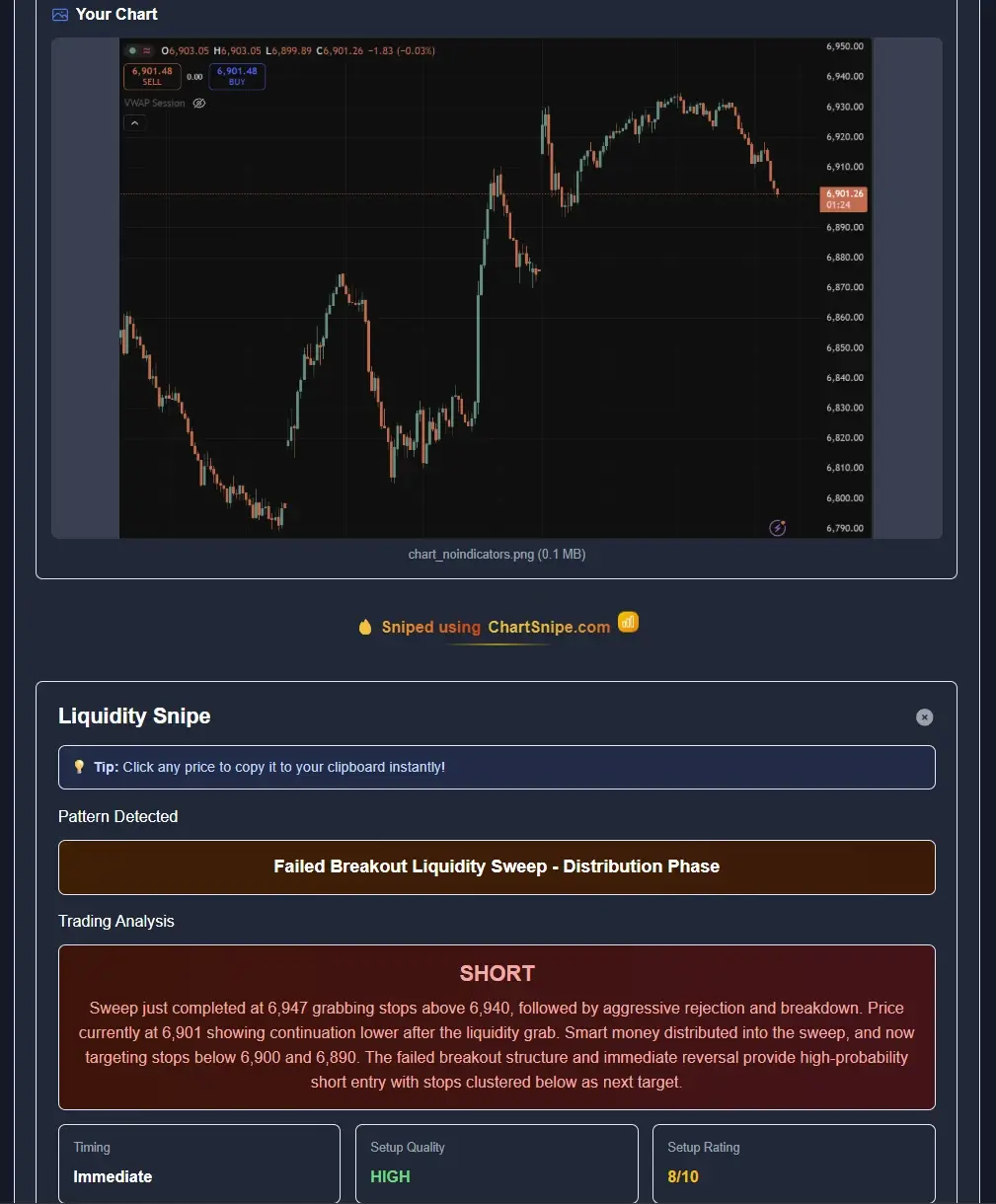
In the screenshot above the model returned a Triple Bottom Reversal with Bullish Breakout — a named pattern from the training set — plus a BUY bias and prose reasoning grounded in the visible price action (“price has carved out three distinct lows around the same level… buyers stepping in with conviction”). That is a very different product to “this looks like a reversal” — it is a labeled call with a testable rationale.
Why that matters for your edge
A named pattern with a named invalidation is something a trader can audit after the fact. You can go back to your analysis history, pull up every Triple Bottom call the AI ever made for you, and compute the hit rate on your own instruments. That is a feedback loop. A vague “looks bullish” from a chatbot is not auditable and will never produce one.
6. News impact — the blind spot of every pure-price AI
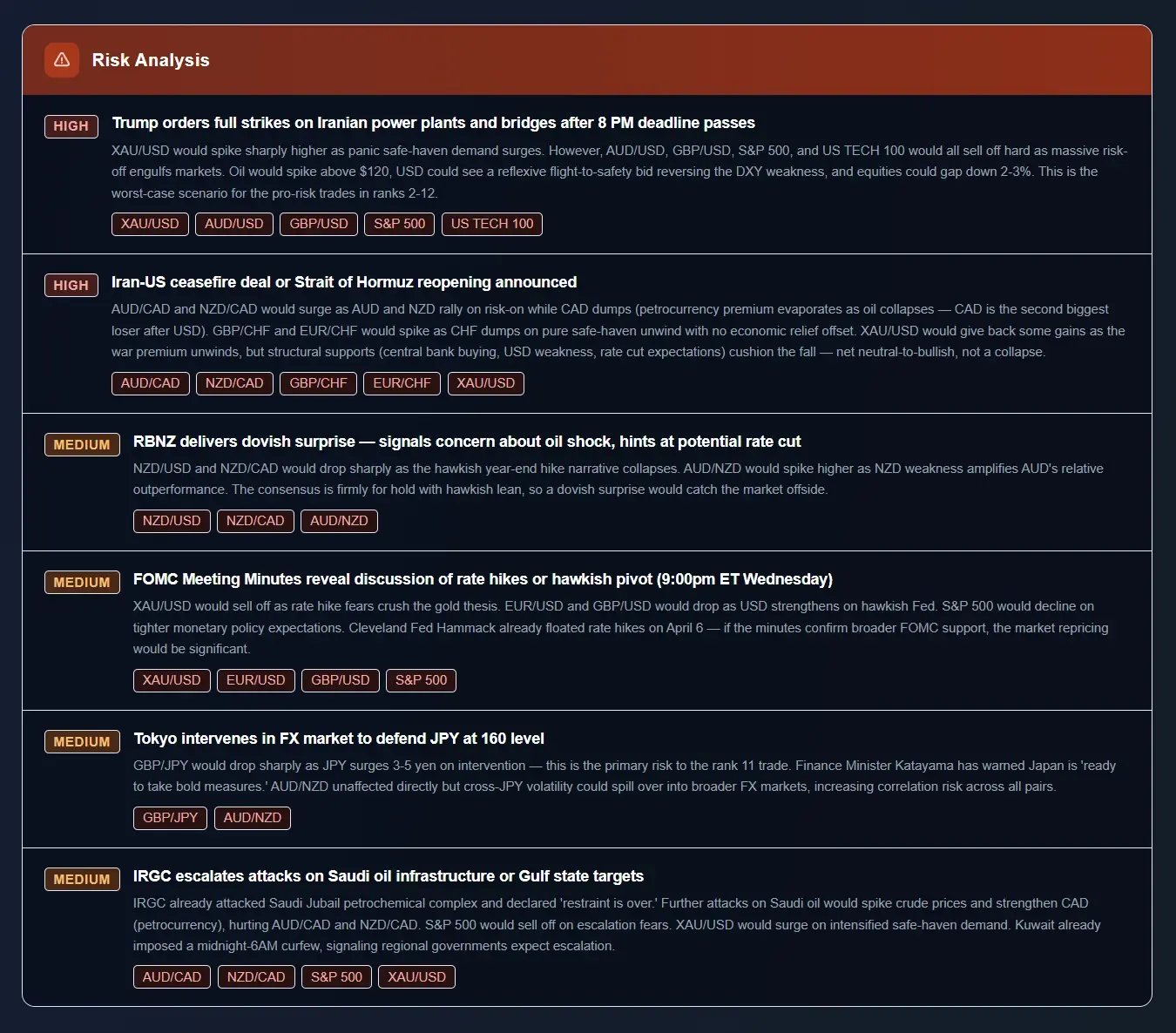
Forex and indices are macro instruments. A clean technical read means nothing if an FOMC decision is four hours away, or if the Middle East picked up a new oil-supply shock overnight. This is exactly where every pure-price bot and every LLM-only workflow breaks down — neither category sees the narrative.
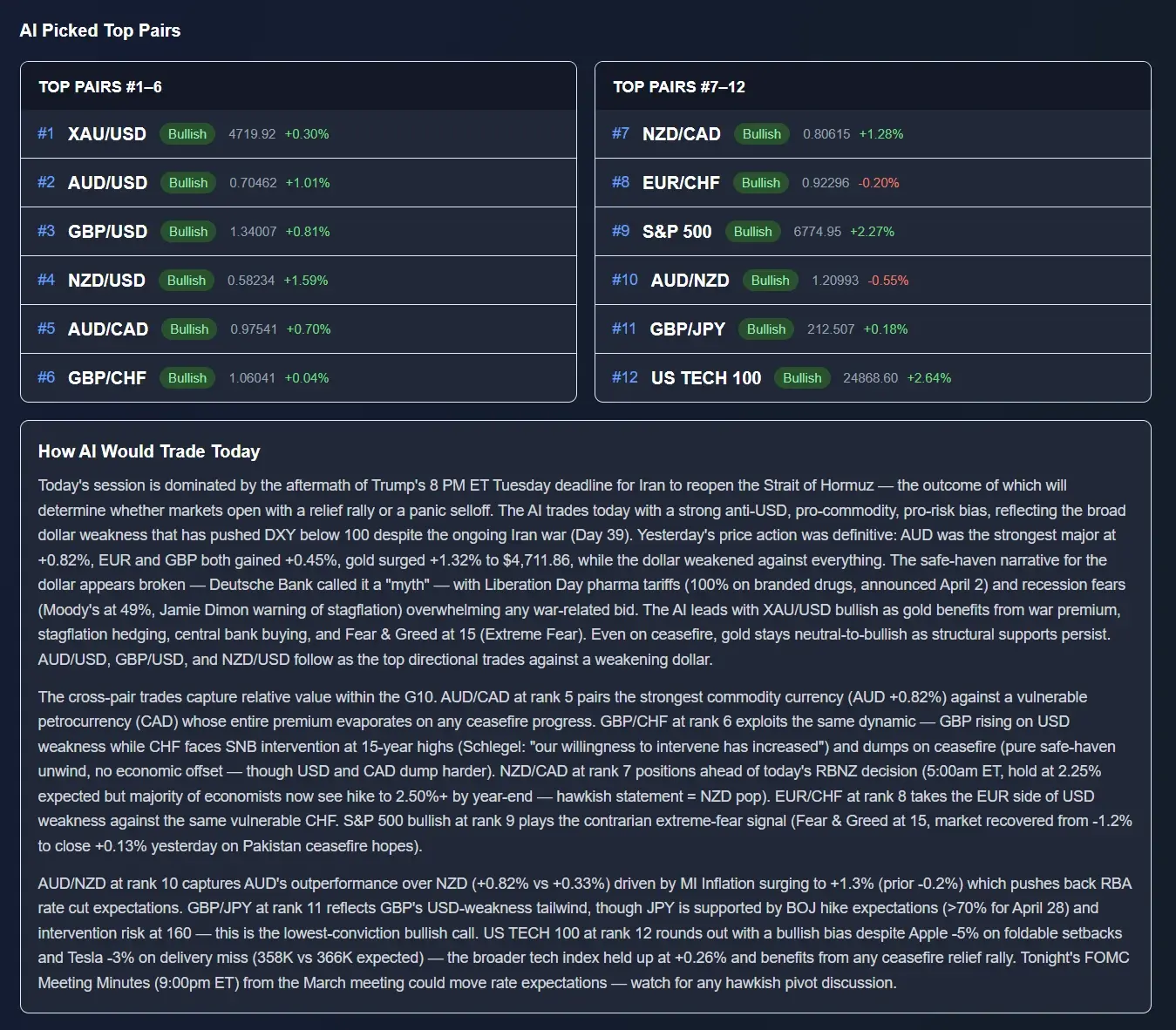
The ChartSnipe Daily AI News Impact dashboard runs every trading day. It pulls central bank positioning, economic releases, geopolitical flow and commodity moves, scores each instrument, and produces a ranked top-bullish / top-bearish list with live prices. Each instrument card shows conviction, the three drivers pushing the read, the specific reversal risks that would invalidate it, and a “how the AI trades today” block written like a prop-desk morning brief.
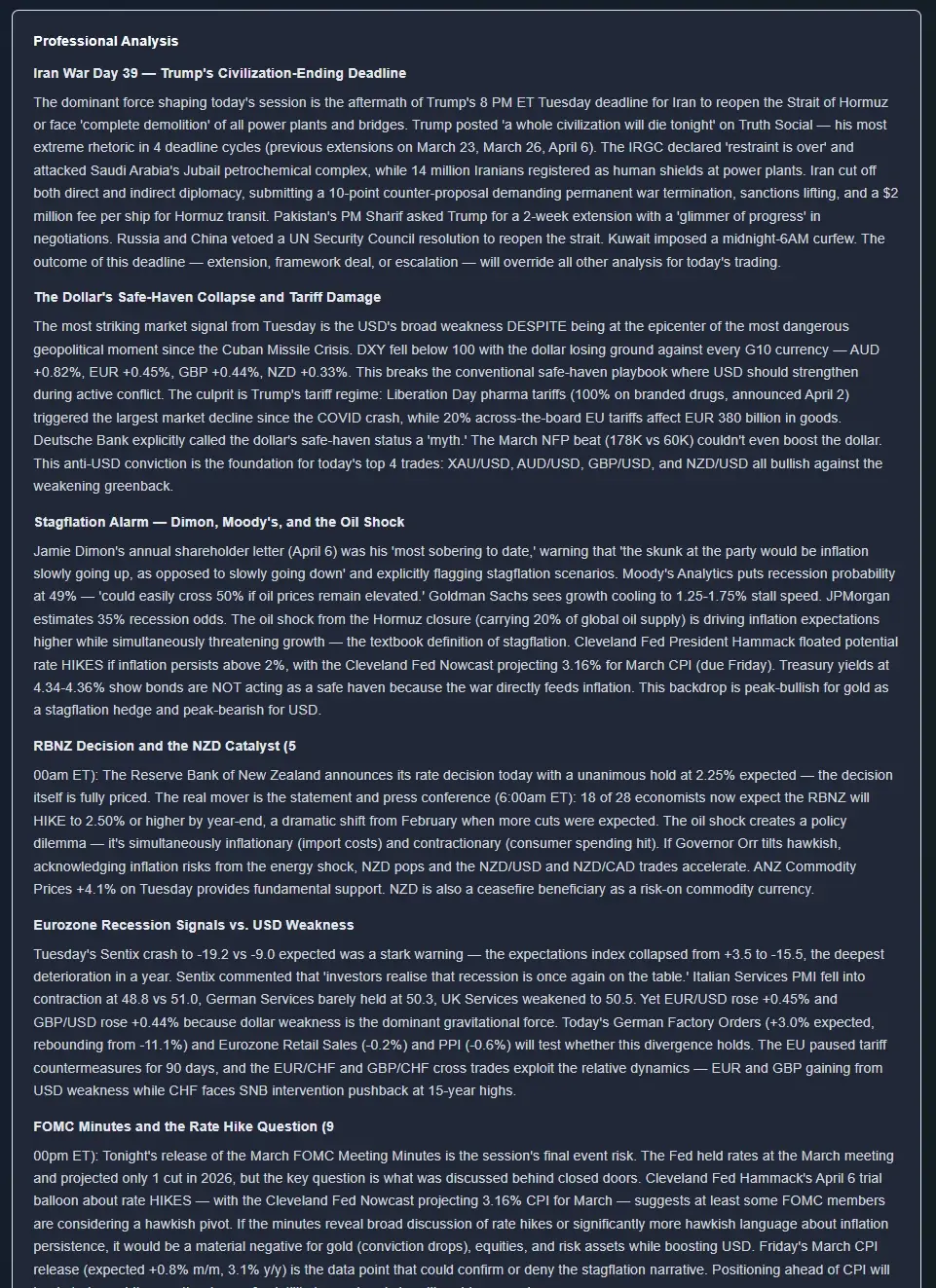
This is the layer that turns AI trading from “chart describer” into decision support. A chart read without a news read tells you where price is. A news read without a chart read tells you why. Stitching them together is the product.
7. Currency strength — the aggregate math every bot misses
Forex moves as pairs. Every chart you look at is a relative value between two currencies, and a move on any single pair is ambiguous until you know which leg is doing the work. EUR/USD up 0.40% could mean EUR is bid, USD is offered, or both — three different trades. Currency strength resolves the ambiguity in a single number.
How ChartSnipe computes it
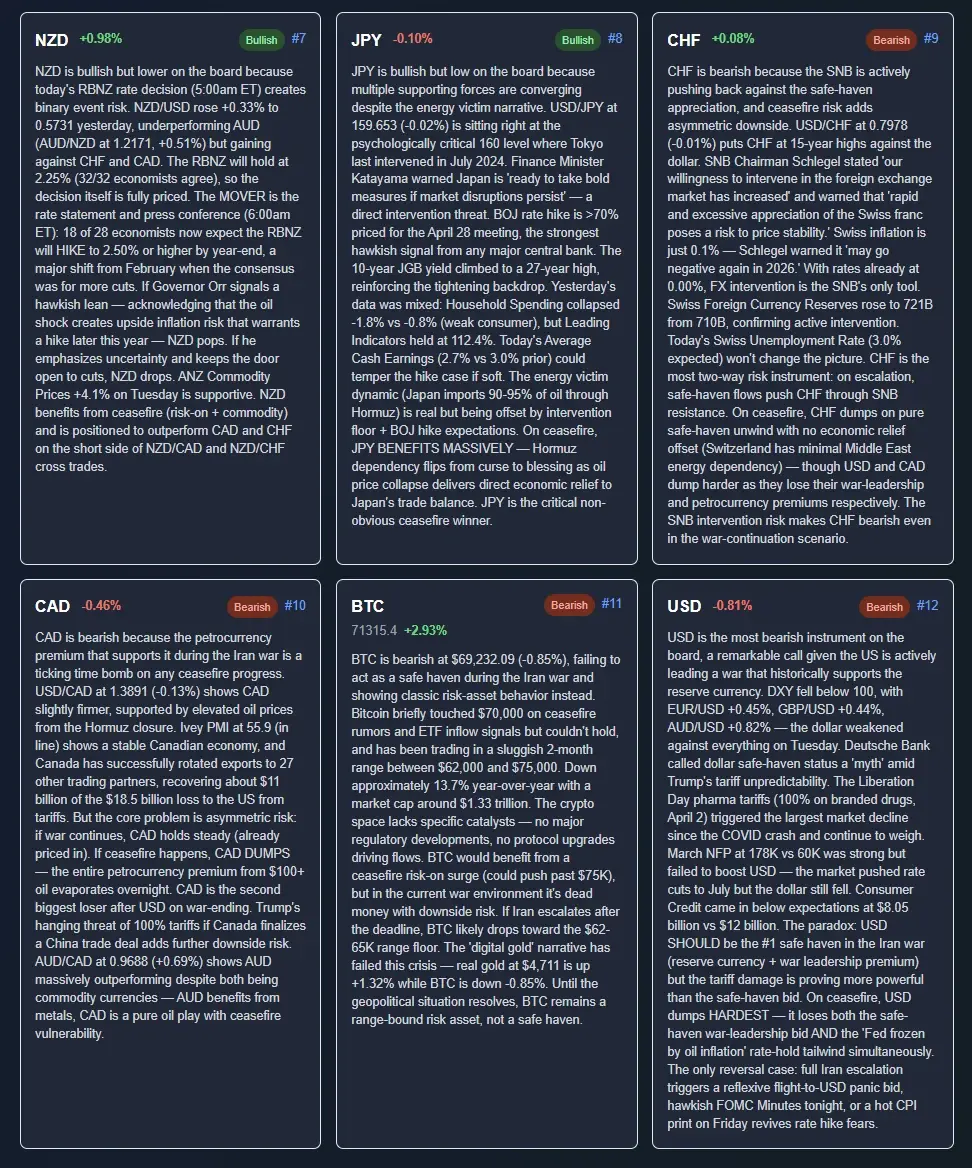
For each of the 8 major currencies the AI averages percentage change across the 7 pairs that currency participates in, flipping sign where the currency is the quote side. USD strength becomes the average of −EUR/USD, −GBP/USD, USD/JPY, USD/CHF, −AUD/USD, USD/CAD, −NZD/USD. The result is a single live number per currency, computed across 28 pairs, updated as prices tick.
Why it changes how you trade
Strongest vs weakest is the cleanest directional trade in FX. If USD prints +0.55% and JPY prints −0.70%, you do not need a chart to know USD/JPY is the default long — the aggregate math says so. An AI that can only read one chart at a time will never give you this. An AI that reads all 28 pairs at once gives it to you for free, every minute.
8. Analysis modes — one AI, five trader profiles
The biggest usability complaint about generic AI in trading is that it gives every trader the same answer. A 5-minute scalper and a weekly swing trader need different readouts on the same chart. ChartSnipe handles this with five distinct analysis modes — the model is told, via a prompt chain under the hood, which trader profile to answer for.
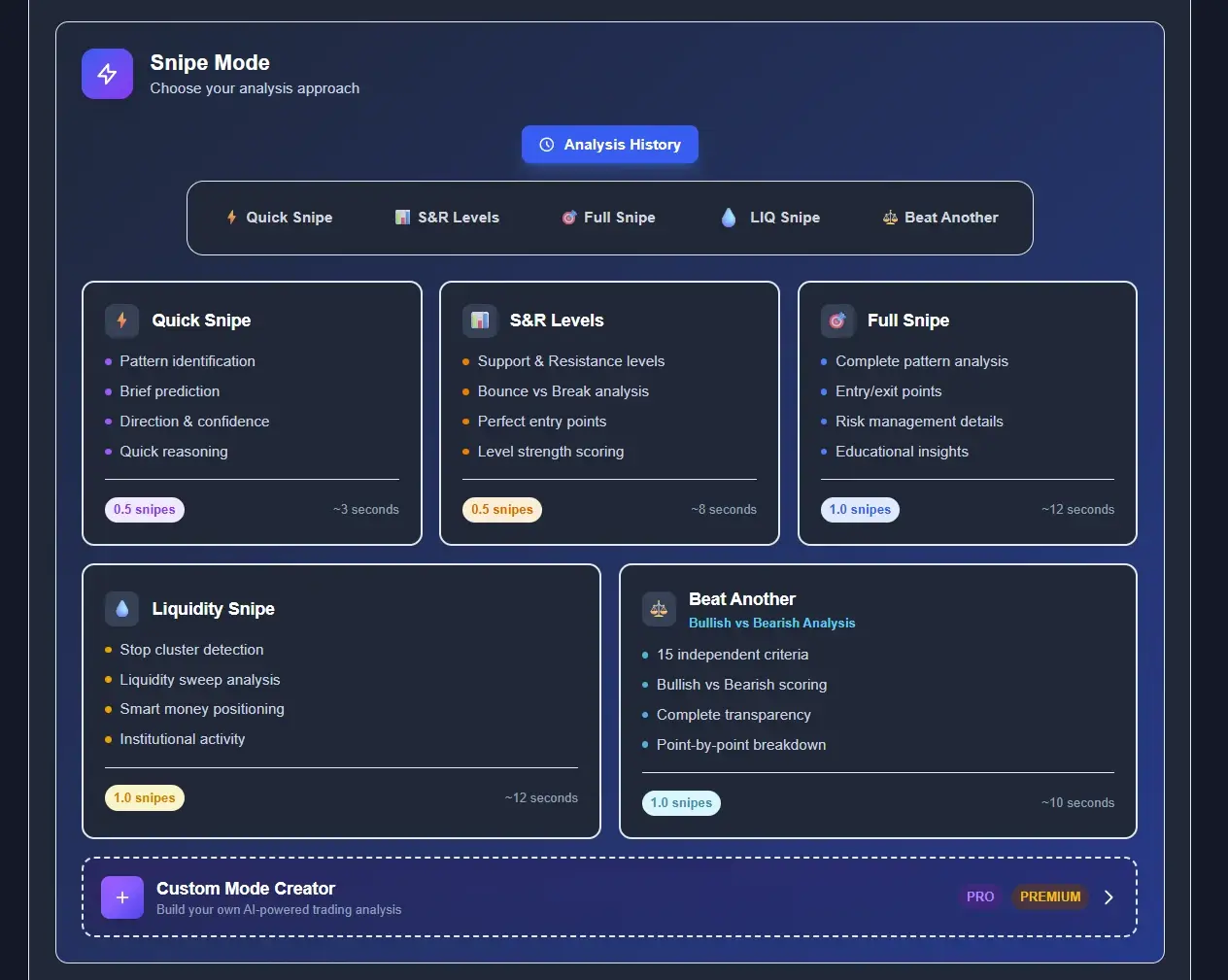
- Quick Snipe — ~3 seconds, pattern + direction + one-line reasoning. For intraday triage.
- S&R Levels — support/resistance with strength scoring and bounce-vs-break bias. For execution.
- Full Snipe — complete pattern analysis, entry/exit, risk management, educational context. The standard readout.
- Liquidity Snipe — smart-money-concepts read: stop clusters, sweep detection, institutional positioning.
- Beat Another — 15 independent bullish-vs-bearish criteria scored point by point. For second-opinion work.
- Custom Mode Creator — Pro/Premium users define their own analysis prompt and lock their style into a reusable mode.
See the full breakdown in our best AI chart screenshot analysis tools deep-dive.
9. Risk management — the part AI cannot do for you
No AI decides how much of your account to risk per trade. That is a parameter you set, and it is the single biggest predictor of whether a trader survives long enough for their AI-assisted edge to show up in the P&L. ChartSnipe builds this directly into the tool with a live position size calculator and profit calculator next to the analysis — so the AI's entry, stop and target feed straight into a risk-adjusted lot size.
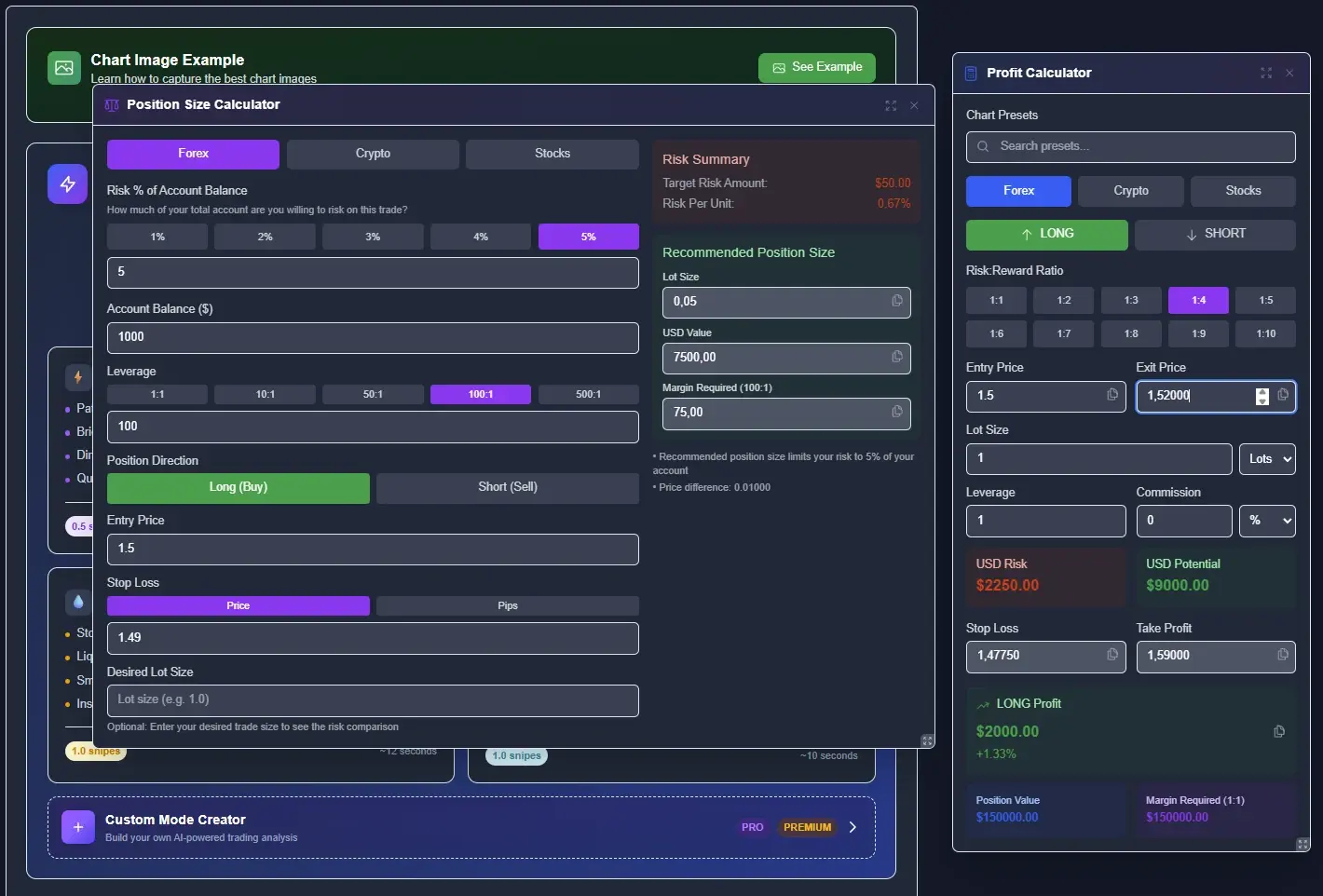
Bigger picture — the risk-reward ratio and stop-loss placement posts cover the mental model behind those inputs.
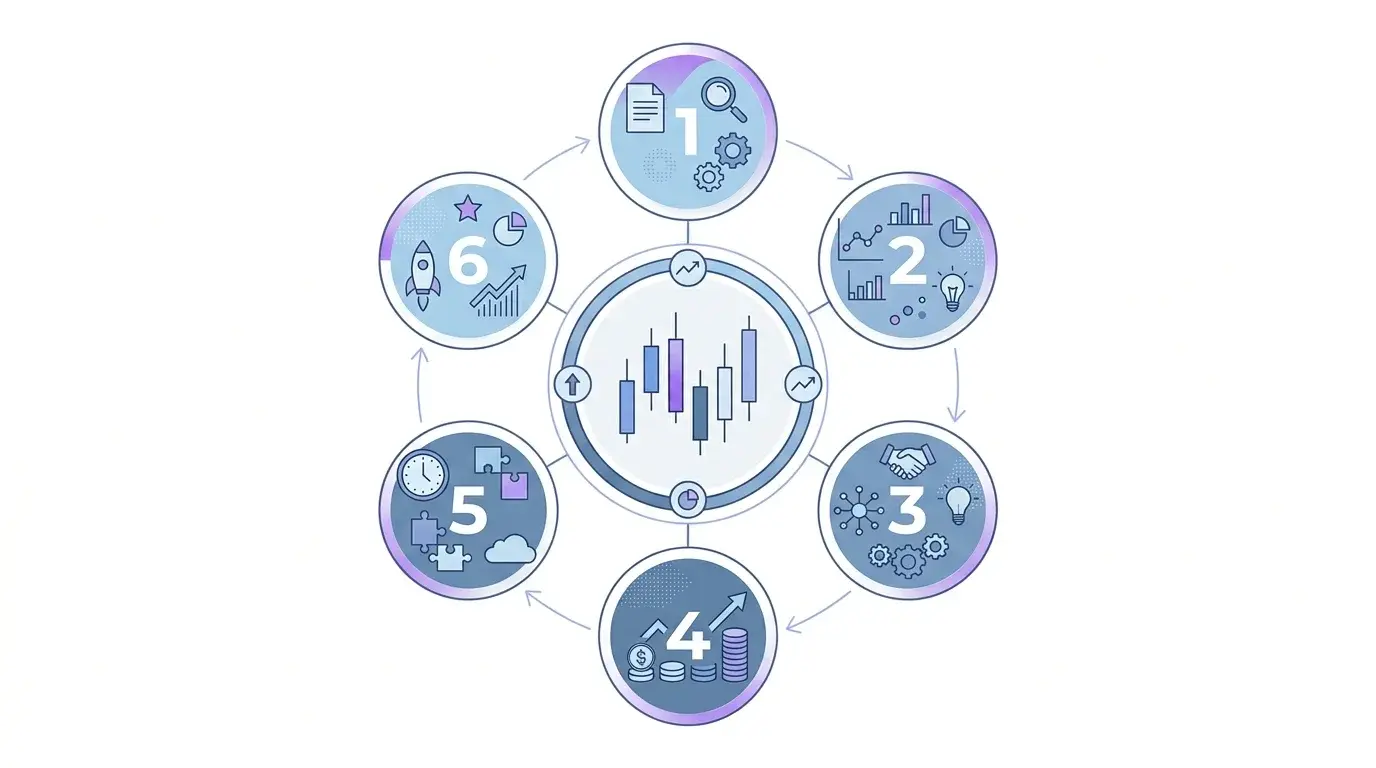
10. The daily AI trading workflow
This is the exact session prep routine serious ChartSnipe users run every morning. Six minutes of structured AI reading, then you are on the chart.
Macro read (90 seconds)
Open News Impact. Read the top bullish / bearish pairs and the professional analysis block. You now own the story of today.
Strength scan (60 seconds)
Scan the 8 currency strength cards. Strongest vs weakest writes your candidate short list.
Chart read (120 seconds)
Drop the candidate pair into the ChartSnipe tool on Full Snipe mode. Check the pattern, direction and reasoning against your own read.
Risk sizing (60 seconds)
Feed the AI's entry, stop and target into the position-size calculator. Take the trade at a size you can defend.
Journal (60 seconds, after exit)
Post-trade, log the outcome in the Trading Journal. Over time this is where your personal edge gets measured.
11. How to spot AI trading scams
The ad funnels under “Quantum AI”, “Qumas AI”, “Bitsoft360” and their rotating names all use the same pattern. Recognise it and you save yourself a $250 deposit into an unregulated broker.

Red flags
- Celebrity endorsement — Elon Musk, Martin Lewis, Jeremy Clarkson “revealed this product”.
- Fixed daily returns — “$1,500 a day”, “profit guaranteed”, “97.8% accuracy”.
- You cannot see the product until you deposit. Legitimate tools have screenshots, docs, a free tier or a public demo.
- Withdrawals require a minimum “trading volume” or a “verification fee”.
- Live chat with a pushy “personal account manager” the moment you deposit.
- Domain registered less than 12 months ago. Brand name not present on any regulator register.
Legitimate AI trading tools look boring by comparison — transparent pricing, a free tier, named authors, named regulators where applicable, and no promises of fixed returns. If the product passes those checks it probably deserves a look. If it fails any of them, it does not.
Frequently asked questions
Does AI trading actually work?
Partly — it depends on which category. Automated bots have a near-universal record of failure or fraud. LLMs are useful assistants but cannot see live data. Purpose-built research AI like ChartSnipe does work because it augments your decisions with live chart reads, currency strength, and daily news impact scoring.
Is ChatGPT good for trading?
Good for concept explanation, plan drafting, and post-trade journaling. Bad for live execution because it cannot see current prices or today's calendar and hallucinates levels on uploaded charts.
What is the best AI trading tool in 2026?
For retail forex, metals, and index traders: purpose-built research AI with live FX data and daily news impact — ChartSnipe fits that description. For US equities: Trade Ideas Holly has the longest track record. For crypto bots: treat every product as experimental and size accordingly.
Can AI predict the stock market?
No system predicts the market. What AI does well is parse structured information fast — charts, statements, correlations, calendars. That is decision support, not prediction. Anyone claiming otherwise is selling you something.
Are Quantum AI Trading and Qumas AI real products?
No. They are funnels for unregulated brokers, flagged repeatedly by the UK FCA, Australia's ASIC and Canada's CSA. The Elon Musk endorsements are deepfakes. Do not deposit.
How much does a legitimate AI trading tool cost?
ChartSnipe starts at $20 / month for 120 chart analyses plus the full News Impact dashboard, with a free tier giving 2 analyses per month. Trade Ideas is around $120 / month for full access. Tickeron sits in a similar range. If a tool is free with no tier gate and no funding round behind it, ask what the business model is.
Try the AI trading workflow that actually works
28 live FX pairs. Currency strength index. Daily AI news impact. Five chart analysis modes. Two free snipes to test it on your own chart.