
10 Stop Loss Placement Methods Every Trader Should Know
ATR, structural swing, % risk, order blocks, liquidity pools, moving averages, Fibonacci, PDH/PDL, volatility envelopes, and fixed pip — the full catalogue with when each one wins and when each one gets you wicked.
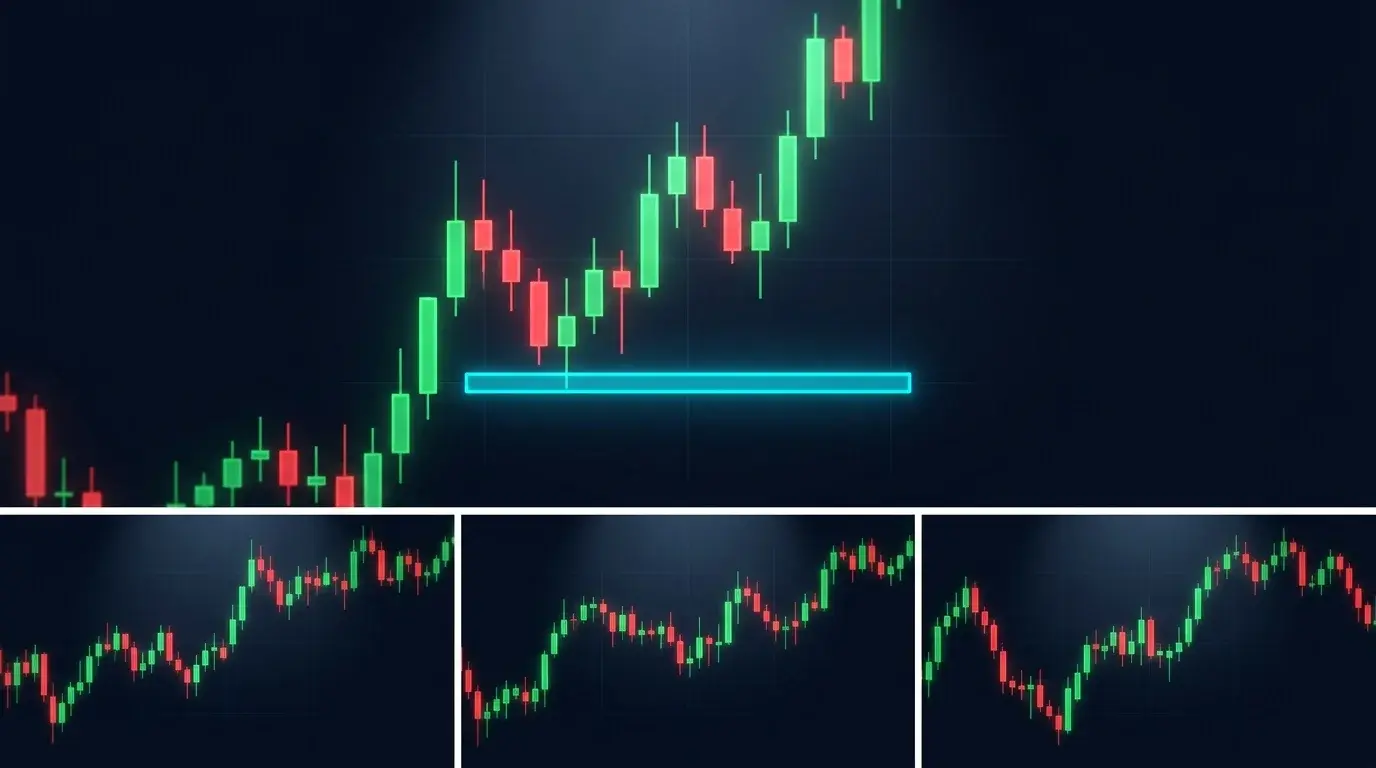
Retail traders obsess over entries. They tweak setups, stack confluences, and backtest patterns for hundreds of hours — then throw the stop loss on at a round number and hope for the best. That is backwards. Your entry decides what trade you are in; your stop decides what trade you survive. Over a career of thousands of setups, placement quality compounds into the single largest driver of whether an account grows or quietly bleeds out.
The reason is mathematical. A trader who is right 55% of the time but consistently gets wicked out one pip before the real reversal will lose money. A trader who is right only 40% of the time but places stops beyond the liquidity where smart money actually hunts will grind out a profitable curve. The edge does not live in the entry — it lives in the two numbers that sit on either side of it: the stop and the target. Between those, the stop is the one the market actively tries to punish you for getting wrong.
This guide walks through 10 stop placement methods real traders use, from volatility-adjusted ATR bands to structural swing stops to the liquidity-pool placements favoured by institutional desks. Each section covers the mechanic, the math, when the method earns its keep, and when it will blow up your account. Read it once end-to-end, then come back to specific methods when you are planning your next trade — because the question is never "should I use a stop" but "which of these 10 fits this setup."
Key Takeaways
- →Stop placement is the single highest-leverage risk decision you make — a wrong stop turns a winning system into a losing one.
- →Volatility-adjusted stops (ATR, envelopes) win on ranging instruments; structural stops win on clean trending setups with clear swings.
- →Stops placed at obvious round numbers, equal highs/lows, and session extremes are stop-hunt bait — always place beyond the liquidity, never at it.
- →% risk sizing pairs with a structural stop, not the other way around — pick the chart level first, then size the position to the loss you can stomach.
- →Trailing methods (MA, ATR trail) unlock outlier trades but only work when the instrument actually trends — on chop they give back the whole move.
1. ATR Volatility Stop
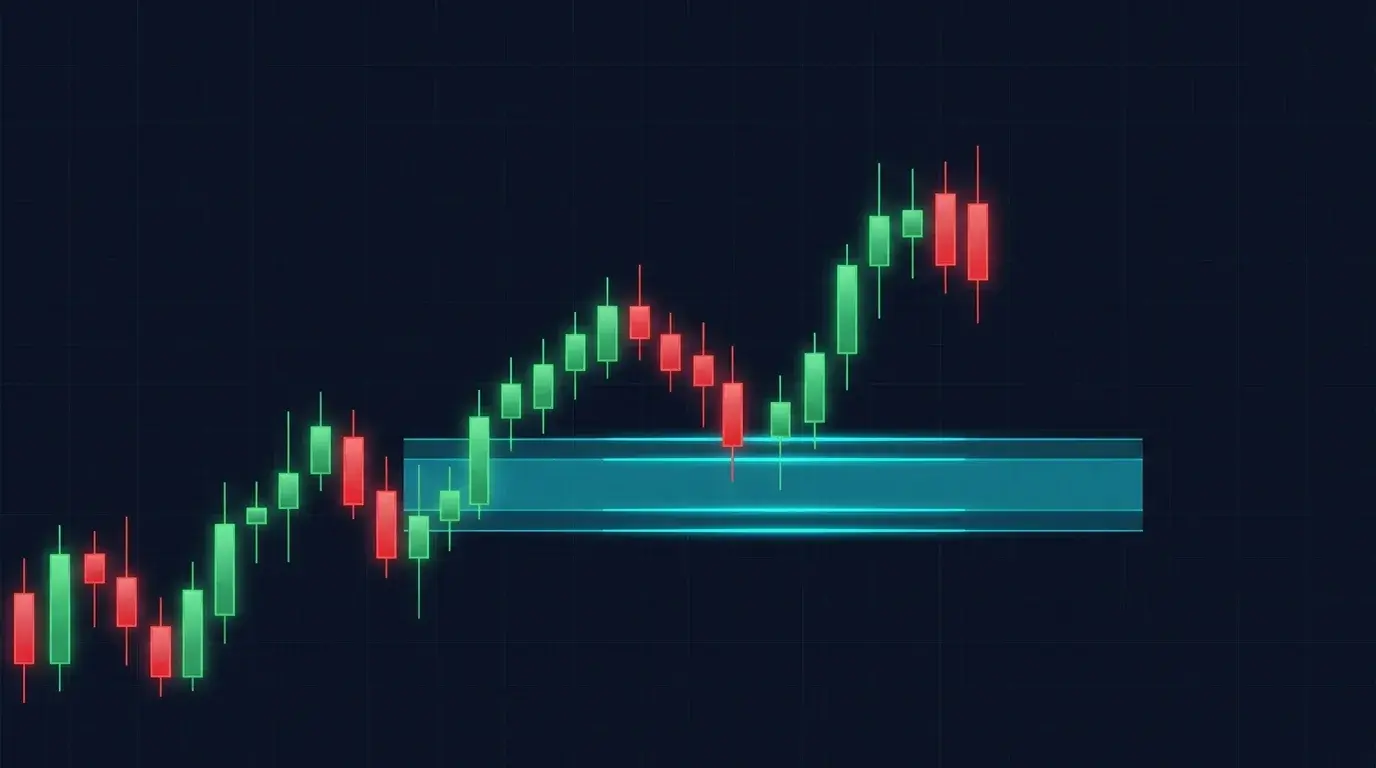
The Average True Range stop is the most honest placement method on the list. Instead of guessing how much room a trade needs, you measure the instrument's actual recent volatility and place the stop a multiple of that range away from entry. The formula is simple: compute ATR over a lookback window (14 periods is standard), multiply by 1.5 to 3, and subtract from entry for a long, add for a short. On a pair printing a 90-pip ATR, a 2x multiplier gives you a 180-pip stop — uncomfortable on the eye, but exactly the distance the instrument has been chewing through on normal days.
ATR stops shine on instruments where the volatility regime actually matters: gold, indices, crypto, and any FX pair during an event week. They force you to size down when ranges expand and size up when ranges compress, which is the correct response to a changing market. The method also kills the temptation to use the same 20-pip stop on EUR/USD on a Tuesday afternoon and on NFP Friday — ATR does the adjustment for you, automatically.
Where ATR fails is when the structure tells you something the indicator doesn't. If price is sitting two pips above a multi-week swing low, a 2x ATR stop below that low is redundant — the structure was going to do the job anyway, and you're just paying extra for the volatility buffer. Use ATR alone on clean ranging or choppy instruments. When there's a real structural level in range, stack ATR behind the structure, not instead of it.
2. Structural Swing Stop
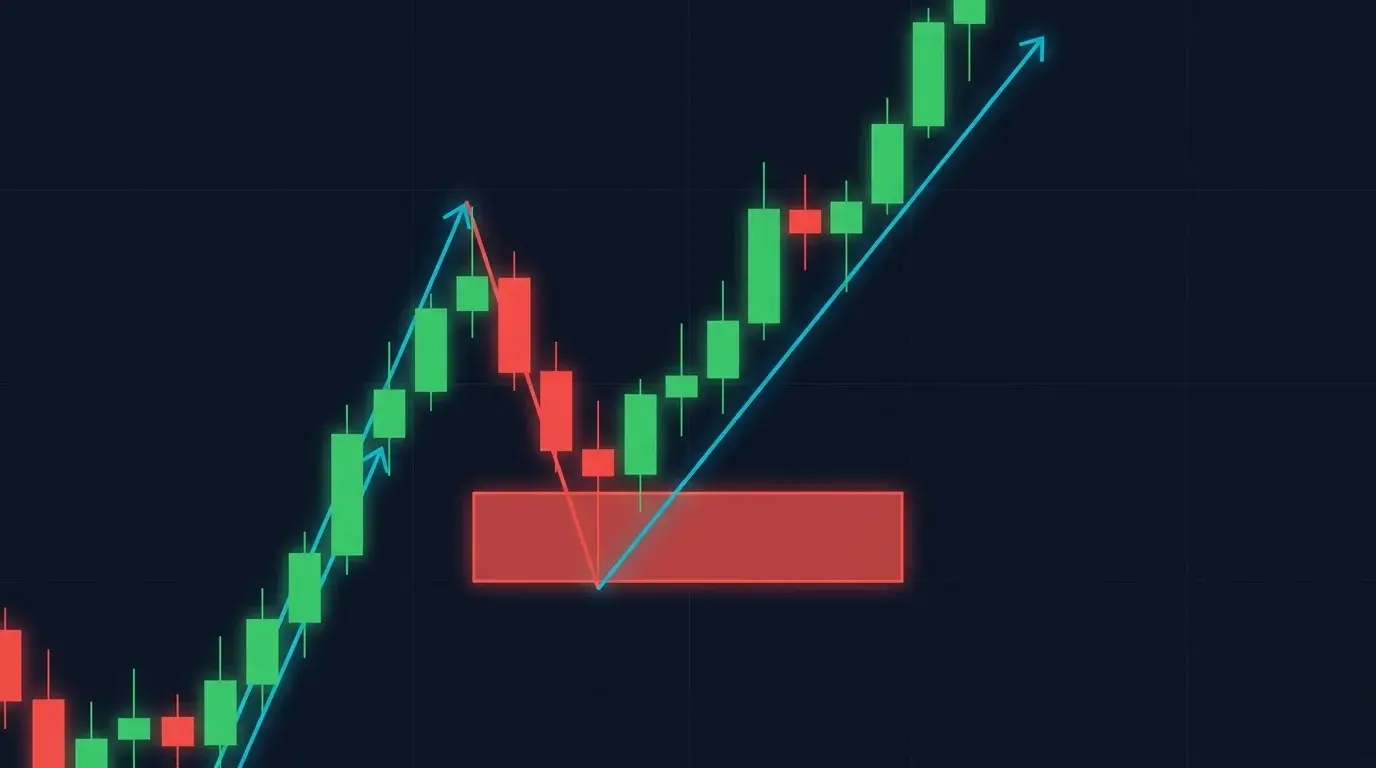
The structural stop sits just beyond the most recent swing low on a long (or swing high on a short) — the last pivot the market made before reversing in your direction. The logic is bulletproof: if price takes out that swing, the reason you entered the trade no longer exists. You are no longer wrong about timing; you are wrong about direction. Get out and come back later.
The math is simpler than ATR. Find the swing low that anchored your entry, add a small buffer (5 to 15 pips in FX, 0.1 to 0.3% on crypto or indices) to cover a spike, and that's your stop. Distance to entry is whatever the chart gives you — which is the point. Structure tells you where you're wrong; you size the position to that truth, not the other way round. Pair this with % risk sizing (method 3) and you have the cleanest, most disciplined framework a discretionary trader can run.
Structural stops fail in two situations. First, in a grinding range with no clear swings, there is no structure to lean on and you'll place the stop somewhere arbitrary. Second, on very low timeframes where "swings" are algorithmic wicks, the level you pick gets run 40% of the time. Structural stops work best on 15-minute and above, on instruments with clean price action, and especially at higher-timeframe confluence zones where the swing is also a daily or weekly pivot.
3. Fixed % Risk Stop
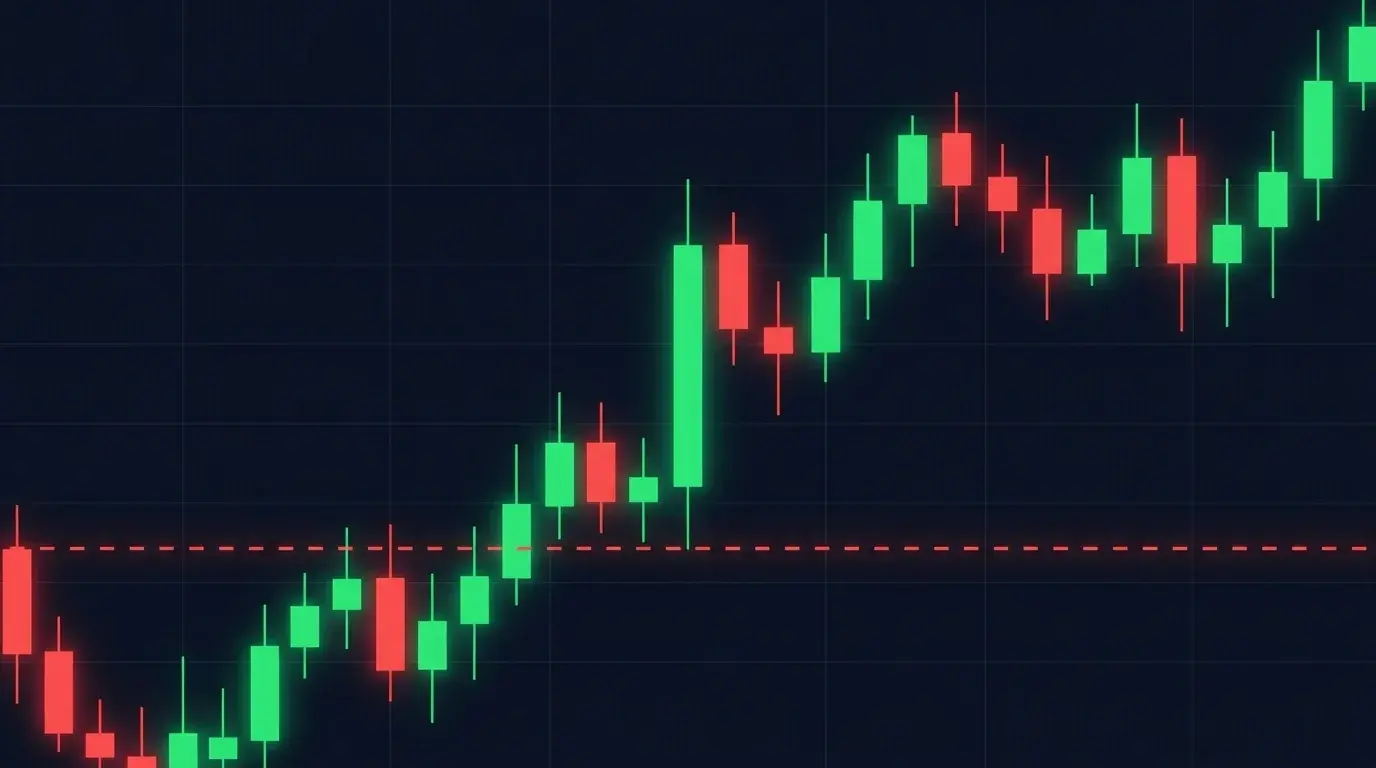
The fixed percentage stop sets a horizontal line at a predefined dollar or percent loss — usually 0.5% to 2% of account equity per trade. The trader decides in advance that they will never lose more than X on a single position, and size the trade to make that number true. This is not really a chart-based placement method; it's a risk budget that sits on top of whatever chart-based stop you picked, enforcing the ceiling.
The math runs in two steps. Pick the structural or ATR stop on the chart. Measure the distance from entry to that stop in pips or percent. Then position-size so that distance equals no more than your risk budget. On a $10,000 account at 1% risk, a 50-pip stop on EUR/USD means a position of roughly 0.2 lots. Same account, 1% risk, 200-pip stop means 0.05 lots. The stop distance is whatever the chart demands; the lot size is what brings you back into budget.
The classic mistake is reversing the order — picking the position size first ("I always trade 1 lot") and then placing the stop wherever 1% of account happens to fall. This puts the stop in the middle of random noise, not at a level that invalidates the trade. A 1% stop that sits inside the previous hour's range will get clipped by a single candle's wick. Always: chart level first, position size second. The % budget is a cap, not a placement rule.
4. Order Block Stop
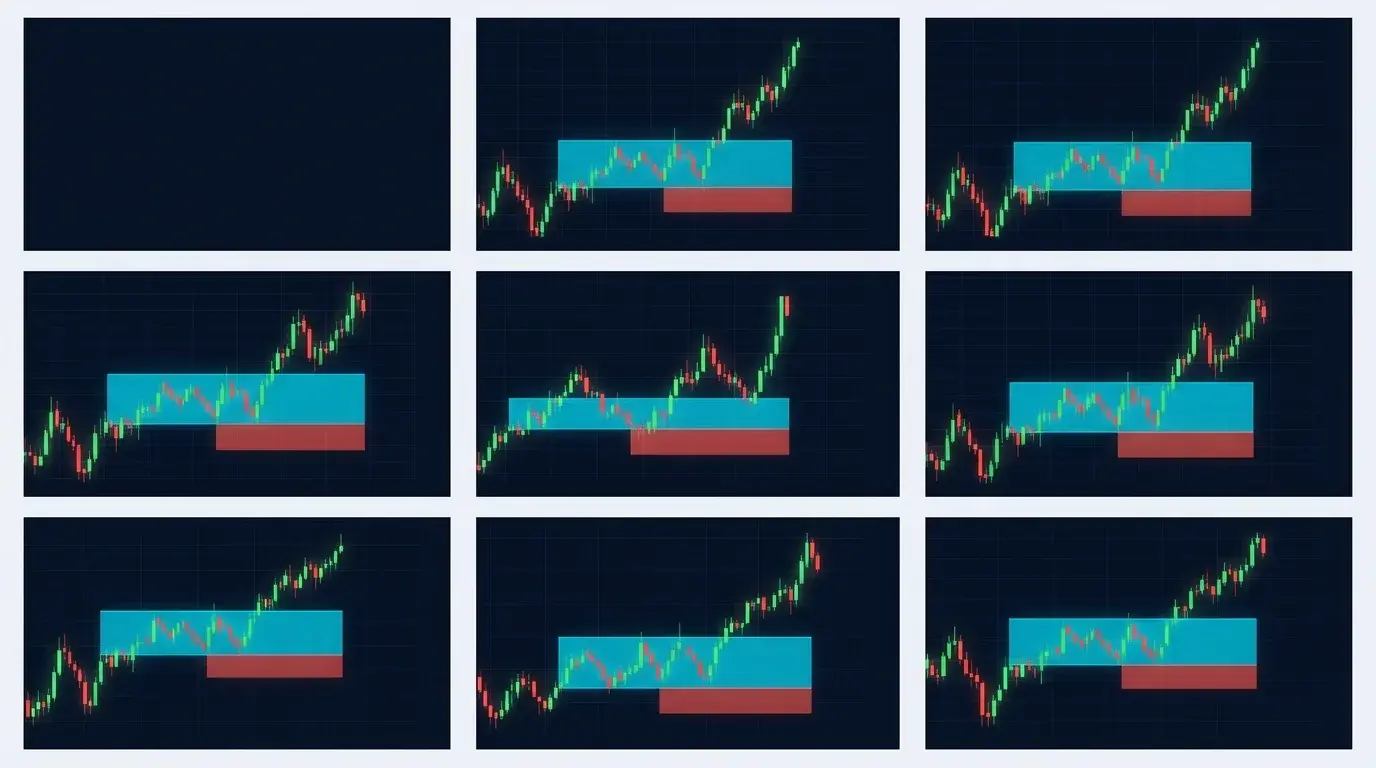
Order block traders identify the last down-close candle before a strong bullish move (for longs) and treat that candle's range as the zone where institutional buy orders were filled. The stop goes just beyond the far edge of the block — below the low for a long, above the high for a short. The logic: if price returns to the block, fills, and then keeps going, the institutional interest that originally launched the move has failed, and the trade is invalid.
Mechanically, this is a structural stop refined to a tighter, more specific zone. Instead of the nearest swing low, you're anchoring on the origin candle of the last impulse. Stop distances tend to be smaller than pure swing stops, which means better risk-to-reward on entries that hold — but also a higher rate of false-break stops when the block is slightly wrong. Buffer of 3 to 10 pips below the block low in FX, or 0.1 to 0.2% on indices and crypto.
The method demands chart-reading discipline most retail traders don't have. "The order block" is not a single obvious level — there are usually several candidate candles, and picking the wrong one gives you a bad reference. Order block stops work best on clean break-of-structure setups where a single large candle clearly launched the move, on timeframes from 1H to 4H. On noisy 5-minute action, every red candle looks like an order block and the method becomes superstition.
5. Liquidity Pool Stop
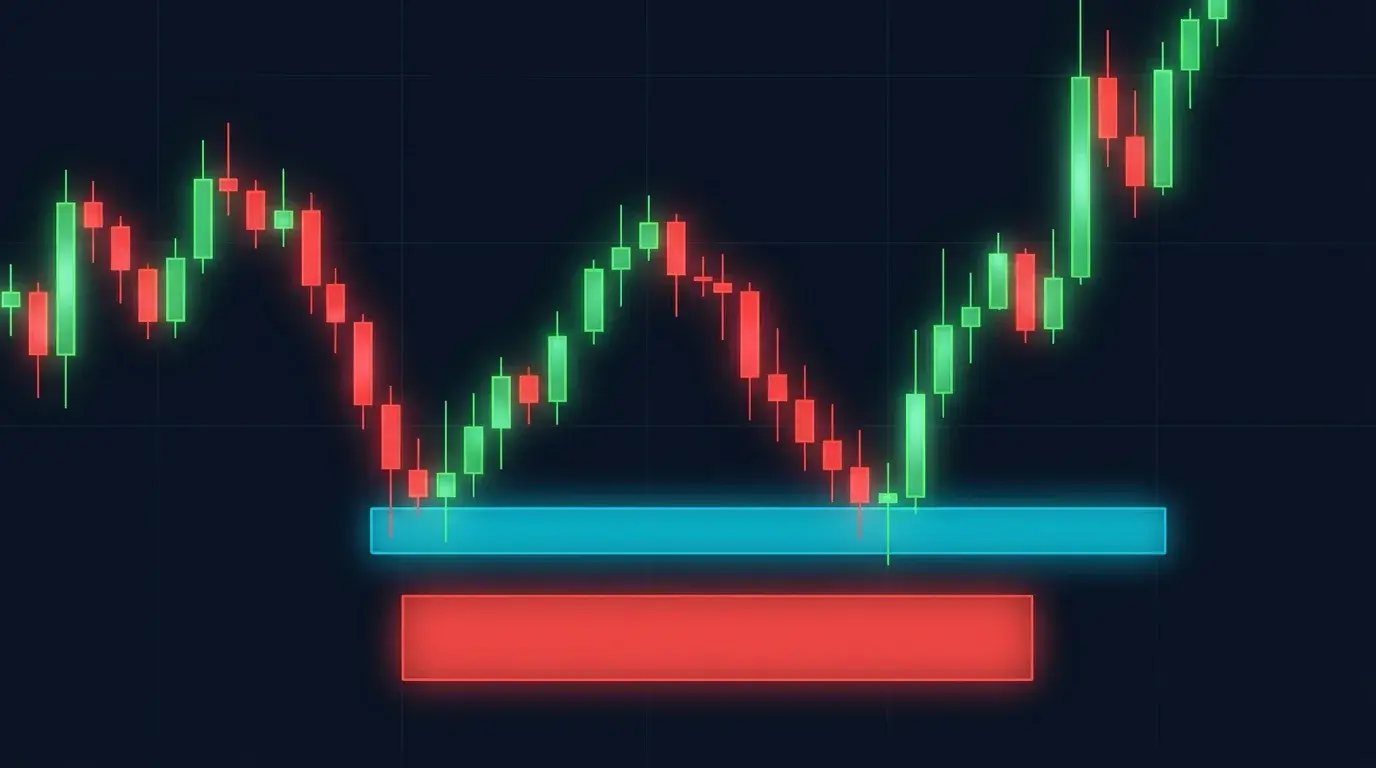
Liquidity-pool placement is the inversion of where most retail traders put their stops. Equal highs, equal lows, and obvious swing extremes are exactly where the cluster of retail stops sits — which means that's exactly where institutional desks hunt. The method: identify the obvious pool of retail stops, and place your stop a meaningful distance beyond it, so the sweep that takes out retail doesn't take you out too.
In practice, if you see a pair with two clean equal lows at 1.0850, every retail short is parked at 1.0849 and every retail long is stopped at 1.0849. The algo that needs to fill a large buy order will engineer a sweep to 1.0840 to trigger that entire stack, then reverse. Placing your long's stop at 1.0849 is donating to the algo. Placing it at 1.0830 — beyond the pool, beyond the typical sweep — keeps you in the trade for the actual reversal. Distance past the pool is usually 0.3 to 0.8 of the recent ATR, or a fixed 15 to 30 pips in FX.
This method costs you more pips per loss — which is the trade-off. You accept a larger individual loss in exchange for a dramatically higher winrate, because you're no longer getting wicked out of correct trades. Use liquidity stops on obvious retail levels: equal highs/lows, session extremes, round numbers, and the swing points highlighted in every single trading influencer's video. Avoid them on setups where the "obvious" level isn't actually obvious — if there's no cluster of retail orders to hunt, the extra room costs without buying protection.
6. Fibonacci Retracement Stop
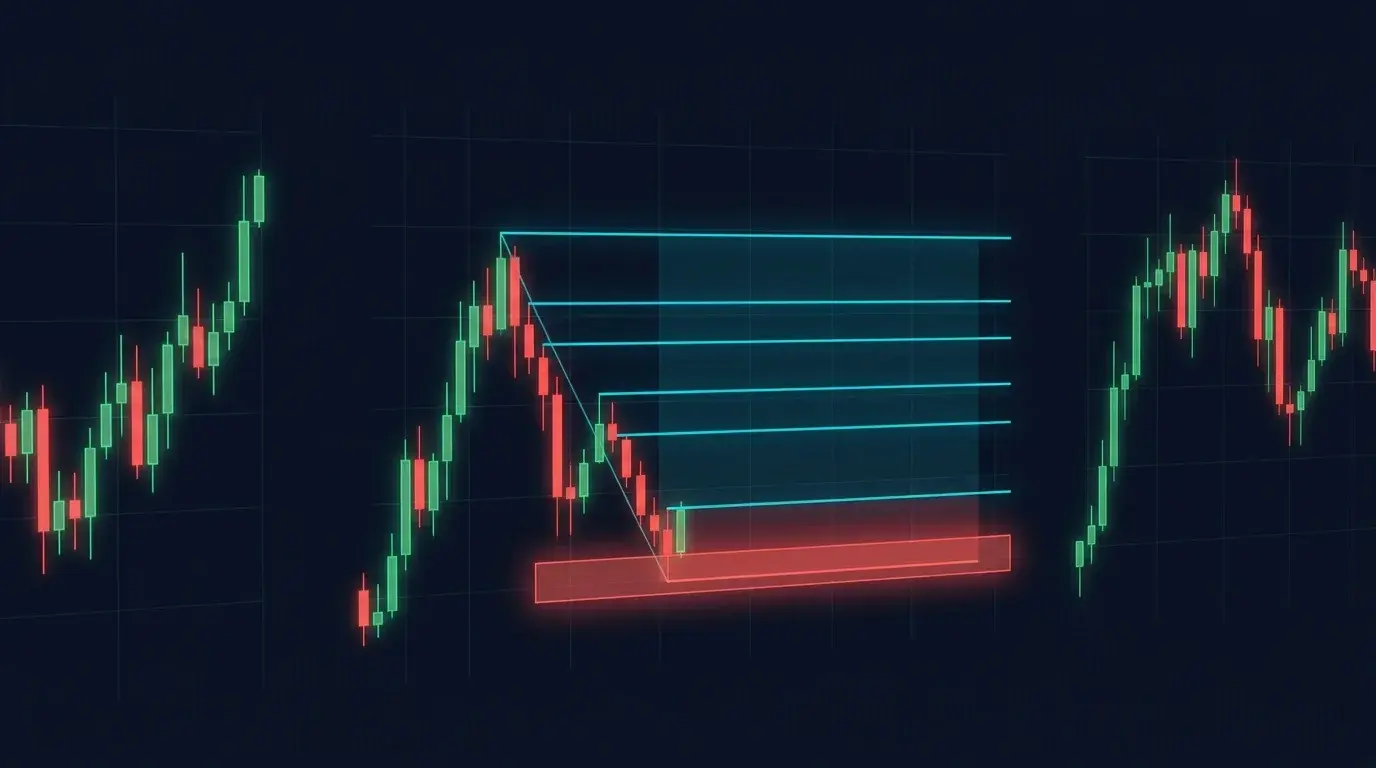
Fibonacci stop placement uses the 61.8%, 78.6%, or 88.6% retracement levels of the impulse leg as the invalidation point. The idea: if you're buying a pullback within a trend, the trend thesis holds only so long as price doesn't retrace past the deep Fibonacci level. Take out the 78.6% and the "pullback" has become a reversal — and the long is structurally dead.
Draw the fib from the swing low that started the leg to the swing high that ended it. For a long on a pullback, the entry might be at the 38.2% or 50%, with the stop a handful of pips beyond the 78.6%. The exact number depends on the instrument and timeframe: on 4H forex, 10-20 pips of buffer below the fib level; on daily indices, 0.4-0.7% of price. The retracement levels are not magic — they're coordination points where enough traders look at the same number that the self-fulfilling prophecy has statistical weight.
Fibonacci stops work on trending instruments with clean impulse legs — major-pair daily charts during a strong directional week, index swing trades, and gold during macro-driven regimes. They fail when the "impulse" you're measuring is actually noise inside a larger range, because the fib levels of meaningless swings have no weight. Always anchor the fib on a leg that is visible on the timeframe above the one you're trading, or the levels are fiction.
7. Moving Average Trail Stop
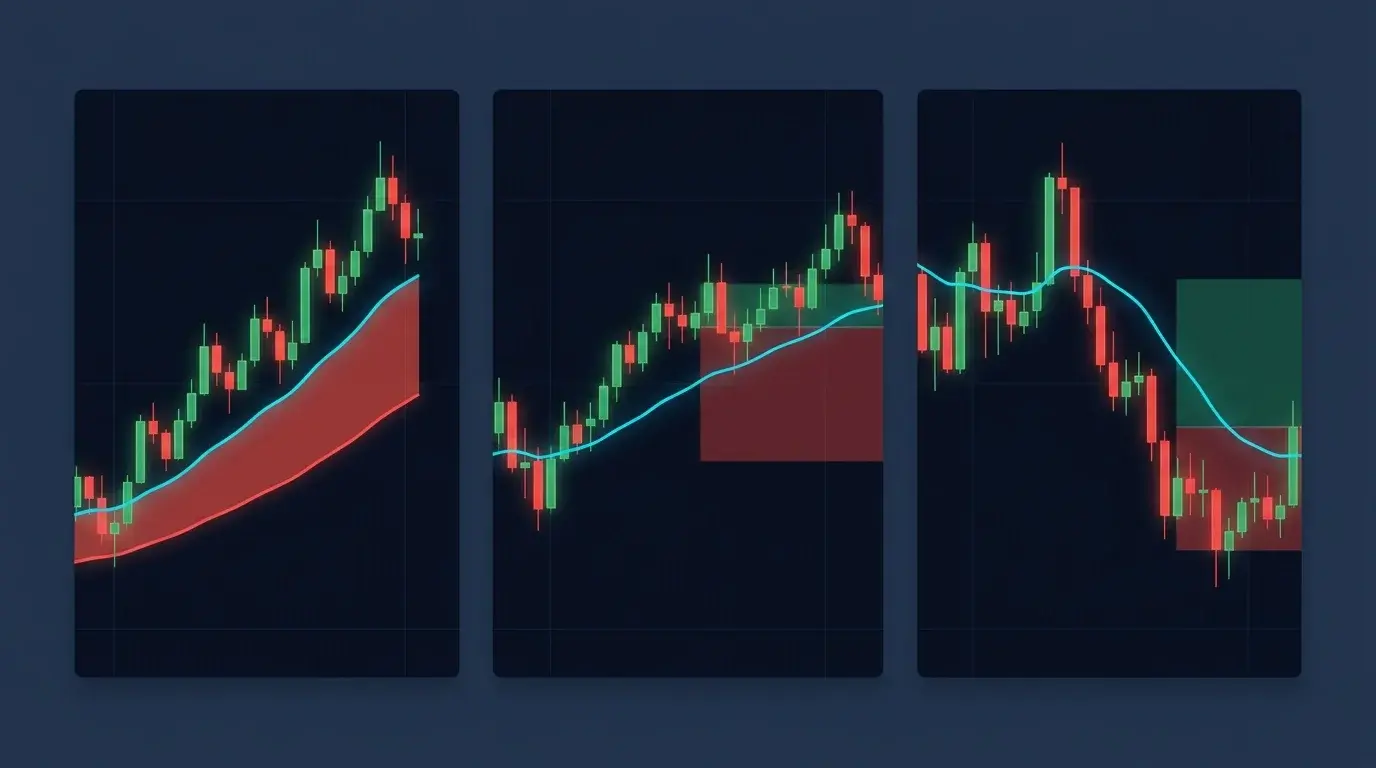
The moving average trail is a dynamic stop that rides below (or above) a chosen MA as price trends. Common choices: the 20 EMA for aggressive trend riders, the 50 SMA for swing traders, and the 200 SMA for position trades. Price closes below the MA, you're out. No discretionary judgement, no moving the line — the average does the work and you just follow it. Built for capturing outlier trend moves where the market runs much further than your original target.
Mechanically, the stop lives at the MA value on a close basis, usually with a small buffer to avoid single-candle spike-outs. Some traders stop on a touch, others on a confirmed close below — closes are more forgiving and produce fewer whipsaws. The trade-off is acceptance: you will give back a meaningful chunk of open profit before the MA catches up, because moving averages are lagging by definition. But on a clean trend you'll capture 60-80% of the total move instead of the 20-30% a fixed target lets you have.
MA trails are built for trend instruments and trend regimes. Use them when volatility is directional — gold during a war-risk premium, indices in a clear bull run, major FX in a central-bank divergence cycle. Avoid them in chop; a ranging EUR/USD will cross the 20 EMA eight times in a week and hand you eight small losses. The filter is simple: if the MA you're considering as a trail isn't visibly sloping, don't use it.
8. Previous Day High/Low Stop
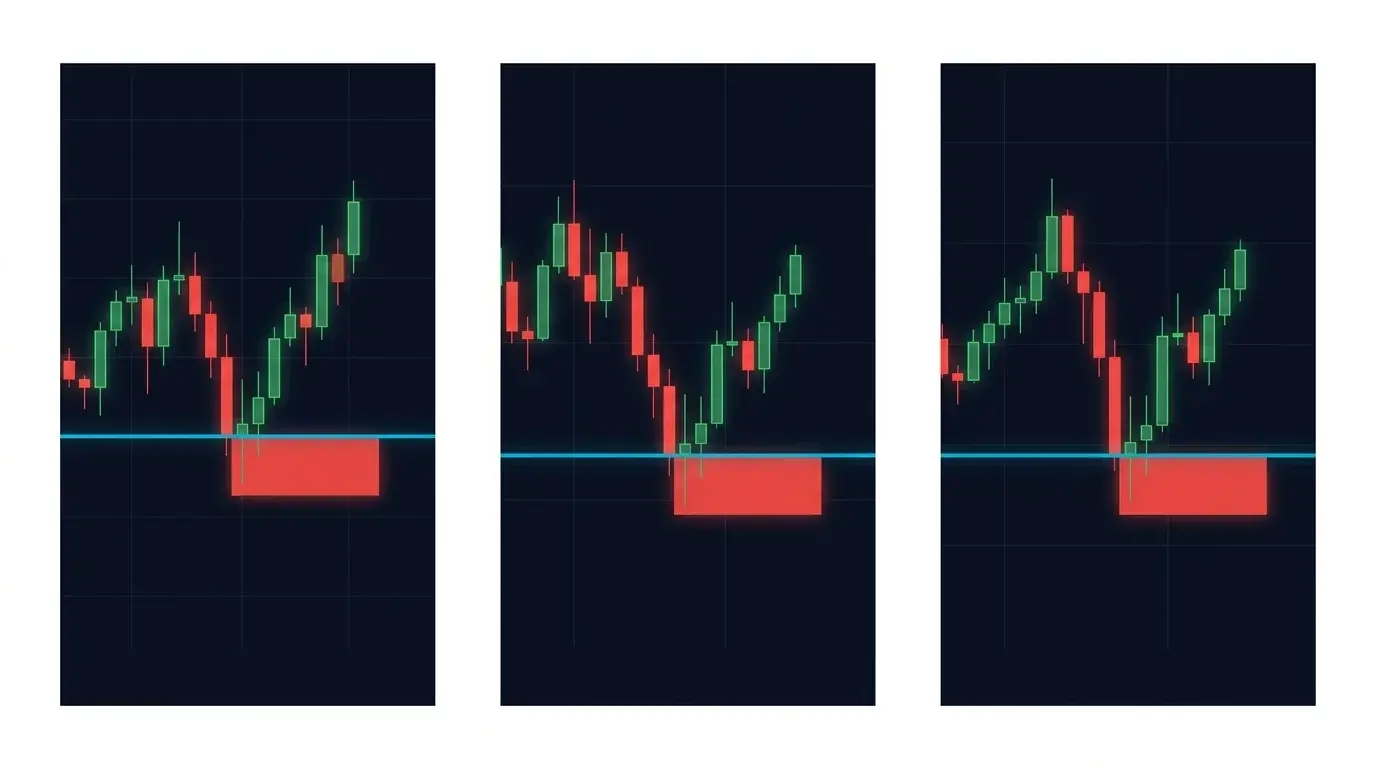
The PDH/PDL stop uses yesterday's extreme as the invalidation level. Buying above the Previous Day High on a breakout, the stop sits below it; shorting below the Previous Day Low, the stop sits above it. The theory: yesterday's range is the most recent map of where participants agreed to trade, and a break back into it means the breakout has failed. Simple, visible, unambiguous — which is why day traders love it.
Drop a horizontal line at yesterday's high and yesterday's low. On a long breakout above PDH, the stop goes 5-15 pips (FX) or 0.1-0.3% (indices/crypto) back below the PDH. You're betting that a genuine breakout won't revisit the prior day's extreme at all; if it does, the buyers who lifted the offer at PDH are getting trapped, and you want out before the unwind. The method stacks well with opening range breakouts and session-based strategies in general.
PDH/PDL stops work on index futures, major FX pairs during active sessions, and crypto during US-session breakouts. They fail on instruments with quiet 24-hour price action or on days when yesterday's range was unusually small — a 30-pip PDH on EUR/USD provides no real protection. Always sanity-check the range size against a 10 or 20 day average; if yesterday's range is in the bottom quartile, the level is weak and you need something else behind it.
9. Volatility Envelope Stop
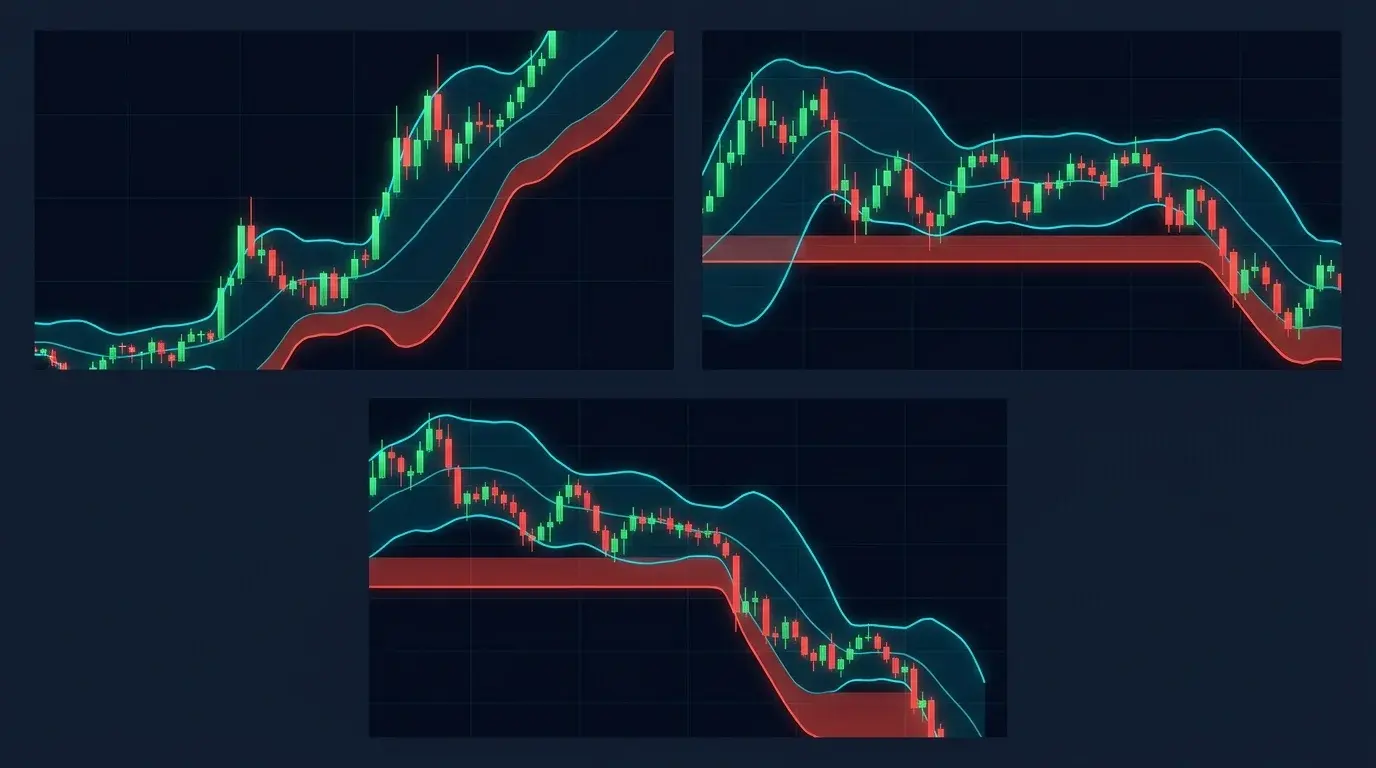
Volatility envelopes — Bollinger Bands, Keltner Channels, or similar — plot a dynamic upper and lower boundary derived from standard deviation or ATR around a central moving average. The envelope stop places the stop just outside the relevant band: below the lower Bollinger Band on a long, above the upper on a short. The logic is probabilistic: price spends roughly 95% of its time inside a 2-standard-deviation envelope, so exits outside the band are statistically meaningful events, not noise.
Settings matter. Bollinger Bands defaulted to 20 periods and 2 standard deviations are the standard reference; Keltner Channels at 20 and 2 ATR are a tighter alternative. The stop distance is the width of the envelope plus a buffer, which means it self-adjusts to volatility exactly like an ATR stop but anchored to the current MA rather than pure range. This method is particularly useful on mean-reversion setups, where you're fading an extreme into the central MA — the stop beyond the band says "if price keeps going, the regime is no longer mean-reverting."
Envelope stops work on ranging and mean-reverting instruments: crosses in quiet weeks, indices in low-volatility regimes, gold during consolidation phases. They fail hard during trends — price can ride the outer band for 30 candles in a strong directional move, and using the envelope as a stop means you exit the winning side of the trade as the trend accelerates. Always pair envelope stops with a regime filter: ADX under 20, or a flat slope on the central MA, before trusting the band as an invalidation line.
10. Fixed Pip Stop
The fixed pip stop is the bluntest method on the list — the same distance from entry on every single trade. 20 pips on EUR/USD. 50 pips on gold. 0.5% on Bitcoin. The trader picks a number that feels right, makes it a rule, and applies it to every position regardless of what the chart is showing. No chart reading, no volatility adjustment, no structural reasoning. Just: entry minus X equals stop.
The attraction is discipline and speed. A fixed pip stop removes discretion from the moment when discretion causes the most damage — right after entry, when you're tempted to move the stop further because price is going against you. It also lets you mechanise scalping strategies where chart-by-chart analysis is impossibly slow: at 200 trades a week, nobody is drawing order blocks. Systematic prop-firm traders and news scalpers use variants of this method heavily.
The cost is equally large. A fixed 20-pip stop is generous during the Asian session on EUR/USD and suicidal on NFP Friday; it will be in the middle of a meaningful structure on one trade and miles from any level on the next. Volatility changes, structure changes, and a stop that doesn't change with them is a stop that's wrong most of the time. Use fixed pip stops only when speed and mechanisation genuinely require them — and always layer a % risk cap (method 3) on top, or a run of wide-volatility days will burn a disproportionate chunk of the account.
The Bottom Line
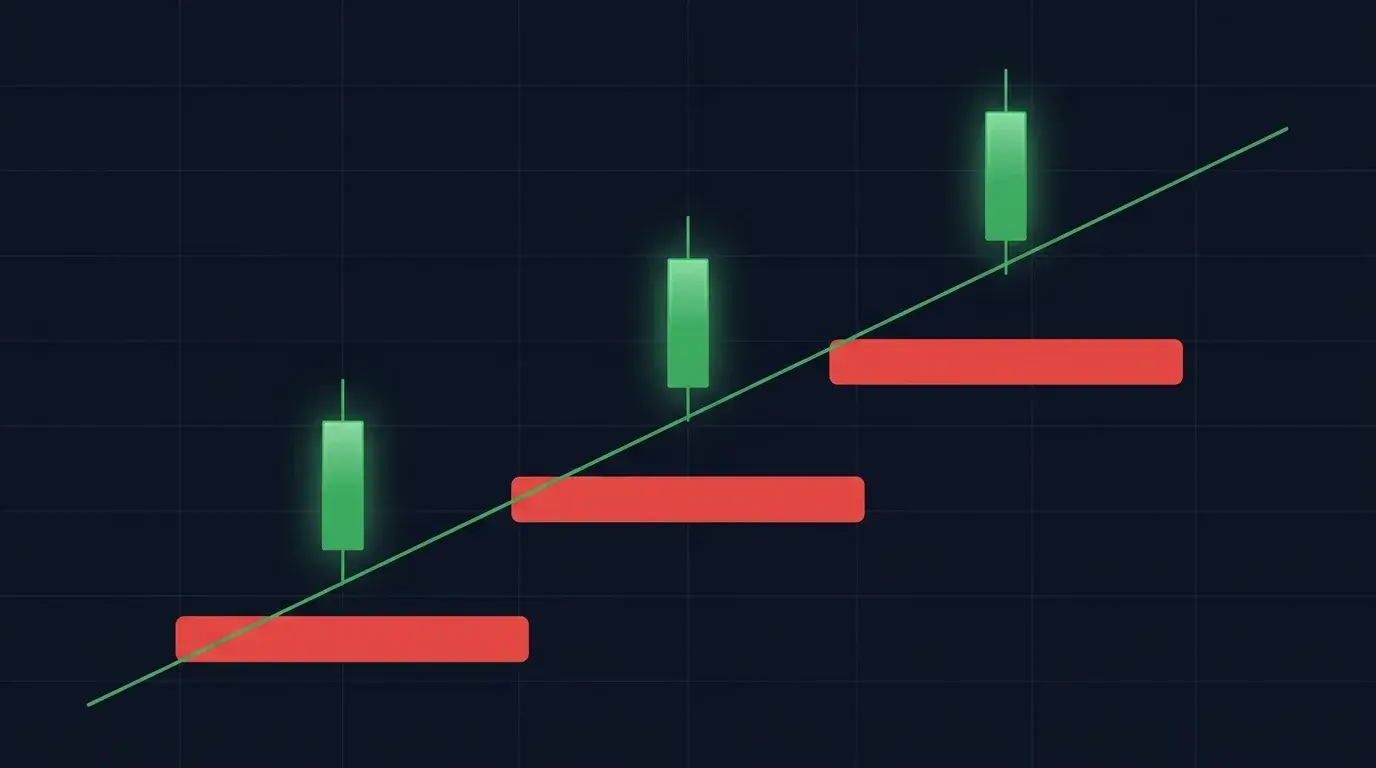
There is no universally best stop loss method — there are only methods that fit the setup in front of you. A structural stop beats an ATR stop on a clean break-of-structure long at daily swing support. An ATR stop beats a structural stop in a chop day on gold during a quiet macro week. A liquidity-pool stop beats both when the retail stack is obvious and the algos are active. The edge comes from knowing which of the 10 fits the trade you're actually in, not from loyalty to one method — the same logic that drives post-entry trade management.
Three rules carry across every method. First, pick the level from the chart, then size the position to the risk — never the reverse, and let your risk-reward ratio fall out of that math, not the other way around. Second, place the stop beyond the obvious level, never at it; if retail can see the line, the stop needs to sit further. Third, test the method on 50 trades in a journal before trusting it with real money. A stop placement strategy you haven't sample-sized is a guess, and the market punishes guesses.
If you want to see how the setup you're eyeing sits against the day's macro catalysts before you commit to a stop — which events are live, which instruments are in the blast radius, and which direction the AI reads the tape — the ChartSnipe AI News Impact dashboard is the fastest place to get that context before you click.
Related Articles

The Bitcoin FOMC Playbook
How BTC actually reacts to Fed rate decisions — the dump-then-rip pattern, DXY correlation, and the full FOMC day timeline.

NFP Trading Strategy Playbook
How to trade Non-Farm Payrolls across forex and gold with a repeatable pre-release framework.

High-Impact Forex News Events
The 15 releases that actually move FX pairs — ranked by pip movement, tradability, and follow-through.

Written by the ChartSnipe Team
ChartSnipe is an AI-powered chart screenshot analysis tool and daily AI news impact analysis platform for forex, gold, Bitcoin, S&P 500, and Nasdaq traders. Our team combines deep experience in technical analysis, AI vision models, and live market data across 32+ instruments to deliver actionable trading insights.
See the day's catalysts before you place that stop
Daily AI news impact analysis across 32 instruments. Know which events are live and which instruments are in the blast radius before you commit size.
Open News Impact Dashboard