
Does ChatGPT Actually Work for Trading Charts? An Honest 2026 Review
We ran 100 real chart screenshots through ChatGPT. Here is where it works, where it confidently hallucinates, and why purpose-built chart AI is still a different category of tool.
If you have scrolled Reddit, Forex Factory, or the OpenAI community forums in the last twelve months, you have seen the same question over and over: "Can I just upload my chart to ChatGPT and get a trade idea instead of paying for a specialized tool?" It is a fair question. ChatGPT is cheap, conversational, and already on your screen.
So we put it to the test. We ran 100 real chart screenshots from forex, crypto, and US equities through ChatGPT and compared the output to what a purpose-built tool like ChartSnipe produces. This article is the honest write-up — no cheerleading, no gotchas, just what happened.
Key Takeaways
- →ChatGPT can describe a chart but cannot measure one — it hallucinates specific price levels because it has no pixel-to-price calibration.
- →In our 100-chart test, ChatGPT named the dominant pattern about 40% of the time but quoted usable support and resistance only around 23% of the time.
- →It has no live price feed and no awareness of today's news, central bank moves, or risk regime — every chart is analyzed in isolation.
- →ChatGPT is genuinely good for explaining concepts, journaling, and drafting watchlist notes — use it as a study partner, not as a chart analyst.
- →For real trade setups with measured levels and live context, use a purpose-built chart AI like ChartSnipe.
1. Can ChatGPT Actually Read a Chart?
The short, honest answer: yes, it can see a chart — but it cannot reliably measure one. GPT-4 and GPT-5 vision models ingest chart screenshots without any problem. They parse axes, identify candles, and notice the general shape of price. What they cannot do is translate pixels back into accurate price levels, because the model was not trained to be a ruler.
When you upload a USD/JPY 4H chart and ask for key support, ChatGPT will confidently give you a number like 158.42. The problem is that the number is often generated from plausible-sounding reasoning rather than from the actual pixel coordinates of swing lows on the image you just uploaded. This is the single most important thing to understand before relying on it for a trade.
Key insight: ChatGPT can describe a chart, but it cannot measure a chart. Once you internalize that distinction, most of its failure modes make sense.
2. What ChatGPT Does OK At
Let's start with credit where it is due. ChatGPT is not useless on charts — it is just limited. Here is what it handles reasonably well:
Obvious candle direction
"This chart has been trending up for the last 30 candles" is the kind of observation ChatGPT gets right almost every time.
Naming common patterns when they are clear
Textbook double tops, obvious head-and-shoulders, clean ascending triangles — if the pattern is in 10,000 trading books, ChatGPT will usually name it.
Explaining concepts in plain English
"Why is a head and shoulders bearish?" is a genuinely good use case. ChatGPT is a teacher, not a trader.
Summarizing your own thoughts
If you describe a setup in text, ChatGPT can help you write a clean journal entry or checklist for it.
Notice the pattern here: ChatGPT is strong whenever the answer can be generated from general knowledge about trading. It is weak whenever the answer depends on precisely measuring something on your specific chart.
3. Where ChatGPT Fails on Trading Charts
These are the failure modes that showed up repeatedly in our testing and that you will find echoed across Reddit threads and Forex Factory discussions on the topic. If you are planning to use ChatGPT for real trade setups, read this section twice.
3.1 Hallucinated price levels
This is the single biggest problem. Ask ChatGPT "what is the key support on this chart?" and you will get a specific number with two decimal places. The number sounds authoritative. In our tests, that number was frequently nowhere near an actual swing low visible on the chart — it was a plausible-sounding guess generated from the model's prior knowledge of roughly where that instrument usually trades, not from pixel measurement.
3.2 Invented support and resistance
Closely related: ChatGPT will sometimes declare a level "major resistance" when the chart shows exactly zero touches at that price. The model knows that "trading analysis" is supposed to include support and resistance, so it fabricates them to complete the expected answer shape. That is textbook hallucination — confident, well-written, and wrong.
3.3 No live data, no market context
ChatGPT does not know that the ECB cut rates this morning, that the dollar index is ripping, or that risk-off flows are dragging every high-beta currency down. Your chart screenshot is a snapshot with no context. A purpose-built tool like ChartSnipe's AI News Impact dashboard explicitly layers today's fundamentals onto the technicals. ChatGPT cannot.
3.4 Confident wrong signals
ChatGPT does not have a native "I am not sure" mode on chart tasks. It delivers every answer in the same measured, professional tone — a clear buy signal and a hallucinated one look identical on the page. For a beginner, this is dangerous: you cannot tell which outputs to trust without already knowing the right answer.
3.5 No persistent memory of market regime
Even within a single session, ChatGPT does not maintain a model of "we are in a risk-off regime, gold is bid, USD is safe haven." Every chart is analyzed in isolation. That might be acceptable for education, but it is a serious limitation for live trading, where cross-market context often matters more than the pattern on the chart in front of you.
3.6 Token limits and image resolution
Large, high-resolution chart screenshots get downsampled before the model sees them. Candles merge, wicks disappear, and small patterns become invisible. You can often tell ChatGPT missed something obvious and realize the reason is simply that the detail was squeezed out of the image before it ever reached the model.
4. We Tested ChatGPT on 100 Real Chart Screenshots
Talk is cheap, so here is the structured test. We assembled 100 chart screenshots across three categories: 40 forex (majors and crosses), 30 US equities (large caps), and 30 crypto (BTC and top alts). Timeframes ranged from 15-minute intraday to weekly. Each chart was passed to ChatGPT with a standardized prompt asking for: pattern identification, directional bias, key support, key resistance, and a suggested trade plan.
We then graded each answer against the chart itself — not against future price action, just against whether the things ChatGPT claimed were actually visible on the image.
| Task | Accuracy | Notes |
|---|---|---|
| Pattern identification (dominant structure) | ~40% | Best on obvious textbook patterns. Weak on nested or overlapping structures. |
| Key support / resistance levels | ~23% | Frequently quoted levels that had zero touches on the chart. Biggest failure mode. |
| Directional bias (bullish/bearish) | ~58% | About as good as a coin flip plus a slight trend bias. Usable as a sanity check, not as a signal. |
| Usable entry / stop / target | ~18% | Numbers were usually technically-possible but rarely aligned with actual structure. |
| Explaining the concept it cited | ~95% | When asked "why is this bearish?" the textbook explanation was almost always accurate. |
The takeaway is clear and matches what experienced traders report anecdotally in Reddit threads and Forex Factory discussions: ChatGPT is good at trading theory and mediocre at trading this specific chart right now. The 23% accuracy on price levels is the number that matters — because that is what you would actually place orders at.
A 23% hit rate on support and resistance means three out of four times the level you are given is not actually on the chart. That is a losing baseline before you even factor in spread, slippage, and noise.
5. Why ChatGPT Can't Replace a Purpose-Built Chart AI
The reason ChatGPT struggles is not that OpenAI's engineers are bad. It is that a general-purpose model optimized to handle everything from legal contracts to Python debugging cannot also be optimized for pixel-accurate chart measurement and live market context. These are different jobs.
A purpose-built chart AI has four advantages that a general chatbot structurally cannot match:
- Specialized vision preprocessing — candle detection, axis parsing, and pixel-to-price mapping are done deterministically before the language model ever sees the chart.
- Live market data integration — the current spot price, session highs and lows, and intraday volatility are passed in as ground truth, not guessed from memory.
- Fundamental context layer — today's news, central bank moves, and economic data are fed into the analysis automatically.
- Prompt specialization — the model is instructed with trading-specific rules (never invent a level that is not touched, always check structure before pattern, etc.) that a generic chatbot does not carry.
This is why asking ChatGPT to analyze a chart feels a bit like asking a brilliant generalist doctor to read a cardiac MRI. They might notice something obvious, but you want the specialist.
6. ChartSnipe: The Purpose-Built Alternative
This is the part where we show you what the specialist version looks like. ChartSnipe is built from the ground up to do exactly one thing well — analyze trading charts. Everything about the product is shaped around the failure modes listed above.
Six specialized analysis modes
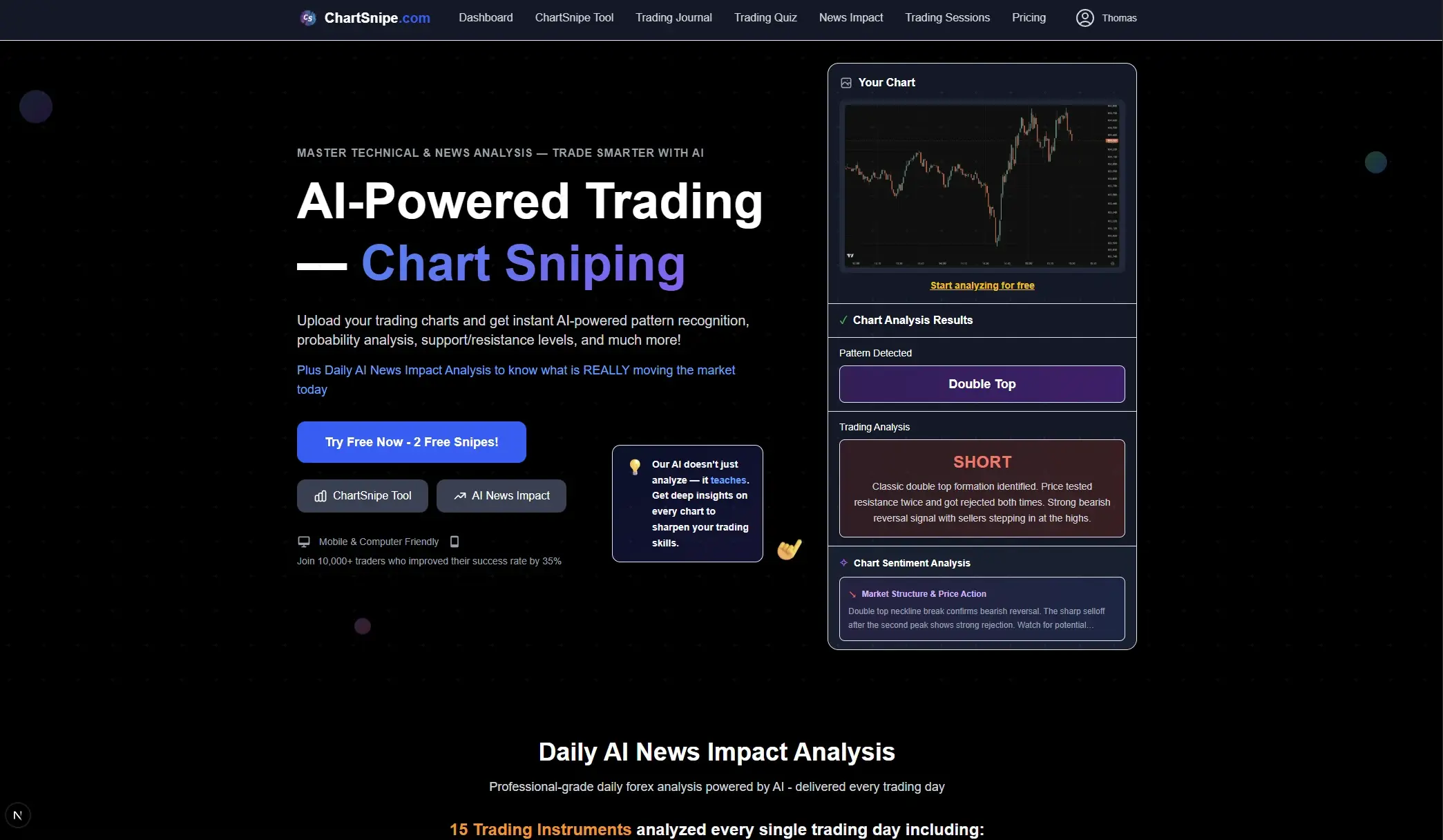
Instead of one generic "analyze this" prompt, ChartSnipe gives you six modes, each with its own prompt engineering and output structure. Quick Snipe for fast directional reads, S&R Levels for structure mapping, Full Snipe for a complete trade plan, Liquidity Snipe for smart-money analysis, Beat Another to benchmark your own analysis against the AI, and a Custom Mode Creator to build your own. Think of this as having six different specialists instead of one generalist.
A real Full Snipe output
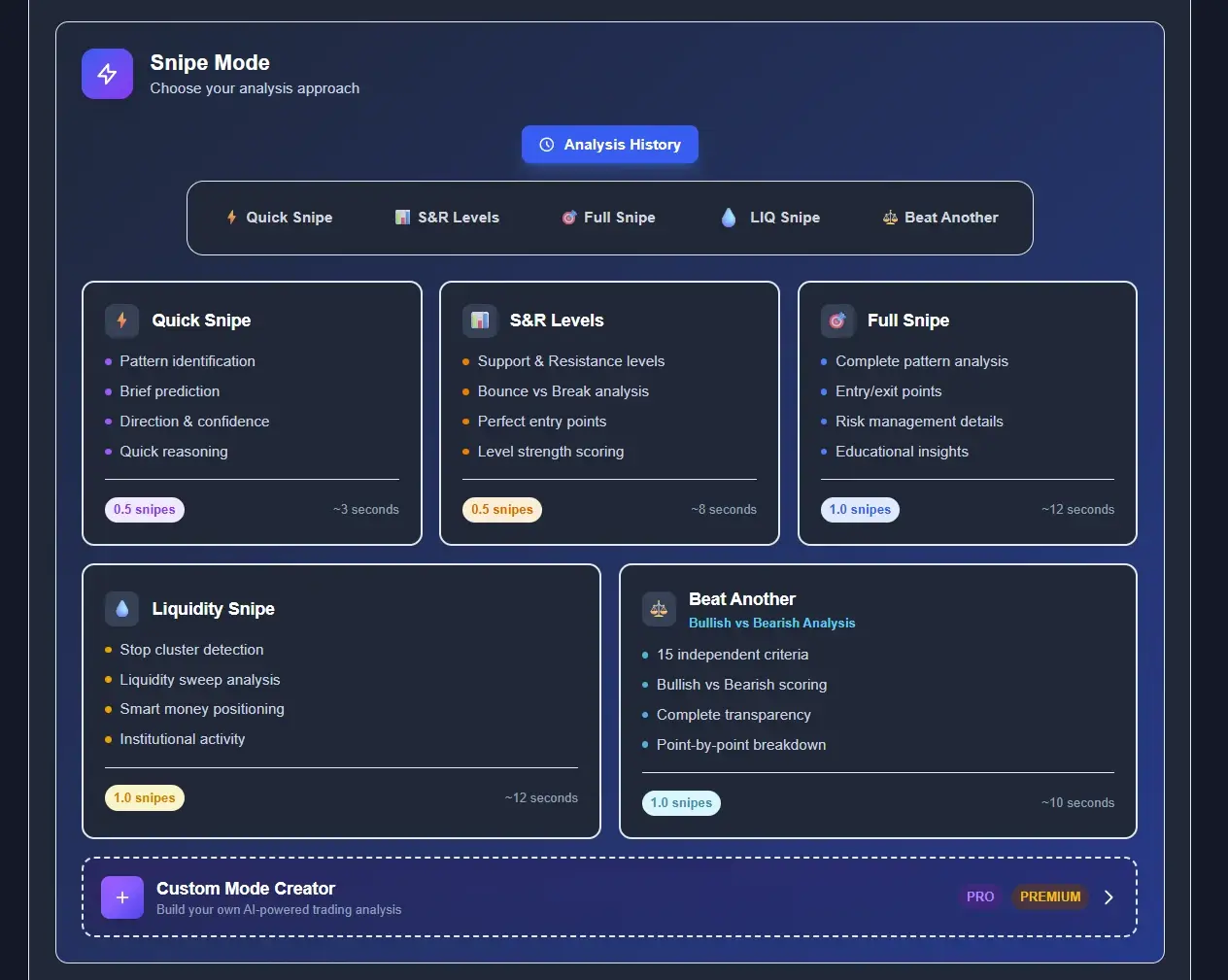
Here is what a Full Snipe analysis actually produces on a USD/JPY Triple Bottom Reversal. Note that the pattern identification, sentiment, and trade plan are separated into distinct parts — and the price levels reference actual candle structure on the chart.
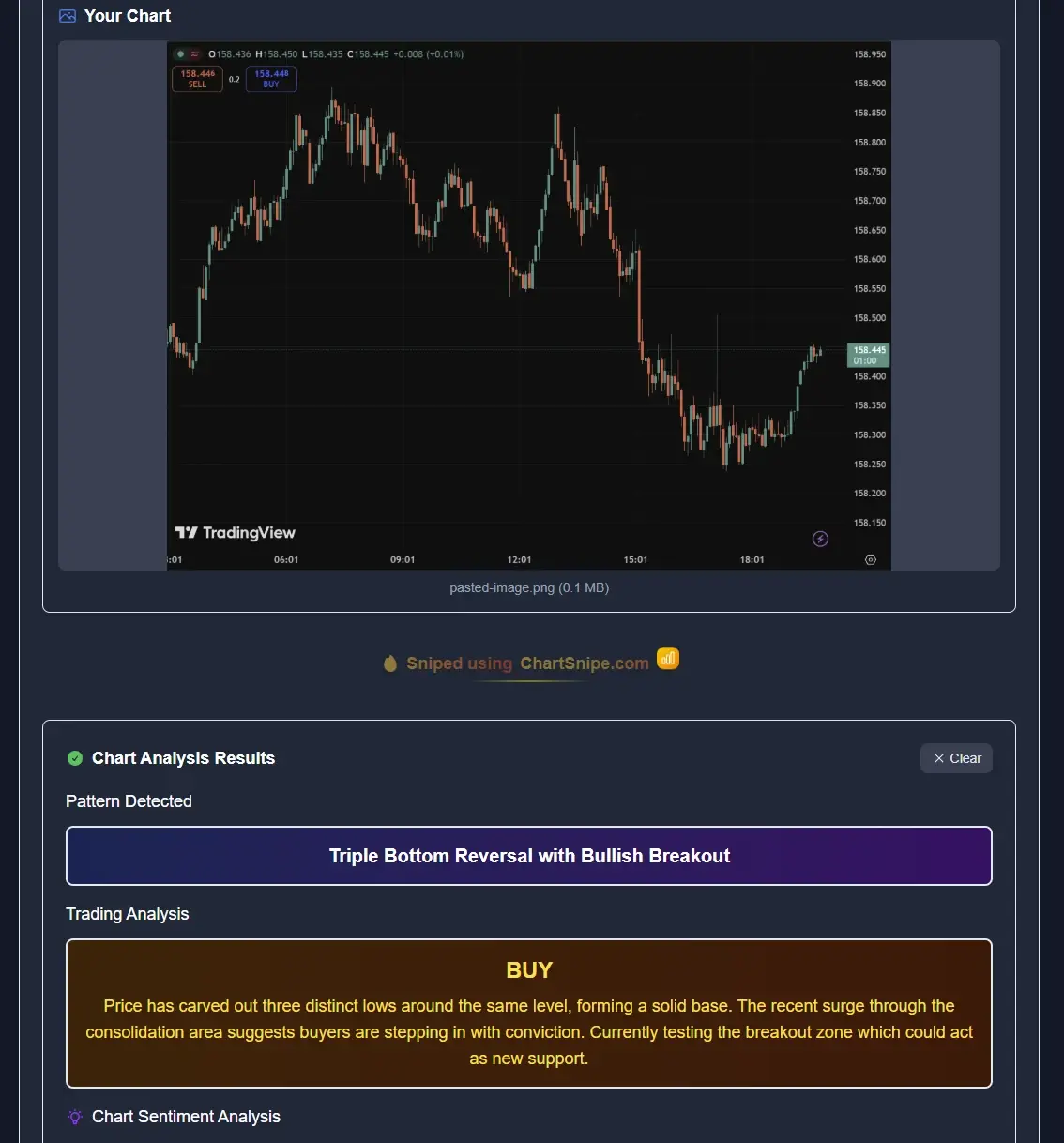
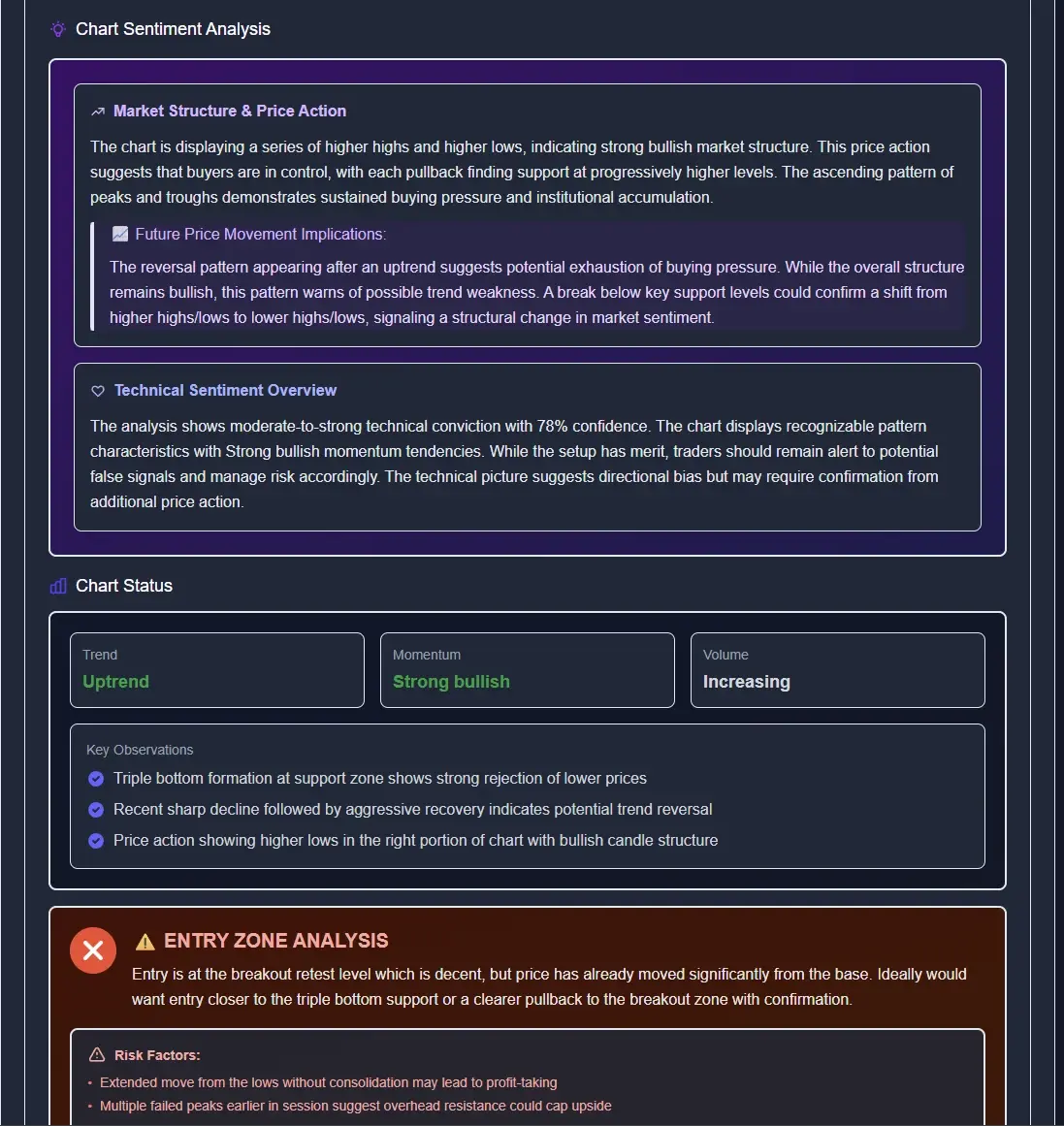
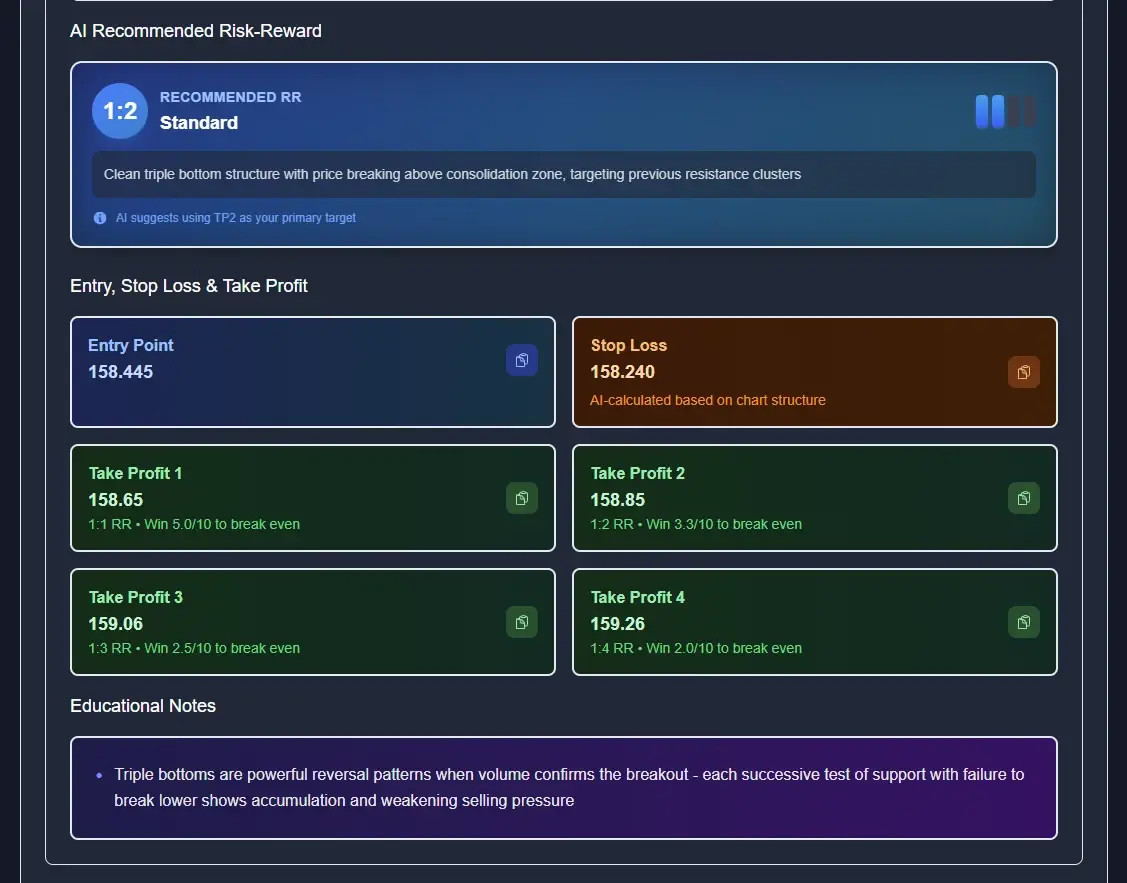
Compare that to the ChatGPT output for the same chart, which typically reads like: "This looks like a bullish reversal. Support is around 158.42, resistance around 159.10, consider a long with a stop below the recent low." The ChartSnipe output anchors every number to visible structure; the ChatGPT output anchors them to vibes.
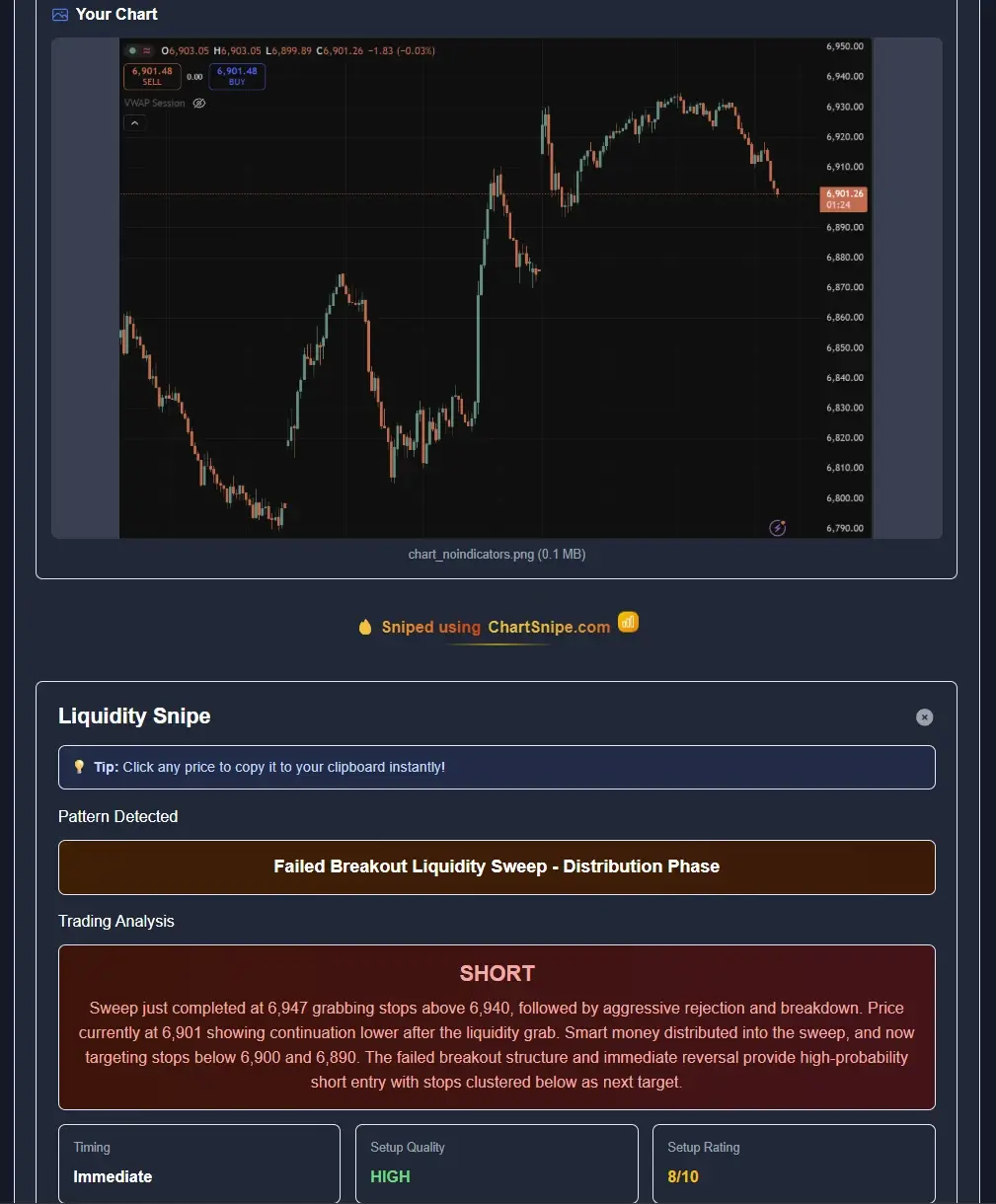
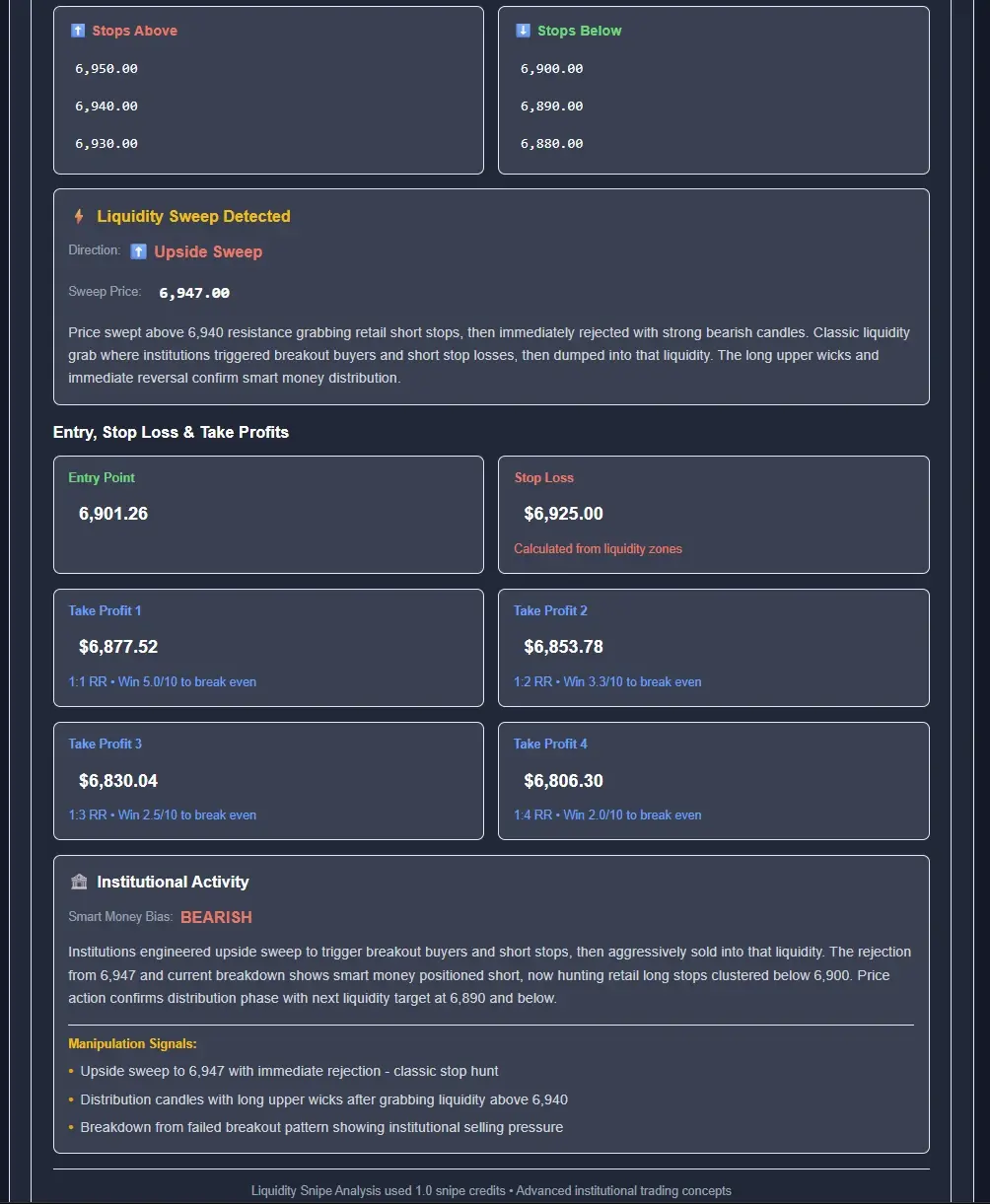
Liquidity Snipe: the mode ChatGPT cannot replicate
Liquidity Snipe is a good example of why specialization matters. It is specifically trained to identify where retail stop losses cluster, where institutional liquidity sweeps occur, and where smart money is likely positioned. You can learn more about the underlying concepts in our guide to smart money concepts, order blocks, and liquidity.
Interactive pattern learning — something ChatGPT cannot do
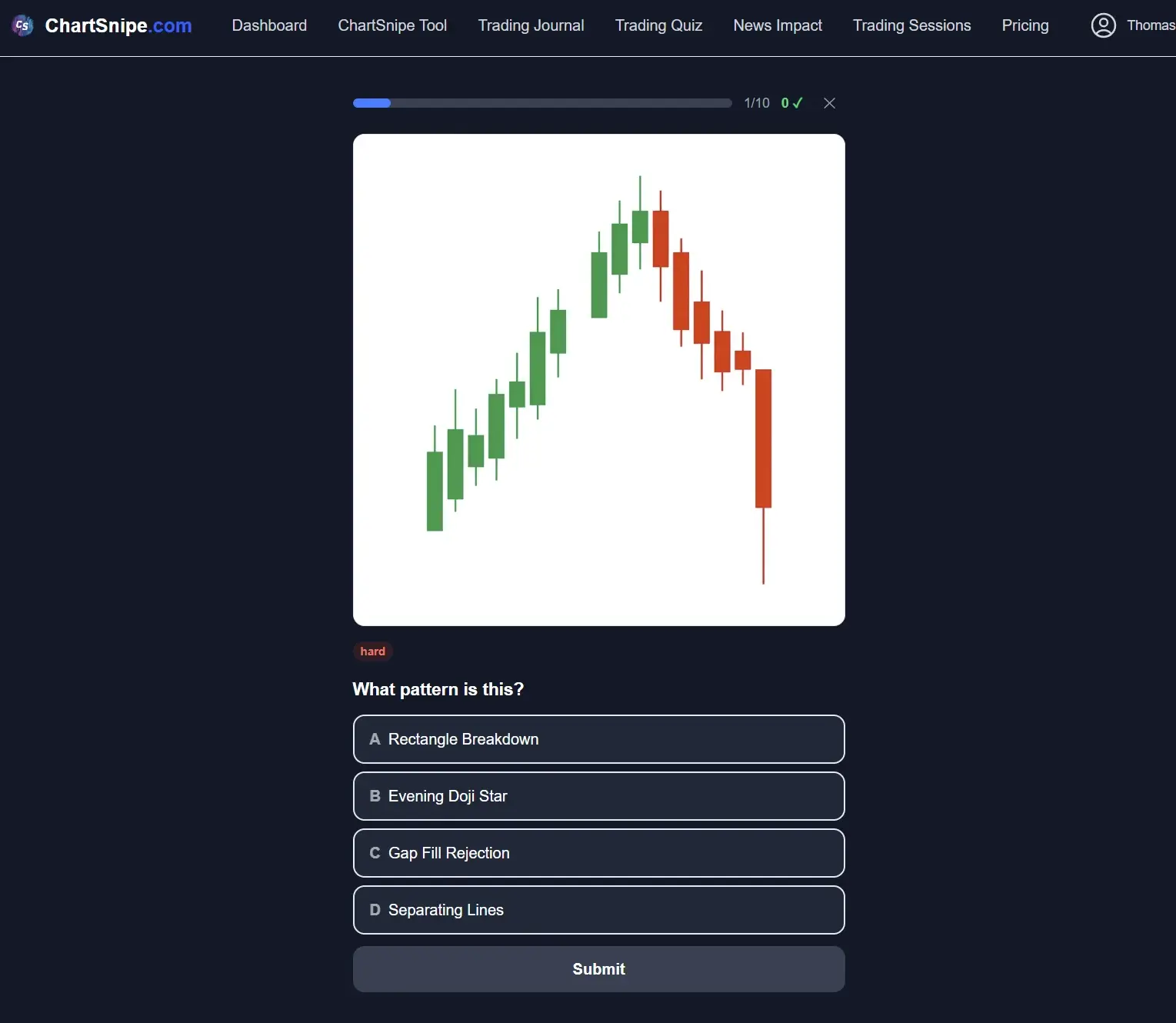
One of the most common ways traders try to use ChatGPT is as a study partner — "show me an example of a double top, quiz me on it." ChatGPT can talk about patterns in prose, but it cannot hand you a real candlestick chart and grade your answer. ChartSnipe ships with a built-in pattern recognition quiz that does exactly that: it shows you an actual chart, asks "what pattern is this?", and gives you four plausible multiple-choice options including tricky distractors like Evening Doji Star versus Gap Fill Rejection versus Separating Lines.
This is a genuinely better way to build pattern-recognition skill than asking a chatbot to describe patterns in words. You are looking at the real thing, forced to commit to an answer, and getting instant feedback on whether you saw the structure correctly. It is the kind of deliberate-practice loop that cannot exist inside a pure text model.
Live market data and news impact context
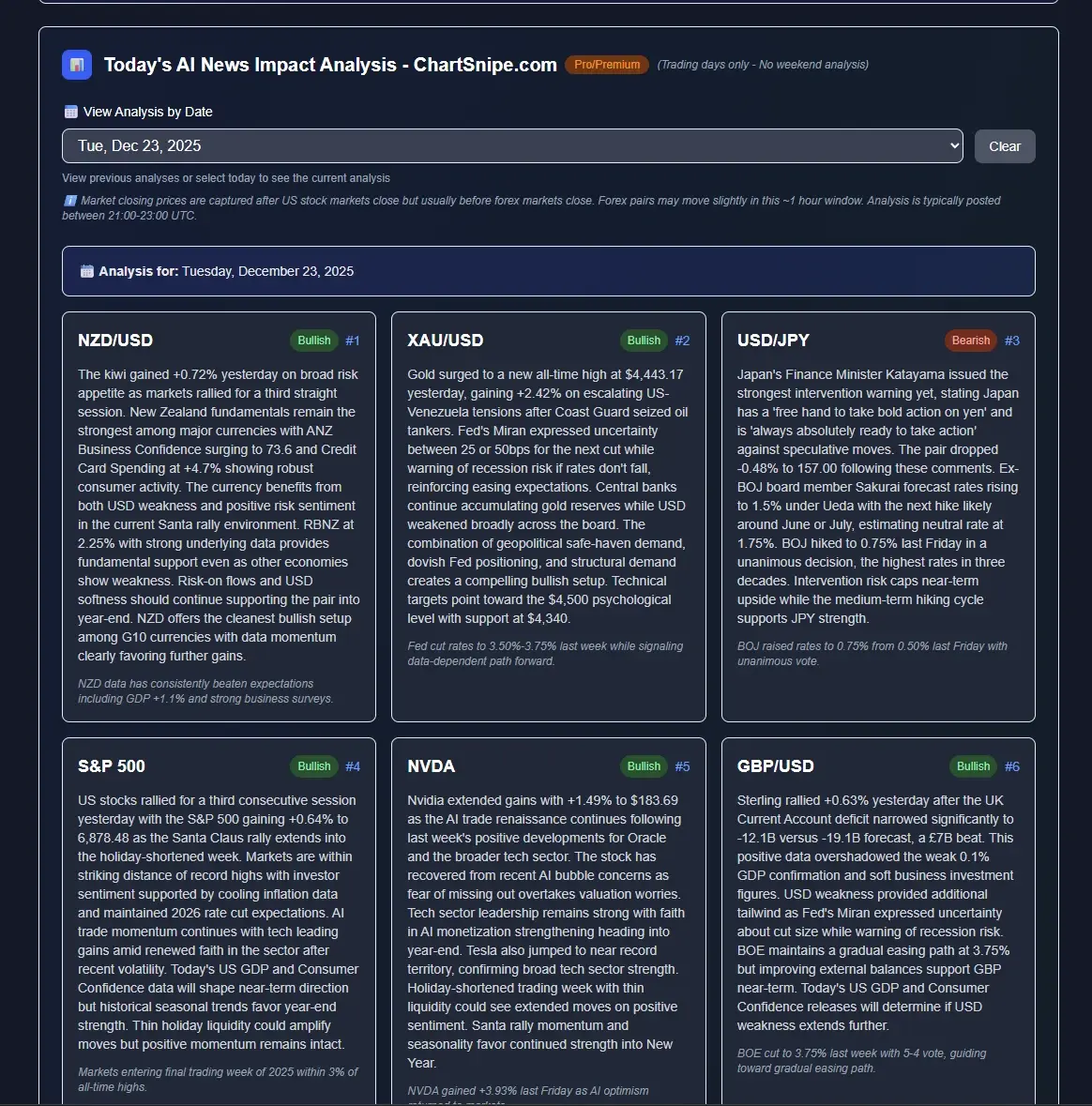
The last piece ChatGPT fundamentally cannot match is fundamental context. Every chart analysis in ChartSnipe is informed by the daily News Impact dashboard, which ranks 15+ instruments with live prices and explains the fundamental drivers behind today's moves. If you want to go deeper on that workflow, the AI economic calendar analysis guide walks through it in detail.
7. ChatGPT vs ChartSnipe: Side-by-Side
Here is the comparison, feature by feature, with no spin.
| Feature | ChatGPT | ChartSnipe |
|---|---|---|
| Reads chart screenshots | Yes (vision model) | Yes (specialized) |
| Accurate pixel-to-price mapping | Unreliable | Yes |
| Named chart patterns | Obvious only | 50+ patterns |
| Invents support/resistance? | Frequently | Structure-anchored |
| Live market prices | No | 32 instruments, live |
| Fundamental / news context | None | Daily News Impact |
| Specialized analysis modes | One generic prompt | 6 modes |
| Complete trade plan (entry/SL/TP) | Generic numbers | Structured, multi-TP |
| Smart money / liquidity analysis | No | Liquidity Snipe mode |
| Position size & risk calculators | No | Built-in |
| Explains trading theory | Excellent | Built into outputs |
| Honest "do not trade this" output | Rare | Frequent and explicit |
The pattern is consistent: ChatGPT is fine where general knowledge is enough, and weak everywhere that measurement, structure, or live context matters. For a deeper look at how specialized chart AI compares to general tools across the board, see the best chart analysis software in 2026 guide.
8. When ChatGPT Is Still Useful for Traders
We are not going to pretend ChatGPT is useless. It is genuinely excellent at several things a trader cares about — just not the ones that involve measuring your chart. Here is the honest use-case list:
Trade journaling
Paste your trade, your reasoning, and your outcome. ChatGPT is great at summarizing, tagging, and spotting patterns across many entries. This is a genuinely top-tier use case.
Learning technical concepts
"Explain why a descending triangle is typically bearish" is the kind of question where ChatGPT shines. For a structured reference, our guide on double tops, double bottoms, and head and shoulders patterns is a useful follow-up.
Drafting watchlist notes and strategy rules
ChatGPT is great for turning messy thoughts into a clean, repeatable trading plan or checklist.
Explaining a ChartSnipe output in plain English
Use the specialist tool to generate the analysis, then use ChatGPT to walk through any terminology you do not know. This is the workflow we recommend.
Not: actual trade setups
Do not use ChatGPT to generate the entry, stop, and target you are going to place on your broker. That is the one job it is bad at, and it is the one job that costs real money when it is wrong.
The right mental model: ChatGPT is your study partner. ChartSnipe is your chart analyst. Use both for what they are good at.
9. Frequently Asked Questions
Does ChatGPT work for trading charts?
Partially. It can describe the general shape of price and name obvious patterns, but it frequently hallucinates specific price levels, invents support and resistance that is not on the chart, and has no access to live market data. It is not reliable for real trade setups where you need accurate numbers.
Can ChatGPT read trading charts accurately?
ChatGPT can read a chart image well enough to identify rough direction and name obvious patterns. However, its pixel-to-price mapping is unreliable, so any specific number it quotes is likely guessed rather than measured from the actual candle structure on the screenshot you uploaded.
How accurate is ChatGPT for stock chart analysis?
In our 100-chart test, ChatGPT correctly named the dominant pattern around 40% of the time and quoted usable support or resistance levels only about 23% of the time. Its confident tone hides how often it is wrong on the details that matter for placing an order.
Is ChatGPT good for technical analysis according to Reddit?
Reddit threads and Forex Factory discussions broadly echo our findings — ChatGPT is useful for learning concepts and journaling trades, but traders regularly report hallucinated price levels, confident wrong signals, and no awareness of the current market regime. The consensus is "good teacher, bad trader."
What is a better alternative to ChatGPT for trading charts?
ChartSnipe is a purpose-built alternative that combines chart image analysis with live market data, a daily AI news impact dashboard, and six specialized analysis modes including Liquidity Snipe and Full Snipe. It gives you context ChatGPT structurally cannot access.
When should I still use ChatGPT as a trader?
Trade journaling, explaining technical concepts, drafting watchlist notes, and walking through your own thinking. It is not a good fit for reading specific price levels off a live chart or for generating the entry, stop, and target on a live trade.
Conclusion: The Honest Answer
So — does ChatGPT work for trading charts? Sort of, and not in the way you want it to. It is a brilliant trading tutor, a decent journal assistant, and a useful general thinking partner. It is a poor chart analyst, and the part where it confidently invents price levels is the exact part you cannot afford to get wrong when real money is on the line.
If you are looking for a tool to help you place actual trades — with measured levels, live data, fundamental context, and specialized modes — use something built for the job. That is exactly what ChartSnipe was designed for. Keep ChatGPT in your browser for the theory. Bring ChartSnipe in when it is time to trade.
Sources & Further Reading
- • OpenAI — official documentation for GPT-4 and GPT-5 vision capabilities
- • Forex Factory — trader community threads on ChatGPT chart analysis experiences
- • BabyPips School of Pipsology — foundational technical analysis education
- • Investopedia — chart pattern and indicator reference definitions
- • TradingView Ideas — community chart analyses used as a real-world comparison baseline
Related Articles
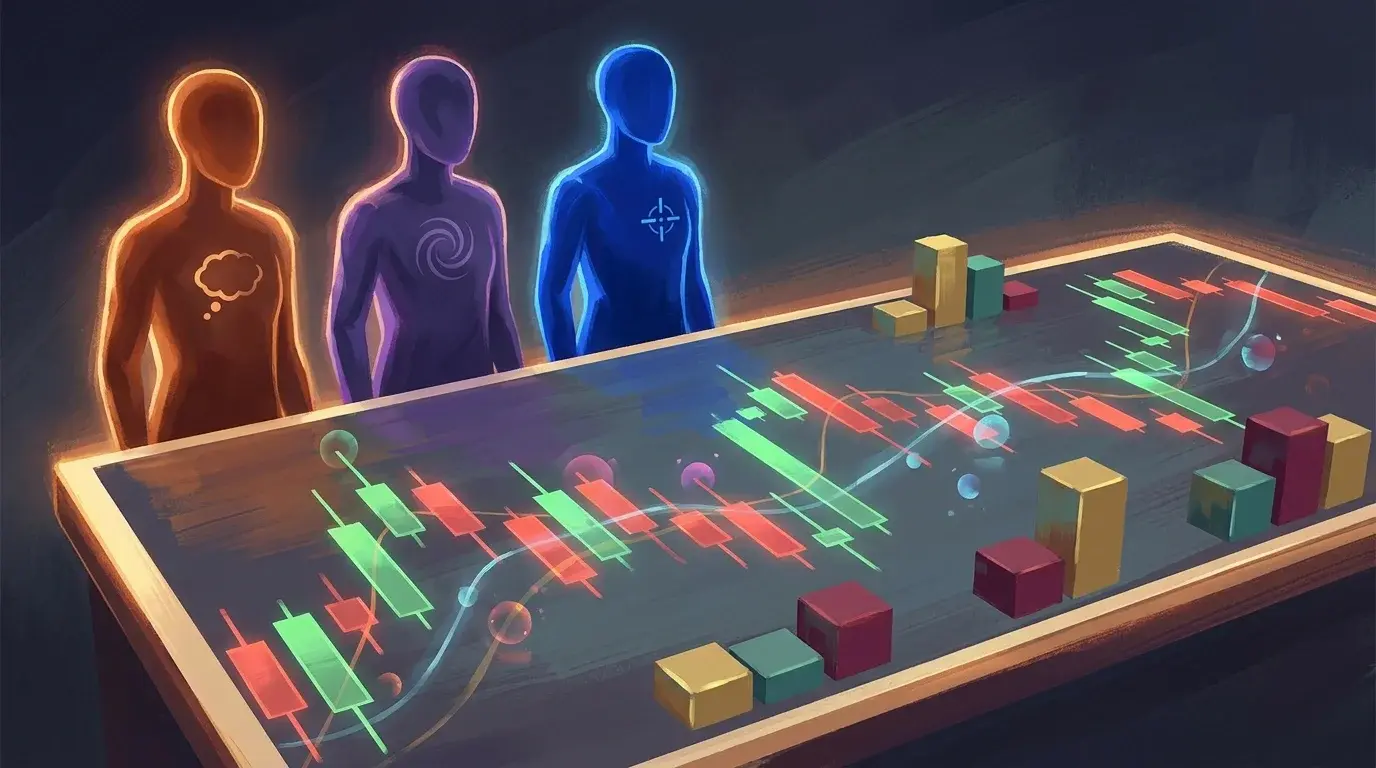
Best AI Chart Screenshot Analysis Tools Tested in 2026
We ranked 6 AI tools that analyze chart screenshots by pattern accuracy, price-level accuracy, live data, and speed.
Claude vs ChatGPT vs ChartSnipe
Head-to-head comparison of the three most talked-about AI chart analysts for traders in 2026.
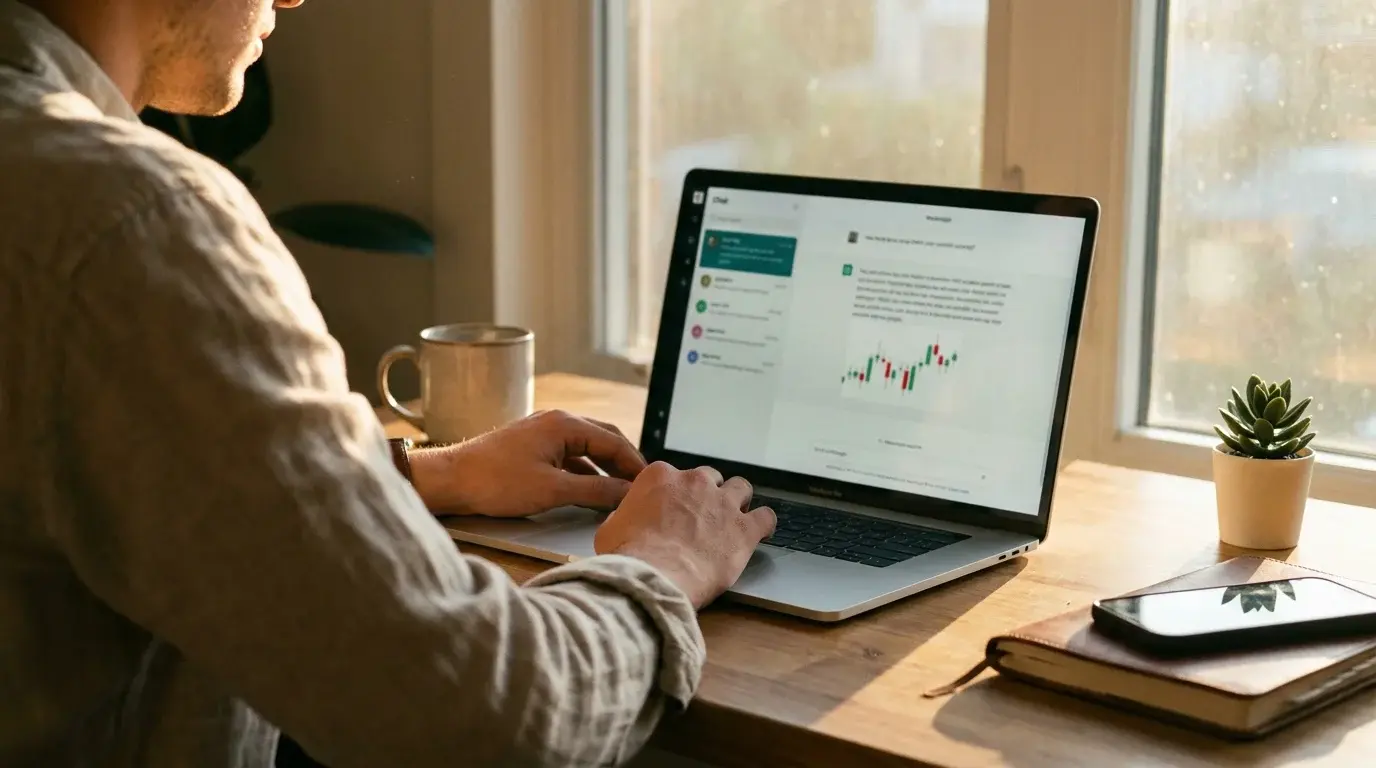
How to Use ChatGPT to Analyze a Forex Chart
A practical walkthrough of prompting ChatGPT for forex chart analysis — and where it still falls short.

Written by the ChartSnipe Team
ChartSnipe is an AI-powered chart screenshot analysis tool and daily AI news impact analysis platform for forex, gold, Bitcoin, S&P 500, and Nasdaq traders. Our team combines deep experience in technical analysis, AI vision models, and live market data across 32+ instruments to deliver actionable trading insights.
Want a chart AI that was actually built for trading?
Try ChartSnipe free — no credit card, 2 analyses per month on the free plan, and the full stack on Pro. See the pricing page for details.
Try ChartSnipe FreeWritten by the ChartSnipe Team — Building the purpose-built alternative to "just ask ChatGPT."