
Two Fed Dissents, Both for a Hike
The Fed held at 3.75% to 4.00% on October 28, and the market barely blinked. The vote is what you should have read: 10 to 2, both dissenters wanting a hike, with December already priced in the mid-80s. Here is how a hawkish hold works, what moved, and what decides the next six weeks.
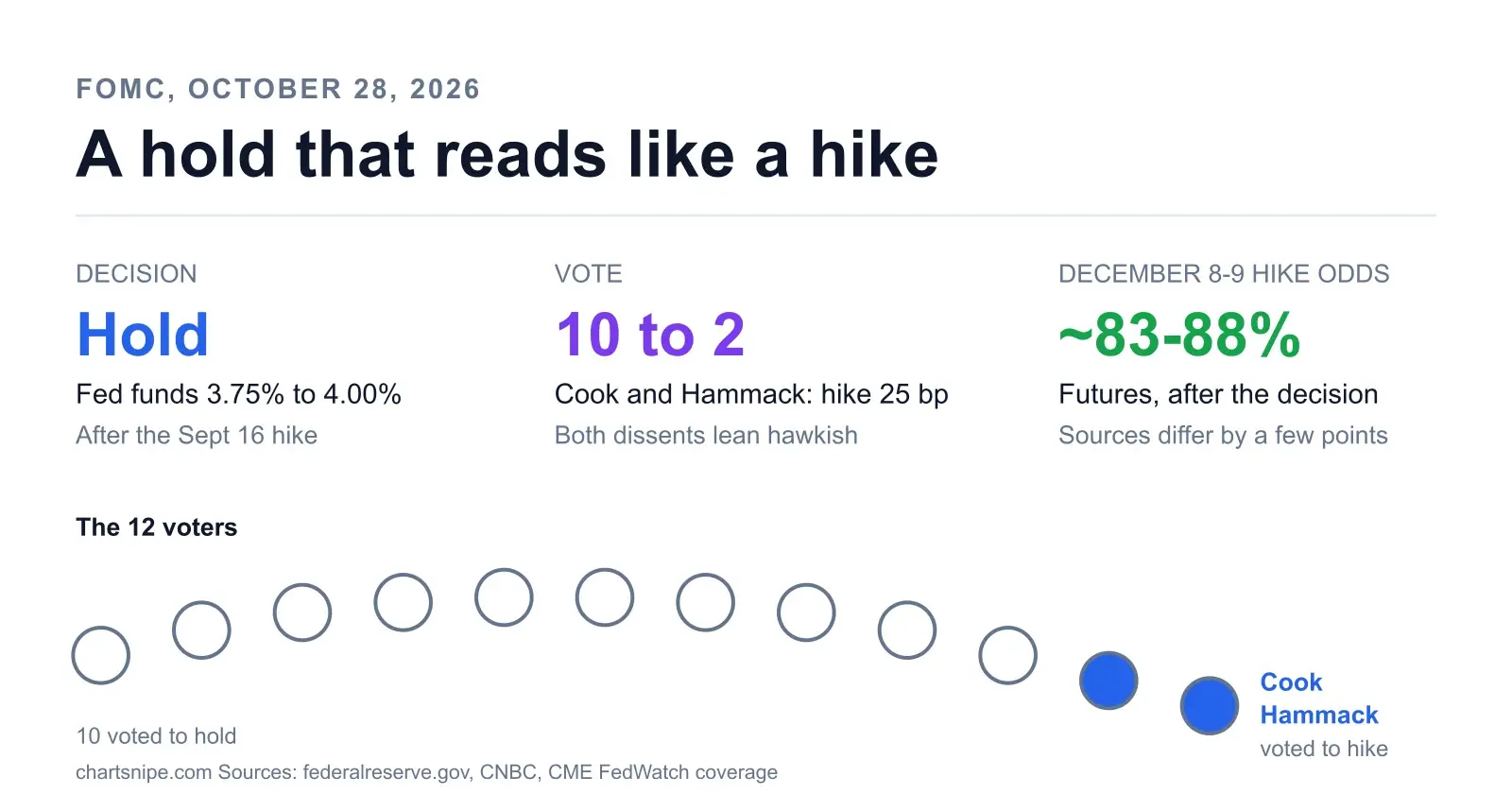
If you only read the headline, October 28 was a boring meeting. The Fed’s own release says the FOMC kept the federal funds target range at 3-3/4 to 4 percent. Nothing changed. The S&P 500 closed up about 0.3%, USD/JPY finished where it started, and nobody walked away with a new thesis.
But the vote was 10 to 2, and the last line of that release names the two who lost: Lisa Cook and Beth Hammack, who wanted a quarter-point hike now. A committee that hiked six weeks ago is holding, and two of its twelve voters think the hold is too soft. The rate is the least interesting thing on the page.
This is a post about reading that kind of meeting. It follows our look at the September 16 hike, the first since 2023, and the earlier July preview of whether the Fed would hike at all. Below we cover what the dissents tell you, what the statement changed, what moved on the day, what futures imply for December, and the calendar up to the December 8-9 meeting.
Key Takeaways
- →Hold at 3.75% to 4.00%, 10-2 vote, both dissents for a 25 bp hike. Cook’s was reportedly her first since joining the Fed in 2022.
- →The statement upgraded activity to “expanding at a strong pace” and dropped the sentence explaining September’s hike. Inflation stayed “elevated”.
- →December was already priced near 80% or higher before the meeting. Outlets disagree on whether odds rose or slipped a point or two on the day. The pricing barely moved.
- →The curve steepened: the 2-year fell and the 10-year rose to about 5.04%. That tells you more than the dollar did.
- →With the hike mostly priced, the risk is asymmetric: a soft print costs the dollar more than a hot print adds.
- →November CPI lands on December 10, a day after the decision. The committee votes without it.
1. What a hawkish hold is
A hold is a decision. A hawkish hold is a decision plus evidence that the people who made it would rather have gone the other way. The evidence comes from three places: the vote, the statement wording and what the chair says at the podium.
The rate decision is almost always priced before it arrives. On October 28 the question was never whether the Fed would hold. It was how loud the hawks would be, and whether the statement would hand them a phrase to point at in December. That is why we start with the vote, not the price chart. The vote is the part the market could not fully pre-trade.
2. Read the dissents first
Two of twelve voters is not many. But a dissent is the costliest signal a central banker can send, because it puts a name on a disagreement the chair would rather keep in the room.
Three things in this vote are worth separating.
Direction. Both dissents were for tighter policy. In a meeting after a hike, the fight is about how fast to go, not whether to stop. A dovish dissent would have said the September move was a mistake. These said it was not enough.
Who. Per CNBC’s report, it was Cook’s first dissent since she joined the Fed in 2022. A governor breaking from the chair carries more weight than a regional president doing it. Hammack is a regional president; Cook sits on the Board. Give the Board dissent the heavier weight.
Who came back. In July, Dallas’s Lorie Logan and Minneapolis’s Neel Kashkari voted for a hike, according to the same report. They joined the majority this time. So the hawkish bloc did not grow so much as rotate, and the center of the committee moved toward them in September. Dissents do not count hawks. They count people willing to put their name against the compromise, and the compromise now sits a notch to the right of where it sat in July.
The rule of thumb. One dissent is a personality. Two in the same direction is a faction. Three or more in the same direction is usually the next decision being announced early. We are at two. The next meeting brings a fresh set of projections.
3. What the statement changed
Central banks change a word or two on purpose. Read a statement by setting it beside the last one and looking only at what moved.
Three differences stand out. Activity moved from “solid” in September to “expanding at a strong pace”, an upgrade. The sentence explaining why the Committee had hiked in September is gone. And the inflation line, “Inflation remains elevated,” did not change. With oil still running, that is no relief. The statement also says further information will help the Committee set the appropriate stance for returning inflation to 2 percent, and it closes the policy paragraph with a flat “The Committee will deliver price stability.”
Put together, stronger growth, unchanged inflation and a missing justification read like a committee that no longer needs to defend its last move because it expects another. A committee that regrets a hike explains it again. A committee that thinks it is mid-cycle stops bothering. That is a read, not a quote, so hold it loosely. Still, a deleted sentence is cheap to make and easy to miss, which is why it is worth checking. The full text is on the Fed’s FOMC calendar page, and a side-by-side takes five minutes.
4. Warsh and the press conference
Chair Kevin Warsh did not give guidance. That is the headline from the room, and it is a choice, not a gap.
Coverage of the press conference agrees on the outline. He declined to prejudge December, said more information would shape the next policy steps, and described the committee as ready and willing to act. He said politics played no role ahead of the midterm elections. He also would not call current financial conditions tight. That matters more than it sounds. If conditions are not tight and inflation is elevated, there is no reason to stop. Read that as the dovish half of the message going thin.
Refusing guidance while two voters want a hike does two things at once. It keeps December live without committing to it, and it keeps the chair from being pinned to a number before the data arrives. For a trader the translation is simple: the Fed has handed the decision to the next four data points, and has told you which side it is leaning on.
5. What moved on October 28
Almost nothing in headline price, and quite a lot in the curve.
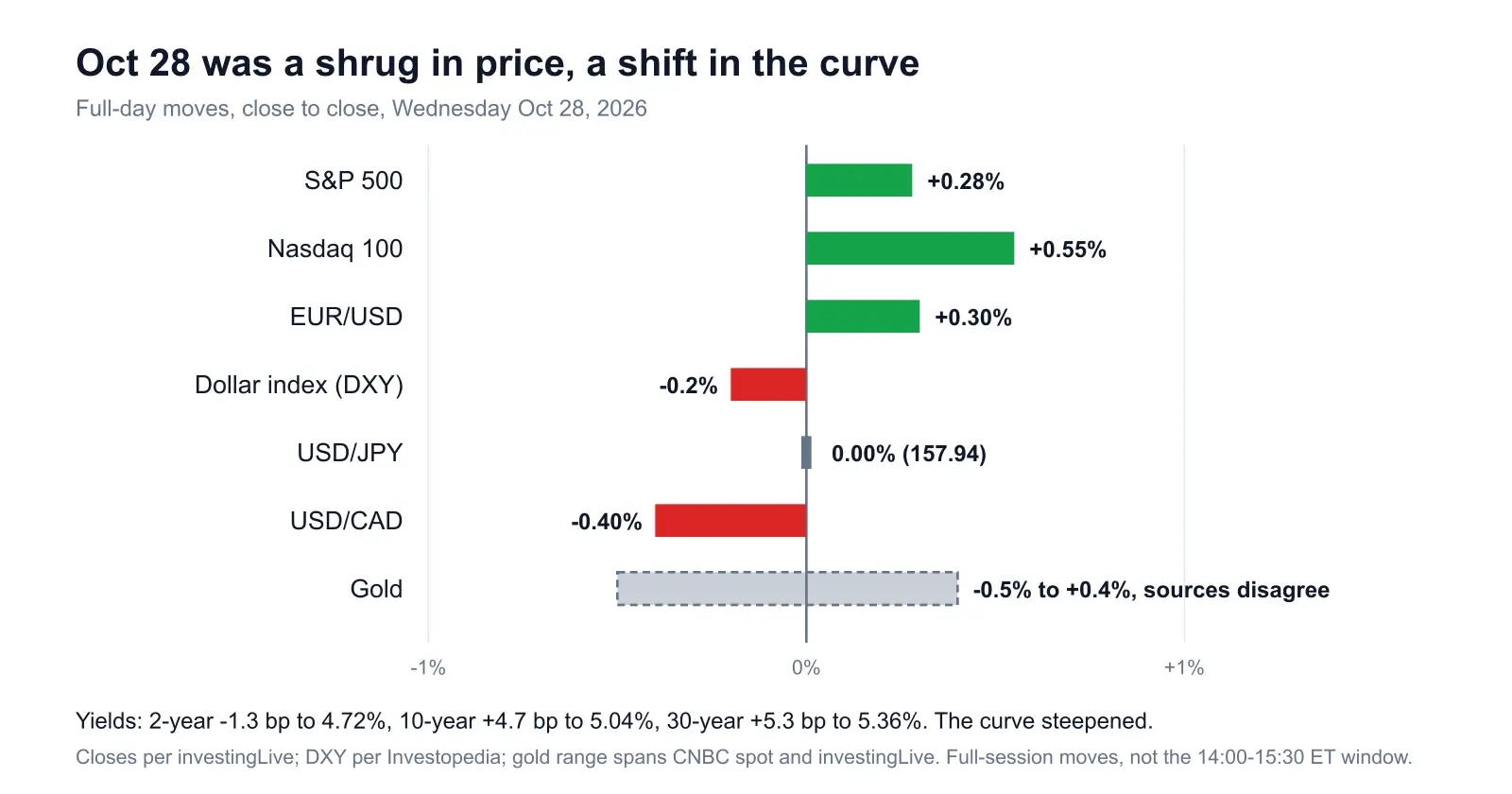
Dollar
The dollar index finished down about 0.2% at 102.14 and EUR/USD closed 0.3% higher near 1.1155. Outlets called the day mixed, and that is fair. A hawkish hold lifts the dollar when it surprises. This one did not, because a December hike was already the base case. USD/CAD fell 0.40%, helped by crude. That is the ordinary oil-up, CAD-up link, not a Fed story. For the wider dollar backdrop this year,our DXY piece covers the rate-differential logic.
USD/JPY
USD/JPY ended at 157.94, unchanged on the day. That flat close is the interesting part. A hawkish Fed with the 10-year at 5% is the setup that normally pushes the pair toward the intervention zone we examined in the 160 piece. It did not get there. The market treated the meeting as priced in, and the pair sat about two yen below the level where Tokyo’s patience has previously run out. That is a poor risk-reward: you are paid little to be long and can lose a lot, fast, if the Ministry of Finance steps in.
Gold
Gold finished near $4,040 to $4,080 depending on the feed, with one source slightly lower on the day and another slightly higher. CNBC’s account has bullion flat after the statement, briefly positive during Warsh’s remarks and then lower again. The pattern is the usual one for a hawkish central bank: gold does not need to fall, it just cannot rally. With the 10-year Treasury at about 5.04%, holding a non-yielding asset is expensive. That is why we keep saying a run to $5,000 needs real yields to cooperate, not just fear.
Indices and yields
The S&P 500 closed up 0.28% and the Nasdaq 100 up 0.55%. Treasuries told the more useful story. The 2-year dipped to about 4.72% while the 10-year rose to 5.04% and the 30-year to 5.36%. Front-end relief because Warsh would not commit to a path. Back-end pressure because strong growth and sticky inflation do not shrink term premium. A steepening curve after a hawkish-leaning hold says the market expects the Fed will not stop, but doubts it can fully contain inflation.
Oil was in the room too. WTI settled near $101 to $102 and Brent was reported around $115 after an attack on a Saudi refinery. We covered that side in the oil shock and forex pairs: the Fed is hiking into an energy shock, the uncomfortable kind of inflation to fight.
6. What December looks like in futures
Mid-80s. The exact figure depends on the outlet and the minute you looked.
Investopedia put the chance of at least a quarter-point hike on December 8-9 at about 85% according to the CME FedWatch tool. CNBC had traders at 86%, down from 88% before the announcement. Other coverage had the number rising to about 83% from 78% the day before, and one outlet had it near 87.5%. We cannot reconcile those, and the likely reasons are mundane: different snapshot times, different data cuts, and different baselines. What they agree on is the level, not the direction of the daily change.
That is the real lesson. Pricing sat in the 80s before the meeting and in the 80s after it. The two dissents did not move it, because the market had already assumed the hawks were on one side of the table. A dissent that confirms the consensus is not news. A dissent that is unexpectedly missing would have been, and the committee had its chance to shift the other way and did not.
The asymmetry. When something is 85% priced, the remaining 15% is the whole trade. A hot print takes the odds from 85% to 95% and the dollar barely notices. A soft print takes them from 85% to 50% and the dollar notices a lot. That is why a hawkish hold into a priced hike carries more downside surprise risk for USD than upside, even with the Fed sounding firm.
Futures also price the possibility of one or two more hikes in 2027, per CNBC. That matters more for the 2-year and USD/JPY than for December itself. If the path extends, the front end can reprice higher even if December plays out as expected.
7. The data that decides December
Five releases and one election sit between now and the next vote.
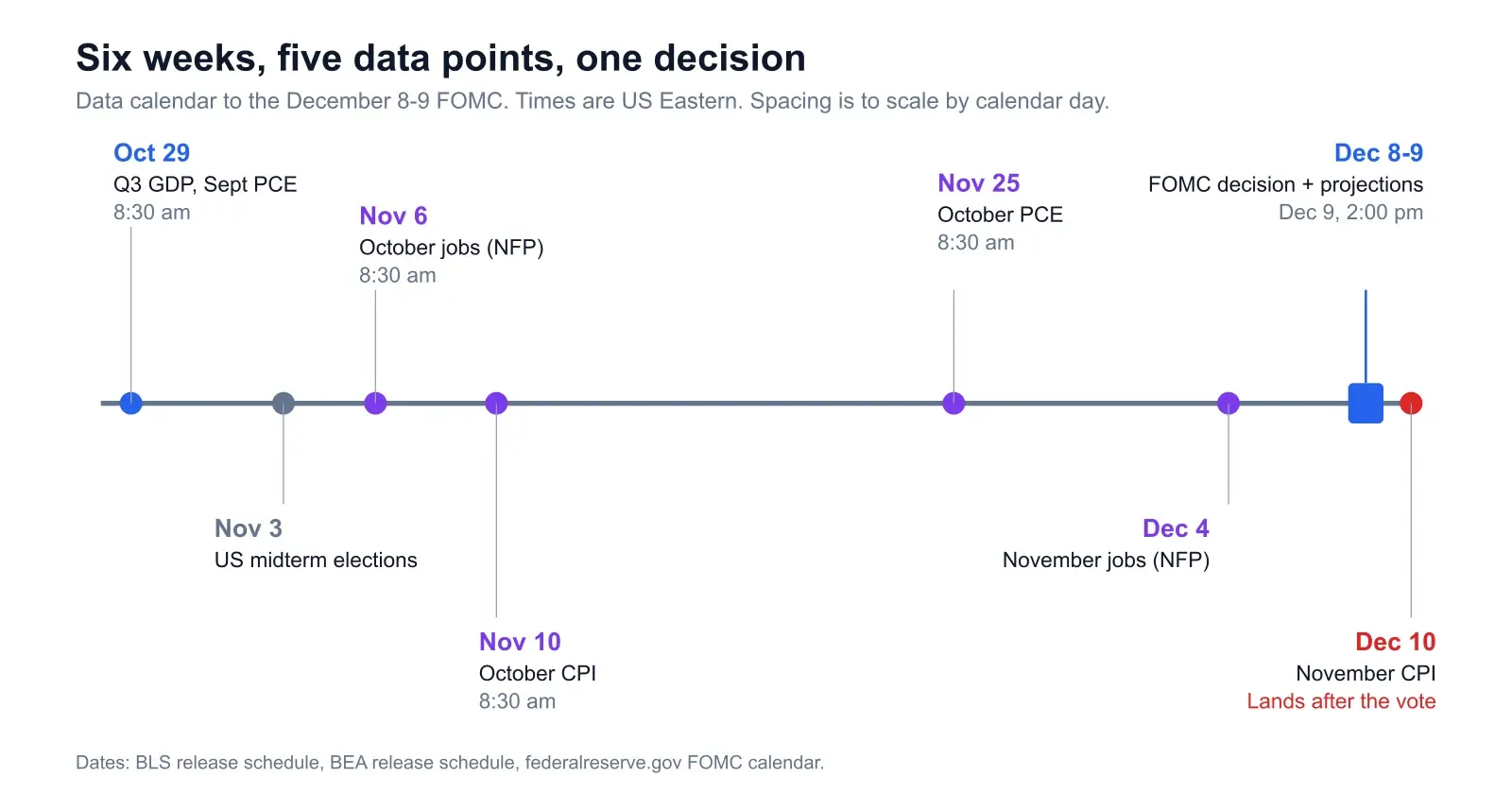
| Date (8:30 am ET) | Release | What the Fed hawks want to see |
|---|---|---|
| Thu Oct 29 | Q3 GDP (advance), September PCE | Core PCE firm. It confirms that “strong pace” was not a rounding error. |
| Fri Nov 6 | October nonfarm payrolls | Hiring and wages that keep the labor side from giving the doves an argument. |
| Tue Nov 10 | October CPI | The big one. Core CPI is the single input that most reliably moves the December odds. |
| Wed Nov 25 | October PCE (and Q3 GDP, second estimate) | The Fed’s preferred inflation gauge, and the last inflation read before the December 4 jobs report. |
| Fri Dec 4 | November nonfarm payrolls | The last labour data before the meeting. |
| Dec 8-9 | FOMC decision with projections | A new dot plot, the first since September. |
| Thu Dec 10 | November CPI | After the vote. It is the first test of whether the decision was right. |
Dates come from the BLS release schedule for jobs and CPI, the BEA schedule for PCE and GDP, and the Fed’s calendar for the meeting. Schedules can move, so confirm them before you plan a week around one. The political calendar matters too. The midterms are on November 3, and CNBC notes an early-November hearing on the administration’s attempt to remove Cook. If you trade around those days, remember that the committee’s makeup is a variable. Cook is one of the two hawkish votes.
The practical rule from our NFP, CPI and FOMC playbook applies with more force than usual. The number that moves price is the gap between the print and consensus. With a hike already priced, that gap has to be large to matter.
8. A six-week playbook
This is not a forecast. It is a set of conditions and what we would do under each. Nothing here is advice. The sizing is yours.
Rule 1: do not buy the dollar because the Fed sounds hawkish
The best-known fact about a priced hike is that the hawkishness is already in the exchange rate. On October 28 the dollar index fell and the pair most sensitive to US yields did not move. If you want to be long USD into December, you need a reason beyond “the Fed is hawkish”, because everyone else has that reason too. A better reason is structural, such as a safe-haven bid from the oil shock. That is the case for USD and CAD firmness in any risk-off week.
Rule 2: let the release set the trade, not the opinion
Three scenarios cover most of the next six weeks.
Hot core CPI on November 10. December odds go to the 90s and more 2027 hikes get priced. The dollar gets a small push, the 2-year a bigger one. Gold struggles, and indices wobble because 5% on the 10-year is already a headwind. The cleaner trade is rates-sensitive rather than USD. We would only look at USD/JPY with a stop sized for intervention risk.
Soft core CPI. The odds drop toward 60% or lower, and this is where the asymmetry pays. The dollar falls harder than it would have risen on a hot print, EUR/USD and AUD/USD benefit, and gold gets room. A soft print after a hawkish hold is the most violent single-day reversal on the calendar, because positioning built for a hike has to unwind.
In-line prints. Nothing changes and the market returns to oil and yields. Most days will look like this. Do not manufacture a trade.
Rule 3: size down around the releases, not into the chop
Spreads widen at 13:30 UTC on CPI and NFP days. Trade smaller, or stay flat, for the first minutes. The information usually lives in the second move, after the first spike is absorbed. If you want a mechanical way to tag which events deserve this treatment, aNews Impact analysis ranks each event and pair before the session and lists the scenarios that would break the day.
Rule 4: watch the long end, not just the Fed
With the 10-year at 5.04% and the 30-year at 5.36%, the pressure on gold and equities comes from term premium as much as from the policy rate. A dollar that falls while long yields rise is a different regime from one that rises with them. If you see that divergence again, treat it as a warning that the bond market and the Fed are no longer saying the same thing.
Rule 5: put the invalidation in writing
For any view you take, write what would end it. Examples: core CPI at or below consensus by two tenths ends a long-USD thesis. A third dissent for a hike means December is more than priced and the debate moves to 50 basis points. Hammack or Cook saying something softer ends the hawkish-bloc idea. Then log the outcome, wins and misses, in a trading journal so you can see whether your Fed reads actually pay or just feel clever. And if you want a second opinion on the chart before acting, the Chart Snipe tool will read a screenshot without caring what your macro view is.
Frequently asked questions
What is a hawkish hold?
A meeting where rates are unchanged but the vote, the statement or the press conference leans toward tighter policy. On October 28, 2026 the FOMC held at 3.75% to 4.00% by 10-2, both dissenters wanted a quarter-point hike, and the statement upgraded activity to “expanding at a strong pace”. The decision was a hold. The information was a hike bias.
Who dissented at the October 2026 FOMC and why?
Governor Lisa Cook and Cleveland Fed President Beth Hammack. The Fed’s release says they preferred to raise the target range by 1/4 percentage point at this meeting. Cook’s was reportedly her first dissent since joining the Fed in 2022. The Fed’s release does not include their reasoning, which usually comes in dissent statements and speeches afterwards.
What are the odds of a December 2026 Fed hike?
Coverage after the decision put it in the mid-80s percent, with figures between roughly 83% and 88% depending on the outlet and the time of day. Check the live number on the CME FedWatch tool rather than trusting a figure that is hours old.
Which data matters most before the December FOMC?
October CPI on November 10 first, then the November 6 and December 4 jobs reports and October PCE on November 25. November CPI on December 10 comes after the decision.
How should you trade after a hawkish hold?
Trade the gap between what is priced and what the next print can change, not the decision itself. With December near 85% priced, a hot print adds little and a soft print can unwind a lot. Size smaller around releases, and remember that long-end yields at 5% are pressuring gold and equities independently of the Fed.
Sources & further reading
- → Federal Reserve — FOMC statement, October 28, 2026 — the vote, the dissenters and the policy wording, primary source.
- → Federal Reserve — FOMC calendar — the December 8-9 meeting and the projection schedule.
- → CNBC — Fed interest rate decision, October 2026 — the dissent background and the statement changes.
- → CNBC — gold and the Warsh comments — the gold session, the 10-year yield and the December odds.
- → investingLive — Americas FX wrap, 28 Oct — index, FX and Treasury closes.
- → CME Group — FedWatch tool — live market-implied odds for each meeting.
- → Bureau of Labor Statistics — release schedule — jobs and CPI dates.
- → Bureau of Economic Analysis — release schedule — PCE and GDP dates.
Know what the next print is worth before it lands
News Impact ranks the day’s events and 12 instruments before each session, with a written thesis for each pair and a list of the scenarios that would break it. Most useful in a week like the next one, when the release matters more than the headline.