
Trading the News: What Works on NFP, CPI and FOMC Days
A single number drops at 08:30 and the major pairs travel 200 pips before you can blink. Most retail traders lose money in that first minute — wide spreads, blown stops, a spike that reverses on them. Here is what actually works instead.

There are maybe a dozen scheduled events each month that reprice the entire dollar complex in seconds. US Non-Farm Payrolls, the CPI inflation report, and the FOMC rate decision sit at the top of that list. A meaningful surprise on any of them can push EUR/USD, GBP/USD or USD/JPY 100 to 400 pips inside a few minutes, and gold can travel several times its normal hourly range on the same headline. That volatility is the entire reason people want to trade the news. It is also the reason so many of them get destroyed.
The core mistake is treating the release as a coin flip on the number and slamming a market order the instant it prints. The market does not move on the number. It moves on the gap between the number and what was already expected — the surprise. And it almost never moves in a clean straight line: the first spike routinely overshoots and snaps back once the algorithms finish repricing. If your plan is “guess the direction, click fast,” you are not trading, you are feeding the spread.
This is the honest version of a news-trading playbook. Three approaches that actually have an edge, which pairs are most exposed to each event, and how to use an AI news read from ChartSnipe to see the exposure before the number lands — as a research co-pilot, not a signal service. Nobody, human or model, knows the print in advance. Anyone who says otherwise is selling something.
Key Takeaways
- →Markets trade the surprise, not the headline. A number in line with consensus barely moves; the deviation from forecast is what reprices the dollar.
- →The first 60–90 seconds is a trap. Spreads blow out, slippage is brutal, and the initial spike often reverses. Getting in fast means getting the worst fill into the least reliable move.
- →Three things actually work: surprise-aligned continuation, fading a clear over-extension after the spike settles, or the break-and-retest 15–20 minutes later.
- →NFP, CPI and FOMC are the big three. In 2026's hot-inflation regime, CPI is the one moving markets hardest.
- →Size down or stay flat. Volatility is several times normal, so either widen the stop and shrink the lot, or take the trade off the table entirely.
1. Why news moves markets — it's the surprise, not the number
The single most useful thing to understand about news trading is that the consensus forecast is already in the price. If economists expect payrolls of 180k and the actual prints at 180k, nothing happens — the market spent the previous week positioning for exactly that. Price moves on the deviation: the distance between what actually came out and what everyone had already bet on. A 260k print against a 150k forecast is a large upside surprise, and the dollar bids hard. The raw headline number tells you almost nothing until you put the forecast next to it.
This is why two “strong” jobs reports can produce opposite reactions. It also explains the counter-intuitive days where a bad-looking number rallies the currency — the number was bad, but less bad than the market had already priced, so the net surprise was positive. Trade the gauge deflection, not the raw reading. Before every release, write down the consensus and decide, in advance, what a genuine beat and a genuine miss look like relative to it. Then you are reacting to the surprise the instant you see it, instead of doing arithmetic while the candle is already 80 pips away.
2. The three releases that actually matter
Plenty of data hits the calendar in red every week. For pure market-moving force on FX and gold, three US releases dominate. If you only ever prepare for these, you have covered the bulk of the scheduled volatility.
Non-Farm Payrolls (NFP)
First Friday of the month, 08:30 ET. Headline jobs added, plus the unemployment rate and average hourly earnings in the same release — and those three can disagree, which is what makes NFP messy. A strong headline with soft wage growth sends a mixed signal and the initial spike often unwinds. It hits USD pairs and gold immediately. The full mechanics are worth a dedicated read in our NFP trading strategy guide.
CPI — the one that matters most right now
The inflation report is the heavyweight of 2026. US inflation has been running hot this year, and every CPI print is now a referendum on whether the Fed stays on hold or leans harder. When the driver of the whole rate path is inflation, the inflation number becomes the highest-conviction event on the calendar. A hot CPI surprise firms the dollar and pressures gold and rate-sensitive assets in seconds; a cool one does the reverse, hard. Right now, if you trade one release a month, this is it.
FOMC rate decision & the statement
Eight times a year the Fed sets rates, releases a statement, and the Chair holds a press conference 30 minutes later. FOMC is different in shape: the decision itself is often no surprise, but the statement wording, the projections, and the press conference each move the market in their own waves. There are effectively two events — the release, then the conference — and the second one frequently overrides the first. It repositions the entire dollar, indices, and crypto at once, because the driver is the forward rate path, not a single data point.
Know the exact release time in your own timezone. Most US data lands at 08:30 ET; FOMC decisions at 14:00 ET with the presser at 14:30 ET. Being off by even a minute means you are staring at the wrong candle. If reading the calendar is still fuzzy, start with how to read an economic calendar and the wider list of high-impact forex news events.

3. The first 90 seconds is a trap
Everyone's instinct is to be fast — see the number, click, ride the spike. In practice the opening seconds are the single worst moment to enter. Three things happen at once, and all three work against you.
Spreads blow out. Liquidity providers pull their quotes the instant a release hits. A pair that costs you 0.4 pips to trade at 08:29 can cost 8 or 10 pips at 08:30:01. You pay that spread on entry and again on exit — a tax that can swallow a good chunk of the move before you are even right.
Slippage fills you somewhere else entirely. Your market order does not fill where you clicked; it fills at the next available price, which in a fast market is a long way away. Stops are just as bad — a stop at a level can fill dozens of pips past it because there is no liquidity at your price. You lose control of both your entry and your risk in the same instant.
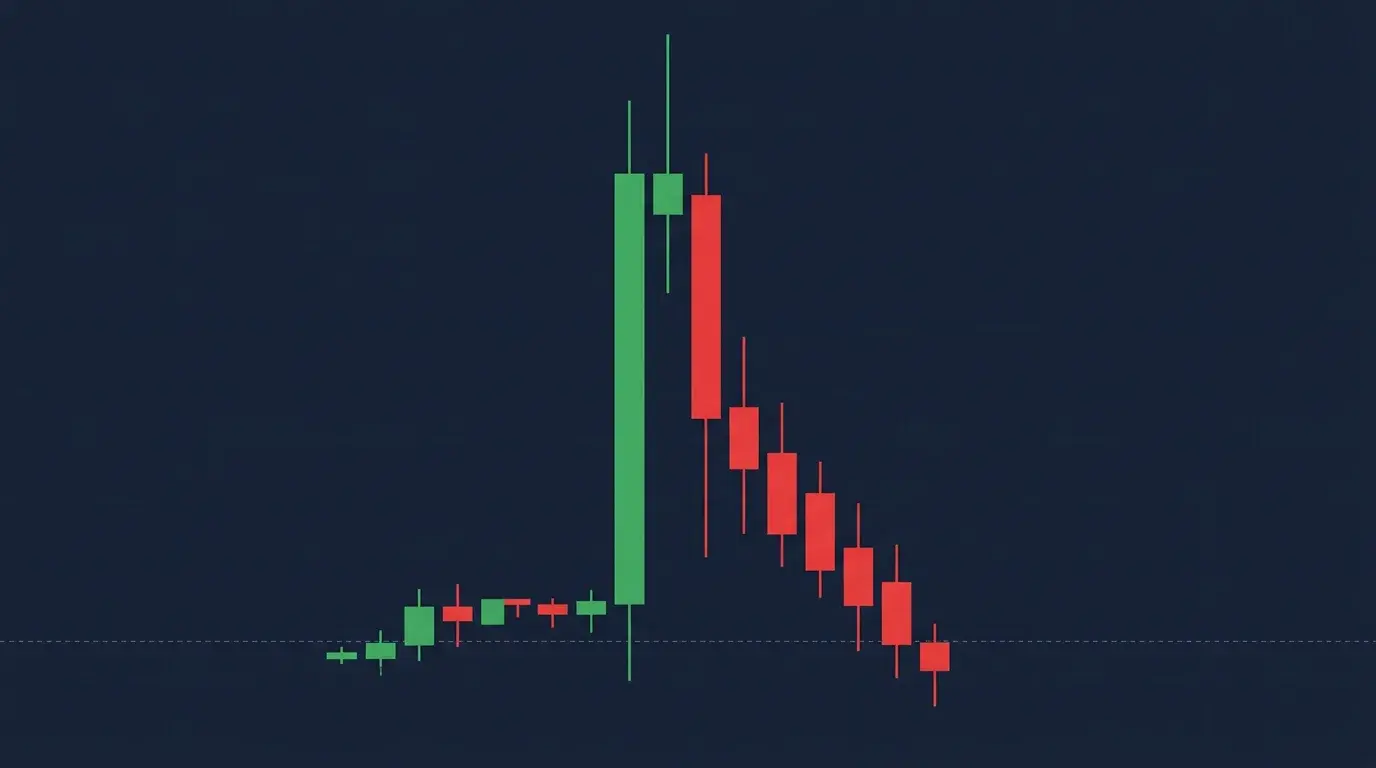
The first spike whipsaws. The initial move is frequently an over-extension driven by stop runs and momentum algos, and it fades once real repositioning takes over. You buy the spike high, it reverses, and now you are underwater on a position you entered at the worst possible fill. This spike-then-reverse shape is so common it is practically the default reaction pattern.
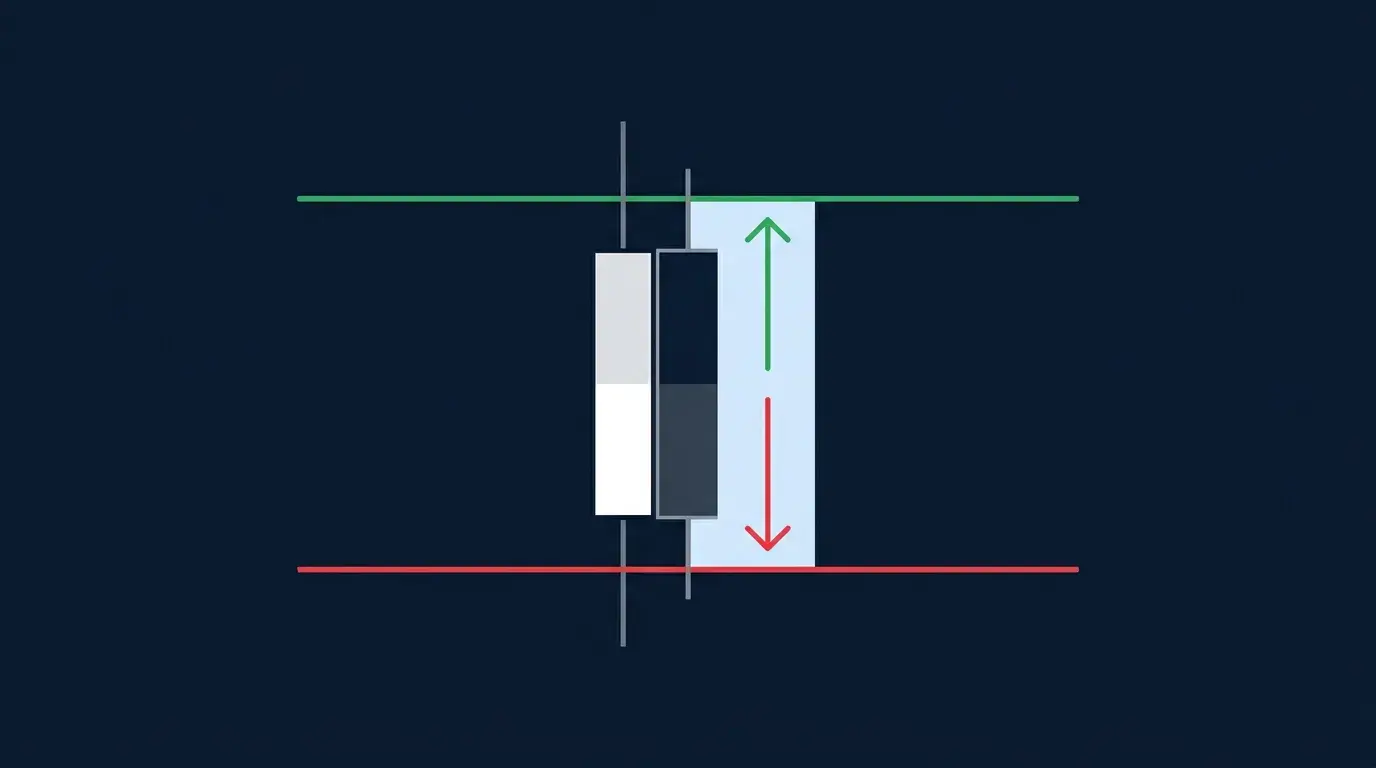
The takeaway: speed is not edge here. Letting the first candle or two close and reading where price settles versus the forecast costs you nothing and removes you from the worst spreads, the worst slippage, and the fake move. Patience is the trade.
4. Three ways to actually trade a release
None of these involves clicking in the first minute. Each waits for the market to show its hand, then trades a defined structure with a defined stop. Pick the one that matches what the tape is doing — do not force all three every event.
A. Surprise-aligned continuation
When the number is a clear, one-sided surprise — a big CPI beat, say — and price drives in that direction and holds after the first candle closes, you trade with it. You are not predicting; you have already seen the deviation and the market's response to it. Enter on a shallow pullback once the initial spread has normalised, stop back beyond the consolidation, target the next level. The edge is that a genuine surprise usually has a second leg once the slower money repositions into the print.
B. Spike fade
When price rockets into a major level on the release and then stalls — long rejection wicks, momentum dying, the move looking exhausted against a mixed or in-line number — you fade the over-extension back toward the mean. This is the higher-risk of the three and demands the smallest size, because you are trading against the immediate impulse. It works best when the initial spike clearly over-shot on a number that did not justify it, and it gets you run over if you fade a real trend day. Stop just beyond the spike high or low; if it makes a new extreme, you are wrong and you are out.
C. Break-and-retest, 15–20 minutes later
The calmest and often the cleanest approach. You skip the release entirely and wait for the initial chaos to resolve into structure. Price breaks a clear level on the news candle, then — once spreads are back to normal — pulls back to retest that level and holds. You enter the retest with a stop on the other side of the level. By now the surprise is known, the fake move has flushed, spreads are tight, and you are trading a textbook structure instead of a coin flip. Most consistent news traders live here, not in the first candle.
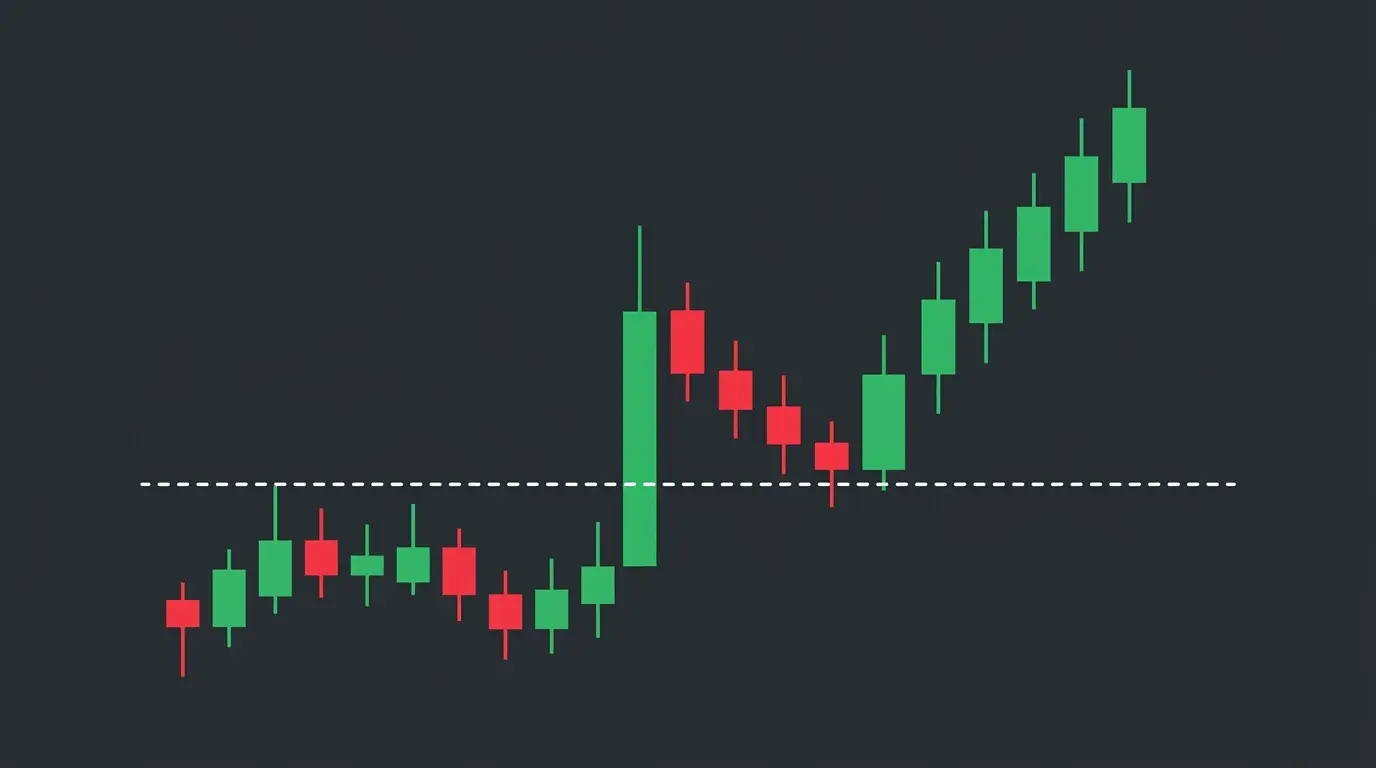
These are not signals. They are three shapes to look for once the release has printed. The discipline that makes them work is the same every time: wait for structure, define the stop first, size to it. A great read with no plan for the stop is still a losing trade.
5. Which pairs and instruments are most exposed
Not every instrument reacts equally to every event. Matching the release to the most exposed instruments is half the preparation — it tells you where to look and where the cleanest moves usually are.
NFP and CPI are US-dollar events. Anything with USD on one side moves — EUR/USD and GBP/USD give the cleanest directional reads, while USD/JPY and gold (XAUUSD) tend to have the largest raw ranges because they are the most rate-sensitive. Gold in particular can travel several times its normal hourly range on a hot inflation print. If you want the widest swings, that is where they are; if you want cleaner structure, the euro and pound are often tidier.
FOMC moves everything at once. Because the driver is the rate path rather than one currency, the whole dollar complex, equity indices, and bitcoin all reprice together. That correlation is a warning as much as an opportunity — if you are long the dollar against three pairs and short gold into FOMC, you do not have four trades, you have one big bet on the rate path wearing four tickets.
The practical move is to rank the exposure before the event rather than guess. A currency strength read tells you which currencies are already stretched going in, and for the crypto side the bitcoin FOMC playbook covers how BTC tends to behave around the decision.
6. Prepping with an AI news read
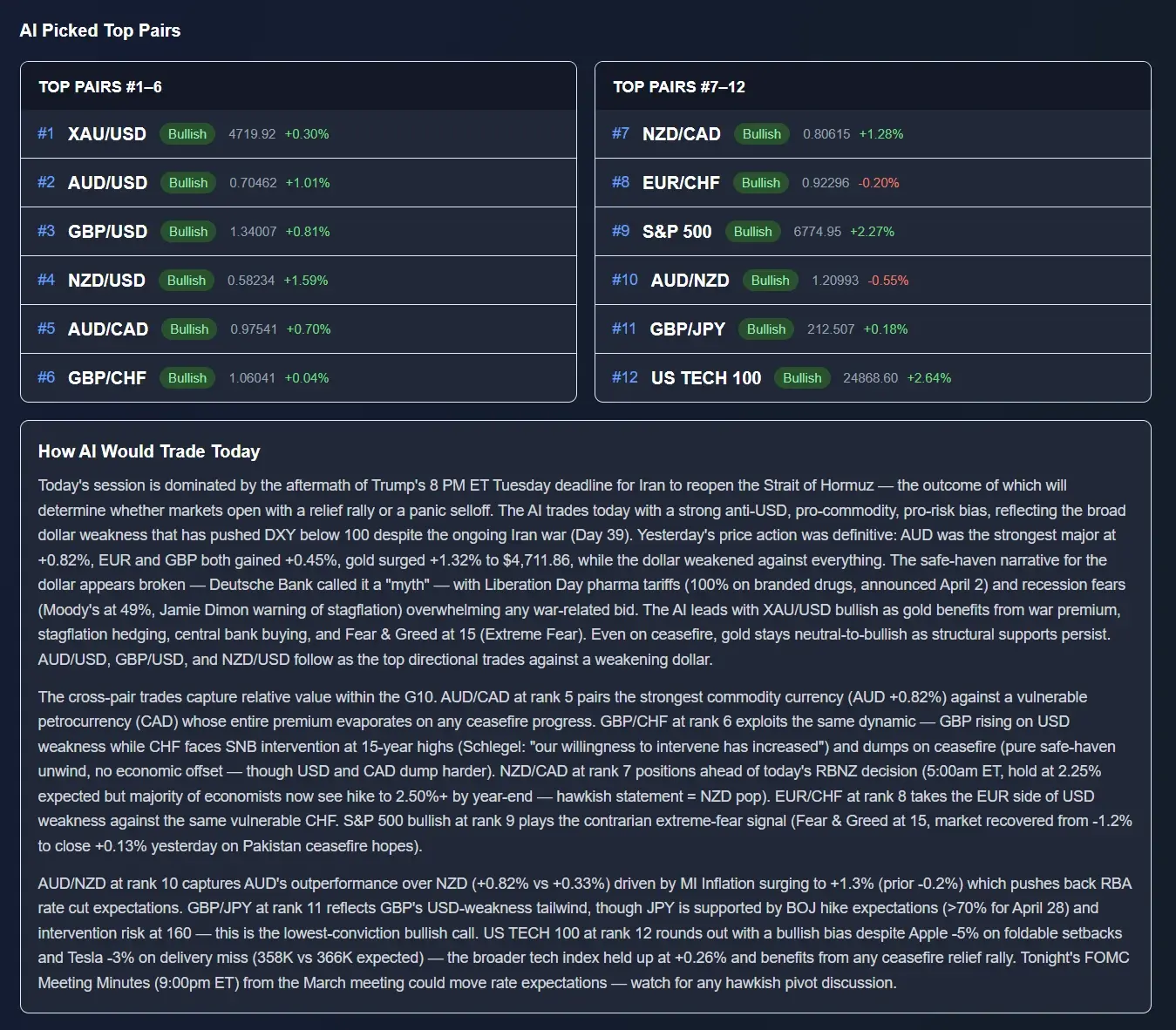
Let's be clear about what AI can and cannot do here, because the scam version of this is everywhere. No model knows the CPI print before it drops. What a good AI news read does is compress the prep work: it scans the day's calendar, ranks which instruments are most exposed to the scheduled events, summarises which way positioning and the macro flow are leaning, and flags the levels that matter. That is research, and it is exactly the part that eats your morning if you do it by hand across 28 pairs and gold.
The Daily AI News Impact is built for exactly this. It ranks the top bullish and bearish instruments each morning with a conviction score and the specific drivers behind each call, so before a release you already know which side of the flow your idea sits on and which instruments are in the blast radius. You still decide the entry, the stop, and the size. The AI does the reading; you do the trading.
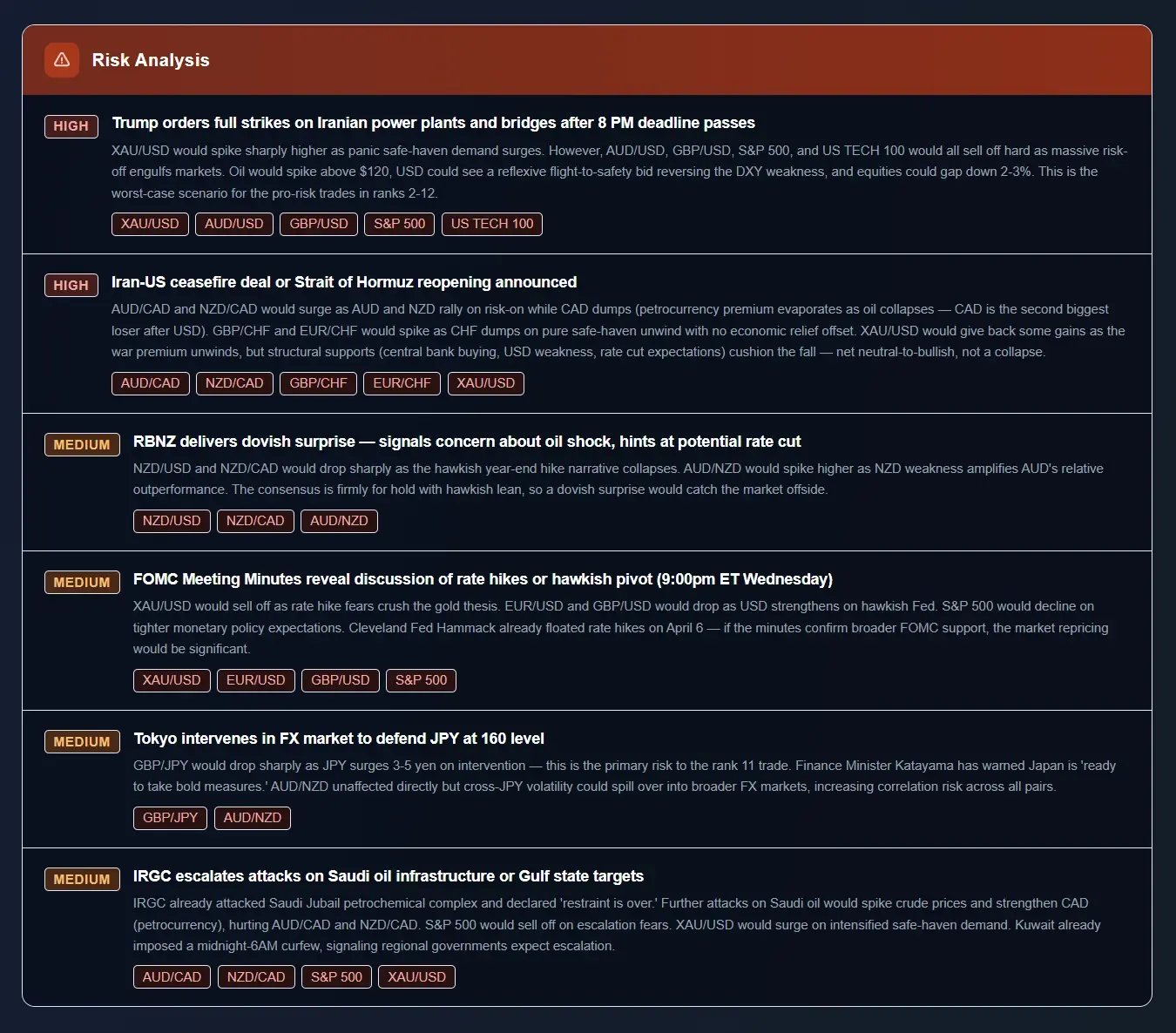
Pair that with the risk view. The news-impact risk breakdown spells out what could go wrong with the day's dominant narrative — the crowded trade, the event that could flip it — which is the part retail news traders almost always skip. Going in knowing the risk to your own bias is worth more than any directional call.
7. Risk rules for news trading
Everything above is worthless without the risk discipline underneath it. On a release, volatility is several times normal, which means every risk parameter you use on a quiet session has to change. These are non-negotiable.
Do
- Size down — a fraction of your normal lot into the event.
- Widen the stop to survive news noise, then shrink the lot to match.
- Write the consensus and your plan down before the print.
- Stand flat if you cannot define a sane stop.
Don't
- Carry full size into the release “because the chart looks good.”
- Use a tight fixed stop — it gets swept in the first candle.
- Chase the spike with a market order in the first minute.
- Revenge trade the next candle after a fast loss.
Size down or stay flat. There is no rule that says you must have a position on for every release. The most profitable decision on a lot of NFP and FOMC days is to watch, let the market resolve, and take the clean break-and-retest an hour later — or nothing at all. A flat trader loses zero on a whipsaw. Cash is a position.
No revenge trades. The wide, fast ranges around news hand you quick losses, and a quick loss is exactly what triggers the urge to win it straight back on the next candle. That urge empties more accounts than any bad forecast. Set a hard daily loss limit, and when a news trade goes against you, the correct next action is to close the platform, not open a bigger position. Log the trade in your trading journal, note whether you followed the plan, and come back tomorrow.
Gold deserves its own mention, because it is the instrument most people over-size into news. Its range on a CPI print can be brutal, and the same rules apply double — the gold volatility guide goes deep on sizing XAUUSD when the range is this wide.
Frequently asked questions
Should I trade the first spike after a news release?
For most retail traders, no. The first 60 to 90 seconds is when spreads blow out, slippage is worst, and the initial spike frequently reverses once the algorithms finish repricing. You get the worst fill of the day into the least reliable move. Let the first candle or two close, see where price settles versus the forecast, and trade the resolution — the continuation or the break-and-retest 15 to 20 minutes later.
What is the difference between the forecast and the actual, and why does it matter?
The forecast is already priced in. Markets move on the surprise — the gap between the actual number and what was expected. An NFP of 180k against a 180k consensus is a non-event; 260k against 150k is a large upside surprise and the dollar reprices hard. Always trade the deviation from consensus, not the raw headline.
Which forex pairs move most on US news?
Anything with USD on one side — EUR/USD, GBP/USD, USD/JPY and gold (XAUUSD) are the usual big movers on NFP, CPI and FOMC. USD/JPY and gold tend to have the largest raw ranges because they are highly rate-sensitive. On FOMC the whole dollar complex plus indices and bitcoin move together, because the driver is the rate path, not one currency.
How much do high-impact releases actually move the market?
A meaningful surprise on NFP, CPI or FOMC can move the majors roughly 100 to 400 pips in minutes, and gold several times its normal hourly range. The size scales with how far the number lands from consensus. A print in line with forecasts barely moves; a large deviation, especially on inflation in 2026's hot-CPI environment, produces the outsized moves that make the calendar dangerous.
What stop loss should I use for news trading?
Wider than you think, or none because you are flat. Volatility is several times normal, so a stop that survives a quiet session gets swept by ordinary news noise. If you trade the event, place the stop beyond the spike structure and size down so that wider distance still equals your fixed dollar risk. If you cannot define a sane stop, the correct size is zero.
Can AI predict what a news release will do?
No, and any tool claiming to is a scam — nobody knows the number before it prints. What an AI news read can do is research: rank which instruments are most exposed, summarise which way the macro flow leans, and flag the levels that matter, so you arrive with a plan instead of reacting blind. ChartSnipe frames this as a research co-pilot, not a signal service or a crystal ball.
Sources & further reading
See the exposure before the number lands
A daily AI news-impact score ranking the instruments most exposed to today's events, live pricing across 28 FX pairs plus gold, screenshot chart analysis, and a position-size calculator for wide-range days. Two free snipes to test it on your own chart.