
AI Forex Trading in 2026: What Works, What Doesn't
Forex is not stocks. It trades in pairs, runs 24 hours, and lives or dies by the macro calendar — which is precisely why most “AI trading” tools fail here. Here's the honest breakdown of what works in FX and what's a trap.

Search “ai forex trading” in 2026 and two thirds of the first page is noise. Fully automated forex bots promising 3% daily returns. “ChatGPT trades FX” Reddit threads. MT4 expert advisors recycled from 2015 with a fresh “AI” coat of paint. Most of it either doesn't work or was never supposed to. The useful stuff — the narrow slice of AI that genuinely changes how a currency trader prepares a session — sits quietly underneath all of it.
This guide is the honest version. Why FX breaks the tools that work fine in equities. The three things AI has to do well to be useful for a currency trader. The bots, chat tools and “quantum” scams that keep showing up in search, and why each one fails. And where ChartSnipe sits on that map — purpose-built research AI for the pair-trading, macro-heavy, 24-hour world that forex actually is.
Key Takeaways
- →FX is relative value — every move is two currencies fighting. Stock-style AI tools that read one chart in isolation miss the other half of the trade.
- →AI that works for forex needs three things: live pair data across all majors and crosses, an aggregated currency strength index, and daily macro news impact — not just chart geometry.
- →Forex EAs and MT4 bots fail out-of-sample for a structural reason: they are curve-fitted to regimes that end. ChatGPT fails for a different reason: it can't see live prices, DXY, or the calendar.
- →“Quantum AI Forex”, “Qumas AI FX”, Bitsoft360 and every deepfake-Musk forex ad are affiliate funnels for unregulated brokers. The FCA, ASIC and CSA have all issued named warnings.
- →ChartSnipe is built around FX from the ground up: 28 pairs on an institutional MetaTrader feed, a live 8-currency strength index, daily AI news impact scoring 12 instruments, and five chart analysis modes.
1. Why FX breaks equity-style AI tools
The single biggest reason generic “AI trading” products underperform in forex is that they were engineered for a different market. Equities trade as standalone instruments on a single exchange during a fixed session. A chart model trained on AAPL candles has a clean input — one price series, one clock, one story. Forex has none of those.
FX trades as pairs — nothing is absolute
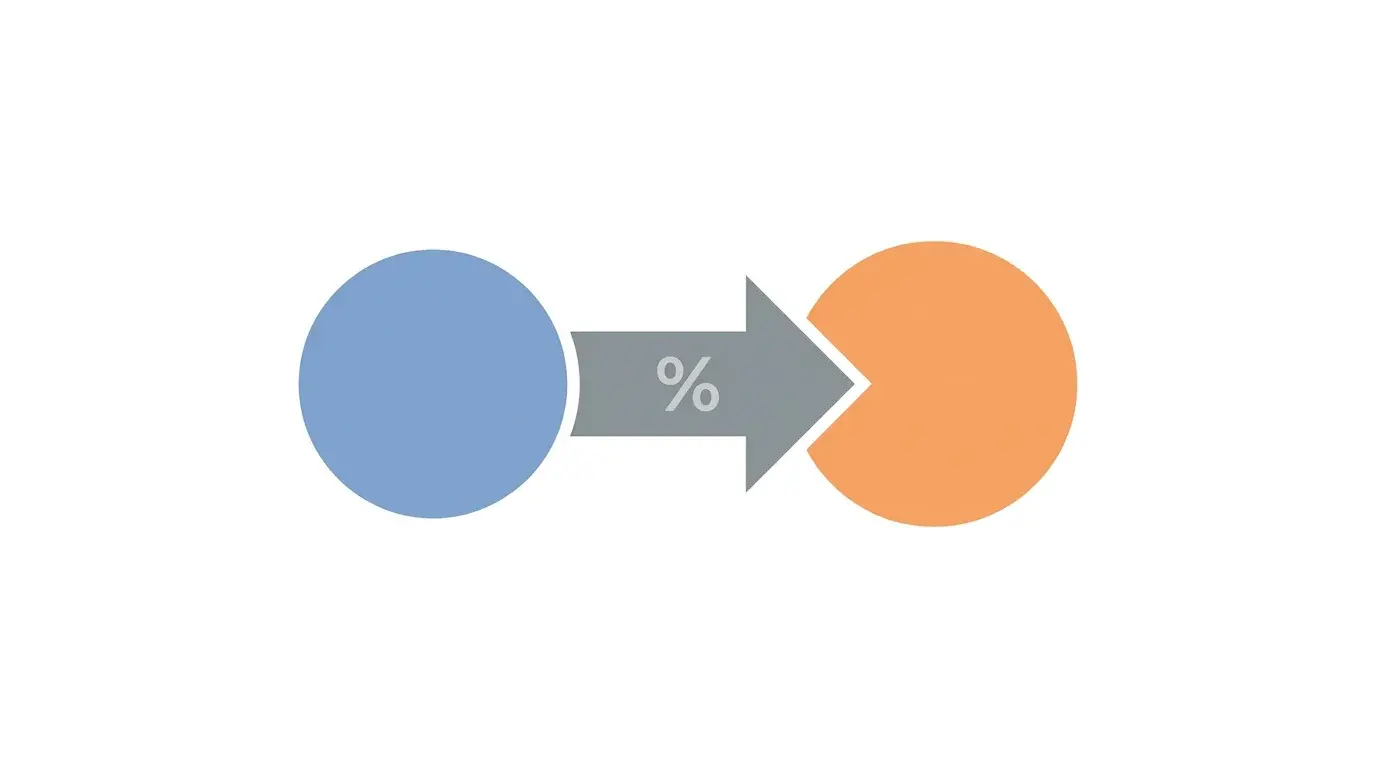
Every forex chart is a relative value between two currencies. EUR/USD up 0.45% can mean EUR bid, USD offered, or both — three different setups with three different follow-through trades. A chart AI that looks at EUR/USD in isolation sees one number. The real trade is whether that number is being driven by the euro leg or the dollar leg, which requires cross-reading at minimum GBP/USD, AUD/USD and USD/JPY in the same breath.
The market runs 24 hours across three sessions
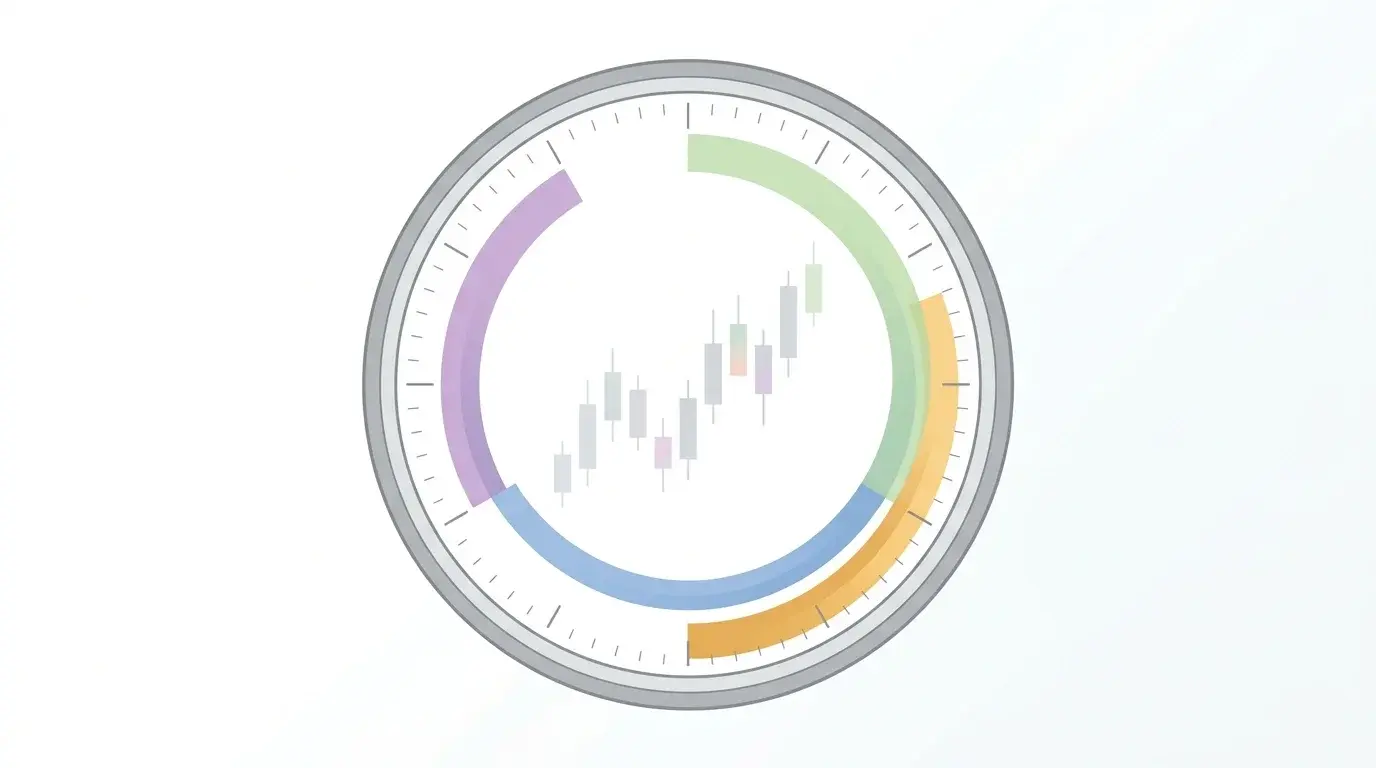
FX trades around the clock through Asian, London and New York sessions, each with completely different behaviour. A mean-reversion model that wins in the quiet Tokyo range gets vaporised at the London open. An equity-trained pattern model will read a Tokyo range-bound H1 setup as bullish continuation and get run over at 8:00 GMT. Session-awareness is mandatory in FX. It is a non-feature in equity tools.
Macro data dwarfs the pattern
A textbook double top on EUR/USD means exactly nothing if the ECB decision is in ninety minutes. Non-farm payrolls, CPI, the FOMC, the ECB, the Bank of Japan, the Bank of England — the calendar sets the regime. A pure-chart AI without a news layer is missing the variable that actually moves the tape.
The dollar is a gravitational well
Seven of the eight major currencies are priced against USD, and the Dollar Index (DXY) is the single most important background variable in FX. A GBP/JPY setup can look clean in isolation and still fail because the dollar is bid across the board — dragging both legs with it. Any AI that cannot read the dollar complex alongside a given pair is blind to half the trade.
2. What works #1 — Live pair data across 28 FX pairs
The first thing an AI forex tool has to get right is the live data layer. Not a delayed feed, not a cached snapshot from an hour ago, not a free API that stops updating out of London hours — a proper live quote on every major and cross that a retail trader actually trades. Anything less and the AI is commenting on a chart that no longer exists.
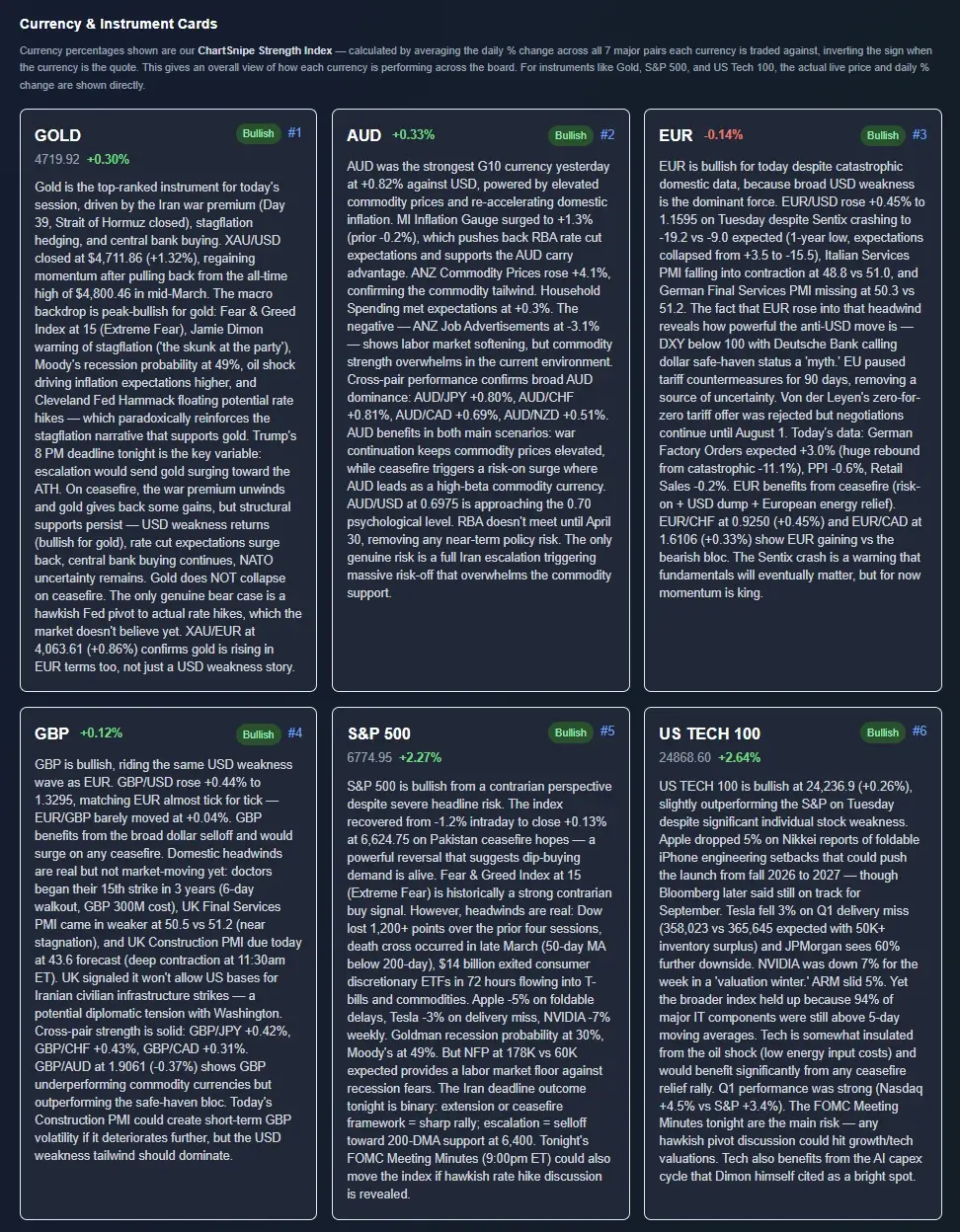
ChartSnipe runs on an institutional MetaTrader feed covering the full 28-pair FX matrix — the 7 USD majors (EUR, GBP, JPY, CHF, AUD, CAD, NZD against USD) and the 21 crosses they generate (EUR/GBP, EUR/JPY, GBP/JPY, AUD/NZD, and the rest), plus XAU/USD, BTC/USD, the S&P 500 and the Nasdaq-100 for macro context. Prices update every few seconds, with a currency strength recalculation running behind them. When the AI writes “USD +0.45% today” it is quoting a number that is seconds old across 28 simultaneous tickers.
Why this matters more in FX than anywhere else
Equity traders live on one exchange and one session. FX traders live on the cross-reference. A live EUR/USD quote without a live GBP/USD and AUD/USD quote tells you where one number is; it doesn't tell you which leg is doing the work. ChartSnipe's feed is designed around that — every ranked pair, every currency strength card, every news impact score is recomputed against the full 28-pair matrix the moment the prices tick.
3. What works #2 — The currency strength index, explained
Of every feature that an AI forex tool can add, the aggregate currency strength index is the one that changes a trader's workflow the most. It is also the one that pure-chart AI and LLM-based tools cannot produce. The reason is mechanical — strength is the output of a calculation across all 28 pairs in real time, not something you can read off a single chart.
The math, in one paragraph
For each of the 8 major currencies (USD, EUR, GBP, JPY, CHF, AUD, CAD, NZD), ChartSnipe averages the percentage change across the 7 pairs that currency participates in — flipping sign whenever the currency is the quote rather than the base. USD strength, for example, becomes the average of −EUR/USD, −GBP/USD, USD/JPY, USD/CHF, −AUD/USD, USD/CAD and −NZD/USD. The minus signs are there because when USD is the quote, a rising pair means USD is weakening; the sign flip makes every term agree on “how strong is USD today”. The result is a single live percentage per currency, updated as the underlying pairs tick.
Why the strongest-vs-weakest trade is the default
When USD prints +0.55% and JPY prints −0.70% on the strength index, you do not need to open a single chart to know USD/JPY is the trend-continuation long of the day — the aggregate math has already told you. When the top-strongest and bottom-weakest currencies both share a single pair, that pair is the cleanest directional trade in FX. Every experienced currency trader runs this check before they touch a chart. An AI that computes it live and surfaces it next to the news impact dashboard collapses that prep into a single glance.
4. What works #3 — Daily AI news impact on CPI, NFP, FOMC, ECB
The final thing AI has to do well to matter in forex is read the news. Chart patterns are decorative when a US CPI print is eight hours out — and the calendar lights up with that kind of event roughly one day in four. Any AI that cannot score macro risk is useless on the days that actually pay.
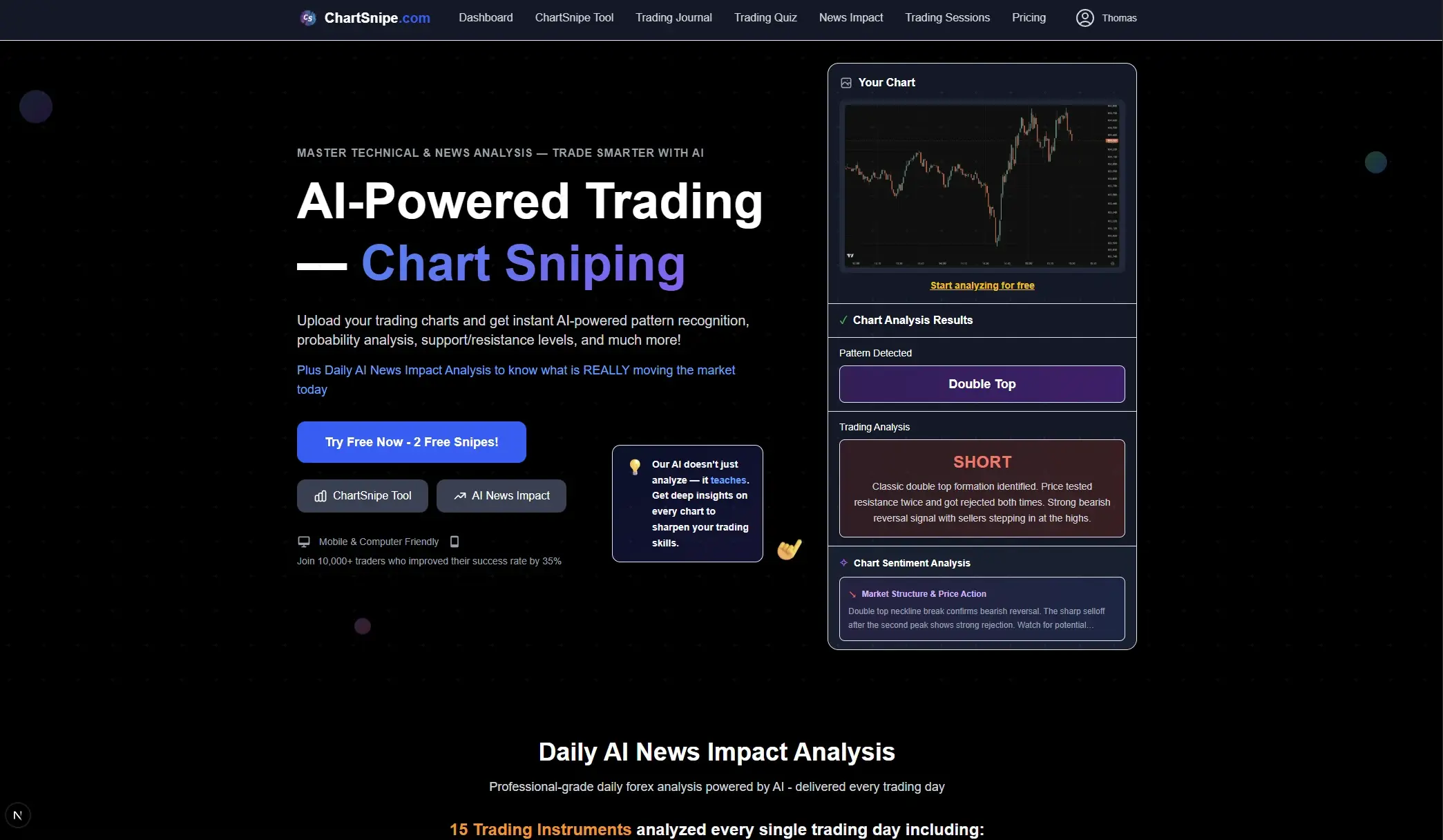
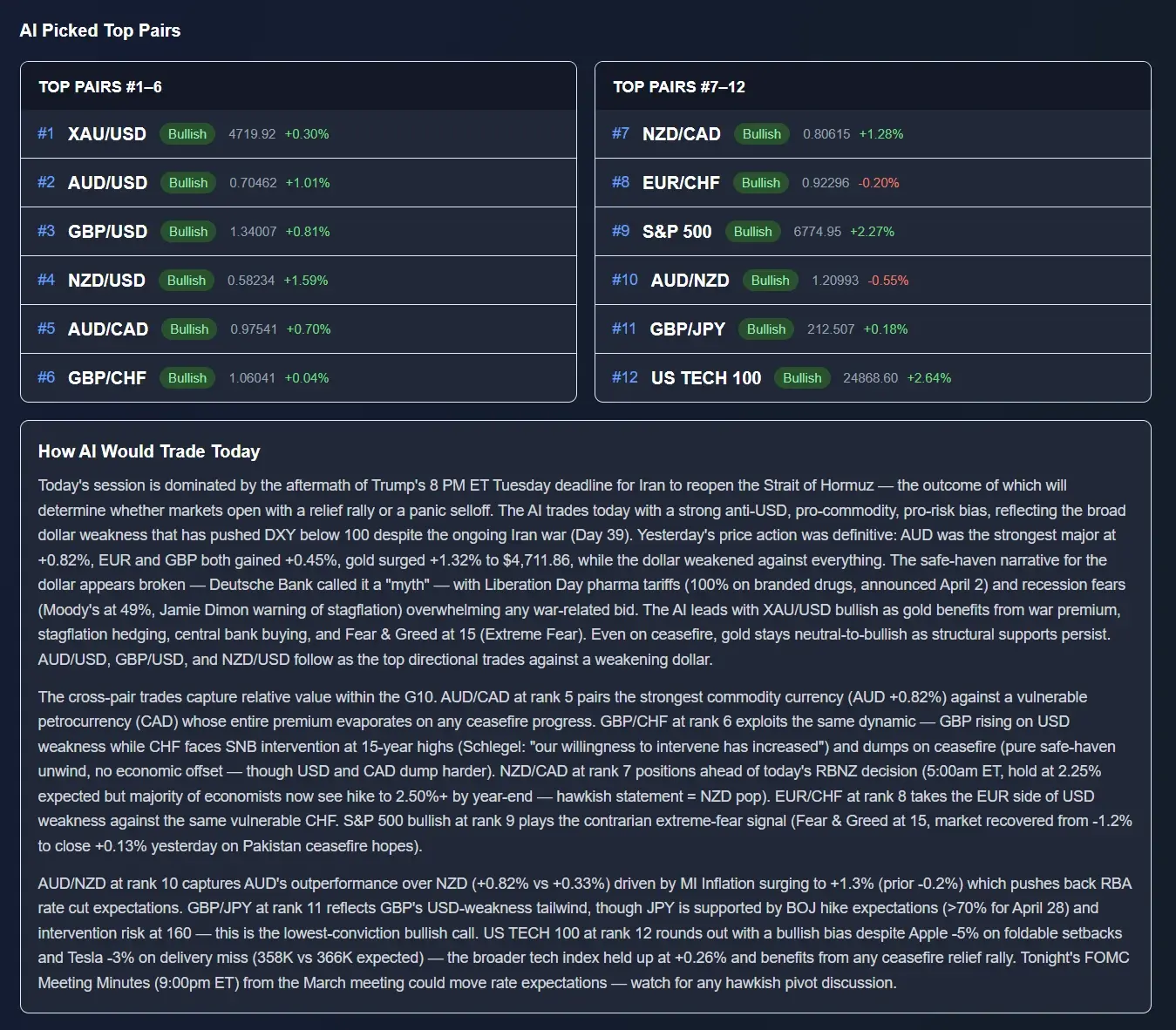
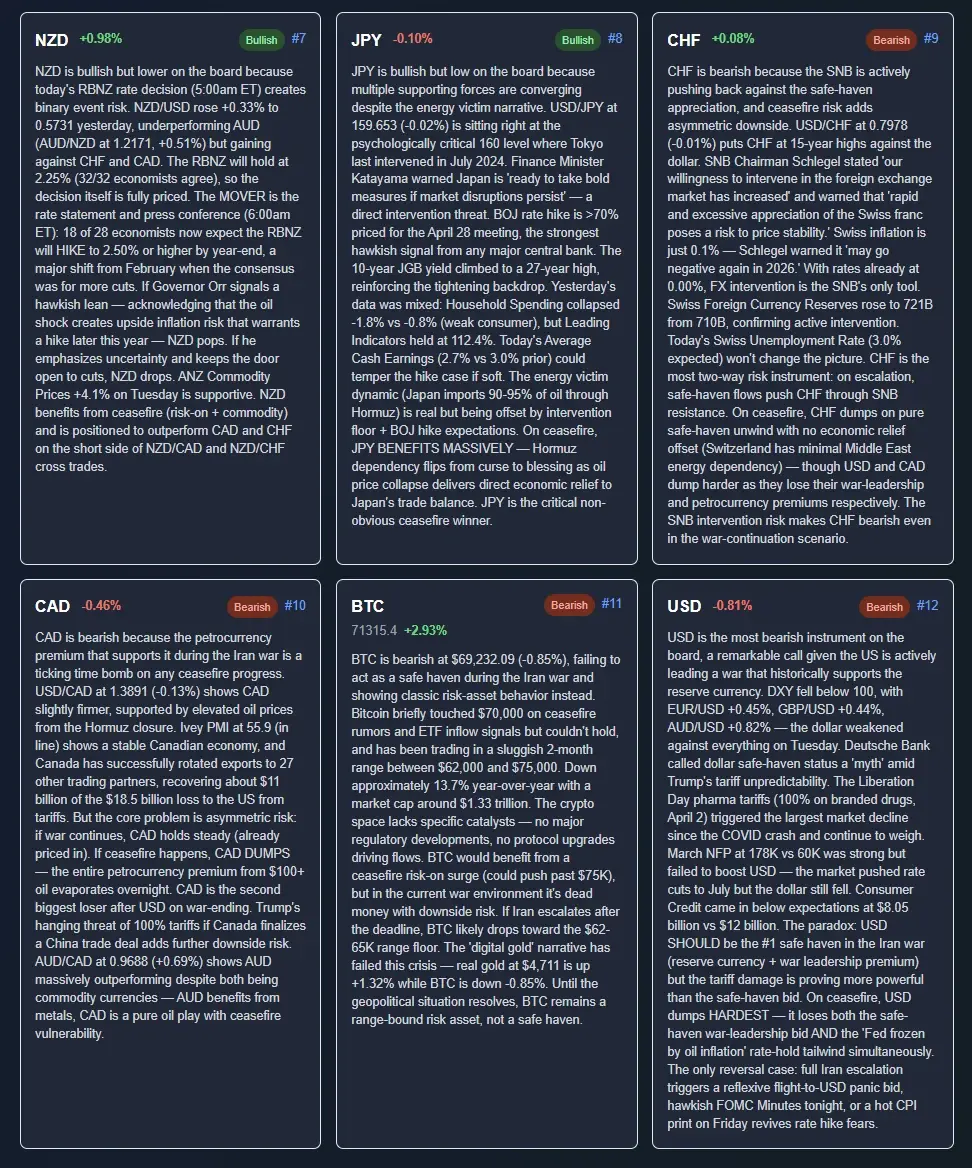
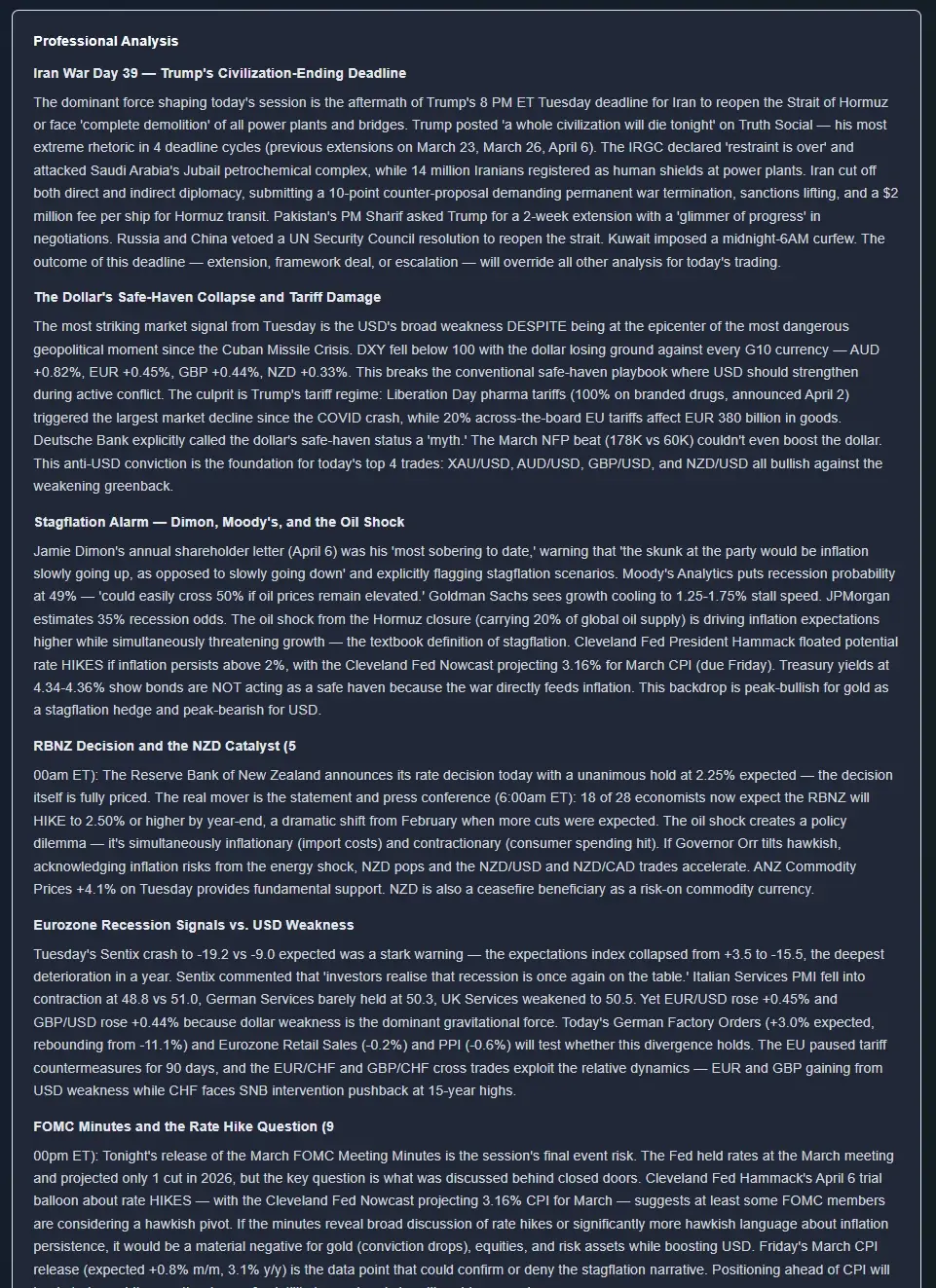
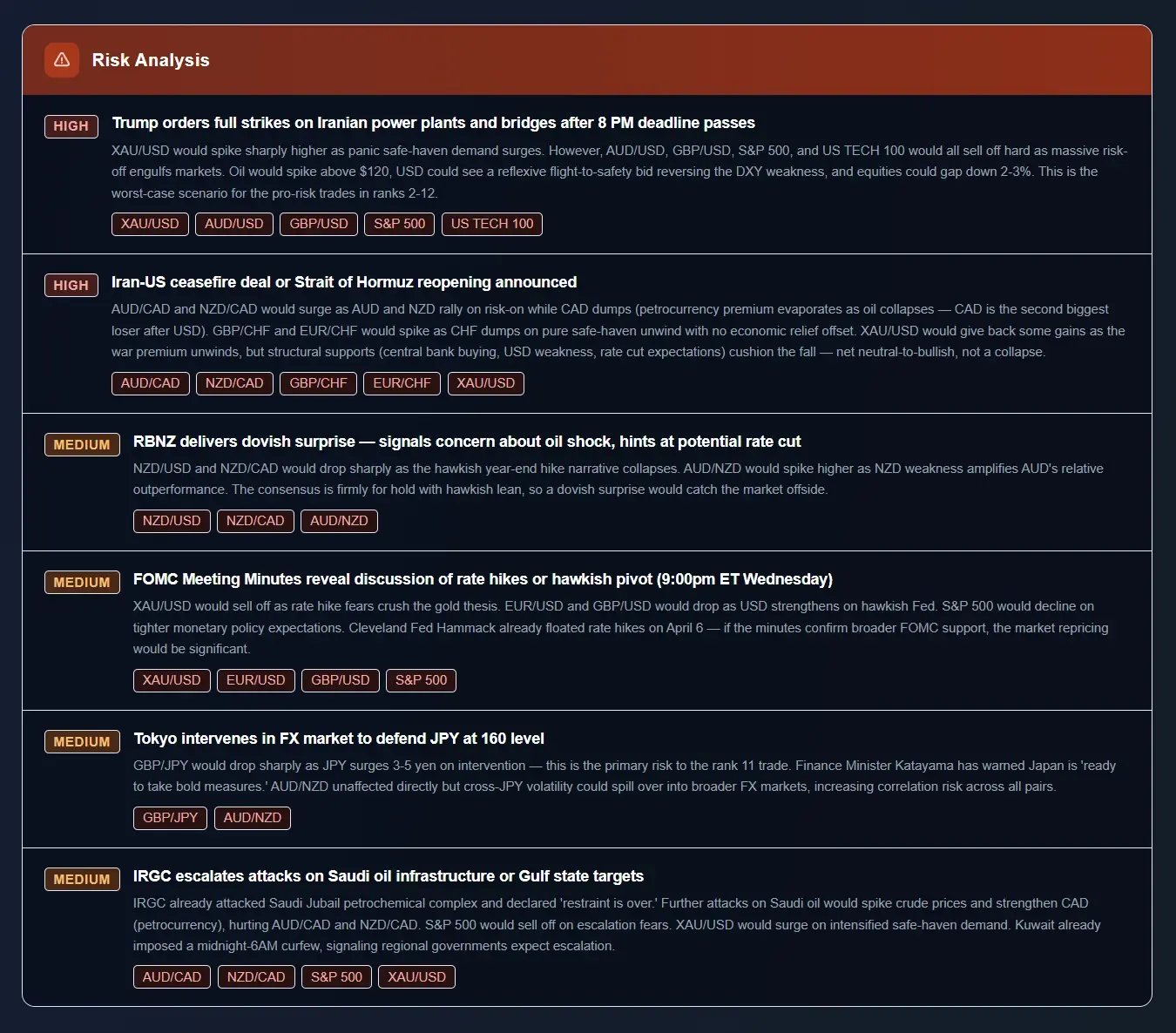
The ChartSnipe Daily AI News Impact dashboard runs every trading day. It ingests central bank positioning, scheduled economic releases, Fed speaker commentary, geopolitics and commodity moves, then scores each of 12 instruments with a directional bias, a conviction rating, and the specific reversal triggers that would invalidate the read. Every card cross-references the live strength index and the day's top ranked pairs, so the narrative and the price tape are telling the same story.
The events that dominate FX
- US CPI — monthly, 13:30 UK, the single most dollar-moving release on the calendar.
- Non-Farm Payrolls (NFP) — first Friday of the month, the other pillar of dollar strength.
- FOMC — eight times a year, plus the Powell press conference. Rates, dots, and the DXY regime.
- ECB, BoE, BoJ — the other majors' decisions, each one moves their own complex of pairs.
- Flash PMIs — monthly European and US manufacturing and services prints. Risk-on / risk-off triggers.
- Geopolitical tape — Middle East, commodities, Treasury supply. The AI reads the wires, not just the calendar.
None of this is geometry. A chart-only AI never sees it. A news-aware AI can tell you — in the same view as the top ranked pairs — whether today is a CPI day to respect, a quiet Tuesday to fade ranges, or a geopolitics day where the default playbook is suspended.
5. What doesn't work #1 — Forex EAs and MT4 bots
The MT4 expert advisor marketplace has been selling “AI forex trading” for over a decade. Every listing shows a backtest curve rising smoothly from bottom-left to top-right, usually against a 2005–2014 EUR/USD chart, usually with no slippage model, usually with a recovery mode that martingales until margin call. Most of them stop working the week they are bought. The reason is structural, not malicious — the strategies are curve-fitted to a regime, and regimes end.
The four ways retail forex EAs break
- Regime change. A grid bot that sells tops in a range-bound EUR/USD is the mirror image of the bot that blew up in the 2022 dollar rally. Both were “AI” in the listing.
- News blindness. Pure price-action EAs do not know a central bank is about to speak. They hold a 30-pip stop through a 120-pip CPI move.
- Spread widening. Backtests assume retail broker spreads that do not hold through NFP, FOMC, or the Sunday open. Live execution costs eat the edge.
- Martingale dressed as recovery. Many advertised “AI” EAs are martingale systems with a neural-network-shaped decoration. The drawdown is not a bug, it is the system.
The institutional desks that actually run FX algorithms — market-making, stat-arb, latency arbitrage — do not sell the code. They never have. Any product in the $50–$500 retail range claiming to be that is almost by definition something else.
6. What doesn't work #2 — ChatGPT for FX charts
The second-biggest slice of “ai forex trading” search traffic is traders pasting a screenshot into ChatGPT. It is a reasonable instinct — ChatGPT is genuinely impressive on many tasks. It is also the wrong tool for FX in particular, and the reason isn't that the model is weak. It is that the model is structurally blind to the variables that move currency pairs.
The three silent failure modes in FX
- No live prices. ChatGPT cannot quote the current EUR/USD. Its training data cuts off months to years before today. Every number it “remembers” is stale.
- No DXY context. It has no idea whether the dollar is bid across the board. A clean-looking GBP/USD long during a DXY rip is a one-click loss it cannot see.
- Hallucinated levels. Asked for support and resistance, a generic LLM obliges with clean round numbers that often do not appear anywhere on the chart. In FX, where levels are rarely round, this is particularly dangerous.
A deeper breakdown lives in Does ChatGPT work for trading charts? and the complementary AI Forex Chart Analysis in 2026 deep-dive. Short version: ChatGPT is useful for explaining an inverse head-and-shoulders, drafting a trading plan, or summarising last night's FOMC statement. It is the wrong tool for “is this EUR/USD setup a buy right now”.
7. What doesn't work #3 — “Quantum AI Forex” scams
The most aggressive category in search results is also the one worth naming directly. Quantum AI Forex, Qumas AI FX, Bitsoft360, Immediate Edge, BitAlpha AI and the rotating menu of Elon-Musk-endorsed YouTube ads are not real products. They are affiliate funnels for unregulated brokers — the “AI” is a landing page, the deposit is the business model, and the withdrawal request is the moment the funnel collapses.
Regulators have named these brands
The UK Financial Conduct Authority, Australia's ASIC, the Canadian Securities Administrators and Spain's CNMV have all issued warnings listing “Quantum AI” and its variants by name. The Elon Musk, Martin Lewis and Jeremy Clarkson endorsements used in the ads are deepfakes — each celebrity has publicly disowned them. Brand names rotate every few months specifically to stay ahead of takedowns, but the mechanic is identical every time.
Red flags that mark a forex AI scam
- Celebrity endorsement — Musk, Bezos, Lewis “revealed this AI forex system”.
- Fixed daily returns — “$1,500 a day”, “profit guaranteed”, “97.8% win rate”.
- You can't see the product until you deposit $250 at a broker you've never heard of.
- Withdrawals require a minimum “trading volume” or a “verification fee” that exceeds your deposit.
- A pushy “personal account manager” calls you within minutes of signup.
- The domain was registered under 12 months ago. The brand does not appear on any regulator register.
Legitimate AI forex tools look boring in comparison — a free tier, transparent pricing, documented features, no promises of fixed returns, no celebrity endorsements, and a team willing to put their name on the product. If a forex AI passes those checks it is worth a look. If it fails any of them, close the tab.
8. A real FX session with ChartSnipe, end-to-end
This is the exact five-step session prep serious ChartSnipe users run before the London open. Seven minutes of structured AI reading, then they are on the chart.
News Impact (90 seconds)
Open News Impact. Read the top bullish and bearish pairs, plus the professional analysis block. You now own the story of today — central bank stances, upcoming releases, geopolitical flow.
Currency strength scan (60 seconds)
Scan the 8 currency strength cards. Strongest vs weakest writes the pair short-list. If USD is +0.55% and JPY is −0.70%, USD/JPY is already the candidate.
Chart upload (120 seconds)
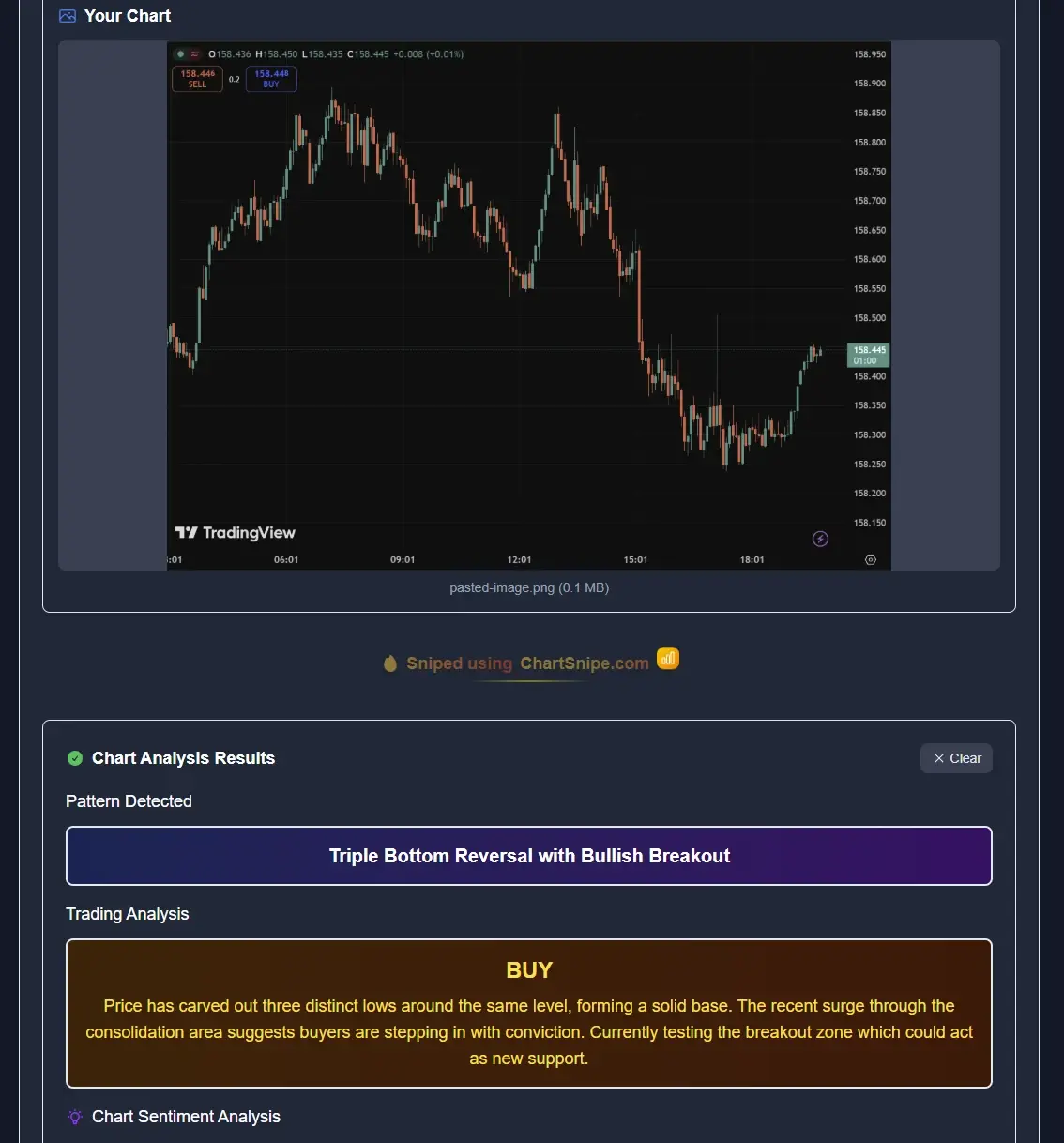
Drop the candidate pair's TradingView screenshot into the ChartSnipe tool. Pick Full Snipe mode. The AI returns pattern, direction, entry, stop and target.
Risk sizing (60 seconds)
Feed the AI's entry, stop and target into the position-size calculator next to the tool. Pick risk percent. Take the trade at a size you can defend.
Journal (after exit)
Post-trade, log the outcome in the Trading Journal. Over time, the log tells you which pairs, sessions and AI modes are actually earning for your style.
9. Analysis modes — one AI, five trader profiles
The other lever ChartSnipe pulls that generic AI doesn't is a per-trader output profile. A 5-minute FX scalper and a weekly swing trader need different reads on the same EUR/USD chart. One AI, five distinct modes — the model is instructed under the hood which trader it is answering for.
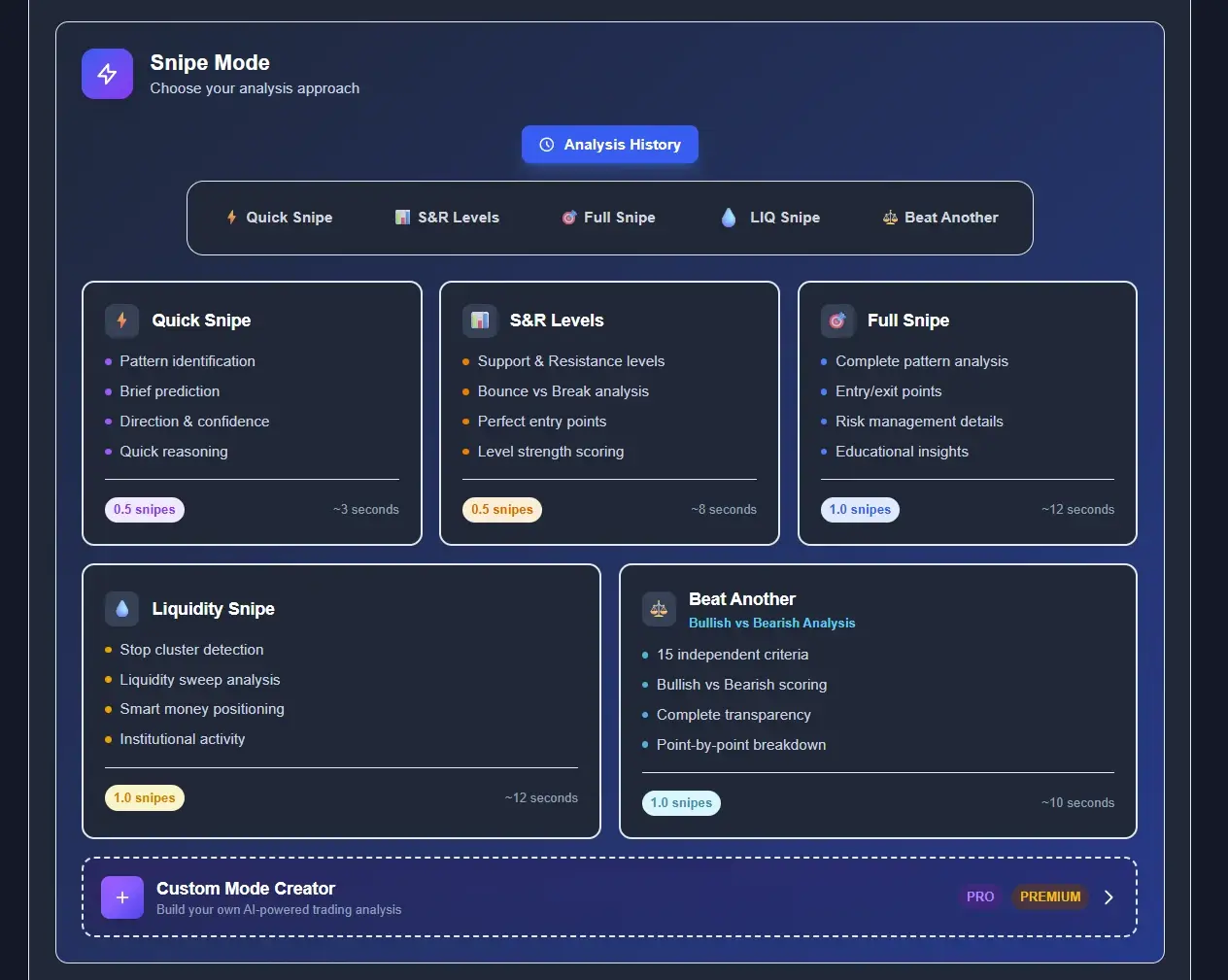
- Quick Snipe — ~3 seconds, pattern + direction + one-line reasoning. For intraday triage when price is already moving.
- S&R Levels — support/resistance with strength scoring, bounce-vs-break bias and an execution-ready readout.
- Full Snipe — complete pattern analysis with entry, stop, target, risk management notes and educational context. The standard FX readout.
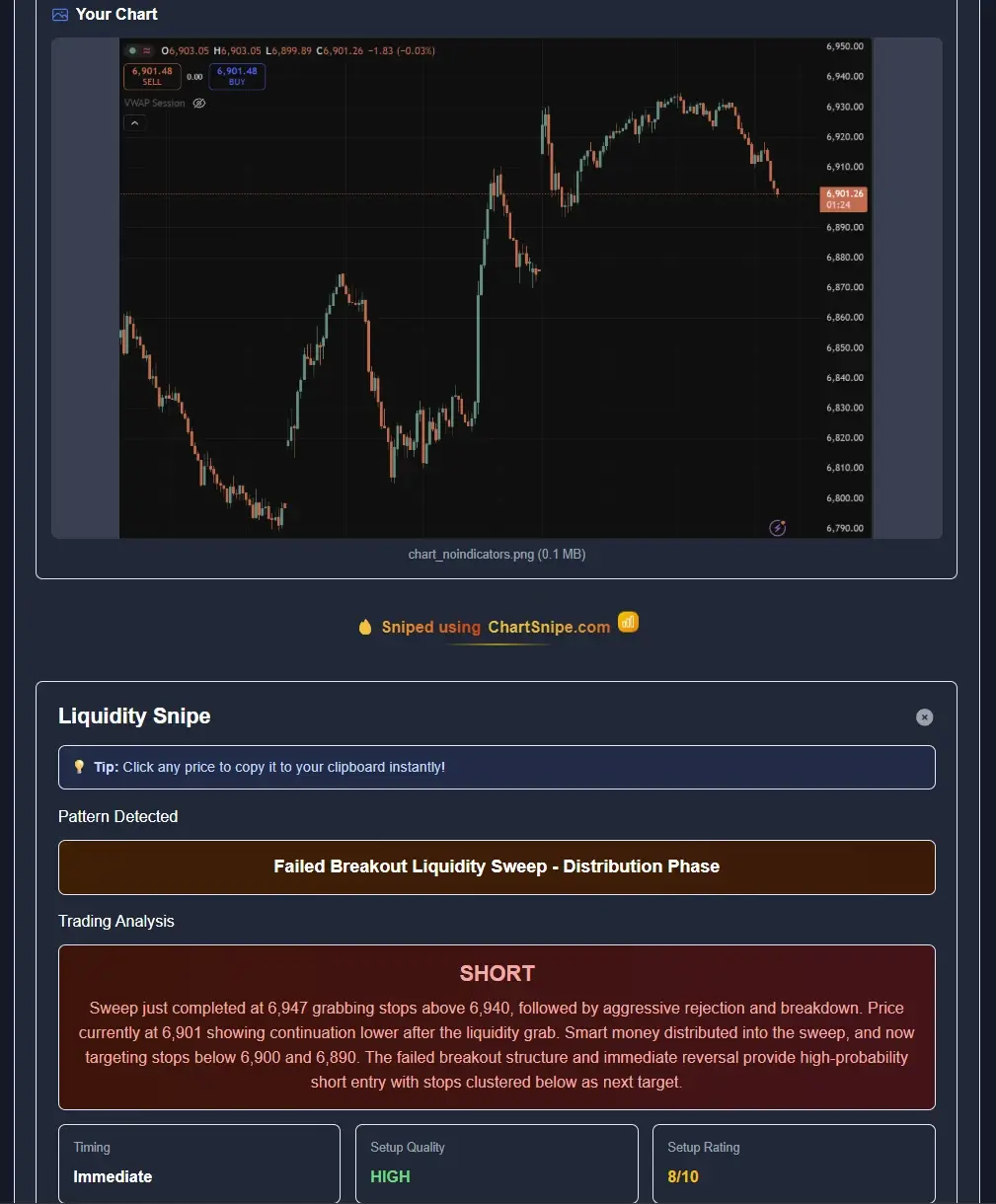
- Liquidity Snipe — smart-money-concepts read: stop clusters, liquidity sweeps, institutional positioning. Built for ICT-style FX traders.
- Beat Another — 15 independent bullish-vs-bearish criteria scored point by point. A true second-opinion when conviction is low.
- Custom Mode Creator — Pro and Premium users write their own analysis prompt and lock their style into a reusable mode.
10. Risk sizing — the part AI never does for you
No AI decides how much of your account to risk on a given forex trade. That is a parameter you set, and in FX — where leverage offered by retail brokers can run to 500:1 — it is the single biggest predictor of whether the account survives long enough for an AI-assisted edge to show up in the P&L. ChartSnipe builds this directly next to the analysis: the AI returns an entry, stop and target, and the position-size calculator turns those numbers into a correct lot size against your account balance and risk percent.
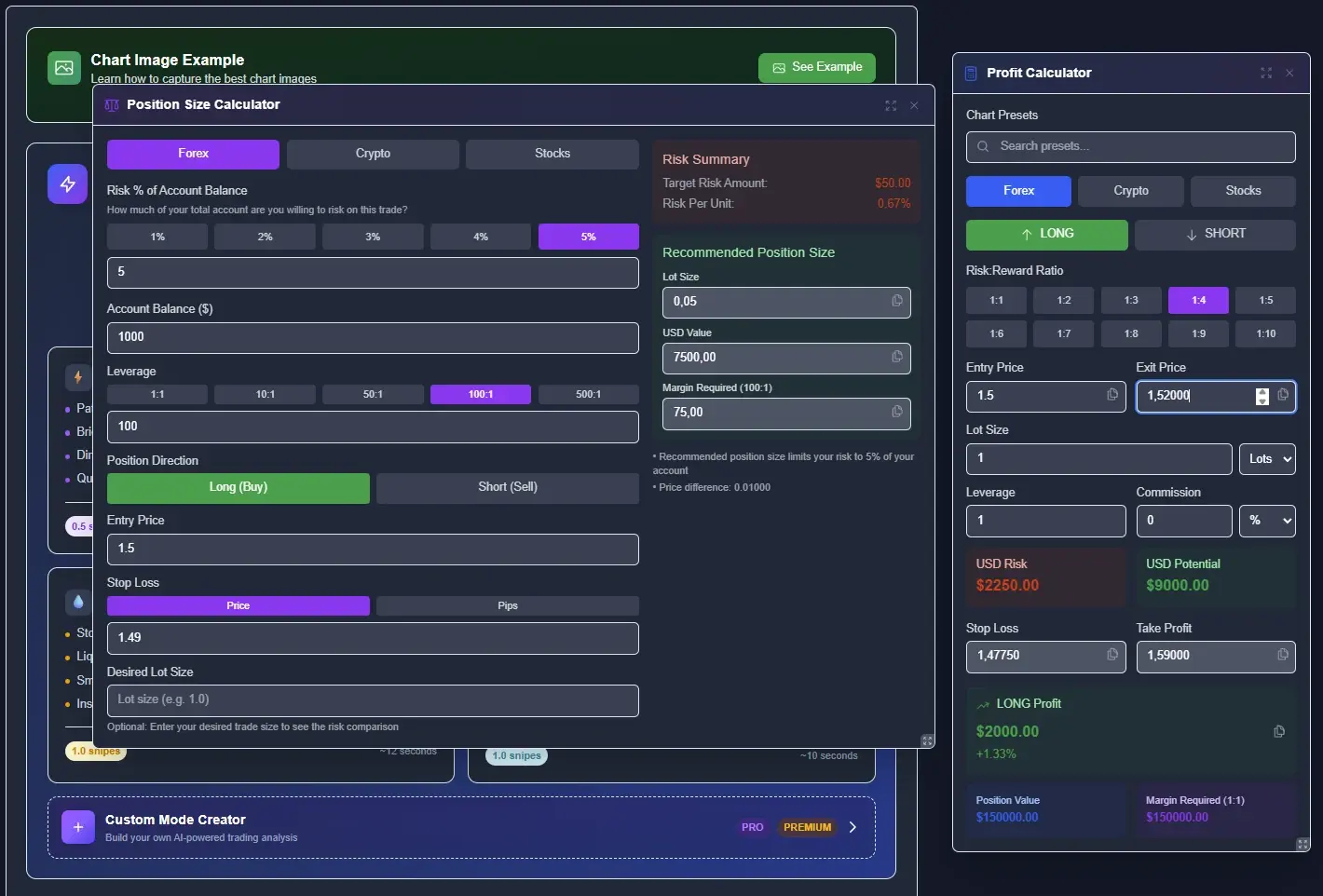
For the mental model behind those inputs, the risk-reward ratio and stop-loss placement pieces are the companion reads.
Frequently asked questions
Is there an AI that actually trades forex?
No AI reliably trades FX hands-off. Fully automated forex bots, MT4 expert advisors, and “quantum AI” platforms have a near-universal record of failing out-of-sample or being outright scams. What does work is AI that supports a human trader — live pair data across 28 FX pairs, an aggregated currency strength index, daily AI news impact scoring, and chart screenshot analysis. ChartSnipe sits in that research-AI category.
Can ChatGPT analyse a forex chart?
ChatGPT can describe what it sees in a screenshot, but it does not know the current EUR/USD price, does not see the DXY, does not know today's economic calendar, and hallucinates support and resistance levels. For FX — where every move is relative to another currency and macro dominates — a pure LLM is the wrong tool for live execution.
What's the best AI for forex trading in 2026?
For retail forex traders, purpose-built research AI with live FX data and daily news impact. ChartSnipe covers 28 FX pairs with a live currency strength index across all 8 majors, a daily AI news impact dashboard, and five chart analysis modes. It is decision support rather than a black-box bot, which is the honest definition of “best” in this category.
Is AI forex trading profitable?
Fully automated AI forex bots are almost uniformly unprofitable for retail users. AI-assisted forex trading — where a human makes the decision and AI handles the research load — can measurably shorten prep time and catch setups a single trader would miss across 28 pairs. Profitability in the end comes down to risk management and discipline, not the AI.
Is Quantum AI Forex real?
No. Quantum AI, Qumas AI, Bitsoft360, Immediate Edge and the rolling cast of “Elon Musk endorsed” forex bots are affiliate funnels for unregulated brokers. The UK FCA, Australia's ASIC and Canada's CSA have all issued named warnings. The celebrity endorsements are deepfakes. Do not deposit.
How much does legit AI forex software cost?
ChartSnipe starts at $20 per month for 120 chart analyses plus the full News Impact dashboard and live currency strength index, with a free tier offering 2 analyses per month. Credible institutional FX analytics platforms run into hundreds of dollars per month and target prop desks. If a forex AI is free with no tier gate and promises daily returns, it is an ad funnel — not a product.
Trade forex with the AI that actually sees the market
28 live FX pairs on an institutional feed. A live currency strength index across all 8 majors. Daily AI news impact on CPI, NFP, FOMC and ECB. Five chart analysis modes. Two free snipes to test it on your own pair.