
High-Impact Forex News Events: The 15 Releases That Actually Move FX Pairs
A data-driven ranking of the news events that cause the biggest pip moves in forex — from FOMC and NFP to the central bank decisions every trader should have circled on their calendar.

Every forex trader has been there: you're holding a clean EUR/USD long, price is drifting higher, and then at 8:30 AM New York time a single headline drops and your stop gets obliterated in three seconds. The culprit is almost always a high-impact news event — the red-folder releases on Forex Factory that genuinely dictate where currencies go.
But here's the thing most beginners miss: not all red-folder news is created equal. The economic calendar lists dozens of "high impact" events every week, yet in reality maybe five of them per month actually move the market with enough force and follow-through to be worth trading. The rest are noise wrapped in a red folder.
This guide ranks the 15 forex news events that actually move FX pairs, based on historical pip ranges, predictability, and tradability. We'll show you exactly what each event is, which currency it moves, typical pip ranges you should expect, and how ChartSnipe's AI News Impact analysis processes every single one of them automatically each day.
Key Takeaways
- →Only about 15 red-folder events per month actually move forex with enough force and follow-through to be worth trading — the rest are noise.
- →FOMC rate decisions and the Powell press conference are the single highest-impact FX event — routinely 80–200+ pips on EUR/USD.
- →NFP, CPI, and central bank decisions (ECB, BoE, BoJ) form the Tier 1 core — they combine large pip ranges with strong follow-through.
- →Not all "high impact" events are equal — ADP and NFIB have largely lost their edge since 2024 and can safely be ignored.
- →The real edge in news trading is knowing which events have historically moved your pairs and pre-ranking them with AI before London open.
1. How We Ranked These Events
Forex Factory's red folder and Quora's "which news moves forex the most" threads are the two places most traders go when they want to know this answer. Both give you pieces of the puzzle — but neither ranks events by the metrics that actually matter to a retail trader. We do.
Every event in this list was scored on four criteria:
Typical Pip Range
How many pips the event typically moves the primary affected pair in the first 60 minutes and over the full session.
Predictability
Whether the market reaction is consistent with the surprise direction. Some events (CPI, NFP) are highly predictable in direction; others (BoJ surprises) are violently unpredictable.
Follow-Through
Does the move hold for hours and days, or does it reverse within 30 minutes? FOMC and CPI have strong follow-through; retail sales often fades.
Tradability
Is the move actionable, or does it spike 100 pips in the wrong direction and then reverse? Tradability is the combination of predictability, follow-through, and the risk/reward of entering on the initial reaction.
Pip ranges cited throughout this article are based on observed moves in EUR/USD, GBP/USD, USD/JPY and their crosses over the last 18 months — the same dataset ChartSnipe's News Impact AI uses to calibrate its daily conviction scores. For a broader primer on how to decode the calendar itself, see our guide on how to read the economic calendar for forex.
2. Master Ranking Table: The 15 Highest-Impact Forex News Events
Here's the quick-reference table. Tradability Score is rated out of 10 and combines predictability, follow-through, and ease of execution.
| # | Event | Currency | Typical Pip Move | Frequency | Tradability |
|---|---|---|---|---|---|
| 1 | FOMC Rate Decision + Dot Plot + Powell Presser | USD | 80–200+ | 8x/year | 10/10 |
| 2 | Non-Farm Payrolls (NFP) | USD | 60–150 | Monthly | 9/10 |
| 3 | US CPI Inflation | USD | 50–150 | Monthly | 9/10 |
| 4 | ECB Rate Decision + Lagarde Presser | EUR | 40–120 | 8x/year | 8/10 |
| 5 | Bank of Japan Rate Decision | JPY | 40–300+ | 8x/year | 6/10 |
| 6 | Bank of England Rate Decision | GBP | 40–100 | 8x/year | 8/10 |
| 7 | US PCE Inflation | USD | 30–80 | Monthly | 8/10 |
| 8 | US Retail Sales | USD | 30–80 | Monthly | 7/10 |
| 9 | SNB Rate Decision | CHF | 50–400+ | Quarterly | 6/10 |
| 10 | RBA / RBNZ Rate Decisions | AUD / NZD | 30–90 | Monthly | 7/10 |
| 11 | US GDP Q/Q (Advance) | USD | 20–60 | Quarterly | 6/10 |
| 12 | ISM Manufacturing / Services PMI | USD | 25–70 | Monthly | 7/10 |
| 13 | Unemployment Rate (standalone) | USD / AUD / CAD | 20–60 | Monthly | 6/10 |
| 14 | Consumer Confidence (Conf Board / UMich) | USD | 15–50 | Monthly | 5/10 |
| 15 | Trade Balance (commodity FX) | CAD / AUD / NZD | 15–50 | Monthly | 5/10 |

3. Tier 1: The Top 5 Biggest Market Movers
These are the five releases that every serious forex trader circles, blocks out, and either trades aggressively or sits out completely. Nothing else on the calendar comes close.
1. FOMC Rate Decision + Dot Plot + Powell Press Conference
The Federal Open Market Committee sets US interest rate policy, and the US dollar is one side of roughly 88% of all forex transactions. That combination alone makes FOMC the single biggest event on the entire forex calendar — but the real fireworks come from the three components of every meeting: the rate decision itself (rare surprises but they create 200+ pip moves when they happen), the Summary of Economic Projections and dot plot released four times a year showing every FOMC member's forecast for the Fed Funds rate, and the Powell press conference 30 minutes later where one sentence can reverse the entire initial move.
Typical EUR/USD moves are 80–120 pips on the statement and another 60–150 pips during the press conference, with full-session ranges regularly exceeding 200 pips. DXY, gold, and US indices all move in lockstep. For a deeper playbook on trading the specific interaction between FOMC and risk assets, see our Bitcoin FOMC playbook — the same three-phase framework (statement → dot plot → presser) applies to every major forex pair.
2. Non-Farm Payrolls (NFP)
NFP is the most-watched monthly data release in global finance. It arrives as a package: headline jobs added, unemployment rate, average hourly earnings, and labor force participation. Forex traders care most about the combination — a hot NFP with soft wages tells a different story than a hot NFP with hot wages, and the market prices those differences in real time.
The initial spike is almost always in the direction of the surprise: big beat = stronger dollar, big miss = weaker dollar. But beware the NFP reversal phenomenon — about 40% of NFPs see the initial 30-minute move completely retrace over the following two hours as traders digest the revisions to prior months and the wage component. Our full playbook is in NFP trading strategy for forex and gold, which covers entry timing, stop placement, and how to avoid getting chopped on the revisions.
3. US CPI Inflation Report
CPI has arguably become the biggest data point of the month during the post-2022 inflation era. Traders watch the core CPI month-over-month number above everything else — a 0.1% surprise in either direction can move EUR/USD 70+ pips and US yields 8+ basis points in the first five minutes. The correlation to FOMC pricing is extremely tight: every CPI print either accelerates or decelerates the market's rate path expectations, which directly translates into dollar strength.
Unlike NFP, CPI has strong follow-through. The initial move typically extends over the full trading session and often sets the weekly tone for EUR/USD, USD/JPY, and gold. This is one of the most tradable events on the calendar because the direction is predictable from the print itself.
4. ECB Rate Decision + Lagarde Press Conference
The ECB is the other half of EUR/USD — the most traded currency pair in the world — and its rate decisions are a near-mirror of FOMC in structure: statement first, Lagarde press conference 30 minutes later. Lagarde specifically moves the market more than the statement in about 60% of meetings because she frequently either walks back or amplifies the initial reaction with forward-guidance comments.
Watch EUR/GBP and EUR/JPY as well — they often move more cleanly than EUR/USD because they aren't fighting concurrent dollar flows. The ECB is one of the events ChartSnipe's News Impact AI pre-positions multiple instruments around in its morning brief.
5. Bank of Japan Rate Decision
The BoJ is the wild card of central bank events. Most meetings pass with zero action and USD/JPY barely twitches. But when the BoJ does something — adjusts YCC, ends negative rates, hikes unexpectedly, or intervenes verbally in the yen — the moves can be genuinely violent. Historical examples include 300+ pip moves in USD/JPY within a single candle. The lack of a fixed release time adds to the chaos.
Tradability here is 6/10, not because the event is unimportant, but because the edge is asymmetric: you either nail a huge move or you get stopped in the noise. Most retail traders should sit out the BoJ and watch the aftermath rather than position into it.
Reading the Non-USD Majors on Their Own Event Days
One of the most common mistakes beginner news traders make is treating every event as a pure dollar story. Four of the five Tier 1 releases above — ECB, BoJ, plus BoE in Tier 2 and RBA/RBNZ further down — are fundamentally about the other side of the pair. If you are long EUR/USD into an ECB decision, you are expressing a view on the euro, not the dollar. Miss that distinction and you will blame USD flows for a euro-specific move every single meeting.
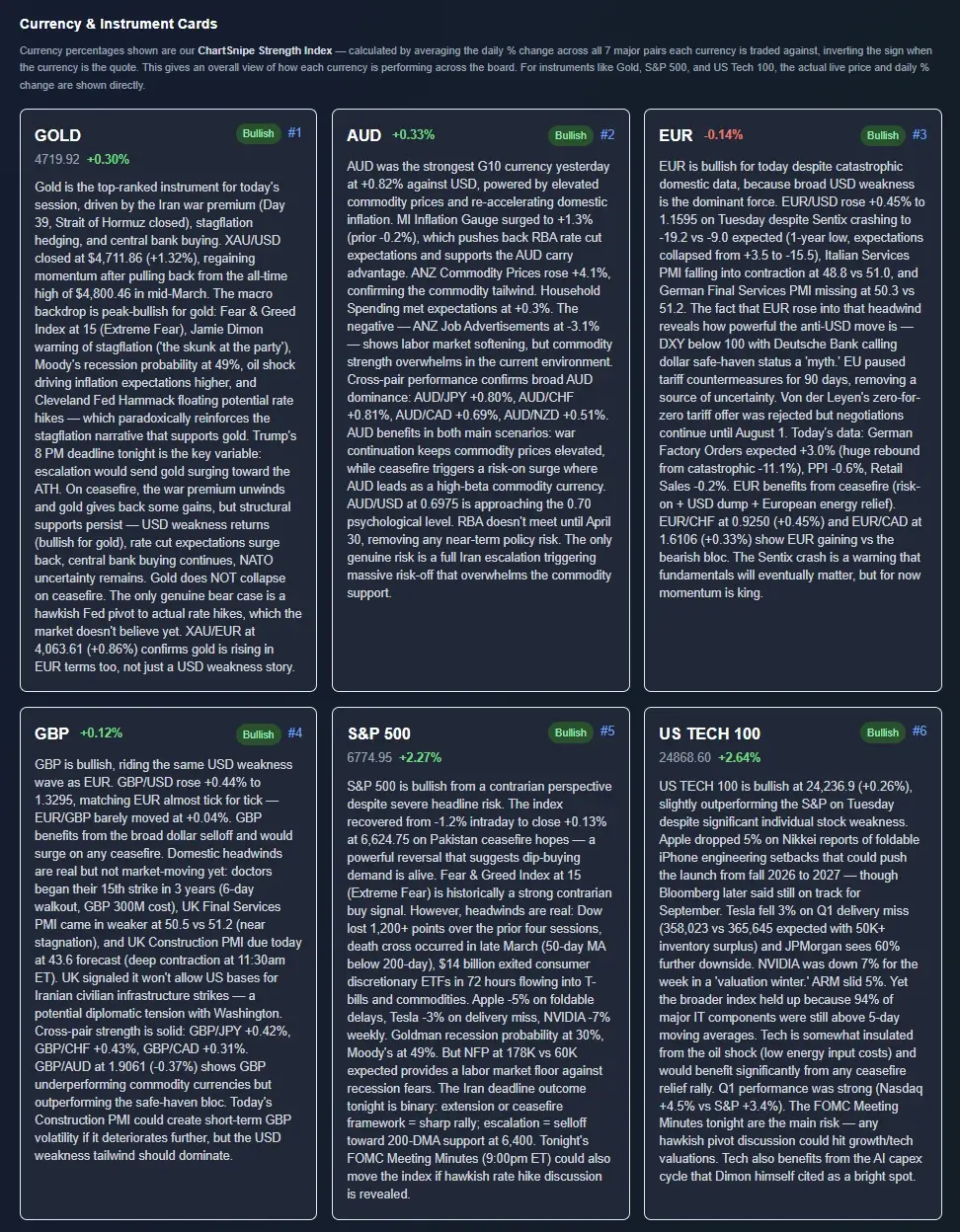
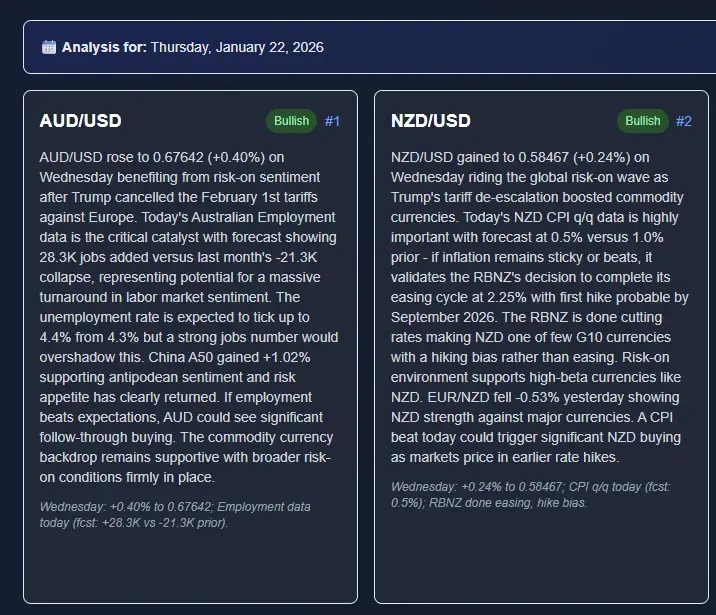
ChartSnipe's News Impact page surfaces this with individual currency strength cards for every G8 currency. On an ECB morning the EUR card is the first thing you read; on a BoE morning it is the GBP card; on a BoJ week it is the JPY card; on an RBA day it is the AUD card. Each card shows the live strength index aggregated across that currency's seven major crosses, the session percentage change, and a pulsing live-price dot so you can see the move developing in real time rather than after the fact.
4. Tier 2: The Next 5 Heavy Hitters
These are the events just below the top tier. They move markets hard and they're tradable — but they don't have the same universal impact across every pair that the Tier 1 events do.
6. Bank of England Rate Decision
The BoE is notable for being the only major central bank that releases the individual MPC member vote split alongside the rate decision. A 5–4 vote where the dissenters unexpectedly shift direction can move GBP/USD 70+ pips instantly, even without a rate change. Andrew Bailey's tone in the statement matters almost as much as the vote itself. GBP/USD and EUR/GBP are the cleanest pairs to trade the reaction.
7. US PCE Inflation (The Fed's Preferred Gauge)
PCE has a smaller immediate reaction than CPI because CPI comes out two weeks earlier and the market has already priced most of the inflation story. But PCE is the inflation gauge the Fed actually targets, so when it diverges from CPI — which happens more often than people realize — the reaction can be sharp. Core PCE month-over-month is the critical number. Strong follow-through into the subsequent week.
8. US Retail Sales
Consumer spending drives roughly 70% of US GDP, so retail sales is a direct read on the real economy. The retail sales control group (ex-autos, ex-gas, ex-building materials, ex-food services) is what matters — it feeds directly into GDP nowcasts. A big miss on control group can move EUR/USD 50+ pips in the first 10 minutes, and the reaction tends to hold if it confirms the direction of recent labor data.
9. SNB Rate Decision
The SNB only meets four times a year, and most of those meetings are non-events. But the Swiss National Bank has a long history of surprising the market — most infamously the January 2015 EUR/CHF floor removal — and the size of SNB moves can be extreme even in routine meetings. 50 pip moves on EUR/CHF are standard; 400+ pip moves happen when intervention rules change. Tradability is limited to short-term reactive plays.
10. RBA and RBNZ Rate Decisions
The Reserve Bank of Australia and Reserve Bank of New Zealand decisions are the biggest Asian session events. AUD/USD and NZD/USD react most cleanly, and AUD/NZD becomes tradable when the two central banks diverge. The RBA statement tone matters more than the decision — Philip Lowe's era set the template for forward guidance driving the reaction more than the rate move itself. Strong complement to building a sense of which currency is strongest — see our currency strength meter guide for how to contextualize AUD and NZD moves across all their crosses.
5. Tier 3: The Remaining 5 That Still Matter
These events won't blow your account in a single minute, but they consistently produce tradable moves and they feed into the broader narrative that drives the Tier 1 and Tier 2 reactions.
11. US GDP Q/Q (Advance Estimate)
GDP is a backward-looking data point, but the advance estimate for the prior quarter is the one that moves markets. A 0.5% surprise in either direction can deliver 40–60 pips on EUR/USD. The price deflator embedded in the GDP release is an inflation proxy and occasionally moves the market more than the headline. Revisions are largely ignored.
12. ISM Manufacturing / Services PMI
The Institute for Supply Management surveys are forward-looking — they ask purchasing managers about new orders, employment, and prices paid. The ISM Services PMI is the one that matters more now because the US is a services economy; the prices paid sub-index inside ISM Services has become a mini-CPI proxy. A 2-point swing in Services PMI can deliver 30–60 pips on EUR/USD.
13. Unemployment Rate (standalone releases)
In the US, the unemployment rate is bundled with NFP and we've already covered that. But standalone unemployment rate releases for Australia, Canada, and the UK are genuine market movers on their respective pairs. A 0.2% surprise on Australian unemployment can move AUD/USD 40+ pips. These are the releases that separate FX traders who actually watch the calendar from those who only trade the US session.
14. Consumer Confidence (Conference Board and UMich)
Conference Board Consumer Confidence and University of Michigan Consumer Sentiment both measure how consumers feel about the economy. UMich includes an inflation expectations component that can move the dollar hard when it surprises — 30–50 pips on EUR/USD is common when the 1-year inflation expectation jumps 0.3% or more. Conference Board is softer but tradable around turning points.
15. Trade Balance (Commodity Currencies)
Trade balance moves the needle almost exclusively for commodity currencies — CAD, AUD, NZD, and occasionally NOK and SEK. A big surprise on Canadian trade balance when oil is trending can give 40+ pips on USD/CAD. For the majors (USD, EUR, GBP, JPY) trade balance is basically noise and usually ignored.
6. Honorable Mentions: Geopolitical and Unscheduled Events
The 15-event ranking above only covers scheduled releases. But in 2025–2026 some of the biggest forex moves of the year have come from events that have no scheduled time at all. These are harder to trade but impossible to ignore.
- War and geopolitical headlines — The Iran war shock of March 2026 moved USD/CHF 180 pips in an hour and gold 4% in a session. USD and CAD emerged as primary safe havens while JPY and CHF lagged, inverting the traditional playbook.
- Fed speakers (especially Powell and the voting members) — A single Powell speech at Jackson Hole, the Economic Club, or a scheduled Fed event regularly moves EUR/USD 50+ pips. Voting regional Fed presidents (NY, Chicago, San Francisco) also matter; non-voting regional presidents rarely do.
- OPEC and OPEC+ decisions — Production cuts move oil instantly, which drags USD/CAD and NOK pairs with it. USD/CAD moves of 40–80 pips on OPEC surprises are routine.
- Trump posts and executive orders — In the current political cycle, Trump's social posts on tariffs, Fed policy, and specific countries have repeatedly moved the DXY 0.3–0.8% in minutes. These are genuinely unschedulable but they belong on any serious trader's radar.
- Unexpected central bank interventions — BoJ verbal intervention, SNB floor adjustments, PBoC fixing surprises. These are rare but huge.
7. The Events That Used to Matter But Don't Anymore
Half the battle in trading news is knowing what to ignore. Forex Factory still tags these as high impact but the market has almost completely tuned them out. Save your attention for the events that matter.
ADP Non-Farm Employment Change
Once considered a preview of NFP, ADP's correlation to the actual NFP print has collapsed since 2023. Traders now wait for the real number on Friday. Typical reaction: 10–20 pips, often fully faded within an hour.
NFIB Small Business Optimism
Historically a leading indicator for labor and wages. In practice the market hasn't reacted meaningfully to NFIB in years. Skip it.
Factory Orders and Durable Goods
The ex-transportation number can still produce a small reaction, but typical moves are 10–25 pips and rarely hold. Not worth trading on their own.
Housing Starts and Existing Home Sales
Relevant during housing-driven macro narratives (2006–2008, 2020–2022) but largely ignored now. Pending home sales occasionally moves USD/JPY but that's about it.
PPI (Producer Price Index)
PPI used to matter because it hinted at CPI direction. Now the market waits for CPI itself. The exception: when PPI is released after CPI in the same week and confirms or denies the CPI story — then it can still push 20–40 pips.
8. How to Build Your Own Red-Folder Watchlist
Here's the practical framework we recommend to every trader starting to take news seriously:
- Block out the Tier 1 five every month. Put FOMC, NFP, CPI, ECB, and BoJ in your calendar as "do not hold positions through" events unless you're specifically trading them.
- Pre-decide your stance the night before. Read the consensus, read two analyst previews, and commit to what a beat or miss means for your pairs before the release. Do not try to decide at 8:30 AM ET.
- Use a wider stop on event days. Your normal stop of 20 pips on EUR/USD should be 40–60 pips on NFP day. If you can't take the risk, sit out.
- Know your session. If you trade Asia only, the BoJ, RBA, and RBNZ are your main events. European traders focus on ECB, BoE, and the 8:30 AM ET US data wave. Don't try to trade events that fire during your sleep.
- Track the reaction, not the prediction. Every time a top-5 event releases, write down what the market actually did versus what you expected. Over 6 months you'll develop an instinct for which events are worth trading and which are worth avoiding.
- Check one source of truth in the morning. Rather than juggling Forex Factory, Bloomberg, and Twitter, load the News Impact dashboard once and get the entire day's red-folder picture pre-ranked.
For the mechanics of actually reading an economic calendar — consensus, previous, and the difference between impact flags — see our companion guide on how to read the economic calendar for forex.
9. How ChartSnipe's AI News Impact Analysis Processes These 15 Events Daily
Reading the calendar is step one. Knowing what the market is going to do with each release is the harder problem — and it's the exact problem ChartSnipe's News Impact AI solves every morning before the London open.
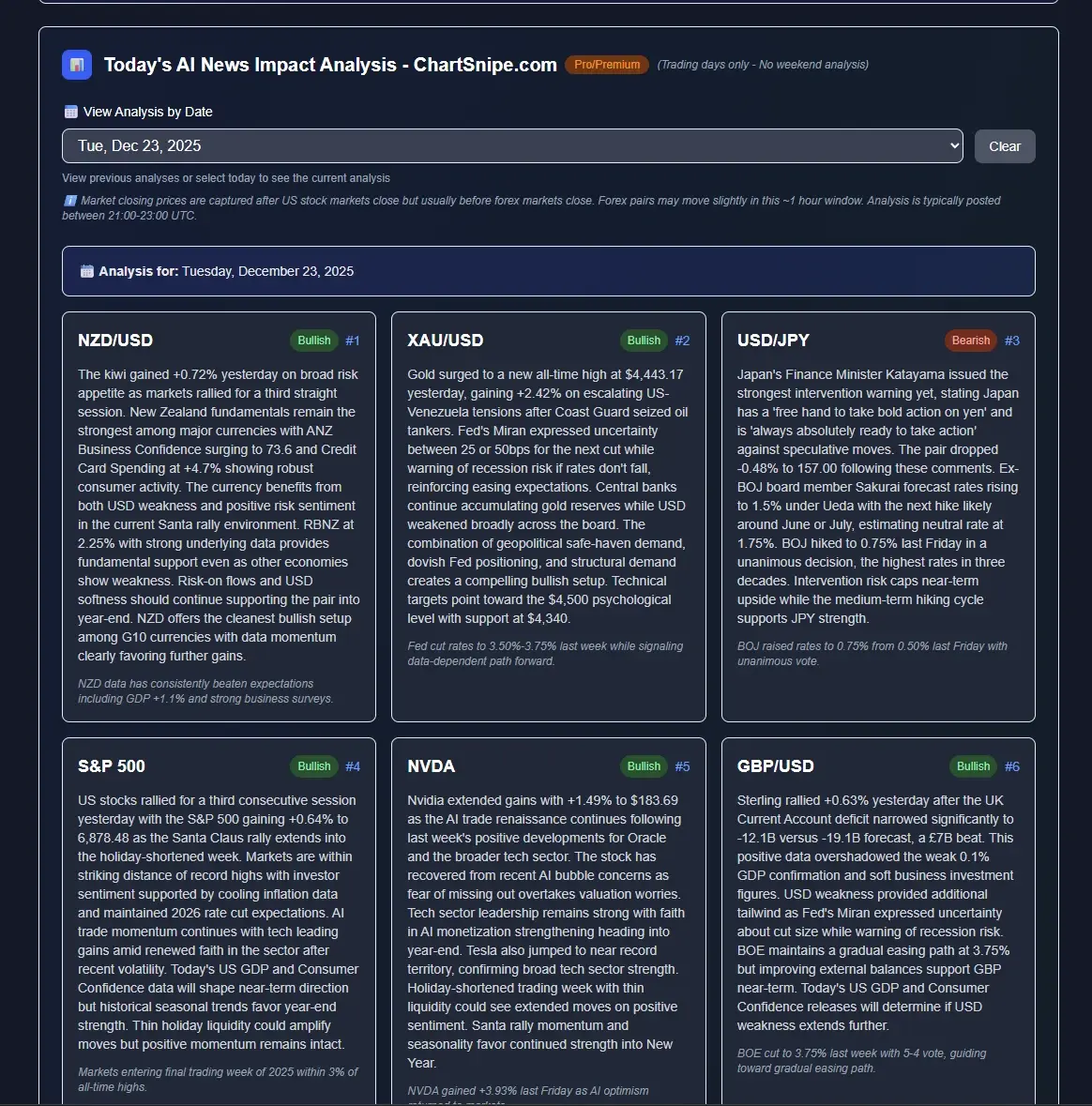
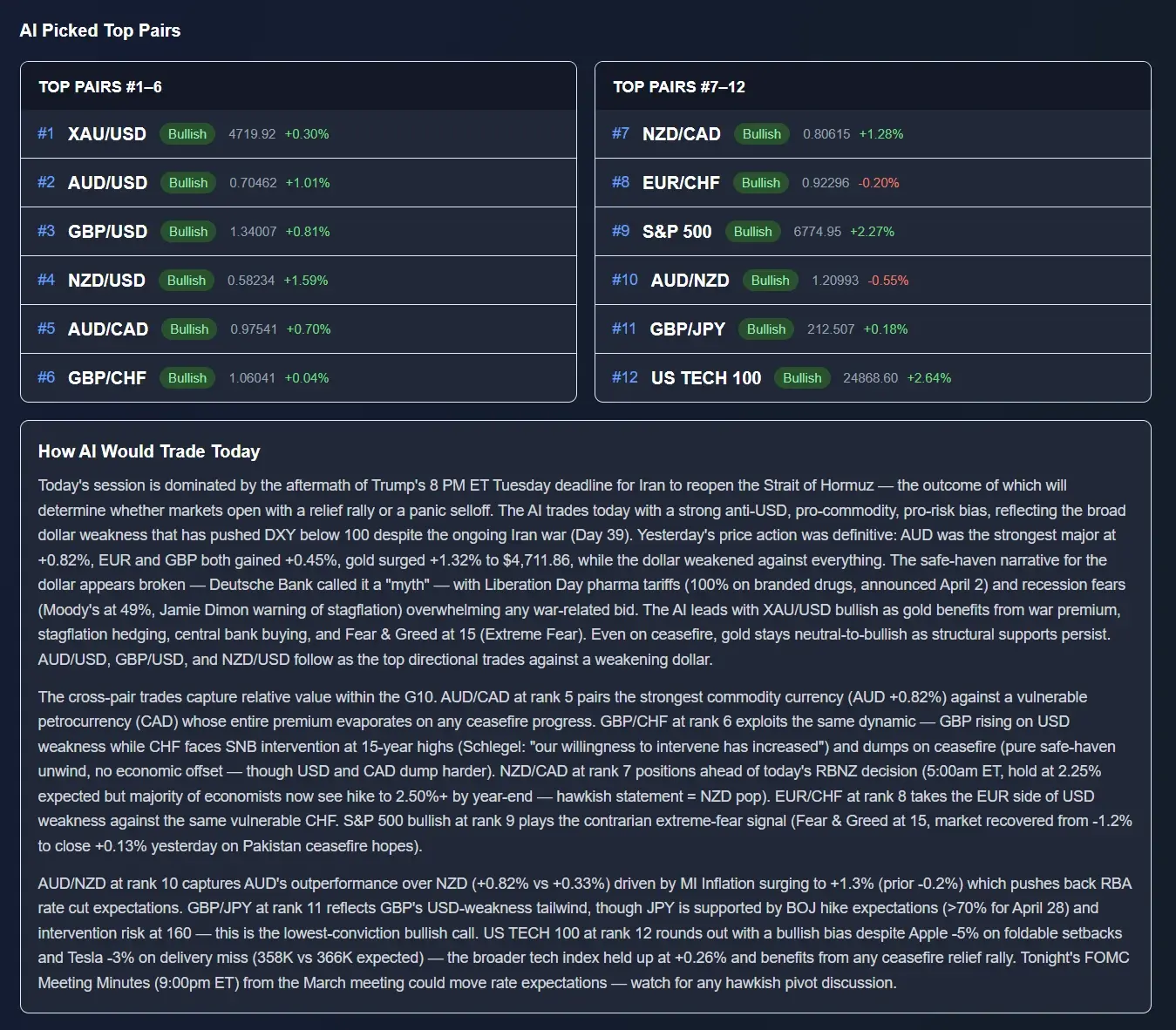
The News Impact engine ingests the full economic calendar, all overnight central bank commentary, geopolitical headlines, and market pricing — then delivers a unified daily brief that ranks 12 instruments as bullish, bearish, or neutral with conviction scores, key levels, and a written thesis for each.
The Four Inputs
- Scheduled red-folder events — Every Tier 1, Tier 2, and Tier 3 event from this article is auto-tagged and weighted by the same methodology we used to build the ranking.
- Central bank speeches and minutes — Every Fed, ECB, BoE, BoJ, SNB, RBA, and RBNZ speaker is tracked. Voting members get higher weight than non-voters.
- Geopolitical and headline risk — War headlines, OPEC decisions, major executive orders, tariff announcements, and Trump posts are pulled into the narrative.
- Cross-market confirmation — The AI checks whether bonds, gold, oil, and indices are confirming or contradicting the FX setup before finalizing conviction scores.
The Output: 12 Pre-Ranked Instruments
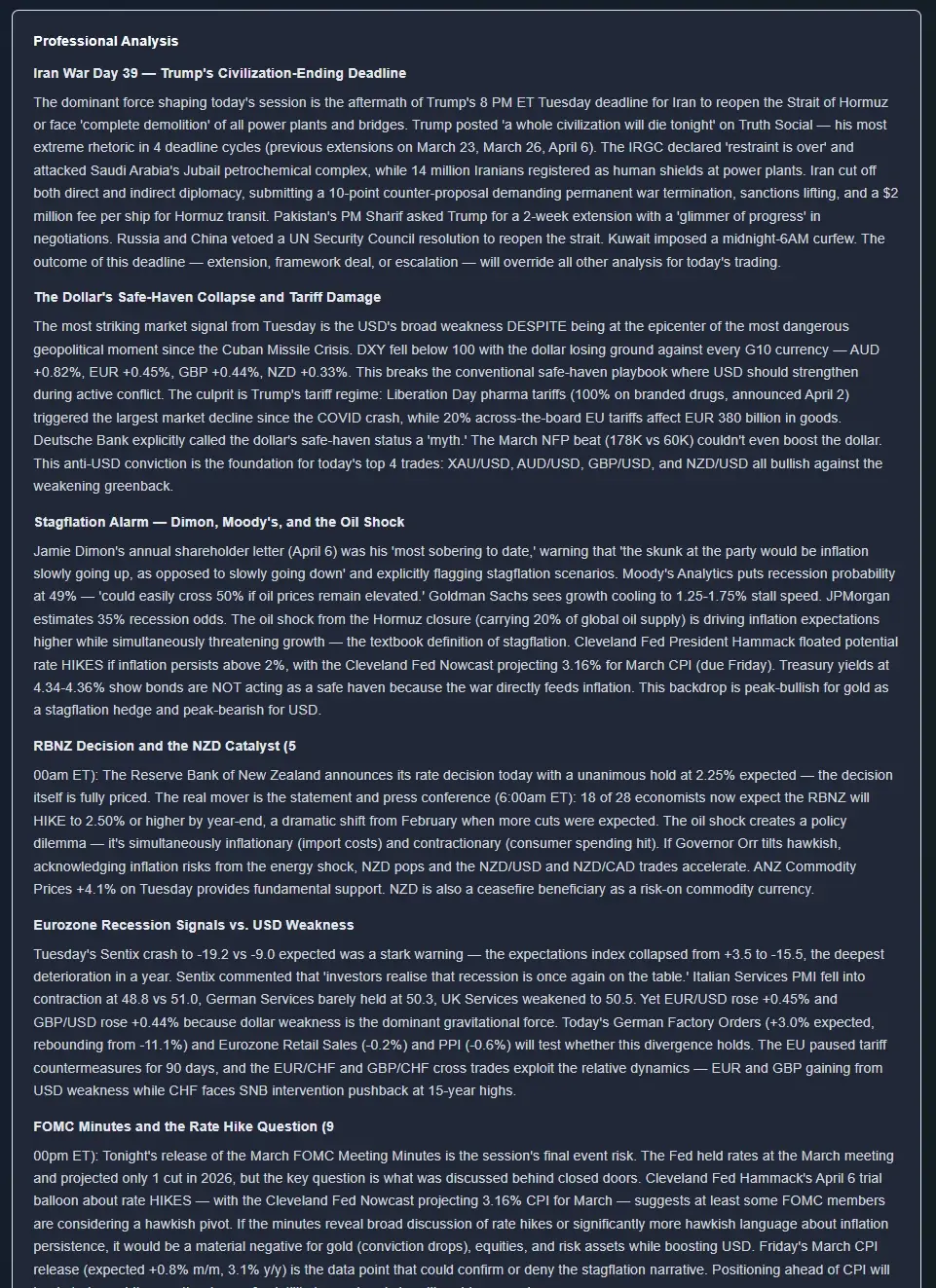
Every morning the News Impact dashboard publishes an AI Top Pairs breakdown — the bullish side lists the currencies and instruments expected to strengthen into the day's events, and the bearish side lists the ones expected to weaken. Each instrument card shows the current live price (streamed from MetaApi), the currency strength index for FX currencies, the percentage change on the session, and the conviction score.
You can drill into any instrument to see the full written analysis: what scheduled event is driving the thesis, which catalysts could reverse it, recommended key levels, and the reversal risks the AI has flagged. It's the same framework a discretionary news trader would build manually — just done in five minutes instead of five hours, and updated every day before markets open.
For a deeper dive on the underlying AI and how it handles edge cases, see AI forex chart analysis 2026 and the full Chart Snipe tool overview.
Pricing
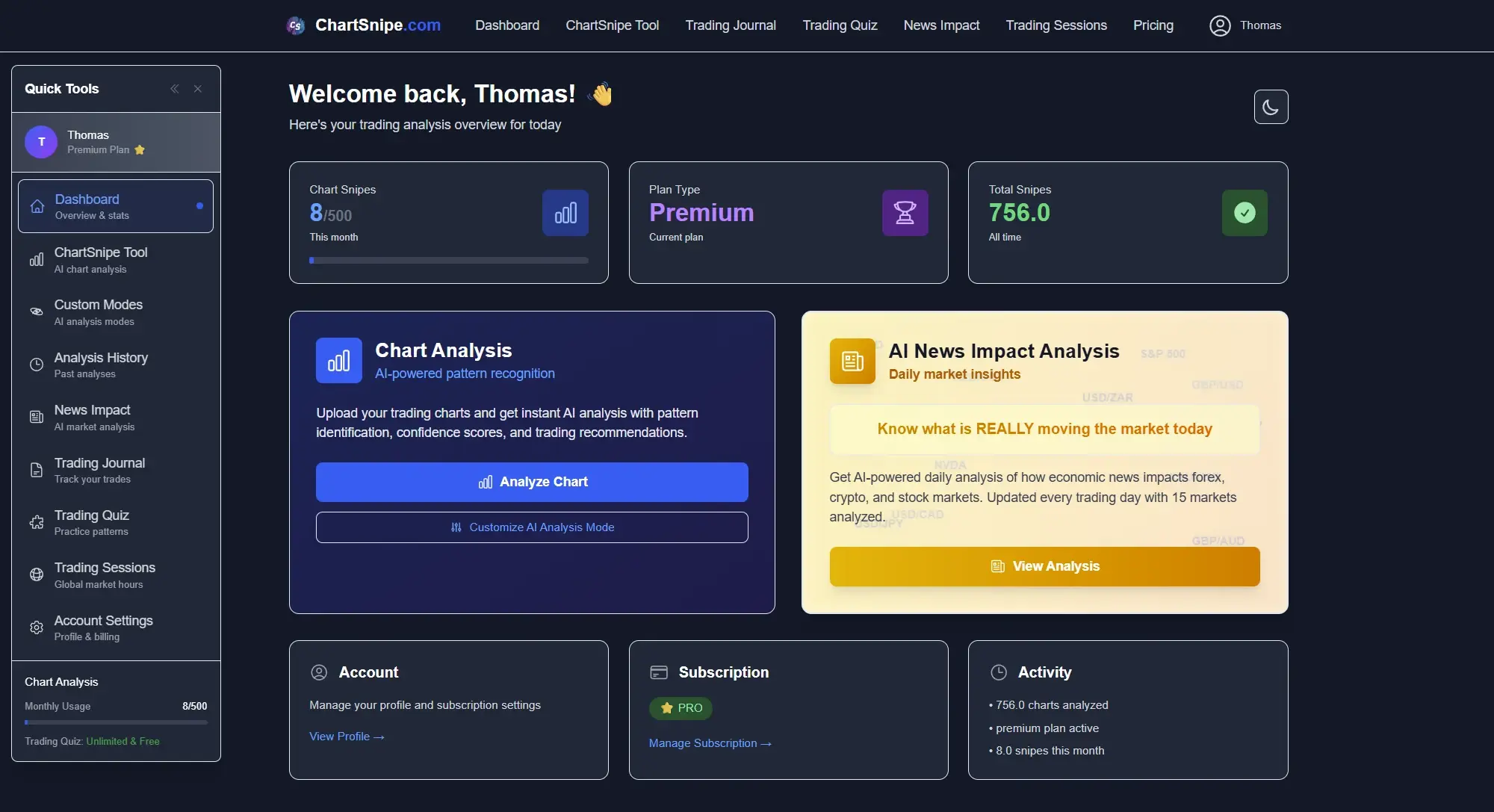
- Free: 2 chart analyses per month + unlimited Trading Quiz
- Pro ($20/month): 120 analyses + Daily News Impact Analysis of every red-folder event
- Premium ($50/month): 600 analyses + full News Impact access + all features
See the full plan breakdown on the pricing page.
Frequently Asked Questions
Which news event moves forex the most?
The FOMC rate decision with the dot plot and Jerome Powell press conference is the single highest-impact forex event. It routinely moves EUR/USD 80–200+ pips and sets the tone for the dollar across every FX pair, gold, and indices for weeks after.
What are red folder news events on Forex Factory?
Red folder events on Forex Factory are tagged as "high impact" — meaning historical data shows they cause the largest market moves. The list includes FOMC, NFP, CPI, central bank rate decisions (ECB, BoE, BoJ, SNB, RBA, RBNZ), retail sales, PCE, GDP, and PMI releases.
What are the most important forex news events in 2026?
In 2026 the most important forex events are the eight FOMC meetings, monthly NFP and CPI prints, ECB and BoJ rate decisions, US PCE inflation, and BoE rate decisions. These account for the vast majority of pip range in major pairs.
How many pips does NFP move EUR/USD?
Non-Farm Payrolls typically moves EUR/USD 40–90 pips on the release spike and 60–150 pips over the full trading day when the print surprises the consensus. On extreme beats or misses with unemployment rate surprises, moves of 150+ pips are common.
Do ADP and NFIB still move the forex market?
ADP and NFIB have lost almost all of their forex impact since 2024 because their correlation to NFP and broader US data has collapsed. Traders largely ignore them now and wait for the real NFP print two days later.
How does ChartSnipe rank high-impact forex news?
ChartSnipe's News Impact AI scans every red-folder release, central bank speech, and geopolitical headline each morning, then ranks 12 instruments as bullish, bearish, or neutral with conviction scores, key levels, and a full trade thesis — updated daily before the London and New York sessions. You can see the live version on the News Impact page.
Conclusion: Trade The Events That Actually Move Price
There are hundreds of red-folder news events in any given year and almost none of them matter for your P&L. The 15 releases in this list do. Commit them to memory, block them in your calendar, and either trade them with a plan or sit out completely.
The edge in news trading is not knowing what's on the calendar — everyone has that. The edge is knowing which events have historically moved your pairs, what size of surprise triggers real follow-through, and how to position the night before. Pair that with AI-assisted pre-ranking and you've got a workflow that used to belong only to institutional desks.
Sources & Further Reading
- • Forex Factory Economic Calendar — the industry-standard red-folder calendar for high-impact forex events.
- • US Bureau of Labor Statistics — Employment Situation (NFP) — official release page for Non-Farm Payrolls and unemployment data.
- • Federal Reserve — FOMC Calendar & Statements — source documents for every FOMC rate decision and dot plot.
- • European Central Bank — Press Releases — ECB rate decisions, monetary policy statements, and Lagarde press conferences.
- • Investopedia — High-Impact Forex News Releases — primer on how each economic indicator is calculated and why it moves FX.
Related Articles

The Bitcoin FOMC Playbook
How BTC reacts to Fed rate decisions — the dump-then-rip pattern, DXY correlation, and full FOMC day timeline.

NFP Trading Strategy Playbook
A repeatable framework for trading Non-Farm Payrolls across forex and gold with real pre-release positioning rules.

How to Read a Forex Economic Calendar
A complete guide to decoding red-folder events, forecasts, and actuals on any economic calendar.

Written by the ChartSnipe Team
ChartSnipe is an AI-powered chart screenshot analysis tool and daily AI news impact analysis platform for forex, gold, Bitcoin, S&P 500, and Nasdaq traders. Our team combines deep experience in technical analysis, AI vision models, and live market data across 32+ instruments to deliver actionable trading insights.
See Today's High-Impact Forex News Ranking
Get the AI-ranked bullish and bearish instrument breakdown for every red-folder event on the calendar — updated daily before London open.
Open News Impact Dashboard