
AI Day Trading in 2026: Tools, Setups, and Risk — The Practical Guide
AI can read a chart faster than you. It cannot size a position for you, cannot stop you revenge trading, and cannot save an undisciplined account. Here is how to use it anyway — the workflow, the setups, and the risk rules that decide whether the edge survives contact with a live session.

The research is unpleasant but consistent. Retail day traders lose, and the losses are rarely about bad chart reads. ESMA and ASIC broker disclosures put the losing rate at 70–85% of CFD accounts year after year. The FINRA and NASAA studies on US equities day trading cluster in the same range. Digging into the why, the pattern is always the same: oversized positions, revenge trading after a loss, no daily cut-off, and ignoring stops. These are behavioural failures, not analytical ones.
That is the frame to hold when thinking about "AI day trading". AI helps with the read — pattern recognition, news scoring, currency strength math, fast screening across 28 pairs. It does not help with the execution discipline that actually decides whether a trader survives. Anyone selling AI day trading as a solution to the problem is selling the wrong half. The goal of this guide is to show how a serious day trader uses AI to sharpen the read, while owning the risk rules themselves.
The throughline: ChartSnipe is positioned as a research co-pilot, not an auto-trader. That distinction runs through every section below.
Key Takeaways
- →Most retail day trading losses are behavioural — sizing, revenge trading, no cut-off. AI sharpens the read, not the discipline.
- →The practical AI day trading stack in 2026 is three layers: a macro news read, a currency strength scan, and a chart-level analysis on a targeted pair.
- →Five setups do most of the work — London open breakouts, NY reversal, liquidity sweep, Asia range fade, and post-release news fades.
- →FX majors and index futures are the AI-friendliest day trading instruments. Single-name stocks belong on equities-native tools; crypto remains experimental.
- →The non-negotiables: fixed per-trade risk, a daily loss limit, a stop on every position, a hard session cut-off, and a journal that logs the AI's call versus the outcome.
1. The honest frame — what kills day traders, and what AI actually fixes
Strip out the top-of-funnel marketing and the academic literature on retail day trading converges on three causes of account death: position size that is wrong for the account, revenge trades that size up after a loss, and refusing to stop when the day has gone sideways. Brazilian retail futures data, Taiwanese equities data, FCA CFD disclosures — they all point at the same behaviour. It is not that day traders cannot read charts. It is that they cannot hold to a risk plan when an R is on the line.
AI has nothing to say about any of that. What it does have something to say about is the five things that happen before you click buy: reading a chart, pricing the impact of today's news, aggregating strength across a currency complex, scanning more pairs than any one trader can cover manually, and pattern-matching a setup against thousands of historical analogues in seconds. Every one of those is a research task, not an execution task. AI is a research co-pilot — the execution discipline is still on the trader.
What “day trading with AI” looks like in practice
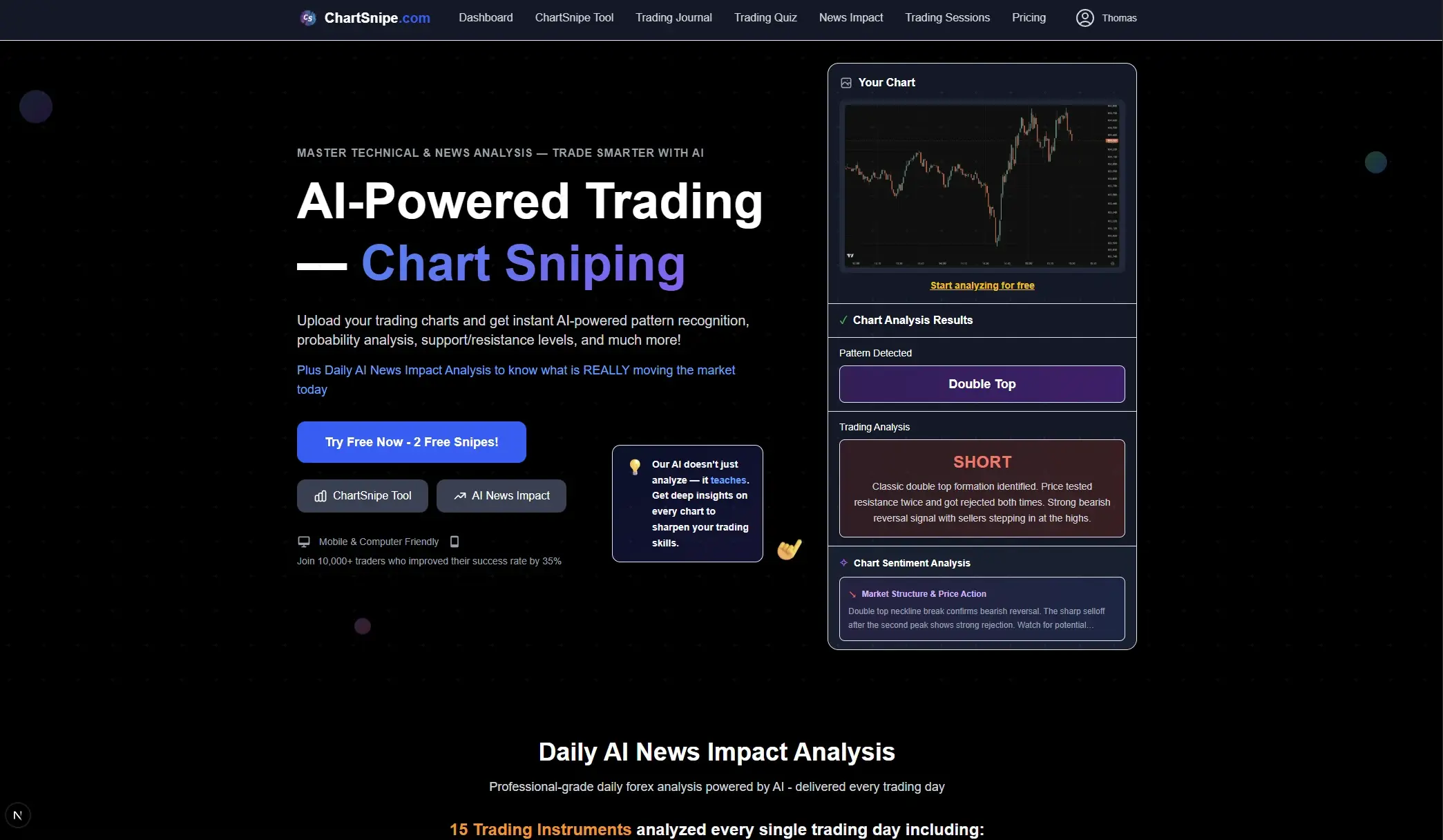
In the workflow this guide describes, AI does four things: it writes the macro narrative for the day, it computes which currencies are bid and offered, it reads the chart you point it at, and it tags the specific news events that would flip its own read. What it does not do: place trades, size positions, move stops, or override a daily loss limit. Those remain where they have to remain — on the trader.
What AI does well for day traders
- Fast chart pattern reads with named invalidation.
- Daily news impact scored per instrument.
- Currency strength across 28 pairs in one glance.
- Consistent second opinion when a setup “feels off”.
- Logged analysis history for post-trade review.
What AI cannot do for day traders
- Size a position correctly for your account.
- Stop you revenge trading after a loss.
- Honour a daily loss limit or session cut-off.
- Identify when the market is in a chop regime.
- Replace screen time on your actual instrument.
2. Pre-session AI workflow
A day trader with a pre-session plan is a different animal from one who opens a chart cold. The plan does not have to be long — five minutes of structured AI reading before the session opens covers more ground than most retail traders assemble in an hour of scrolling Twitter. Three jobs, done in order.

Job 1 — Macro read
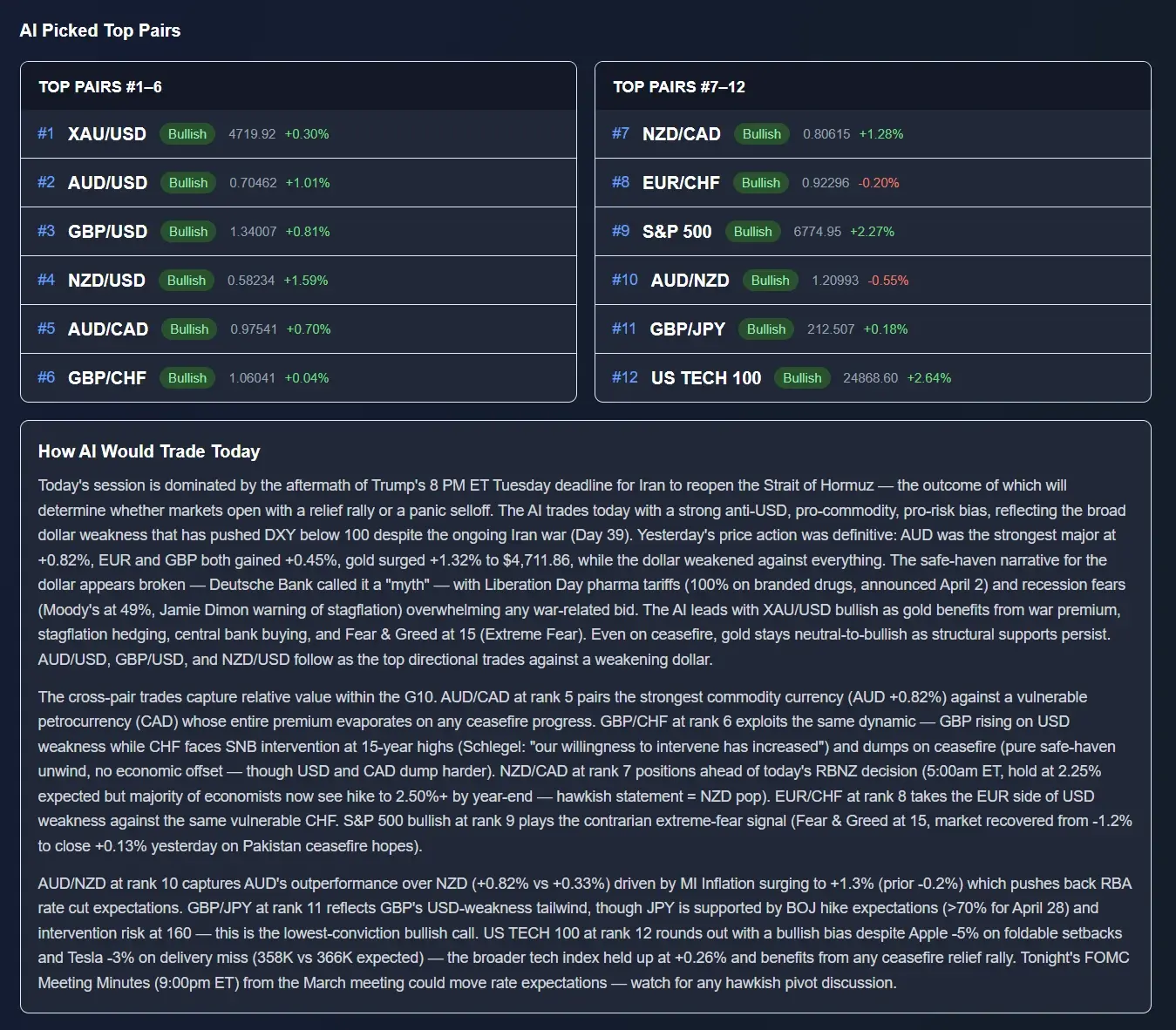
Open the Daily AI News Impact dashboard. The AI has already ranked today's top bullish and bearish pairs, with live prices, conviction scores, and the three drivers behind each read. Read the professional analysis block once — central banks, geopolitics, commodities, the tone into the US open. By the end of that block you own the story of today. The point is not to adopt every call the AI makes; the point is to enter the session with a framework for what would surprise you and what would not.
Job 2 — Currency strength scan
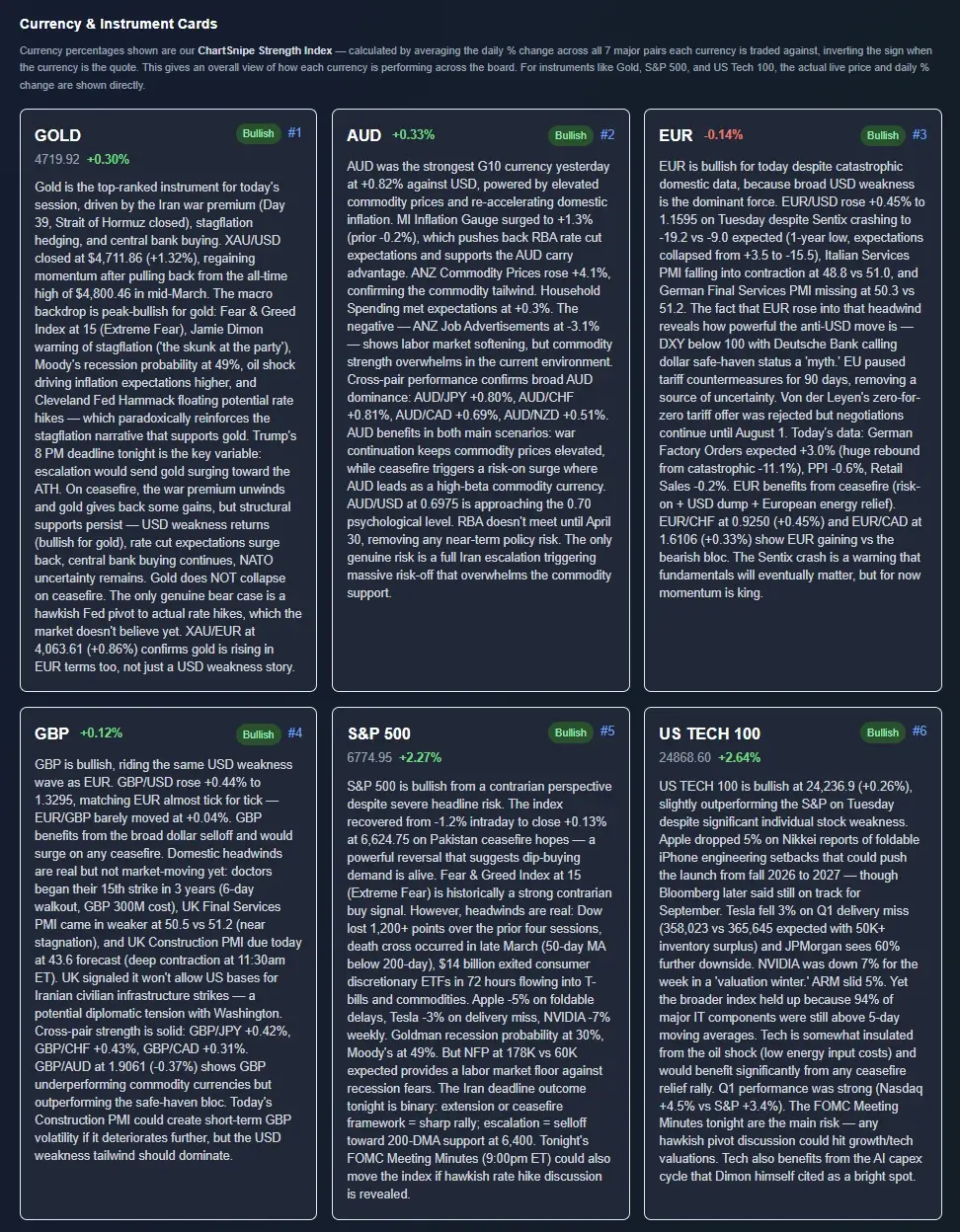
Scan the eight major currency strength cards — USD, EUR, GBP, JPY, CHF, AUD, CAD, NZD. Each card aggregates the currency's move across all seven pairs it participates in, flipping sign where appropriate. Strongest versus weakest writes your candidate shortlist in a single glance. If GBP is bid +0.42% and JPY is offered −0.55%, GBP/JPY is on the list whether you love the chart or not. Ignoring that gradient is how day traders end up fighting a macro flow without realising it.
Job 3 — Session time awareness
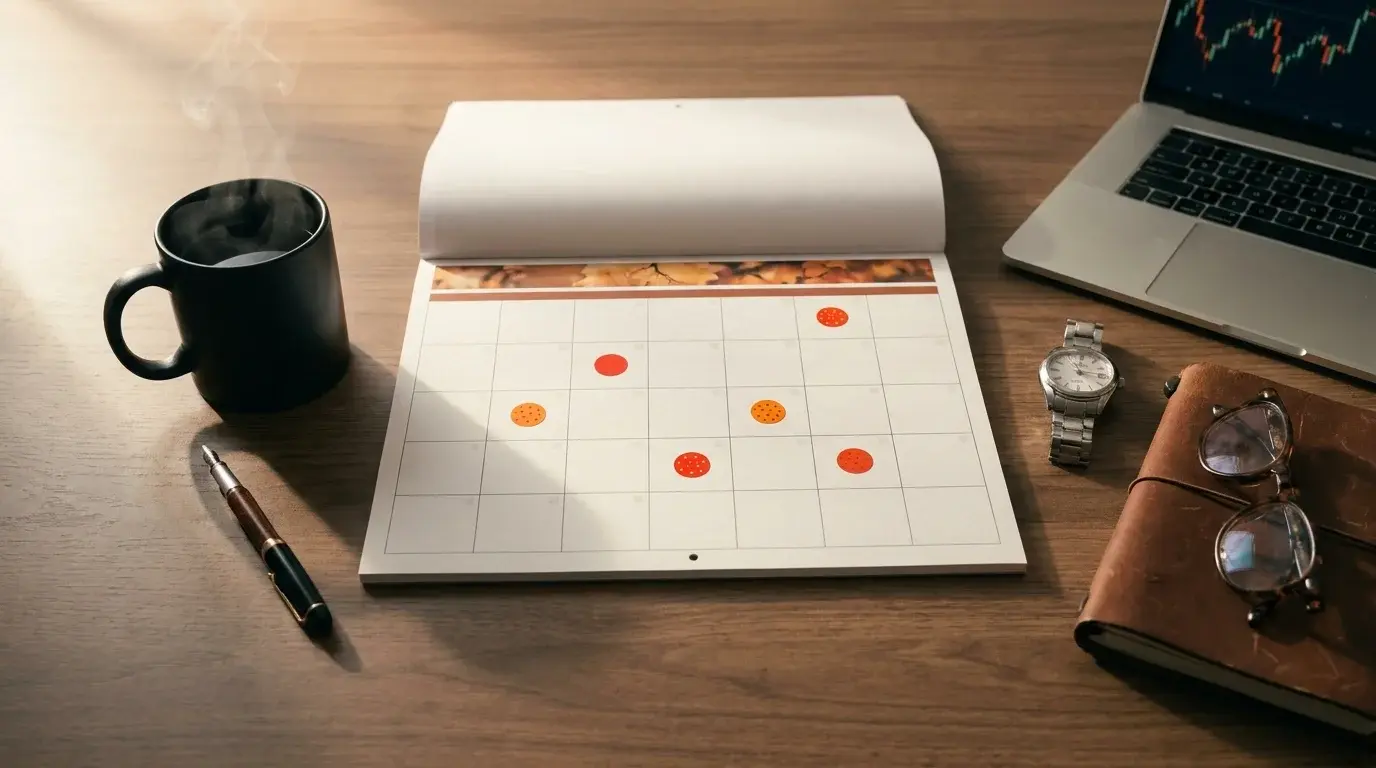
Day trading is session-bound work. The London open (07:00 GMT) and the London-New York overlap (13:00–16:00 GMT) carry the majority of FX volume and the cleanest breakouts. Asia is thinner, more range-bound, and mean-reverting. A setup that prints at 03:00 GMT is not the same setup it becomes at 14:00 GMT. The AI gives you the read, the calendar gives you the reaction window — treat them together. Our forex session times guide has the full map.

3. Intraday chart reads with AI
The core intraday loop is simple: something on the chart gets your attention, you screenshot the relevant timeframes, the AI reads them, and you either take the trade, pass, or go deeper. The discipline is in keeping each read a discrete decision — not an excuse to add a new position every time the AI prints a bullish label.
The three-timeframe rule
Most serious day traders on ChartSnipe upload three timeframes per pair: a 1-hour for bias, a 15-minute for the setup, and a 5-minute for the trigger. The AI reads each independently, and the trader takes the trade only when all three align. This is slower than firing on the 5-minute alone, and that is the point — the slowness is the filter.
Quick Snipe for triage, Full Snipe for conviction
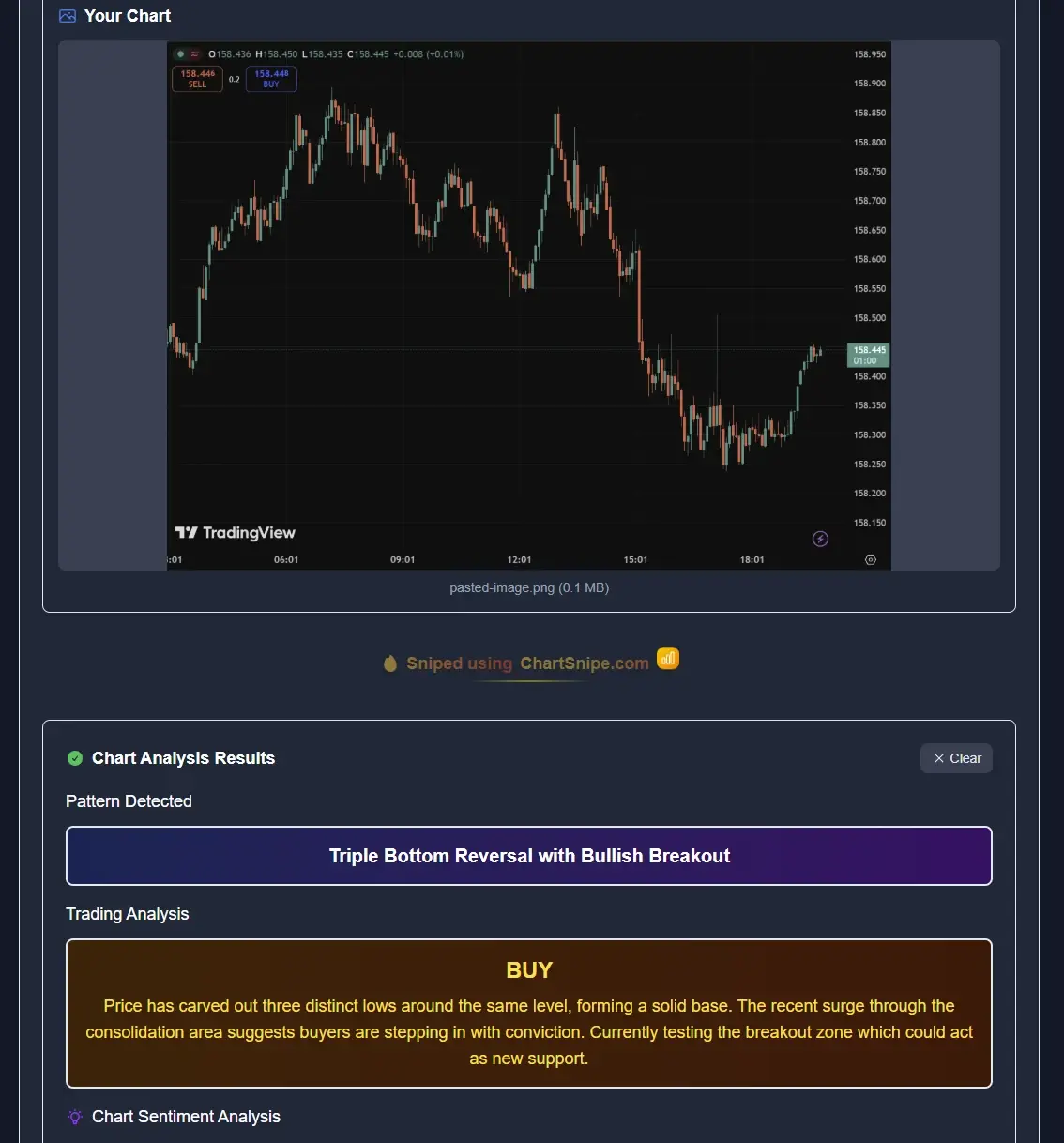
Not every chart deserves the full readout. Quick Snipe returns a pattern label, direction, and one-line reasoning in roughly three seconds — it exists specifically for intraday triage, when you are scrolling a watchlist and need a yes/no on twelve pairs in a minute. Full Snipe is the heavier readout: named pattern, entry zone, stop, target, risk logic, educational context. Reserve it for charts that have already cleared the triage step.
Liquidity Snipe for SMC traders
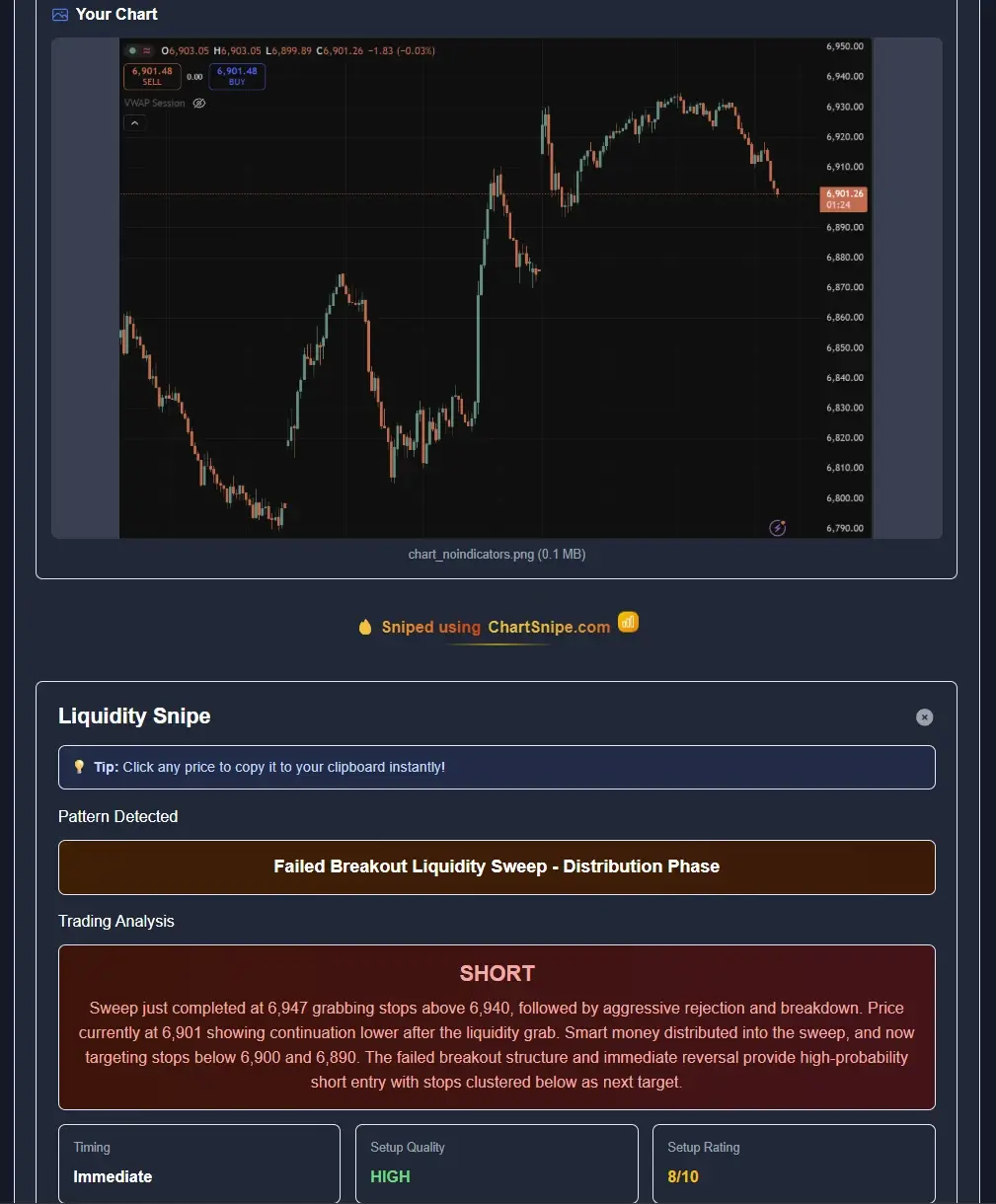
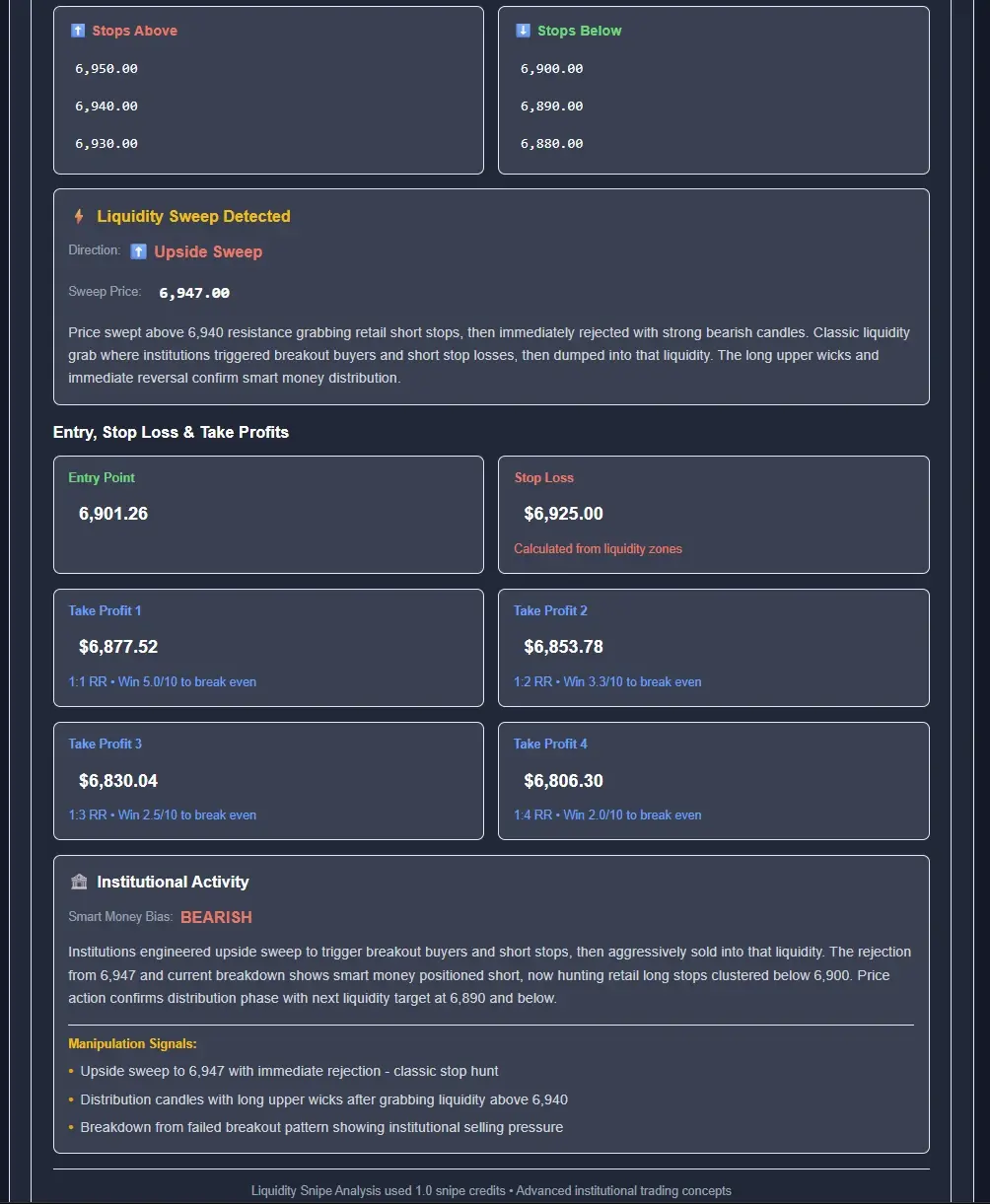
Day traders running smart-money-concepts methodology get a dedicated mode. Liquidity Snipe reads the chart for stop clusters, sweep evidence, and institutional positioning, and returns a setup score out of 10 with the specific liquidity pool being targeted. For intraday sweep-and-reverse plays around session opens — a setup the traditional pattern taxonomy does not capture cleanly — this is the mode to use.
Five modes, one tool
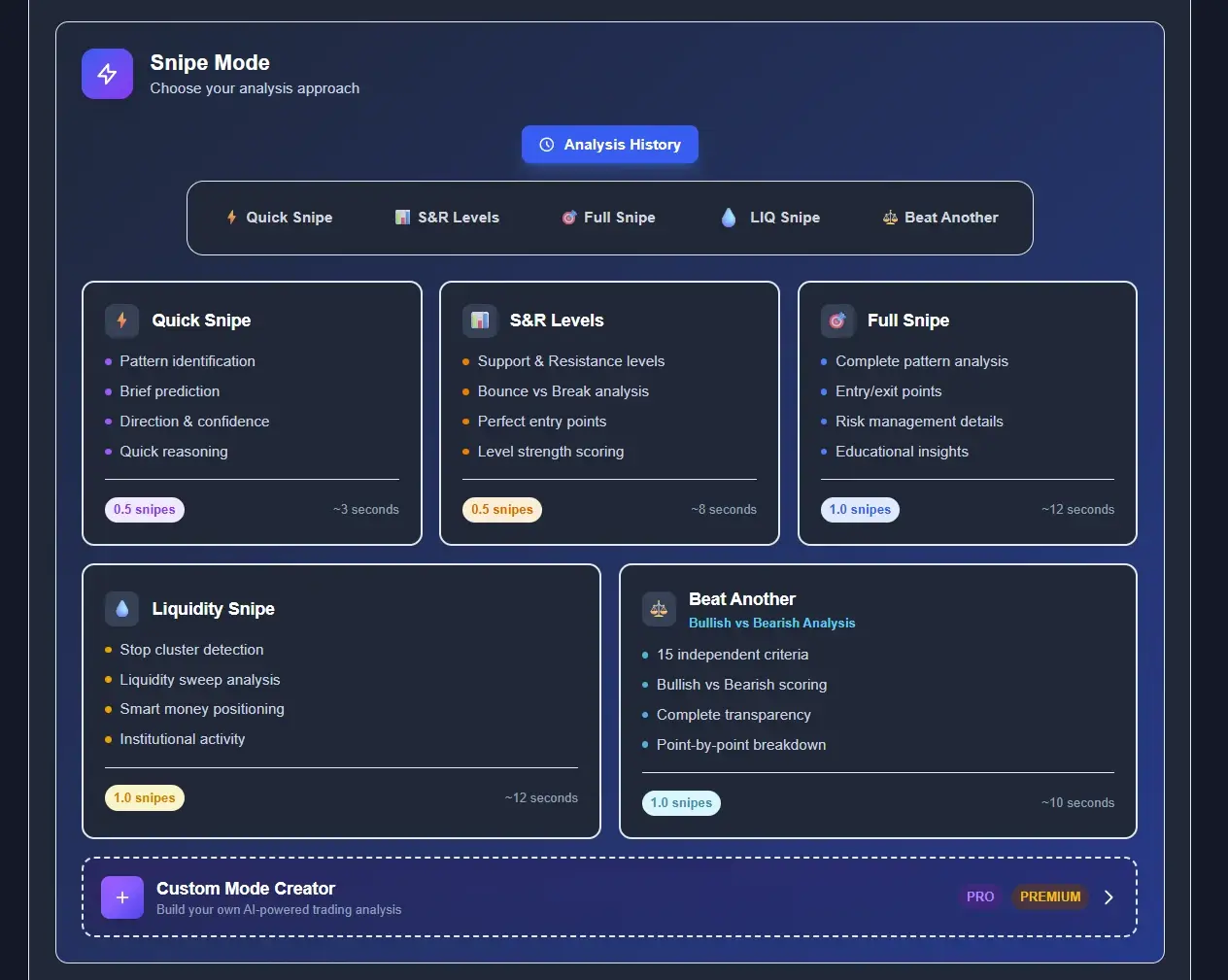
The full mode set — Quick Snipe, S&R Levels, Full Snipe, Liquidity Snipe, Beat Another — exists so the same AI can answer five different trader profiles without rewriting itself. A scalper wants a 30-second triage. A discretionary day trader wants the full reasoning. An SMC reader wants liquidity language. A second-opinion check wants the point-by-point Beat Another breakdown. One model, five prompt chains, five native outputs.
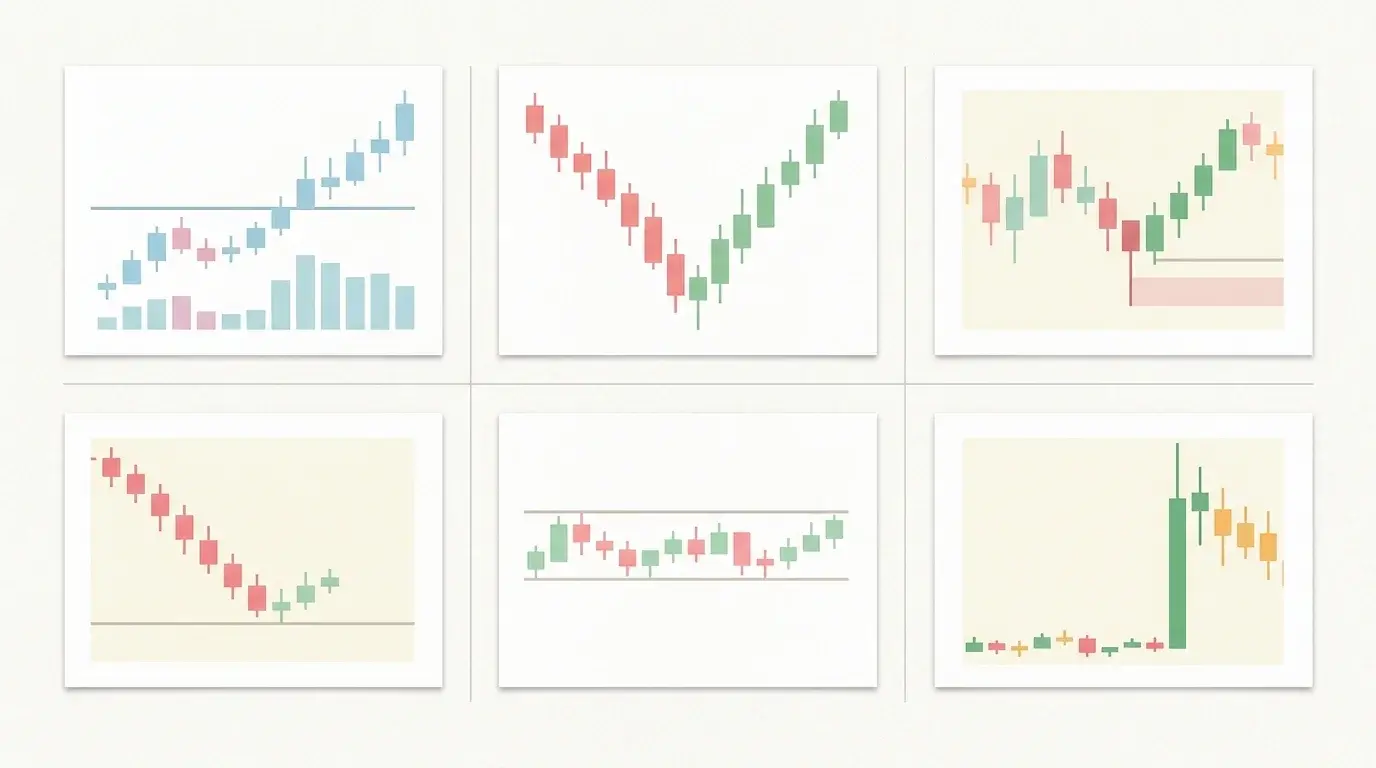
4. Five concrete setup examples
Setups are where the AI earns its keep. Below are five that account for most intraday opportunity on FX and index futures — the AI's role and the trader's role are separated explicitly, because confusing the two is how AI-assisted day traders blow up.
Setup 1 — London open breakout with news alignment
The 07:00 GMT London open is a classic volatility window. A pair that has carved an Asia range and then breaks cleanly in the first fifteen minutes of London — with the AI's currency strength and news impact in agreement — is one of the cleanest setups in FX. Take the example of GBP/USD pushing through the Asia-session high at 07:05 while the AI shows GBP top-three strongest and the daily news read flagged a hawkish BoE speaker into lunch. The bias, strength, and news all line up.
AI's role: confirms the macro context (GBP bid, USD drifting), names the pattern (Asia range break, London momentum continuation), and supplies entry zone, stop below the Asia range low, target at the next 4-hour resistance.
Trader's role: sizes the position, picks whether to enter at the break or wait for a retest, and honours the stop. The AI is not going to move the stop for you when the candle closes back inside.
Setup 2 — NY reversal at prior day high/low
Prior day high and prior day low are two of the most-watched levels in intraday forex. A push into them during the NY session that prints a sweep-and-reverse pattern is a textbook reversal setup — especially when the AI's currency strength flips mid-session. Example: EUR/USD runs yesterday's high at 14:20 GMT during US equity open, the AI flags USD turning from offered to bid over the last hour, and the 5-minute chart prints a bearish engulfing at the prior high.
AI's role: flags the level, catches the strength rotation, labels the engulfing, and provides the reversal invalidation (a close above the PDH sweep wick).
Trader's role: decides whether NY is a trend day or a reversal day — this setup fails on strong directional days and the AI will not always distinguish the two in real time. Screen time does.
Setup 3 — Liquidity sweep after false breakout
A key level breaks, stops trigger, price snaps back inside the range. This is the bread-and-butter SMC play, and it is the one Liquidity Snipe mode was built for. Example: USD/JPY taps an overnight high by two pips, prints a 3-bar rejection wick, and closes back below the breakout candle's open. Liquidity Snipe labels the sweep, scores the setup 8/10, and flags the untouched liquidity pool below as the likely next target.
AI's role: identifies the sweep wick, scores the conviction, names the target pool, and supplies the invalidation (a second push above the sweep high with momentum).
Trader's role: decides whether to enter at the sweep close or on a pullback into the order block. Also: accepting that liquidity sweeps fail roughly 30–40% of the time — position size accordingly.
Setup 4 — Asia range fade
Asia is thinner and more range-bound than London or New York. A pair that has held a tight range for the first four hours of Tokyo, with no Asia-specific catalyst on the calendar, often fades its own extremes. Example: AUD/JPY oscillating in a 30-pip band between 22:00 and 04:00 GMT, with the AI showing muted strength across both legs and no Australian or Japanese data due. A push into the range high that prints an S&R Levels “strong resistance, bounce bias” is the fade.
AI's role: scores range strength, flags the level as a fade candidate, and warns when calendar events inside the London window could blow the range open.
Trader's role: knowing when to stop fading. The moment London hits, the regime shifts — any range trader holding fade positions into 07:00 GMT is asking to get run over.
Setup 5 — NFP / CPI post-release fade
High-impact US data releases — Non-Farm Payrolls, CPI, FOMC — produce a first-spike reaction in the first 60–120 seconds that frequently over-extends. The fade of that over-extension, once the initial spike has printed and started to correct, is one of the oldest news-trading setups in FX. The AI layer improves it substantially: the News Impact read tags the release, the currency strength index registers the post-release shift, and the chart analysis labels the exhaustion pattern.
AI's role: supplies the news framing (what the release means, which instruments are most exposed), identifies the initial impulse pattern, and flags the fade trigger when strength rotates.
Trader's role: every single bit of execution. Trading news releases live is unforgiving — spreads widen, slippage is real, stops get run. No AI fixes that. The rule here is conservative sizing and a wide stop, or stay flat and take the post-release continuation twenty minutes later when the initial volatility has cleared.
A note on these setups. They are not signals. No setup wins 100% of the time, and the AI's role is to compress the research work so a day trader can sit at the tape with a plan. Edge comes from running the same plan across hundreds of sessions with consistent risk — not from any single setup.
5. Which markets are AI-day-tradeable
AI day trading is not equally useful in every market. The usefulness is a function of three things: data availability, news structure, and time-of-day segmentation. Some instruments score well on all three. Others do not.
FX majors — best fit
Twenty-four-hour market, deep liquidity, clean session structure, and a news layer that is easy to score (central banks, rates, macro data, commodity flows). AI reads here have the most follow-through per signal because the underlying market is the most efficient at pricing the information. If you are learning AI day trading, start on EUR/USD, GBP/USD, USD/JPY and GBP/JPY.
Metals — good fit
Gold (XAU) in particular maps well onto AI news impact scoring — it reacts predictably to real yields, DXY direction, geopolitical risk, and central bank flow. The ChartSnipe News Impact ranks XAU daily with full driver breakdown. Silver follows gold imperfectly; trade it with wider stops.
Indices — good fit
US500 and USTEC (S&P 500 and Nasdaq 100 futures) follow a readable macro playbook — rates, earnings cadence, sector rotation, VIX. Both are on the News Impact dashboard. Europe (GER40, UK100) and Asia (NIKKEI, HSI) are harder for retail AI day trading because the news flow is thinner and less standardised in English-language feeds.
Crypto — experimental
BTC and ETH technicals are readable — AI pattern recognition works fine on crypto charts. The problem is the news structure: a Twitter post from a single influential account can move 3% in a minute, and that flow is almost impossible to score in advance. Treat AI day trading in crypto as technical-only, size conservatively, and widen stops for the regime.
Single-name stocks — use equities-native tools
Individual stocks are driven by company-specific catalysts — earnings, guidance, sector news, 8-Ks — that a FX-first AI is not built to score. For intraday equities day trading the better tools are Trade Ideas Holly, Tickeron and Tradytics, which are purpose-built for that surface. Use them for the equities read, and use ChartSnipe for the macro and index context around them.
6. Execution & risk — the part AI cannot do
Everything above is the research layer. What separates day traders who survive from day traders who fund the broker is not the quality of the research — it is whether the execution layer is actually followed. The five rules below are non-negotiable and AI has nothing to say about any of them.
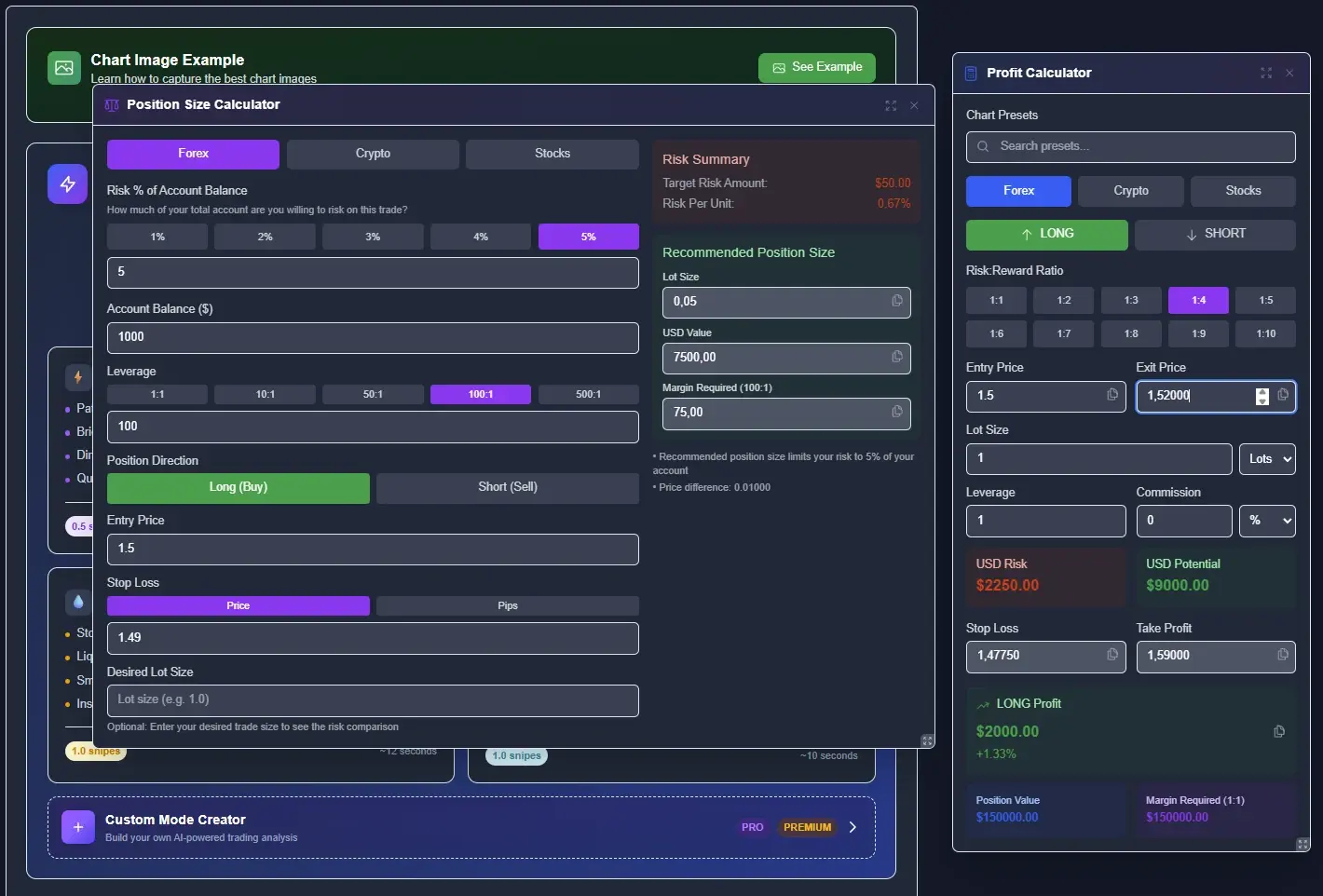
Position sizing — a fixed percent, every time
One number, written down, never negotiated intraday. Most surviving day traders risk between 0.25% and 1% of account equity per trade. Whatever number you pick, pick it once, feed the AI's entry and stop into a position-size calculator, and take the lot size the calculator returns. If the math says 0.22 lots and the AI's read feels like a 10/10, the lot size is still 0.22. “I love this one” is the phrase that precedes most account blow-ups.

Stop placement — structural, never arbitrary
A stop belongs at the level where the setup is wrong, not at a fixed number of pips that makes the position size look nice. Below the swing low on a long. Above the sweep high on a short liquidity play. Beyond the opposite side of the range for a fade. The AI's readout will name an invalidation — use that. The stop-loss placement guide covers the full framework.
Multi-TP exits — take something, leave something
The strongest edge most day traders never claim is partial exits. Take half at 1R, move the stop to breakeven, leave the rest running to the next structural level. This is mechanical — it does not require reading the tape, it does not require the AI's opinion. It converts a marginal win rate into a survivable P&L curve. See the risk-reward ratio guide for the math.
Daily loss limit — a number that ends the day
One number per day, typically two to three times the per-trade risk. If you hit it, you close the platform. No one more trade, no “this setup is different”, no trying to recover on a fresh coffee. The discipline here is the entire game — the 90% failure rate is not a failure of analysis, it is a failure to walk away from a red day before it becomes a crimson one.
Session cut-off — time-box the day
Day traders who last treat the session as a shift. Open at 07:00 GMT, close at 16:00 GMT. Whatever the market is doing at 16:01, it is not your problem. Traders who sit at the tape for 14-hour stretches are making every decision under fatigue and most of those decisions are bad ones. The session cut-off is a risk control, not a lifestyle choice.
7. Where AI fails day traders
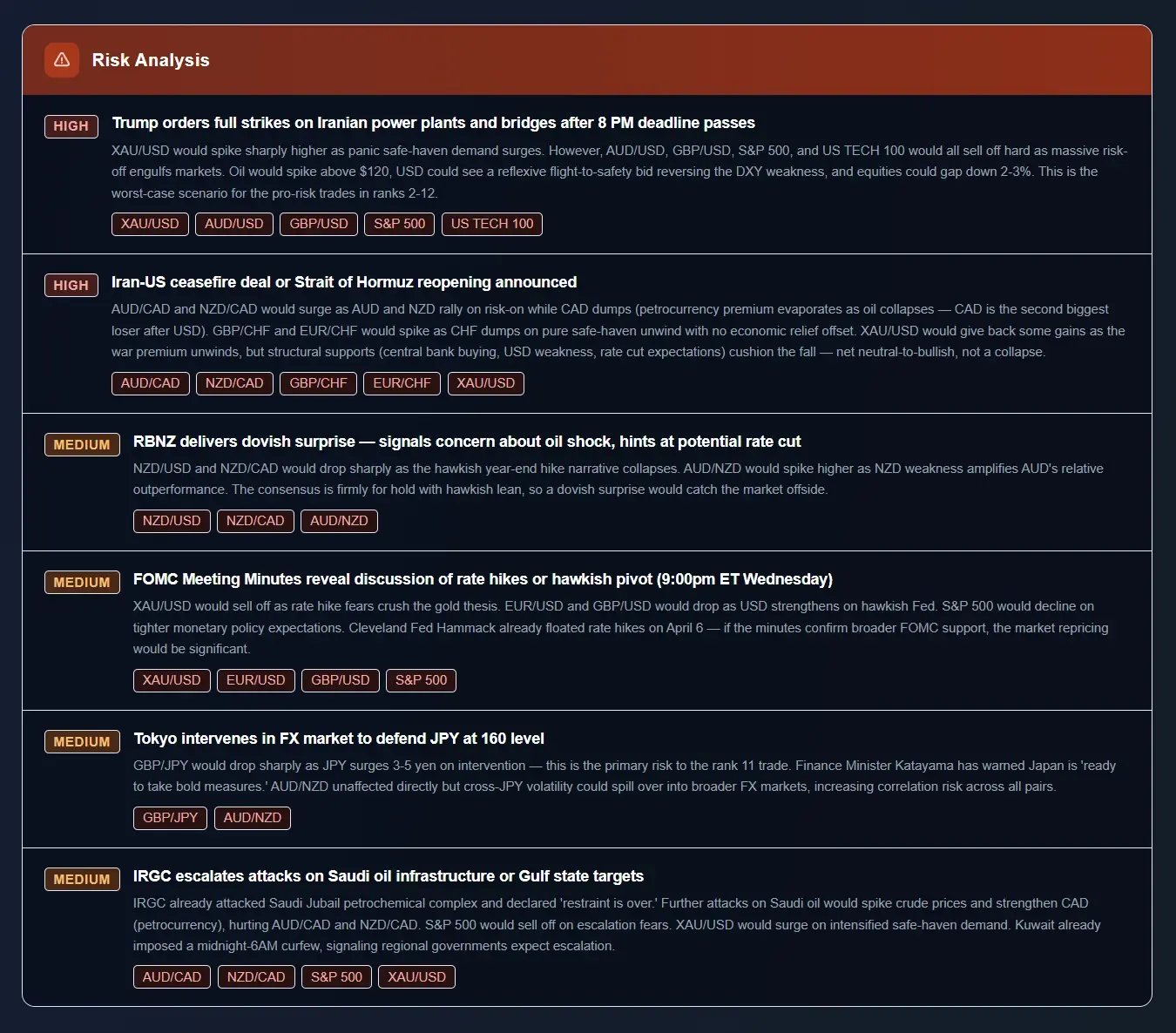
Every honest tool carries a list of its failure modes. For AI day trading the list is short, but each item on it accounts for a meaningful chunk of account damage among users who skip the fine print.
Over-trading driven by FOMO on AI signals
The biggest failure mode is not the AI being wrong — it is the AI being available. A tool that prints a clean readout in three seconds is a tool that lets a trader take thirty trades in a session instead of three. On any given day most of those thirty trades are mediocre setups that would not have passed the old manual filter. Over-trading turns a 55% win rate into a 50% win rate, and a 50% win rate combined with cost of trading is a negative expectancy. The fix is not technical — it is a fixed daily trade count cap. Five trades, then stop. The AI does not get a vote.
Ignoring stop discipline because the AI “feels right”
When the AI delivers a confident read with clear reasoning, it is tempting to widen the stop or skip it entirely when price approaches the invalidation level. This is the other half of the oversizing problem — a high-conviction readout becomes a justification for carrying a loser. The AI does not know where your stop is. It is still your stop. Respect it on every trade or the one trade you override eats the month.
Reading the AI on a range day when it is seeing a breakout ghost
Pattern recognition models are biased towards finding patterns. On genuinely rangebound days — low realised volatility, no catalyst, holiday sessions, pre-FOMC drift — the AI will occasionally tag a breakout that the market has no intention of delivering. Screen time catches this. If the prior four hours have printed a tight range and there is no obvious catalyst, be more sceptical of any breakout readout, regardless of how confident the AI sounds. The AI forex chart analysis guide covers the regime-detection problem in more depth.
Treating AI output as a signal when it is a read
A signal implies “take this trade”. A read is an opinion with reasoning that the trader is still responsible for vetting. Users who convert the former into the latter — click buy every time the AI says bullish — get the worst of both worlds: the AI's mediocre calls included, the trader's own filter removed. The point of the tool is to augment your filter, not to replace it.
8. The daily AI day trading checklist
The workflow compressed into a checklist you can run in six minutes before the London open. Every serious ChartSnipe day trader runs some version of this.
Macro read (90 seconds)
Open News Impact. Read the top bullish and bearish ranks and the professional analysis block once.
Currency strength scan (60 seconds)
Scan eight strength cards. Strongest vs weakest writes the shortlist.
Calendar check (30 seconds)
Know what is due during your session. Size smaller into scheduled events; consider staying flat for the first two minutes of a release.
Chart reads on candidate pairs (120 seconds)
Run Quick Snipe across the shortlist for triage. Promote two or three to Full Snipe on the 1h + 15m + 5m.
Risk plan (60 seconds)
Per-trade risk fixed, daily loss limit written down, session cut-off on the clock. Position-size calculator open.
Journal (after the session)
Log every trade. Record what the AI called, what you did, what happened. Over time this is where the edge gets proven or disproven.
Related reading that plugs into this workflow: AI trading in 2026 — does it actually work? for the big-picture frame, and scalping strategy forex setups for the short-timeframe tactical variants of the five setups above.
Frequently asked questions
Can AI day trade for me?
No legitimate AI day trades hands-off for retail traders. The credible use case is AI as a research co-pilot — reading charts, scoring news impact, computing currency strength, flagging setups — while the trader handles entries, sizing, stops and cut-offs. Every ad promising hands-off AI day trading profits is a funnel for an unregulated broker.
Is ChatGPT good for day trading?
Useful for pre-session concept work, post-trade journaling, and drafting the day's plan. Poor as a live tool because it cannot see current prices, does not know today's economic calendar, and hallucinates support and resistance levels. For live decisions, pair it with a tool that reads real market data.
What is the best AI for day trading forex?
For retail FX day traders, purpose-built research AI with a live 28-pair feed, a currency strength index, and a daily news impact layer beats both signal bots and generic chatbots. ChartSnipe fits that shape — screenshot chart analysis across five modes, live prices, and an AI-written morning brief built around the economic calendar.
How much capital do I need to day trade with AI?
For US equities, the SEC's pattern day trader rule requires $25,000 in margin accounts taking four or more day trades in five business days. For forex and CFDs there is no regulatory minimum, but realistic retail sizing wants at least $2,000–$5,000 to avoid a single loss destroying the account. AI does not change those constraints.
Can AI beat the 90% day trading failure rate?
The 90% figure from broker and regulator data mostly describes retail traders losing to poor position sizing, revenge trading, and over-trading — not bad chart reads. AI can sharpen the read but cannot override undisciplined risk. Traders who combine AI research with strict per-trade risk, daily loss limits and session cut-offs do measurably better. Those who use AI signals as an excuse to trade more usually do worse.
Is AI day trading profitable?
Profitability in day trading comes from a defensible edge executed at size with consistent risk management. AI can supply part of that edge — faster chart reading, cleaner news framing, aggregated currency strength. It cannot supply discipline, cannot stop revenge trading, and cannot turn a losing methodology profitable. Treat AI as a sharp tool that rewards an already-disciplined trader, not a substitute for one.
Run the AI day trading stack on your own chart
28 live FX pairs. Currency strength index. Daily AI news impact. Five chart analysis modes. Two free snipes to test it in your own session.
Keep reading
- → AI Trading in 2026 — Does It Actually Work?
- → AI Forex Chart Analysis in 2026
- → Scalping Strategy Forex — 10 Setups for M5 and M15
- → Forex Session Times — The Best Time to Trade
- → Stop-Loss Placement — Methods Guide
- → Risk-Reward Ratio — Trading Examples
- → Does ChatGPT Work for Trading Charts?