
Can You Trade News in a Prop Firm Challenge?
Short answer: it depends on your firm, and the restriction takes one of four shapes. Longer answer: the rule that actually ends most evaluations on CPI day is not a news rule at all.
You bought an evaluation, NFP lands on Friday, and you want to know whether you are allowed to be in a trade at 13:30 UTC. That is the actual question, so here is the actual answer: it depends on your firm, and you cannot get a trustworthy version of it from a blog. Prop firm rules are contract terms. They differ between firms, they differ between account types at the same firm, and they change without much ceremony.
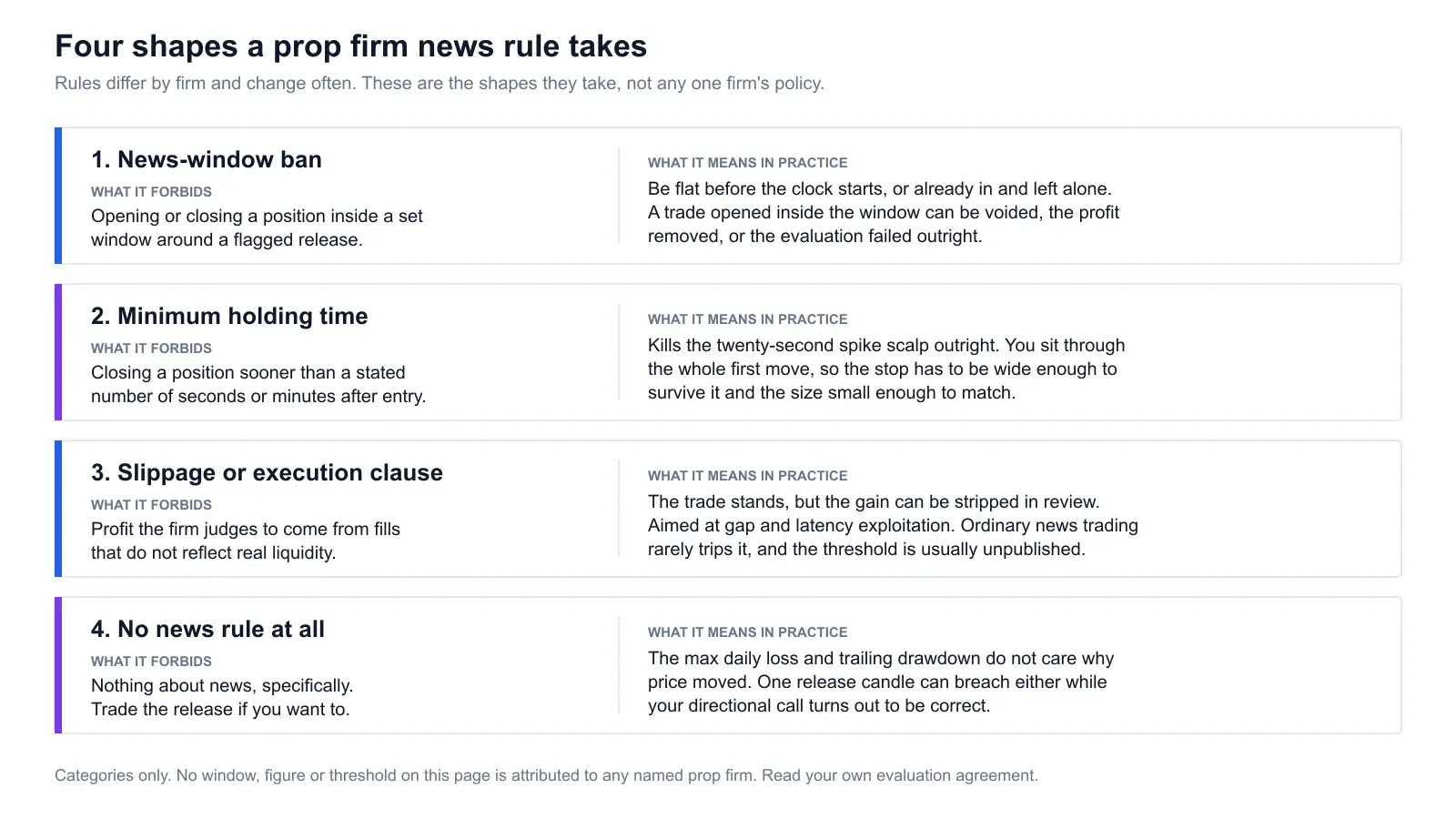
What generalises is the shape of the restriction. There are four of them, they are easy to recognise once you know what you are looking at, and knowing which one you are under tells you exactly what you can and cannot do on a release day. That is the first half of this piece.
The second half is the part most articles on this query skip entirely. The rules that actually end evaluations on CPI and NFP days are not the news rules. They are the max daily loss and the trailing drawdown — limits that say nothing about news, apply every second of every session, and are usually measured on open floating equity. A single release candle can breach one of them while your directional call was correct and your stop was never touched. That failure mode does not care whether your firm permits news trading.
Key Takeaways
- →Sometimes. The restriction takes one of four shapes: a news-window ban, a minimum holding time, a slippage clause, or nothing at all.
- →The rules exist to manage the firm’s execution risk on gap and slippage. They are not there to protect you, which is why they read the way they do.
- →Max daily loss and trailing drawdown fail more accounts on release day than any news rule does — and they usually count open floating loss.
- →A correct directional call can still breach a daily limit, because the first spike routinely goes the wrong way before the real move starts.
- →Search your agreement for: news, high-impact, holding time, slippage, latency, gap, restricted, prohibited strategies. Then get anything ambiguous confirmed in writing.
- →Analysis tools are a different category from execution tools. What firms actually prohibit is copy trading, account sharing and third-party management.
- →During an evaluation, sitting out tier-one releases is frequently the correct trade. The payoff is asymmetric and the downside is terminal.
1. The short answer
Sometimes. There is no industry standard, no regulator setting a baseline, and no default you can assume.
Some firms let you trade whatever you like whenever you like. Some ban opening or closing positions inside a fixed window around flagged high-impact releases. Some impose the restriction only on the funded account and not during the evaluation, which catches people out badly because they build a habit under one rulebook and get paid under another. Some apply it to specific instruments only. Some do not mention news at all but have a slippage clause that does similar work after the fact.
We are deliberately not going to tell you what any named firm’s rule is today. Those rules change, sometimes quietly, and a stale claim in an article is how traders end up arguing a rule they read on a website against a clause they agreed to in a contract. That argument has one outcome.
The only source that counts is the current terms document on your own account dashboard, plus any written clarification you get from support. Screenshot both. If you are still deciding whether to buy an evaluation in the first place, that is a separate question and we have a separate piece on it: are prop firms worth it in 2026. This article assumes you have already decided and now need to know how to survive a release day inside the rules.
One more framing point before the mechanics. Most evaluations run on simulated accounts under a commercial services agreement, not a regulated brokerage relationship. That is why the constraints read like contract terms rather than regulation. Compare it to the securities world, where the US pattern day trader framework was published, identical at every broker, and enforceable through a regulator — and where FINRA has now replaced it with new intraday margin requirements effective 4 June 2026, with a transition period for firms running to 20 October 2027. Prop firm rules have no equivalent public rulebook and no appeal. That is not a scandal. It is just the deal, and it means the reading is on you.
2. Why the rule exists at all
Understand the motive and the wording stops looking arbitrary.
A prop firm is not worried that you will hurt yourself trading NFP. It is worried about its own execution economics. In the seconds around a tier-one print, spreads widen, order books thin out and fills land a long way from where they were requested. If the firm mirrors profitable accounts into a live book — and many do, in some form — then every fill it gave you at a favourable price and could not obtain itself is a loss it absorbs.
Read the four shapes through that lens and each one makes obvious sense:
- News-window bans remove the firm’s exposure to the widest-spread minutes of the week entirely.
- Minimum holding times stop a trader being flat again 15 seconds after the print, which is the pattern that most reliably extracts value from a fill the firm could not have obtained.
- Slippage clauses are a retrospective version of the same thing: they let the firm strip a gain it judges to have come from unrepresentative pricing rather than from a market view.
- Latency and gap clauses target the traders who were genuinely exploiting quote delays, which is a real thing that happens and is why the clause exists.
None of that is about you being safe. Once you accept it, two useful things follow. First, you stop expecting the rules to be fair in the sense of being calibrated to your risk — they are calibrated to the firm’s. Second, you can predict where the ambiguity will be: the clauses are written broadly on purpose, because a precisely defined threshold is a threshold that can be traded right up to.
The practical consequence of vague drafting. If a rule says the firm may void trades that “exploit” latency or “abnormal” market conditions and never defines either word, then you are relying on the firm’s judgement, not on a number. That is a reason to keep your news-day behaviour boring and well inside the spirit of the rule — not because you are afraid, but because there is no upside in being the edge case that gets reviewed.
3. The four shapes a news restriction takes
The hero diagram at the top of this page is the whole taxonomy. Here is each one in more detail, with the failure mode it produces.
Shape 1 — the news-window ban
A fixed window either side of a flagged release during which you may not open a position, and often may not close one either. Three details decide how much this actually restricts you, and all three are commonly under-specified:
- Which calendar defines “high-impact”? If the rule does not name a source, you are guessing about the exact list. Some firms publish their own restricted-event list; some point at a third-party calendar; some leave it open.
- Does it forbid closing as well as opening? This is the one that hurts. A rule that lets you hold through but not exit means an existing position is locked through the most violent minutes of the week.
- Does it apply to positions already open before the window started? Some rules only bite on new entries. Some treat any position open during the window as a violation.
Failure mode: a trader who was flat, entered two minutes before the print because the chart looked good, and did not realise the window had already started.
Shape 2 — the minimum holding time
A stated minimum period between entry and exit. Sometimes it applies to every trade; sometimes only around news; sometimes it is expressed as an average across all trades rather than a per-trade floor, which is a meaningfully different rule and worth checking.
This kills the classic release scalp outright. You cannot take 20 seconds of the spike and leave. You have to sit through the whole first move, which means two things: your stop needs to be wide enough to survive an excursion you cannot manually exit, and your size needs to be small enough that a wide stop is still affordable. If you have never had to place a stop that anticipates being untouchable for several minutes, our guide to stop loss placement methods covers the volatility-based approaches that suit this better than a fixed pip distance.
Failure mode: a trader who sizes for a tight stop, gets the direction right, and is stopped out during the initial noise because the position was never built to survive being held.
Shape 3 — the slippage or execution clause
The subtlest of the four, because it operates after the trade. The firm reserves the right to review and adjust profits that it judges to have come from fills unrepresentative of real tradable liquidity — gaps, latency, or pricing errors. The trade is not blocked; the gain is removed in review.
In practice this is aimed at systematic exploitation rather than at somebody who took a discretionary long on a CPI beat. But because the threshold is almost never published, you cannot know in advance whether an unusually good fill will be flagged. The honest guidance is: do not build a strategy whose edge is the fill quality. If your results depend on getting filled better than the quoted market, you are trading the clause rather than the market.
Failure mode: a trader who passes, requests a payout, and discovers a chunk of the profit was from trades now under review.
Shape 4 — no news rule at all
The most dangerous of the four, precisely because it reads as permission. The firm says nothing about news; you conclude news is fine; you hold a full-size position into NFP.
It is fine, in the narrow sense that no news clause will be enforced against you. It is not fine in the sense that matters, because the daily loss and drawdown limits are still running and they are entirely indifferent to your reasoning. That is section 4, and it is the important one.
4. The rule that actually fails accounts
Every prop firm evaluation has a loss limit. It usually has two: a max daily loss that resets each session, and a total or trailing drawdown that follows your equity high water mark upward and never comes back down.
Two properties of these limits do most of the damage on release days, and neither is obvious from the marketing page:
- They are usually measured on floating equity, not closed trades. An unrealised loss on a position you are still holding counts against the limit in real time. You do not have to take the loss to breach the limit; you only have to have it on screen.
- A trailing drawdown ratchets with your high water mark. Make a good week and the floor rises with you. That means a single bad release day can breach a limit that has quietly moved much closer to your current balance than it was on day one.
Now combine that with how a tier-one release actually behaves. The first move after CPI or NFP is frequently the wrong one. Algorithms react to the headline number, the market then reads the revisions, the core figure, the internals — and reverses. Anyone who has traded a few of these has watched a print produce a hard move in one direction for 60 to 120 seconds and then spend the next hour going the other way, ending exactly where the fundamentals said it should.
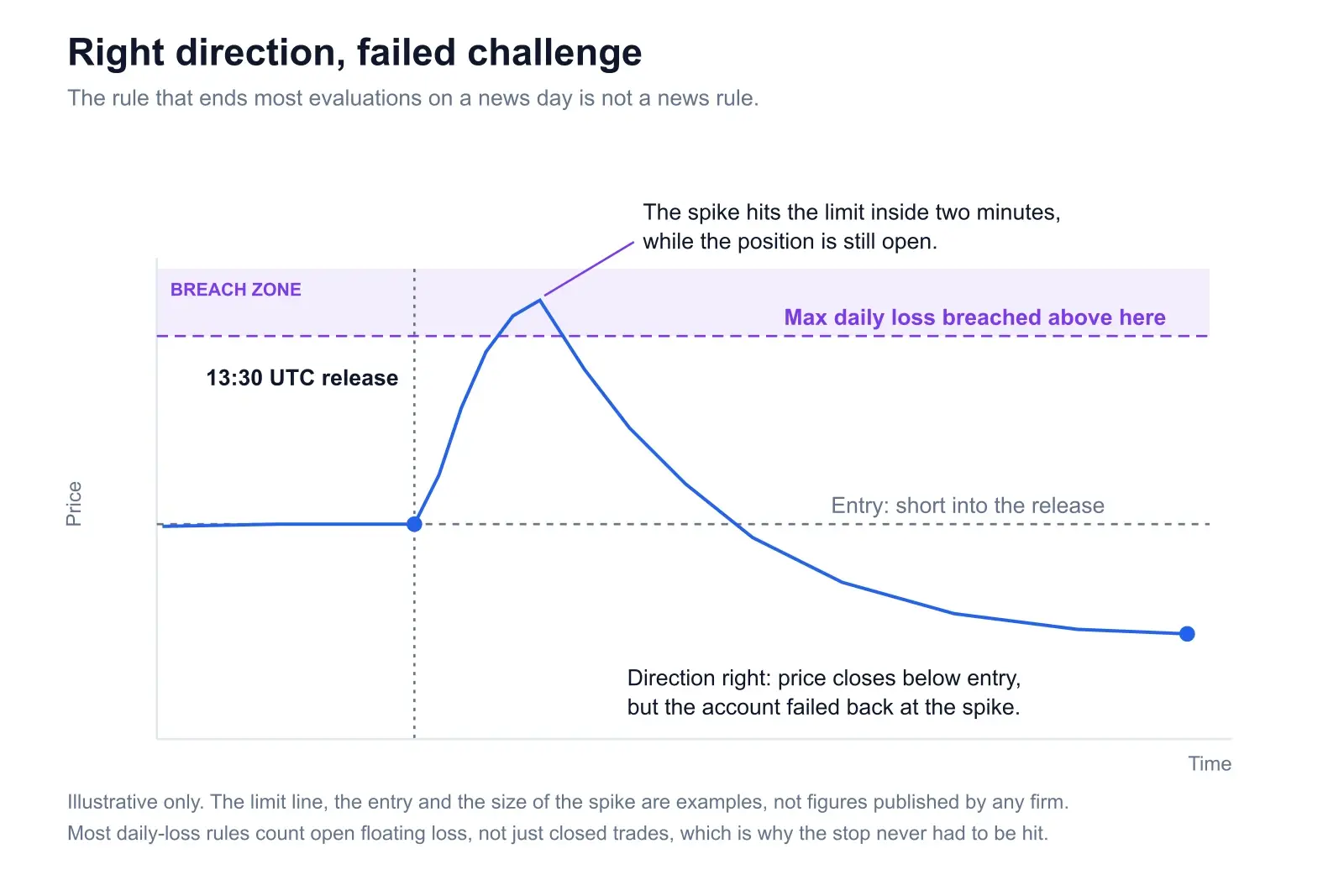
This is the failure people describe as “I was right and I still failed.” They were. It happens because a prop evaluation grades you on path, not on outcome. A retail account with your own money would have shown a drawdown and then a profit. An evaluation account shows a drawdown and then a closed door.
The rule that follows from this: any position held into a tier-one release has to be sized so that the entire plausible spike fits inside your remaining daily loss limit — not just your stop distance. Your stop protects your account balance. It does not protect you from a floating excursion that breaches a limit before the stop fills. Those are two different risks and only one of them is on your chart.
Why a tighter stop is the wrong fix
The instinct is to tighten the stop. It does not work, for two reasons. A stop is an instruction to fill at the next available price once the level trades, and around a release the next available price can be a long way past your level — that is slippage, and it gets worse the tighter your stop is, because tight stops sit inside the noise band where the book is thinnest. Second, if your limit is measured on floating equity, the breach can register before the fill does.
The fix is size, every time. Half the position with double the stop distance carries the same risk in dollars and a far better chance of surviving the excursion. Our worked examples on risk-reward ratios go through the arithmetic of that trade-off with numbers attached.
5. How to read your own rulebook
Twenty minutes with the terms document, once, before you place a trade. Do it properly and you never have to wonder again.
Open the current version from your account dashboard — not a PDF someone posted on a forum, not a cached copy, not the version you downloaded when you bought the challenge. Then text-search for each of these terms in turn:
| Search term | What you are looking for |
|---|---|
| news / high-impact | The window itself, and which calendar or event list defines “high-impact”. |
| holding time / holding period | Minimum hold, and whether it is per-trade or an average across all trades. |
| slippage / latency / gap | The retrospective clause that lets profit be removed in review. |
| daily loss / drawdown | Whether it counts floating equity or closed balance, and when the daily figure resets. |
| trailing / high water mark | Whether the drawdown floor ratchets with profit, and whether it stops trailing at any point. |
| prohibited strategies | Copy trading, group trading, hedging across accounts, arbitrage, third-party management. |
| expert advisor / EA / automated / algorithm | Whether automation is allowed at all, and whether AI is named separately. |
| weekend / overnight / rollover | Holding restrictions that interact badly with a Friday release. |
The four questions you must be able to answer
Write these down in your own words. If you cannot, you have not finished reading.
- How wide is the window, and from which calendar? Minutes or seconds, before and after, and whose event list defines the trigger.
- Does it forbid opening only, or closing too? A rule that also forbids closing changes your whole pre-release routine, because it means you cannot manage a position that is already on.
- Does it apply to the evaluation, the funded account, or both? Firms frequently restrict news only on the funded side. Do not build a habit in phase one that fails you in month one.
- What is the stated consequence? There is a large practical difference between voiding the trade, removing the profit, and failing the account.
Anything that is genuinely ambiguous — and there will be something — goes to support in writing. Email or a ticket, never live chat you cannot export. Keep the reply. It will not override the contract, but a written answer from the firm is dramatically better evidence than your recollection of a blog post.
6. Trading a release day inside the constraints
Assume you now know your rule. Here is how the day is structured, and where each clock bites.
Before the session
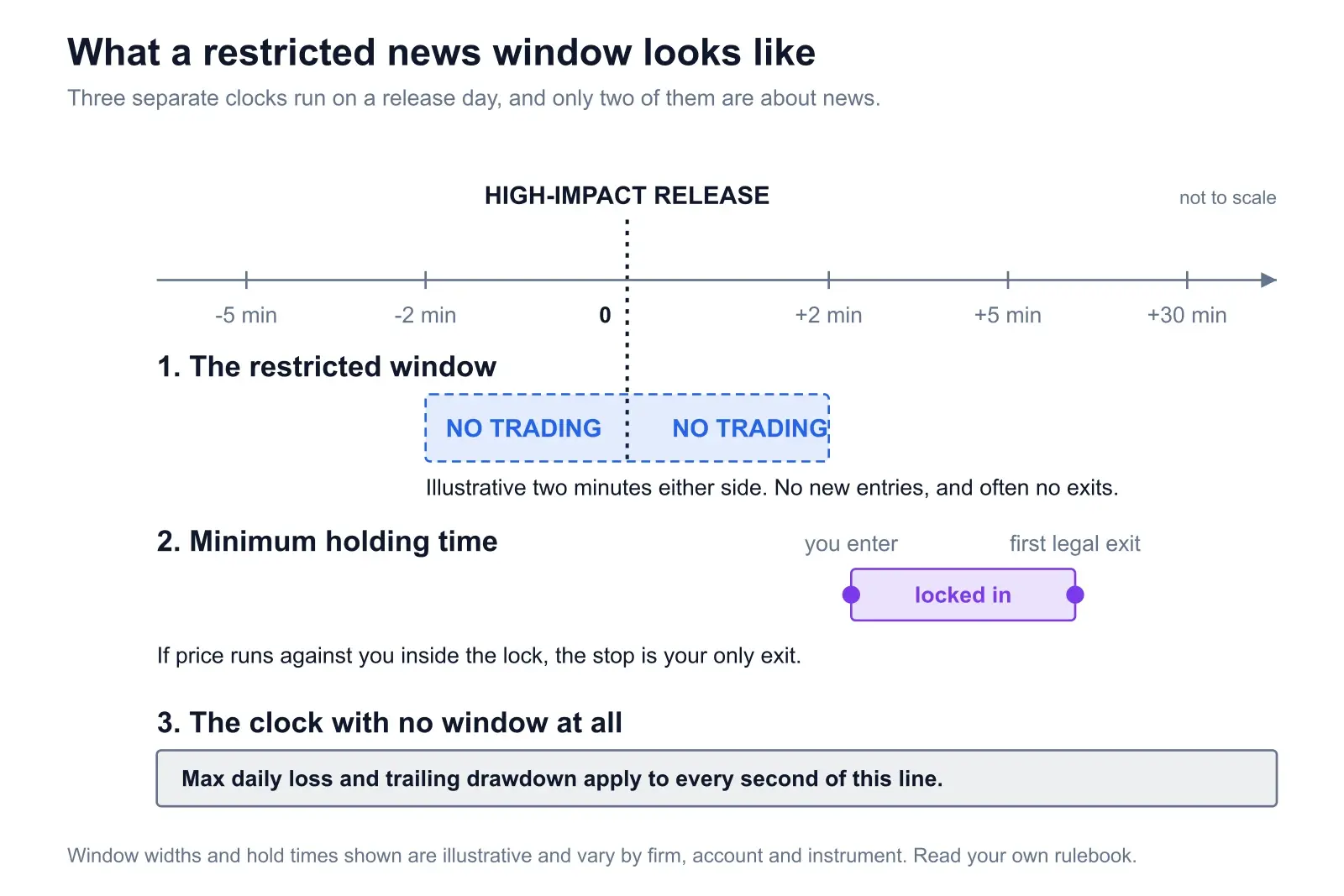
- List the releases and their exact times in UTC. US CPI and the employment situation report land at 08:30 Eastern, and the Bureau of Labor Statistics publishes the schedule a year ahead. There is no excuse for being surprised by a scheduled print.
- Convert the window to clock times and set an alarm for the start, not the release. The window opens before the print. That is the moment your behaviour has to change.
- Check what you are already holding. A position opened yesterday on a correlated pair is still exposure. If your rule bans closing inside the window, decide before the window whether that position stays or goes.
- Know your remaining daily loss headroom as a number, in account currency. Not a percentage, a number. Percentages do not stop you from clicking.
Around the print
If your firm bans the window, this part is easy: you are flat or untouched, and you do something else for a few minutes. If it does not, the decision is yours, and here is the honest version of it.
Entering before a print is a coin flip with a variable payoff, dressed up as analysis. The direction depends on the gap between the number and consensus, which nobody knows, and on how the market was positioned going in, which you cannot observe. If you want to trade the event, the higher-quality version is to wait for the first move to complete and trade the reaction — the mechanics of which we cover in how to trade NFP, CPI and FOMC. That approach also happens to sit better with a minimum holding time, because you are entering after the worst of the spread and volatility, so the position you are locked into is a calmer one.
Which instruments the release actually reaches
A US inflation print does not hit every symbol equally, and knowing the spread of impact is how you avoid taking three positions that turn out to be one position. Dollar pairs move most, gold and index products move on the rate-path implication, and the crosses that contain neither currency often barely register. We measured the dispersion in which pairs move most on CPI, and the broader tiering of events is in the high-impact news events that actually move price.
This matters more in an evaluation than in a normal account, because correlated positions stack against a single daily loss limit. Three dollar-short trades on a CPI day are not diversification. They are one trade at triple size, and the limit will treat them accordingly.
The case for sitting out
During an evaluation, this is frequently the right answer, and it is worth stating plainly because nobody selling a course will say it.
The payoff is asymmetric. A good release day moves you a few percent closer to a profit target you probably have weeks to reach. A bad one ends the attempt and the fee with it. Release-day volatility raises the variance of both outcomes symmetrically, but your exposure to those outcomes is not symmetric at all — upside is incremental, downside is terminal. Adding variance to a game scored that way is a bad trade regardless of your edge.
The traders who pass evaluations repeatedly tend to be dull about this. They treat tier-one windows as scheduled downtime and take their ordinary setups in the other 90 percent of the week. That is not caution as a personality trait. It is recognising that the challenge is scored on survival first and profit second.
7. Size for the drawdown, not for the target
Most people size a prop challenge backwards. They start from the profit target, work out how many wins they need, and pick a size that gets them there. That is how you end up with a position that cannot survive a Tuesday.
Size from the constraint instead. The binding number is not the target, it is the remaining daily loss headroom — and on a release day the relevant question is not “what if my stop is hit?” but “what is the worst floating excursion this position could show before the market decides?”
A workable sequence for a release-day position, if you are taking one at all:
- Write down your remaining daily loss in account currency. Today’s number, after any losses already taken.
- Decide what fraction of it you are prepared to expose to one release. A quarter is defensible. A half is aggressive. All of it is not a plan, it is a bet.
- Estimate the worst plausible excursion, not the average one. Look at what the same release did to the same instrument on its last few prints. Use the largest, not the typical.
- Solve for position size. Exposure budget divided by excursion distance. The answer is often uncomfortably small, and that is the honest output rather than an error.
- Place the stop outside the excursion, not inside it. A stop that sits inside the expected noise is a donation.
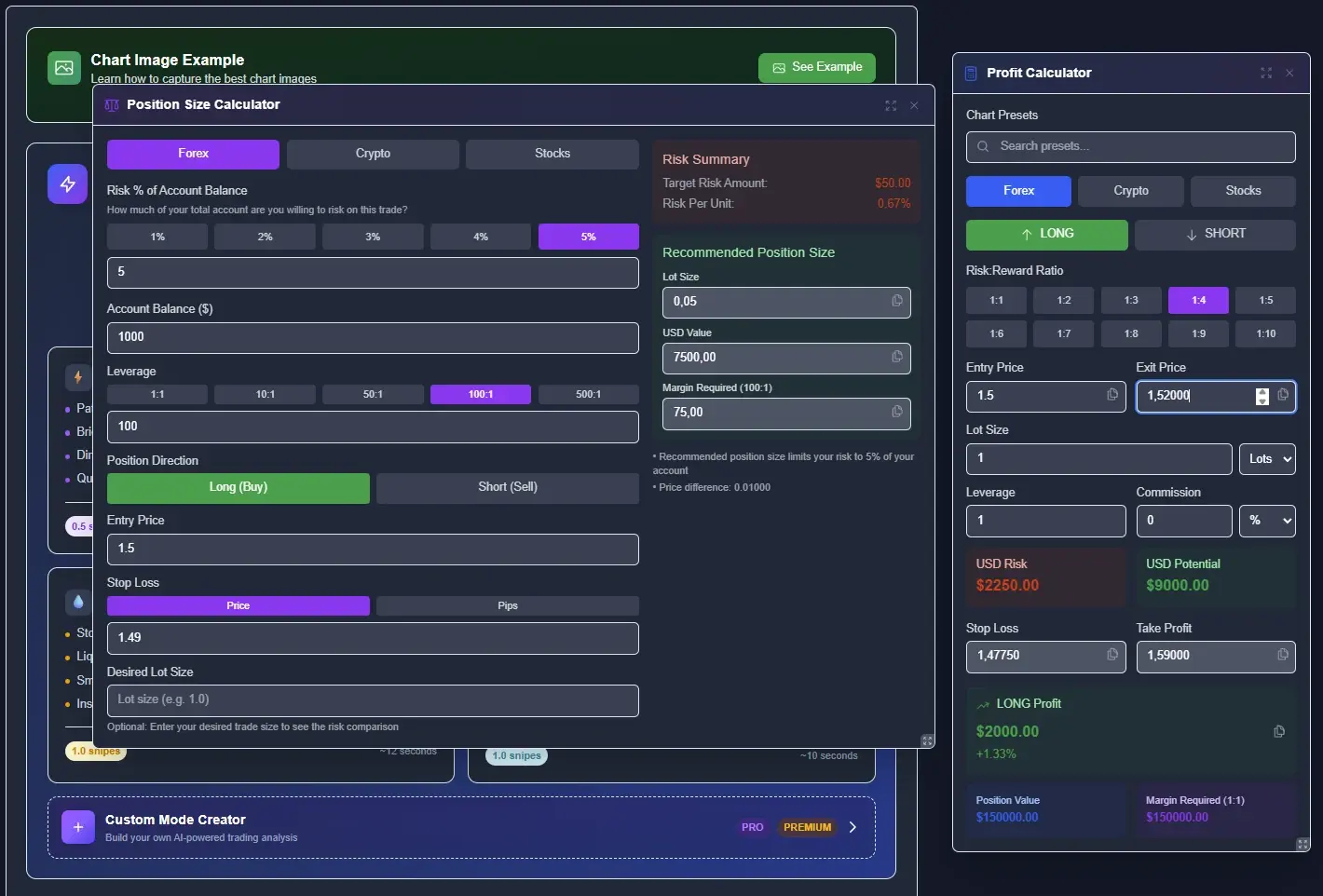
One small note on that screenshot, since the panel offers risk presets up to 5 percent: those are the tool’s options, not a recommendation. Inside an evaluation with a daily loss limit, single-trade risk of that size on a release day is how the diagram in section 4 happens to you.
8. Can you use AI in a prop firm challenge?
This is a real search with a real answer, and the answer is: it depends what the AI touches.
Prop firm agreements are generally not written around the word “AI” at all, which is why searching for it returns nothing useful. They are written around execution and control. The prohibited-strategies section is where the answer lives, and what it typically prohibits is:
- Copy trading — mirroring trades between accounts, whether yours or someone else’s.
- Group or signal-service trading — many funded accounts placing the same trade at the same second, which is the pattern firms detect and act on.
- Account sharing or third-party management — anyone other than the account holder trading the account.
- Latency, arbitrage and gap exploitation — strategies whose edge comes from the price feed rather than the market.
- Automated systems, sometimes — some firms permit expert advisors, some restrict them, some allow them only if you built them. This one genuinely varies and must be checked.
An analysis tool sits outside all of that. If a tool reads a chart screenshot and tells you it looks like a bear flag, or summarises tonight’s calendar and tells you which currencies are exposed, it has done the same job a research note does. It has not placed an order, it does not hold your credentials, and the decision to click buy remains entirely yours. That is a materially different thing from a bot with API access.
Where ChartSnipe sits, stated plainly. ChartSnipe is analysis only — no API, no broker connection. It cannot place a trade, cannot connect to a prop account and has no way to touch an order. That is a fact about the product, not a claim that any firm approves it. No prop firm has certified ChartSnipe or any other analysis tool, and we are not going to pretend otherwise. If your agreement has a clause about third-party tools, read it and ask support if it is unclear.
The useful test, when you are unsure about any tool: did the tool make the decision, and did the tool execute it? If the answer to both is no, you are almost certainly in the same category as a trader reading a bank research note. If the answer to either is yes, you are in the territory the prohibited-strategies section was written for, and you need explicit permission rather than a reasonable inference.
One more thing worth saying, since this corner of the market attracts a particular kind of marketing: an AI tool that promises to pass your challenge for you is either automating your account, which is the thing most likely to get you removed, or lying. The CFTC’s retail forex material is a reasonable primer on what the regulated side of this market looks like and which claims are red flags.
9. Knowing what lands inside your window
Everything above reduces to one operational habit: know, before the session starts, which releases land in your trading window and which instruments they reach.
That is not an edge. Nobody passes an evaluation because they read a calendar. It is risk avoidance — the difference between deciding in advance not to be exposed at 13:30 and discovering at 13:31 that you were. In an evaluation, avoiding one terminal day is worth more than several good ones.
A free calendar does the timing half of this perfectly well. Forex Factory tiers events by impact and shows the consensus figure next to each one; the BLS release schedule is the primary source for the US prints that matter most. Between them you can build the timing map in ten minutes a week.
The half a calendar does not do is the second question: which instruments does this reach, and what breaks if it surprises? That is what the Risk Analysis section of the News Impact analysis is for — scenarios tagged High, Medium or Low severity, each with the trigger, the expected market impact and the specific pairs it would hit as tags.
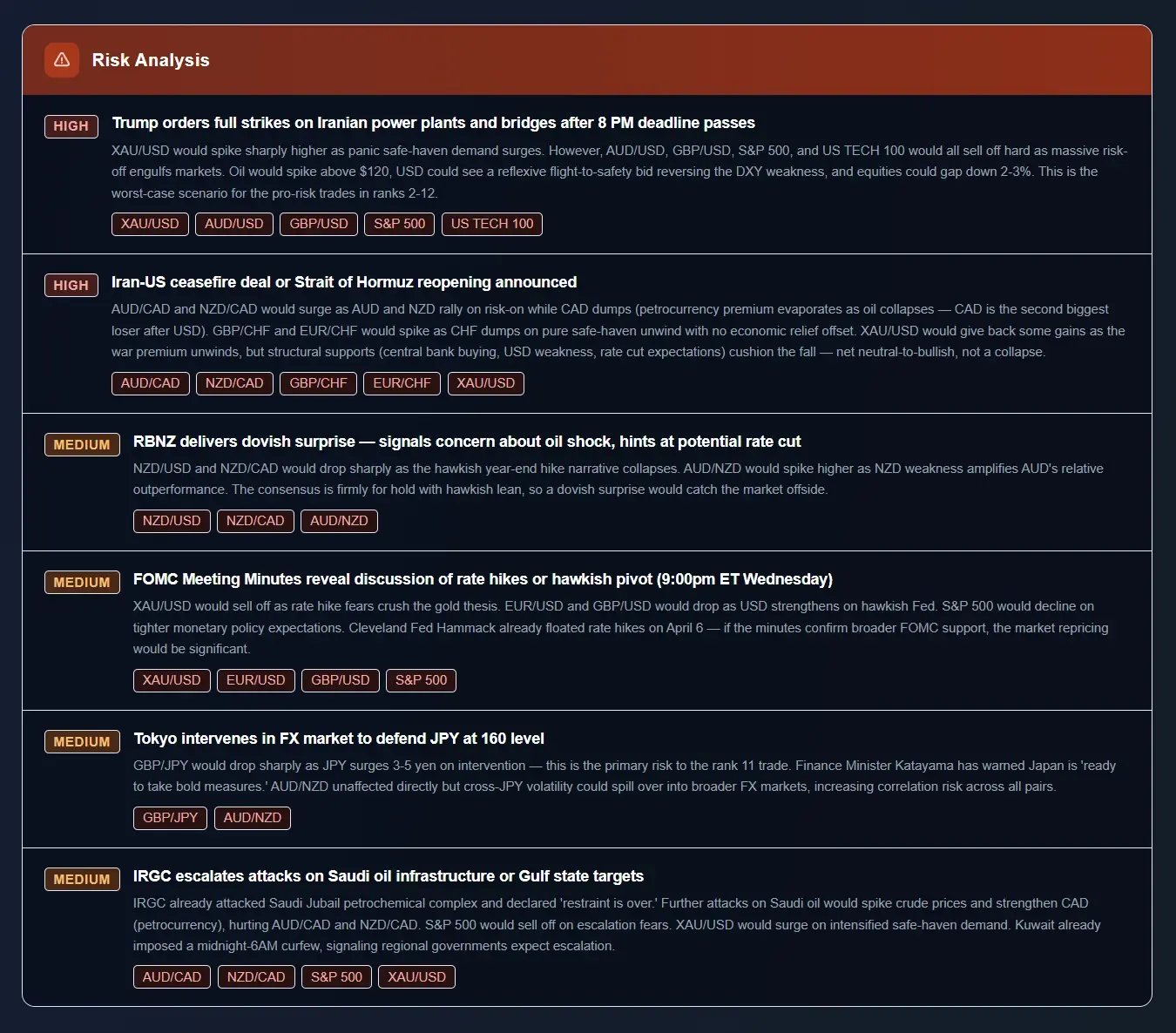
Used properly during an evaluation, that list is a stand-down list rather than a trade list. You read the High-severity scenarios, check whether anything you hold appears in the tags, and reduce or close before the window. That is the entire workflow, and it takes about two minutes.
The News Impact page also carries an economic calendar widget with Low, Medium and High impact levels alongside the analysis, so the timing map and the exposure map are in the same place. It publishes Monday to Friday between 20:00 and 23:00 UTC for the upcoming session, which is the only useful publication time for this purpose — a scenario list that arrives after the release is a post-mortem. It is an in-app page rather than an email, the full analysis sits on the Pro and Premium plans, and free accounts see an admin-featured past-day preview so you can judge the format first.
To be clear about what this is and is not: it will not tell you whether your firm allows news trading, and it will not stop you breaching a daily loss limit. It tells you what is scheduled, what it is likely to reach, and what would break if it surprises. The decision to stand down is still yours to make.
Frequently asked questions
Can you trade news in a prop firm challenge?
It depends entirely on the firm, and there is no industry standard. Where a restriction exists it takes one of four shapes: an outright ban on opening or closing positions inside a window around flagged high-impact releases; a minimum holding time that stops you scalping the spike; a slippage or execution clause that lets the firm strip profit it judges unrepresentative of real liquidity; or no news rule at all. Some firms restrict news only on the funded account and not during the evaluation, or only on certain instruments. The only reliable answer is in your own written agreement, and it can change between the day you buy the challenge and the day you trade it.
Why do prop firms restrict news trading at all?
Because the firm is managing its own risk, not protecting you. Around a high-impact release spreads widen, liquidity thins, and orders fill well away from where they were requested. A firm that mirrors profitable accounts into a live book eats the difference between the fill it gave you and the fill it got. Minimum holding times exist for the same reason — a trader who is flat again 15 seconds after the print has extracted value from a fill the firm may not have been able to obtain. The rules are about execution economics. Reading them as investor protection leads you to the wrong conclusions about what is allowed.
What actually fails most prop firm accounts on a news day?
The max daily loss and the trailing drawdown, not the news rule. Both are usually measured on open floating equity rather than closed trades, so an unrealised loss counts against the limit in real time. A CPI or NFP print routinely produces a violent initial move one way before reversing and settling the other. If you were positioned for where price ended up but the first spike went against you, the account can breach while the call was right and the stop was never touched. Any position held into a tier-one release has to be sized so the whole spike fits inside the daily loss limit, not just the stop.
How do I find the news trading rule in my prop firm agreement?
Open the current terms document and text-search these one at a time: news, high-impact, economic calendar, holding time, holding period, slippage, latency, gap, restricted, prohibited strategies, hedging. Then answer four questions in writing. Is the window measured in minutes or seconds, and from what source calendar? Does it forbid opening only, or closing as well? Does it apply to the evaluation, the funded account, or both? What is the stated consequence — void the trade, remove the profit, or fail the account? If the document does not answer all four, ask support in writing and keep the reply. Blog posts, including this one, are not a defence in a rule dispute.
Can you use AI in a prop firm challenge?
Generally yes for analysis tools and generally no for anything that executes on your behalf or shares control of the account — but confirm it against your own agreement. What firms overwhelmingly prohibit is copy trading between accounts, group signal-following that produces identical trades across many funded accounts, account sharing or third-party management, and latency or arbitrage exploitation. A tool that reads a chart or summarises a calendar and hands you an opinion is in a different category, because it never touches the account. The distinguishing question is not whether AI was involved. It is whether the decision and the execution were yours.
Is it better to just sit out news during an evaluation?
During an evaluation, usually yes. The payoff is asymmetric: a good day moves you a few percent closer to a profit target you probably have weeks to hit, while a bad day ends the attempt and the fee with it. Release-day volatility raises the variance of both outcomes, and you do not want variance when the downside is terminal. Traders who pass consistently tend to treat tier-one release windows as scheduled downtime and take their ordinary setups in the other 90 percent of the week. Sitting out is not weakness — it is recognising that the challenge is scored on survival first and profit second.
Do the SEC or FINRA day trading rules apply to a prop firm challenge?
Usually not, and that is why prop firm rules feel arbitrary. Most evaluations run on simulated accounts under a commercial services agreement, not a regulated brokerage relationship, so the constraints are contract terms rather than regulation. The contrast is instructive: the US pattern day trader framework was publicly documented and applied identically at every broker, and FINRA has replaced it with new intraday margin requirements effective 4 June 2026, with a firm transition period running to 20 October 2027. Prop firm rules have no equivalent public rulebook, no notice period and no regulator to appeal to. Which is exactly why you read the agreement rather than the marketing page.
Does a stop loss protect you from breaching a daily loss limit on news?
Not reliably. A stop is an instruction to fill at the next available price once a level trades, and around a release the next available price can be a long way past your level. That is slippage, and it is normal rather than a broker conspiracy. There is a second problem: if your daily loss limit is measured on floating equity, it can be breached by an unrealised excursion before the stop even fills. The fix is not a tighter stop, which slips worse because it sits inside the noise band, but a smaller position, so the worst plausible excursion still sits comfortably inside the limit. Size is the only control you fully own on a release day.
Sources & further reading
- → SEC Investor.gov — pattern day trader — the definition, the historical $25,000 minimum equity requirement, and the note that FINRA’s new intraday margin requirements take effect 4 June 2026 with a transition period to 20 October 2027.
- → FINRA — frequent intraday trading: understanding the basics — margin account mechanics and the house requirements brokers may impose above the regulatory minimum.
- → CFTC — foreign currency trading — how retail forex is regulated in the US, the registration and disclosure requirements, and the fraud advisories that go with them.
- → Bureau of Labor Statistics — news release schedule — exact dates and times for CPI and the employment situation report, published a year in advance.
- → Forex Factory — economic calendar — the retail standard for impact tiering, and the calendar many firms’ restricted-event lists are informally benchmarked against.
Note on named firms: this article deliberately names none. Prop firm rules change frequently and vary by account type, so any specific figure quoted here would be stale before you read it. Every window width, hold time and limit level shown in the diagrams is illustrative and is not attributed to any firm.
Know what lands in your window before the session opens
News Impact publishes Monday to Friday between 20:00 and 23:00 UTC for the upcoming session: an economic calendar widget with Low, Medium and High impact levels, and a Risk Analysis list of scenarios tagged by severity with the exact instruments each one would hit. During an evaluation, use it as a stand-down list rather than a trade list. Full analysis is on Pro and Premium.