
The AI Tools Traders Actually Use in 2026
Ignore the ads promising an AI that trades your account while you sleep. The tools working traders actually keep open fall into a handful of honest categories — and the ones who get value combine them into a stack instead of hunting for one magic app.
Search “best AI trading tools” and the first page is a wall of products promising a bot that turns your deposit into a salary. Almost none of them deliver, and a decent share are outright scams. But underneath the noise there really is a set of AI tools that serious traders use every session — they just look nothing like the ads. They do not place trades. They do not guarantee anything. They compress the research: reading a chart faster, ranking the day's catalysts, telling you which currency is actually strong. That is the honest version of AI in trading, and it is genuinely useful.
The mistake almost everyone makes is looking for the one app that does it all. There isn't one, and the emerging best practice in 2026 is not a single product but a multi-model, multi-tool workflow — a generalist LLM for concepts and journaling, a purpose-built chart-analysis AI for the actual read, a news and economic-calendar layer, a currency-strength scanner, and something to keep your risk and journal honest. Each category is good at exactly one thing and useless at the others. This piece walks through all of them: what each is genuinely for, what is just marketing, and how to assemble a stack that helps without pretending to be a money printer.
The research layer referenced throughout is ChartSnipe — the purpose-built tool in this stack, used the way it is meant to be used: it reads the chart, scores the news and scans strength, while you keep the size, the stop and the decision.
Key Takeaways
- →“AI trading tool” splits into three honest categories: signal bots (mostly junk), generalist LLM helpers (great for thinking, blind to price), and purpose-built research AI (the useful middle).
- →The winners in 2026 run a stack, not a single app — a multi-tool workflow where each layer does one job well.
- →LLMs like Claude, ChatGPT and Gemini are for concepts, checklists and journaling — not for reading a live chart, which they cannot actually see.
- →A purpose-built chart AI, a daily news-impact read and a currency-strength scanner cover the parts an LLM can't: the price, the driver and the instrument.
- →Any tool that guarantees returns or won't show its reasoning is marketing. The CFTC has said it plainly: AI cannot predict the future.
1. The three honest categories
Before you can pick tools, you have to sort them. Almost everything marketed as an “AI trading tool” falls into one of three buckets, and they are wildly different in how much they can actually help. Get the categories straight and most of the buying decision makes itself.
Signal bots and auto-traders. The loudest category and the one to treat with the most suspicion. These promise to generate winning signals or trade your account outright, usually alongside a win-rate that no honest system advertises. The CFTC has issued a plain-language caution that AI cannot predict the future of prices, and the SEC, FINRA and NASAA have all flagged AI-flavoured fraud — guaranteed returns, fabricated profit dashboards, and silence about custody or API keys are the classic tells. Some tools in this bucket are merely useless; a meaningful share are scam-adjacent. If you want the full checklist of warning signs, the AI trading scam red flags guide lays them out.
Generalist LLM helpers. Claude, ChatGPT and Gemini. These are real, powerful and cheap — but they are general-purpose reasoning engines, not market tools. They cannot see a live price and will happily hallucinate a chart pattern from a screenshot. Used for what they are good at, they are the most useful $20 in the stack. Used as a market oracle, they lose money.
Purpose-built research AI. The useful middle, and the least hyped. Tools built specifically for the trading read: analysing a chart screenshot against visible structure, ranking the day's news impact, scoring currency strength, sizing a position. They do not promise to trade for you, which is exactly why they are worth paying for. For a deeper split of these three, the pillar post on whether AI trading actually works goes further than we can here.

2. Generalist LLMs — great for concepts, blind to price
A large language model is the single most useful general tool a trader can add, and the one most often misused. Where it earns its keep is language and logic: explain what a fair value gap actually is, turn a vague strategy idea into a written checklist, pressure-test the assumptions behind a trade, draft the pseudo-logic for a backtest, or interrogate your own journal for patterns you keep repeating. It is a tireless, well-read study partner. That is not a small thing — most retail traders lose to psychology and inconsistency, and an LLM is a genuinely good tool for building the process that fixes both.
What it cannot do is see the market. An LLM has no live price feed, so it does not know where gold or EUR/USD is trading right now unless you tell it. And when you paste a chart screenshot, image reading is still its weakest link: it will describe candles that are not on the chart, invent a support level, and state it all with total confidence. That confidence is the danger. A tool that is wrong and unsure is easy to ignore; one that is wrong and certain talks you into trades.
The 2026 nuance is that the models have specialised. The rough consensus among traders who use them daily: Claude tends to be the most careful at following a structured rule set, Gemini is strongest when you want it tied to real-time news, and ChatGPT is the reliable all-rounder for data and drafting. That is why the workflow is multi-model — you route the task to the model that fits it. We put all three head-to-head on real charts in this comparison, and the short version is that none of them should be your chart reader.

LLMs are great for
- Explaining concepts and strategies
- Building checklists and trade plans
- Journaling prompts and self-review
- Drafting and debugging backtest logic
LLMs are bad at
- Knowing the current price of anything
- Reading a chart image accurately
- Naming levels that actually exist
- Admitting when they are guessing
3. Purpose-built chart-analysis AI
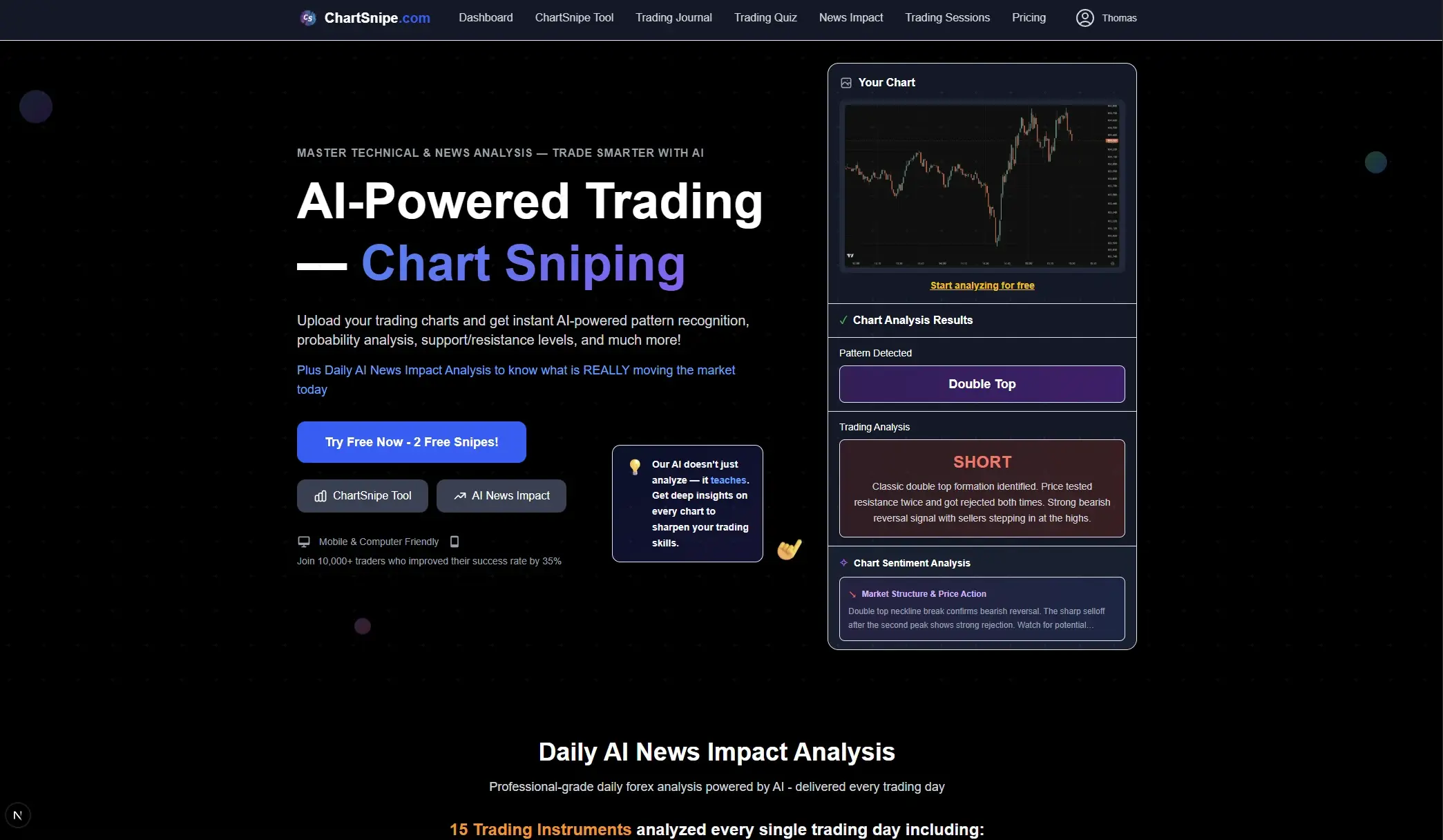
This is the layer that fixes the LLM's blind spot. A purpose-built chart-analysis AI is trained and constrained to read a chart the way a technical trader does — grounded in the price structure actually visible in the image, not in a plausible-sounding story. You screenshot a setup, and instead of a paragraph of confident fiction you get a structured read: the pattern, a directional bias, candidate entry, stop and target, and the reasoning tied to levels that are genuinely on the chart. The difference from pasting the same screenshot into a chatbot is night and day, because the tool is doing one job and is built not to wander off it.
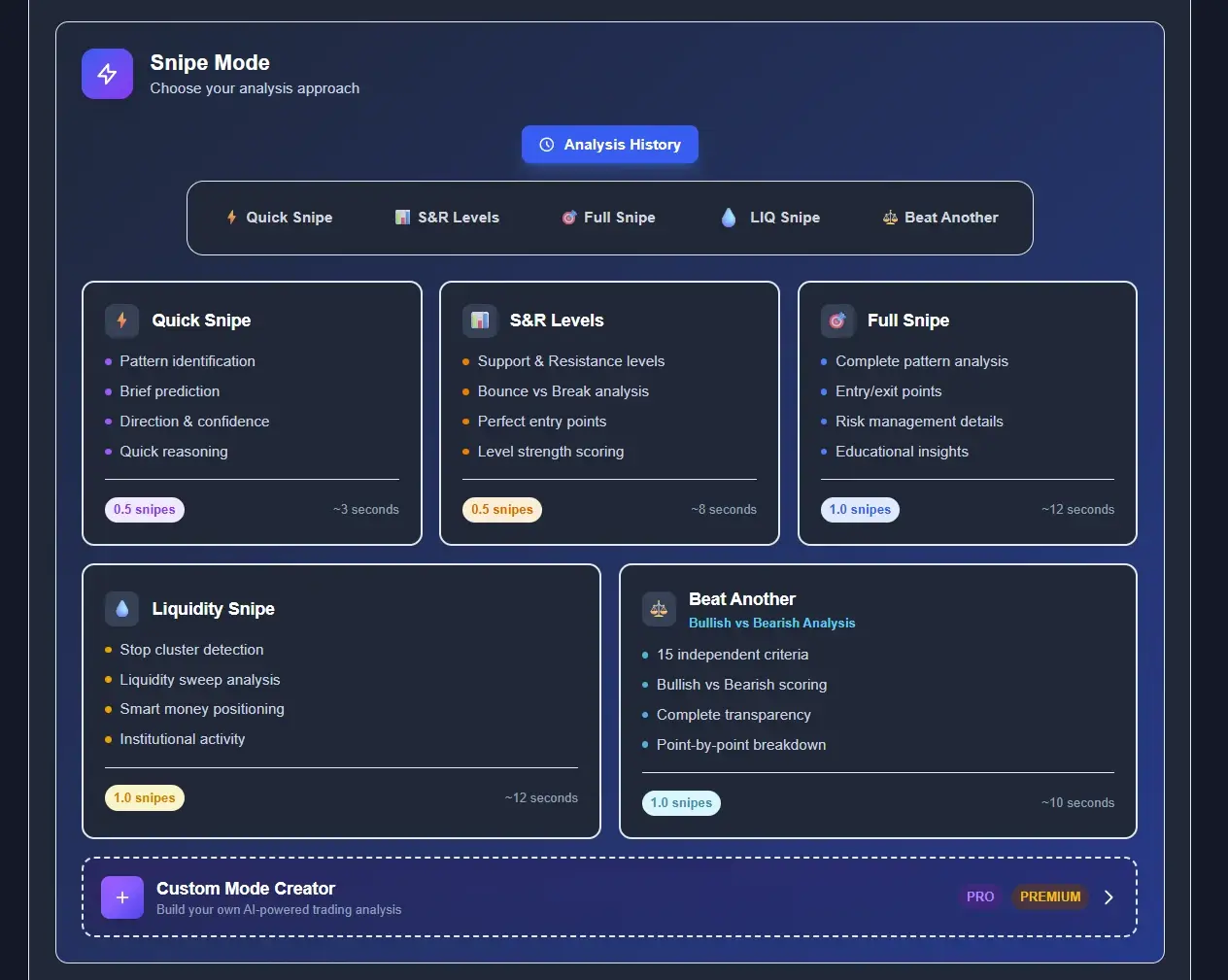
ChartSnipe is the purpose-built research layer this article keeps pointing at, and the reason it earns the slot is the range of reads it gives from one screenshot. It runs five analysis modes: Quick Snipe for a fast triage, S&R Levels for the map of support and resistance, Full Snipe for the complete readout of pattern, entry, stop, target and reasoning, Liquidity Snipe for the smart-money view of sweeps and order blocks with a setup score out of ten, and Beat Another for a deliberate second opinion on a trade you already have. It is backed by live prices for 28 FX pairs plus gold, so the read is anchored to where the market actually is. Try it on your own chart in the chart analysis tool.
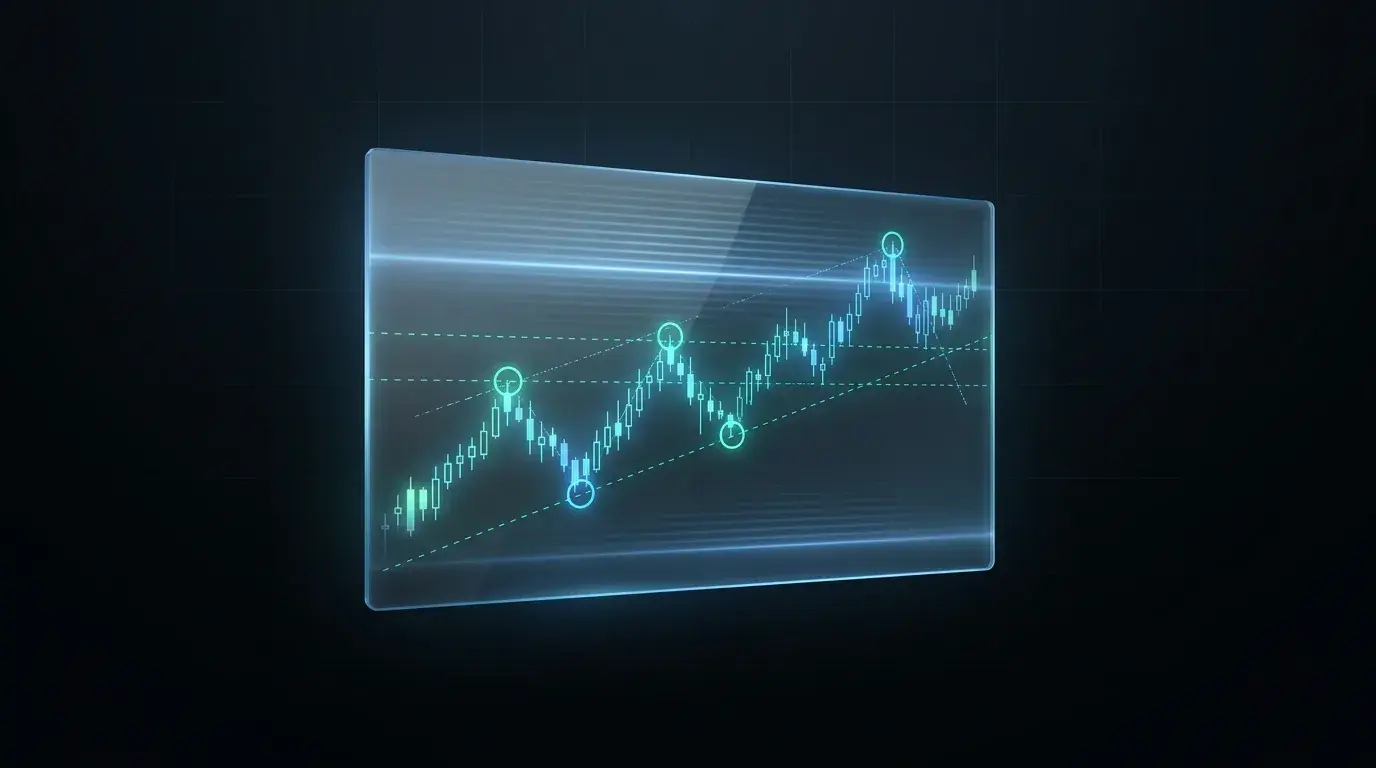
The honest limit. Even a purpose-built chart AI is a read, not a verdict. It sees the structure well; it does not know your risk tolerance, your open positions, or the headline about to hit. Treat its output as a fast, disciplined analyst's opinion — the start of your decision, not the end of it.
4. AI news and economic-calendar tools
A chart tells you where price has been. It says nothing about the CPI print due in three hours or the central-bank headline that just crossed. That gap is where most technically-clean trades die, and it is exactly what an AI news layer is built to close. The job is not to read you the calendar — anyone can do that — but to translate a day's scheduled events and live flow into a bias: which instruments are catching a bid, which are under pressure, and why.
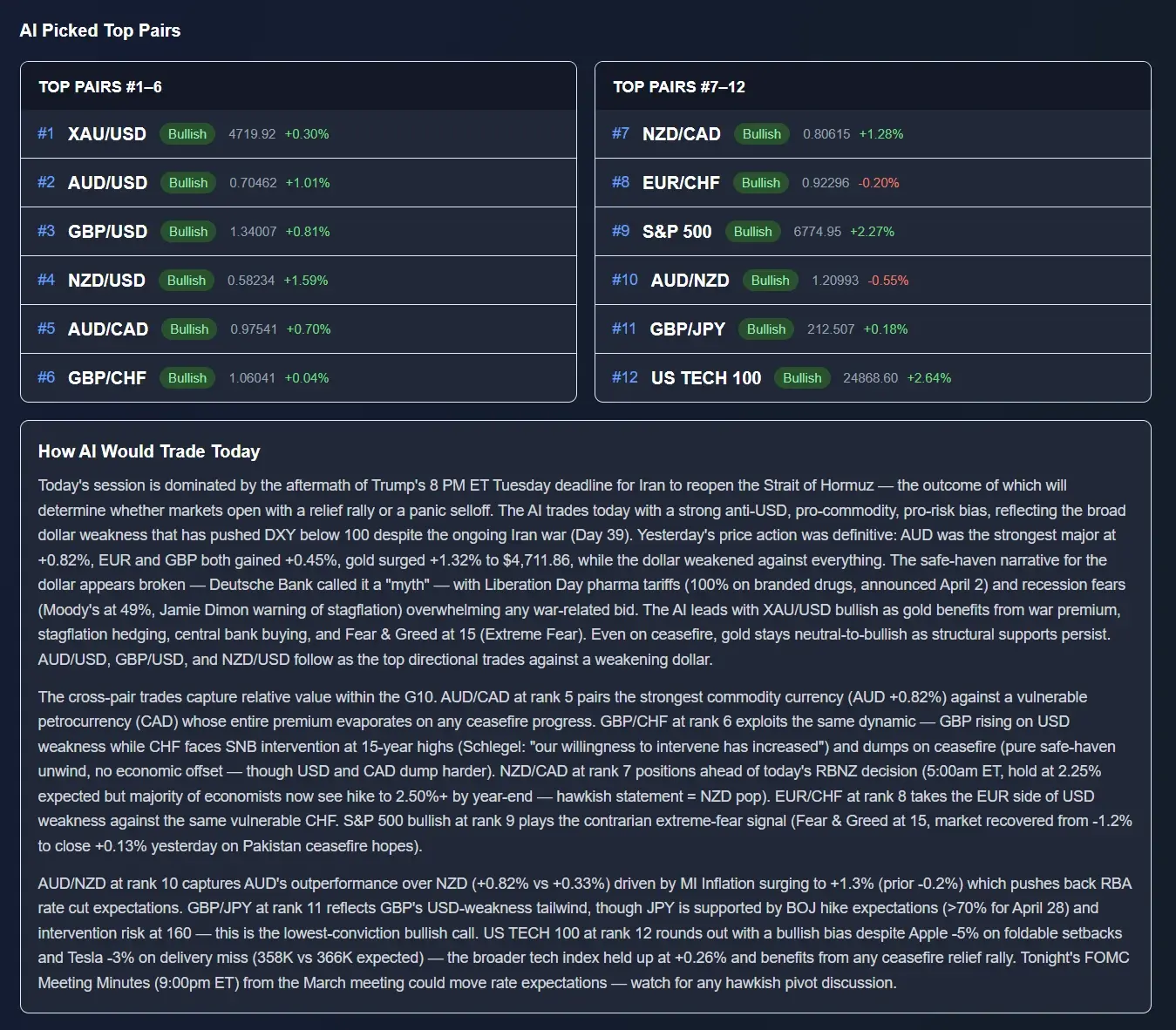
ChartSnipe's Daily AI News Impact is this layer in the stack. Each morning it ranks the top bullish and bearish instruments with a conviction score and the specific drivers behind each call, then adds a “How AI Would Trade Today” view so the read turns into a plan rather than a headline dump. In mid-2026 that context matters more than usual: a hawkish Fed, inflation running hot on the oil shock, a dollar back above 100, and gold whipping around after its January record all mean the macro flow can override a chart in a single candle. Knowing which side of that flow you are on before you click is the whole point.
5. Currency-strength and multi-pair AI
Most FX traders stare at one pair and miss the obvious question: is this a story about the base currency or the quote? A currency-strength engine answers it by scoring all eight majors — USD, EUR, GBP, JPY, CHF, AUD, CAD, NZD — against each other, so you stop trading a chart in isolation and start pairing the strongest currency against the weakest. If the dollar is broadly bid and the yen is broadly offered, that is a cleaner reason to be long USD/JPY than any single candle. It is the difference between picking a pair and picking a trade.
ChartSnipe's currency strength index does this scan continuously, and it pairs naturally with the news layer: strength tells you which currency is moving, the news read tells you why, and the chart tool tells you where to get in. That sequencing — driver, instrument, entry — is what a multi-pair AI is actually for. It is not a signal; it is a way to point your attention at the two or three instruments worth a screenshot today instead of doom-scrolling twenty charts. For the mechanics of reading one, the currency strength meter guide goes step by step.
6. AI in journaling and prop-firm risk
The least glamorous category is the one that actually saves accounts. Trading is lost far more often to sizing and discipline than to a bad chart read, and this is where AI-adjacent tooling quietly does its best work. A position-size calculator that turns your account, risk percent and stop distance into a lot size is not fancy, but running it on every trade is the single habit that separates traders who survive a volatile year from those who don't. ChartSnipe bundles position-size and profit calculators for exactly that reason.
A trading journal is the other half. Logging every trade — setup, size, outcome, and what you were thinking — is where the real feedback loop lives, and pairing that log with an LLM to surface your recurring mistakes is one of the highest-value uses of AI in the whole stack. On the prop-firm side, the same technology now runs against you: after the wave of firm collapses in 2024, the survivors deploy AI real-time risk monitoring that flags Martingale, grid and HFT behaviour and enforces the rules automatically, with KYC and AML now standard. If you trade a funded account, understanding that the evaluator is watching with its own AI is part of the game.
One line worth internalising. Trading your own money with AI research tools needs no license and breaks no rule — the regulated activity is managing other people's money or selling signals with performance claims. The moment a tool promises returns, you have left the research aisle and walked into the marketing one.
7. Building your own AI trading stack
Put the categories together and a stack falls out naturally — and it is smaller and cheaper than the marketing wants you to believe. You do not need a wall of subscriptions. You need one tool covering each job, and for most retail traders that is two products, not ten.
A workable 2026 stack runs like this. Start the day with the news read to find the macro flow and a shortlist of instruments. Cross it with the currency-strength scan to pick the cleanest pair. Screenshot that chart into the purpose-built chart AI for a structured read on the setup. Take the entry, stop and target into the calculator to size it so a normal swing can't blow your risk budget. Log the trade in the journal, and once a week hand the journal to an LLM to interrogate your patterns and refine the plan. Notice what is missing from that sequence: nothing places the trade for you. The decision stays where it belongs.
In practice, four of those six jobs live inside one tool — ChartSnipe covers the news read, strength scan, chart analysis, calculators and journal for around $20 a month, with two free snipes to test it — and the sixth is an LLM subscription you probably already pay for. If you want the app-by-app comparison of the purpose-built players in this space, including the ones this article deliberately doesn't re-litigate, the honest AI trading app comparison does exactly that.
The thread running through every category is the same: AI compresses the research, and that is a real edge when the market moves as fast as it has in 2026. What it does not do — what nothing sold to retail does — is remove the trader. Size, stops, patience and the decision to click are still yours. Build the stack around that truth and the tools help enormously. Build it around the fantasy of a hands-off money printer and you are the product being sold to.
Frequently asked questions
What are the best AI trading tools in 2026?
There is no single best tool — the traders getting value combine a few. A generalist LLM for concepts and journaling, a purpose-built chart-analysis AI like ChartSnipe for the read on a screenshot, an AI news and economic-calendar layer for the day's driver, and a currency-strength scanner to pick the cleanest instrument. The stack beats any one app.
Is there an AI that trades for you automatically?
Products that claim to trade for you and guarantee returns are the category to avoid. The CFTC has warned plainly that AI cannot predict the future of markets, and regulators flag guaranteed profits and fake performance dashboards as fraud tells. The consumer “set it and forget it” bot advertised to retail is where most of the scams live.
Is ChatGPT good for trading?
It is genuinely useful for the thinking half — explaining concepts, drafting checklists, structuring a journal, sketching backtest logic. What it cannot do is see live prices or reliably read a chart from an image; it will confidently describe candles that are not there. Use it for reasoning, not the market read.
Do I need to pay for several AI tools?
Not many, and not much. A workable stack is one LLM subscription you probably already have, plus one purpose-built research tool that bundles chart analysis, a news read and a strength scanner. ChartSnipe sits around $20 a month for the research layer; a $20 LLM plan on top is enough for most retail traders.
Are AI signal bots worth it?
Most are not. That is the category with the loudest marketing and the thinnest honesty — guaranteed win-rates, impossible return screenshots, and no explanation of the edge. A signal with no reasoning you can check is a bet on a stranger. If a tool can't show its work, treat the output as noise.
What is the best AI stack for a retail trader?
Use an LLM for concepts and journaling, a purpose-built chart AI for the read on your screenshots, a daily news-impact layer to know the macro flow, and a currency-strength scanner to pick the pair. Keep sizing, stops and the final decision with you. AI compresses the research; it does not replace the trader.
Sources & further reading
Build the research half of your stack in one tool
Live prices for 28 pairs plus gold, five screenshot analysis modes, a daily AI news-impact read, a currency-strength index, and position-size calculators — the purpose-built layer that pairs with the LLM you already use. Two free snipes to try it on your own chart.