
7 Red Flags of an AI Trading Scam
The CFTC's own advisory is blunt: AI cannot predict the future or sudden market changes, and no bot turns into a money machine. The 2026 wave of “AI trading” scams follows a predictable script. Here are seven red flags — and the honest contrast with what a legitimate AI research tool actually does.
A regulator does not usually put a sentence in bold. The Commodity Futures Trading Commission did. In its customer advisory on AI scams it wrote, in effect, that AI cannot predict the future or sudden market changes, and that no AI trading bot is going to become a money machine. That is the whole con, killed in one line. Everything the 2026 scam wave sells — guaranteed returns, a robot that never loses, a dashboard that only goes up — contradicts that single sentence from the people whose job is to watch these markets.
The frustrating part is that the scam and the real thing wear the same clothes. Both say “AI.” Both show charts. Both talk about edge. So the useful skill is not avoiding the word AI — it is reading the structure underneath the pitch. Who holds the money? Can you withdraw it? What exactly does the AI claim to do, and is that claim physically possible? Once you learn the seven tells below, the scams stop being clever. They start looking like the same photocopied script, over and over.
To be clear about where we stand: ChartSnipe is an AI trading tool, and we think AI is genuinely useful for traders. That is exactly why the scams annoy us — they poison the well for the honest version. So each red flag below is paired with the contrast: what a legitimate research tool does instead. Spoiler on the difference — you keep custody of your funds, and you make every decision.
Key Takeaways
- →Guaranteed, risk-free, or fixed-daily AI returns are the single loudest red flag. The CFTC says AI cannot predict the future — a system that never loses is a claim, not a strategy.
- →Follow the money, not the marketing. If you cannot withdraw, or the platform is silent on custody and regulation, the “profits” on your screen are just numbers in a database.
- →Any tool asking for broker or exchange API keys, passwords, or withdrawal access is asking for the keys to your money. A research tool never needs them.
- →“Quantum AI,” secret proprietary algorithms, urgency, limited slots and referral bonuses are packaging. Underneath, most funnels dump you onto an unregulated offshore broker.
- →The honest test: a legitimate AI tool gives you reads, not guarantees, never touches your funds, and leaves every trade in your hands.
1. Guaranteed or “risk-free” AI returns
Start here because it is the one flag that ends the conversation on its own. “Our AI delivers 2% a day.” “Risk-free, algorithmic profits.” “The bot has never had a losing week.” If you see any version of this, you can stop reading their site. Markets move against positions — that is what a market is. A system that removes downside does not exist, and the regulators say so in plain language: the CFTC advisory states that AI cannot predict the future or sudden market changes, and that AI trading bots will not become money machines.
Do the arithmetic on the promise and it collapses faster. Two percent a day compounds to roughly 137 times your money in a year. If any bot could actually do that, it would quietly own the planet inside a decade — it would not be cold-messaging you on Telegram for a $250 deposit. The math is the fastest lie-detector you own. Real trading is stated in edge and variance, not in a fixed daily number, because the second someone quotes you a guaranteed return they have told you they are not describing a market.
The tell in one line: If the pitch quotes a return with no mention of loss, it is selling a feeling, not a strategy. Honest tools talk in probabilities and scenarios — and about what happens when they are wrong.

2. Fake profit dashboards you can't withdraw from
This is the mechanism that makes the scam feel real. You deposit, and a slick dashboard shows your balance climbing every day — green numbers, tidy charts, a running “total profit” counter. It is intoxicating, and it is fabricated. Those numbers are not trades; they are text in the operator's database, tuned to keep you depositing. The SEC, FINRA and NASAA flagged exactly this pattern in their joint alert on AI investment fraud: a convincing interface that shows gains you can never actually take out.
The moment of truth is the withdrawal. Suddenly there is a “release fee,” a “tax” to pay first, a “verification deposit,” or a minimum threshold that keeps moving up as you approach it. This is the classic advance-fee turn — every payment to unlock your money is just another deposit into theirs. The rule is simple and it never fails you: a rising number you cannot withdraw is not profit. Test small, test early, and if the withdrawal has any friction beyond a normal bank rail, treat the whole balance as gone.
Scam dashboard
- Balance only ever goes up.
- Withdrawals need a fee paid first.
- “Profit” you can never move to your bank.
- Support goes quiet when you push to cash out.
Real research tool
- Holds none of your money at all.
- Nothing to withdraw — funds stay at your broker.
- Shows analysis, not a fake balance.
- You cancel the subscription anytime.
3. Silence on custody, withdrawals and regulation
Ask a legitimate financial firm where your money is held and you get a straight answer — a named, regulated broker or custodian, segregated client accounts, a jurisdiction, a license number. Ask a scam and the topic evaporates. There is a lot of copy about the AI and almost none about custody. Who holds the funds? Which regulator? How, mechanically, do you get your money back out? The absence of those answers is itself the answer.
This is why enforcement in this space involves such staggering sums — when a platform controls both the money and the numbers that describe it, the damage compounds before anyone can withdraw. One crypto scheme unwound by US authorities involved on the order of 30,000 bitcoin — around $1.7 billion at the time. That scale is only possible because the money went into a black box with a nice front-end. Before you send a cent, follow the custody trail. If it does not lead to a regulated, named institution holding your funds separately from the operator's, there is no floor under you.

4. It wants your broker or exchange keys
A newer, more technical version of the con does not ask for a deposit at all — it asks for access. “Connect the AI to your exchange for automated trading,” it says, and requests your API keys, or worse, your account password and 2FA codes. Handing over API keys with trade and withdrawal permissions is the same as handing over the account. The bot does not need to grow your balance; it can simply move it. Credential and API-key theft is one of the fastest-growing patterns the regulators name, precisely because it skips the theatre of a fake dashboard and goes straight for the money.
Guard the boundary hard. If you ever connect a third-party tool to an exchange, never grant withdrawal permission, and never, under any circumstances, share a password or a one-time code — no legitimate service asks for those. And notice the contrast that matters most: a genuine research tool needs none of this. It reads a screenshot of your chart, or pulls public market data, and hands you back an opinion. It has no reason to touch the account where your money actually lives, so it never asks.

5. “Quantum” branding with no verifiable track record
Watch the language. “Quantum AI.” “Proprietary neural core.” “Military-grade predictive algorithm.” The words are chosen to sound advanced and to shut down questions — you are meant to feel that the technology is beyond you and just trust it. It is the oldest trick in a new costume, and the fake-celebrity-endorsement versions of it (a well-known founder or investor supposedly backing the bot) have been called out by regulators repeatedly. Impressive branding is not evidence. It is the absence of evidence, dressed up.
Evidence is specific and checkable. What does the tool actually do, concretely? Can you see it work on a chart you choose, right now, before paying? Is there a transparent, verifiable record — not a marketing reel of winners? A legitimate tool explains its method in plain terms and lets you test it on your own inputs. If the only proof on offer is a buzzword and a testimonial, you are looking at packaging with nothing in the box.
A useful question to ask: “Show me what this does on my chart before I pay.” A real tool says yes — that is what two free snipes are for. A scam changes the subject back to the technology.

6. Urgency, limited slots and referral pressure
Every scam runs on the same emotional engine: do not give the target time to think. “Only 5 spots left in this funding round.” “The bot closes to new users at midnight.” “Prices double tomorrow.” Manufactured scarcity exists to short-circuit the boring, sensible steps — checking the regulator's register, testing a small withdrawal, sleeping on it. If a decision cannot survive twenty-four hours of you thinking about it calmly, it was never a decision, it was a squeeze.
Referral pressure is the same engine pointed at your friends. “Earn 10% of everyone you bring in.” Paying users to recruit users is the structural signature of a scheme that needs fresh deposits to pay the old ones — the returns are not coming from trading, they are coming from the next person's money. When the recruiting slows, the whole thing folds. A real tool grows because it is useful, and it has no reason to rush you or to turn you into its unpaid sales force.
7. It's a funnel to an unregulated offshore broker
Follow the click path and many “AI trading” sites reveal their real business. The AI is a lure; the product is a sign-up. You are pushed to open an account with one specific broker — conveniently the one the “AI” is “optimised” for — and that broker turns out to be registered in a jurisdiction with light or no oversight. The operator earns a commission for every funded account they deliver. The bot may not even exist; its only job was to walk you to the deposit button.
This is the most important habit to build, because it catches all the others: before funding anything, check whether the broker is registered with a real regulator — the CFTC or NFA in the US, the FCA in the UK, ASIC in Australia. It takes two minutes on a public register. If the AI insists you must use one particular offshore broker to make it work, the broker is the point and the AI is the bait. A legitimate research tool is broker-agnostic on purpose — it gives you a read, and you place the trade wherever you already, safely, hold your money.
Two-minute defence: before any deposit, look up the broker on a regulator's public register. Not listed, or listed with warnings, means walk away — no matter how good the AI story sounds.
What a legitimate AI trading tool looks like
Flip every red flag over and you get the honest version. A legitimate AI trading tool does not take your money — there is nothing to withdraw because your funds never leave your own broker. It does not promise returns; it gives you a read, with reasoning you can agree or disagree with. It does not need your keys, your password, or your codes. It does not rush you, and it lets you test it on your own chart before you pay a cent. In short, it is research infrastructure, and you remain the trader.
That is the line ChartSnipe is built on. You upload a screenshot of a chart, or check the day's AI news impact, and you get back a structured opinion — a named pattern, the levels that matter, a directional bias, and the reasoning behind it. Then you decide. We never see your brokerage, never hold a dollar, and never tell you a trade is guaranteed. It is a co-pilot for the research half of the job; the sizing, the risk and the click stay with you.
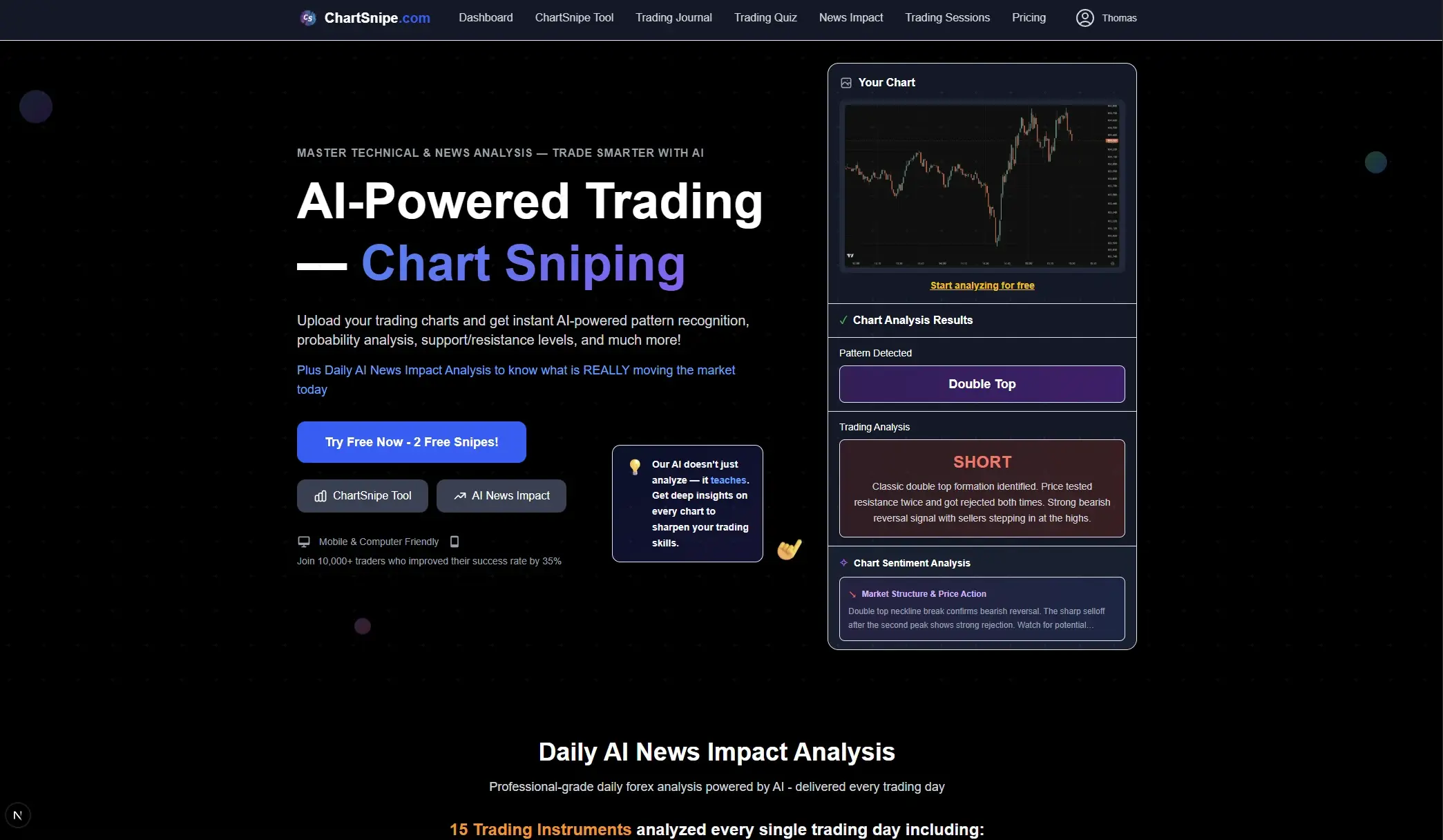
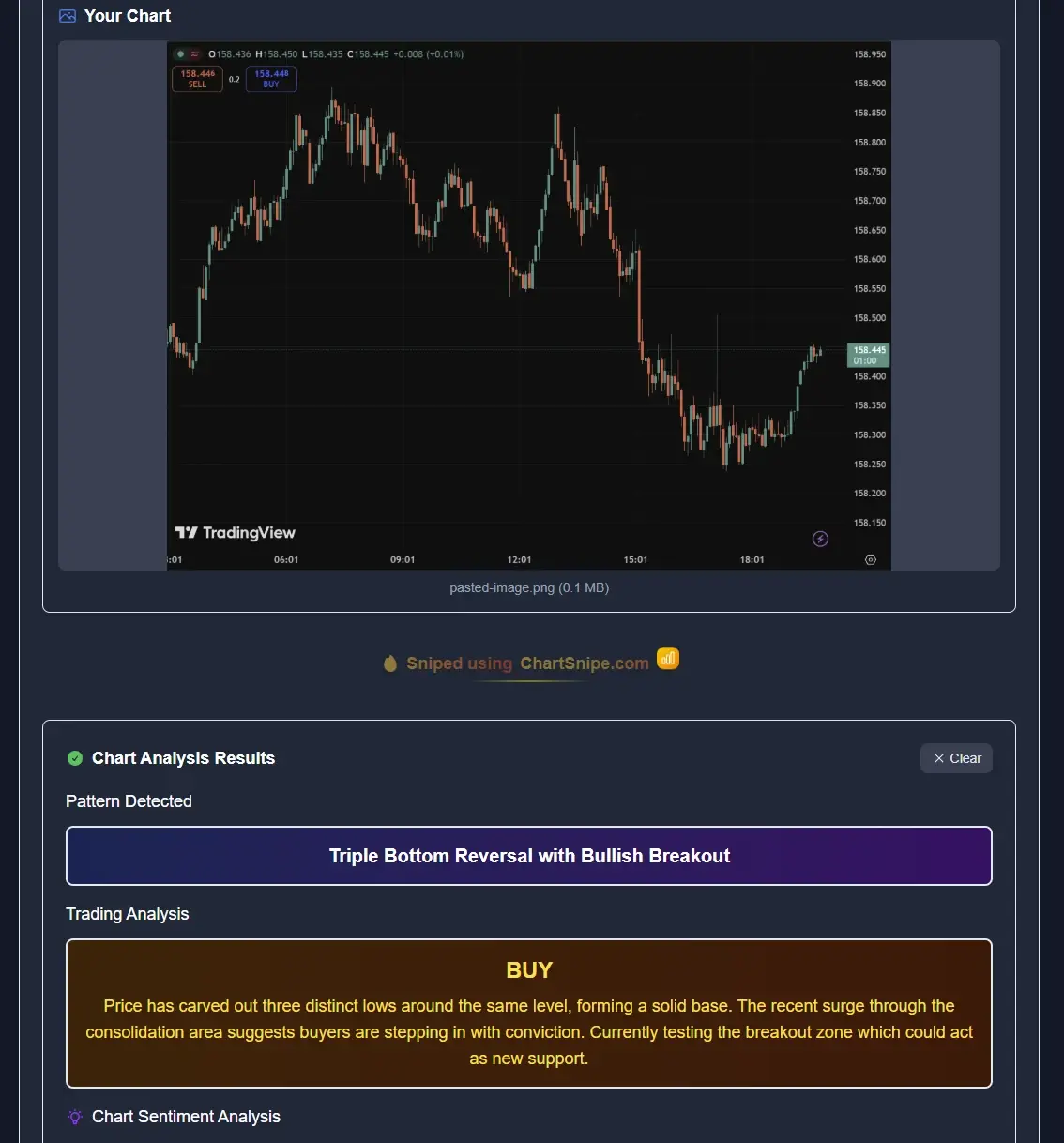
The difference is visible the moment you use one. A scam wants access to your account and a deposit. A research tool wants a screenshot. Below is what a real read looks like: the AI describes the structure that is actually on the chart — pattern, bias, entry, stop and target — as an argument you can weigh, not a command you must obey. There is no balance to inflate and no withdrawal to block, because your money was never in the loop.
One more thing worth saying plainly, because it comes up constantly: using a tool like this on your own account is not a regulated activity. A retail trader using AI as research on their own funds needs no special license. The obligations — CTA or RIA registration in the US — attach to people who manage other people's money or sell trading advice for compensation. If a “signal service” is charging you for calls on other people's trades, ask whether they are registered to do that. If a tool just helps you analyse your own charts, you are simply a trader with better software.
For the wider picture on which AI actually helps and which is noise, we go deep in AI trading in 2026: does it actually work, compare the real products head-to-head in the honest AI trading apps comparison, and cover the FX-specific traps in AI forex trading: what works, what doesn't.
Frequently asked questions
Can an AI trading bot really guarantee profits?
No. The CFTC states plainly that AI cannot predict the future or sudden market changes, and that AI trading bots will not turn into money machines. Any product promising guaranteed, risk-free, or fixed daily returns is describing something that does not exist. A system that never loses is a marketing claim, not a trading strategy.
What does the CFTC say about AI trading?
Its customer advisory warns that fraudsters exploit AI hype, that AI cannot predict the future or sudden market changes, and that no bot becomes a reliable money machine. The SEC, FINRA and NASAA have added their own joint warnings on AI-washing and AI investment fraud. Four regulators, one message.
Is all AI trading a scam?
No — the scam is the promise, not the technology. AI genuinely helps with research: reading a chart, scoring the day's news, flagging levels and patterns. What does not exist is an AI that guarantees profit, takes custody of your money, and trades it into ever-rising returns. The honest version keeps you in control of your funds and your decisions.
Should I ever give a trading app my exchange API keys?
Be extremely careful. If you do, never enable withdrawal permissions and never share a password or 2FA code. Many bot scams request keys with trade and withdrawal rights, then drain the account. A pure research tool needs no keys at all — it reads a chart screenshot you upload and gives you an opinion.
Do I need a license to use AI to trade my own money?
No. A retail trader using an AI tool as research on their own funds needs no special license. Registration — CTA or RIA in the US — attaches to people who manage others' money or sell trading advice for compensation. Analysing your own charts with software is not a regulated activity.
How is ChartSnipe different from an AI trading bot?
ChartSnipe is a research co-pilot, not an auto-trader or signal seller. It never takes custody of your money, never asks for broker or exchange keys, and never promises a return. You upload a chart, it gives you a structured read, and then you decide whether and how to trade — on your own account, with your own broker. The money and the decisions stay with you.
Sources & further reading
See what an honest AI trading tool actually does
No deposit box, no “connect your exchange,” no guaranteed returns. Just a research co-pilot that reads your chart and scores the day's news — while your funds stay at your own broker. Two free snipes to test it on your own chart.