
AI Trading Agents Aren’t Trading Bots
A bot executes. An agent decides. One holds your broker connection and places orders while you sleep; the other hands you a judgement and stops. The distinction is not academic — it changes what can go wrong, and it changes what you have to do about it.
Around 2024 the retail trading industry quietly swapped one word for another. Products that had spent a decade calling themselves “bots” started calling themselves “agents”. Nothing under the hood necessarily changed. The word was just newer, and the old one had accumulated too much history.
Which is a shame, because the distinction is real and it is useful. A bot and an agent are genuinely different kinds of software with genuinely different risks, and confusing them is how people end up applying a bot’s safety checklist to an agent’s failure mode, or worse, applying nothing at all to a piece of software that holds their broker credentials.
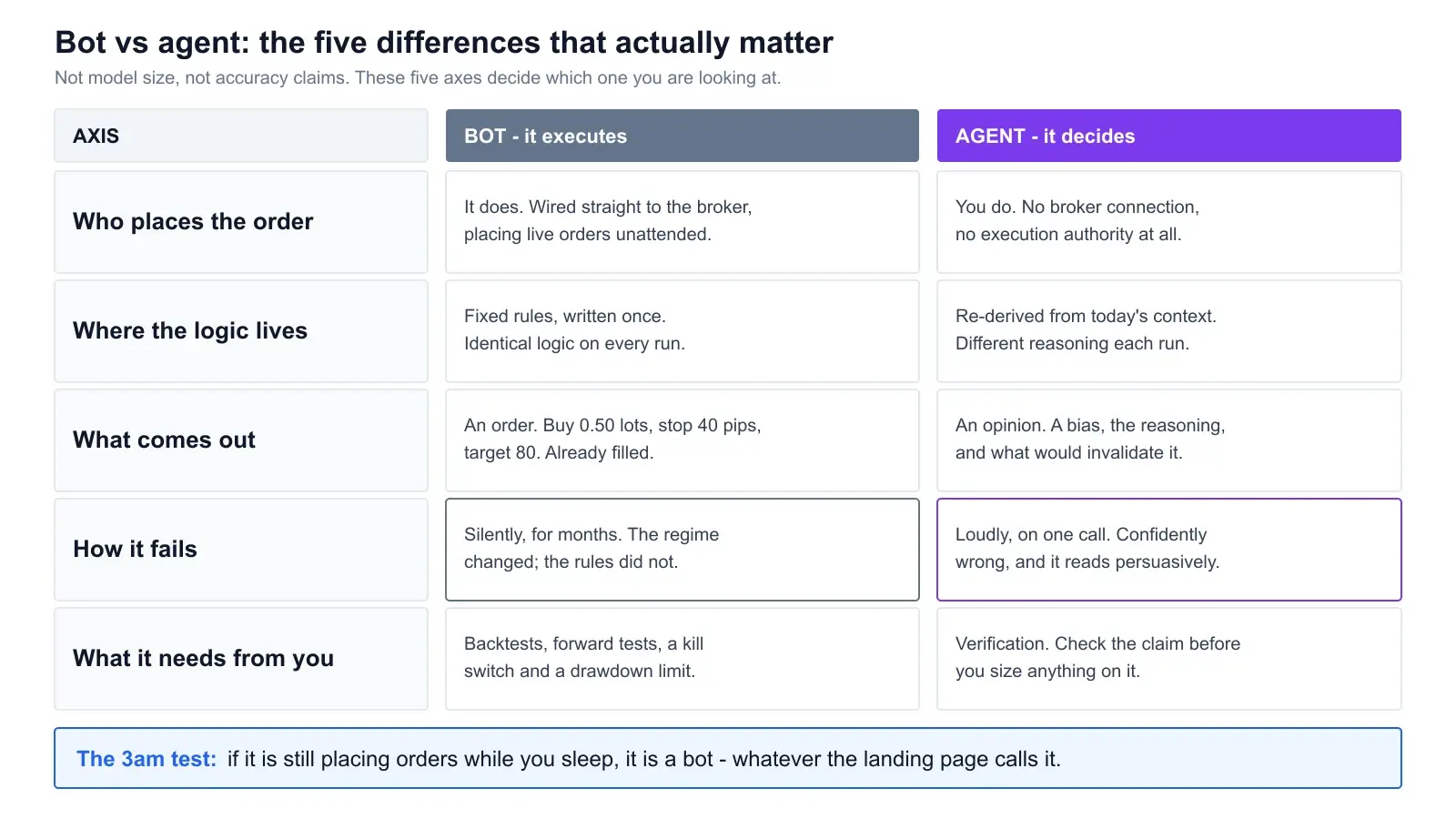
So here is the distinction in one line, and then the rest of the article is just working out what it implies. A bot executes. An agent decides. A bot runs fixed logic and produces an order. An agent gathers context, reasons about it, produces a judgement, and hands that judgement to a person. The moment the second one starts placing orders itself, it has become the first one, and it inherits all of the first one’s problems.
Key Takeaways
- →A bot executes: fixed rules, a broker connection, an order at the end. An agent decides: context, reasoning, a judgement handed to a human.
- →Execution authority is the only axis that cleanly separates the two. Everything else follows from it.
- →A bot’s logic is fixed at write time. An agent re-derives its logic every run, which is a strength and an inconsistency at the same time.
- →They fail in opposite ways. A bot bleeds silently for months with no error. An agent is confidently, fluently wrong on one call.
- →A bot needs backtesting, forward testing and a kill switch. An agent needs verification. Neither discipline catches the other failure.
- →The test: ask what happens if it is wrong at 3am. If it keeps trading, it is a bot regardless of the vocabulary.
- →ChartSnipe is on the analysis side of that line. No API, no broker connection, nothing that can open a position.
1. The distinction, stated plainly
Most comparisons of this pair get lost in architecture. Tool calling, planning loops, memory, orchestration. None of that matters to a trader, because none of it changes what the software can do to your account.
Strip it down and there are two categories of thing you can buy.
A bot
Software that executes. It has a connection to a broker. It runs logic that somebody wrote at some point in the past. It produces orders. It does this whether or not you are awake, and it does it identically every time the same conditions appear.
An agent
Software that decides. It reads sources, cross-references them, works out what it thinks, and writes that down. Then it stops. A human reads the output and chooses. It has no way to act on its own conclusion.
That is the whole thing. Everything that follows in this article is a consequence of those two paragraphs. And note what is not in either definition: the model. A bot can have GPT-class reasoning bolted into its entry filter and still be a bot. An agent can be running on a modest model and still be an agent. The category is defined by what it is allowed to do, not by how clever it is.
The confusion is not accidental. “Bot” carries fifteen years of retail baggage — blown accounts, martingale grids, vendors who vanished. “Agent” is clean, current and sounds like it comes from a research lab. If you were selling automated trading in 2026 you would rebrand too. That is exactly why the word cannot be the thing you evaluate.
If you want the longer history of the bot side specifically — expert advisors, MT4 and MT5, why the marketplace performance charts look the way they do — we went through that in detail in do forex robots actually work. This article does not re-argue that ground. It is about the line between the two categories.
2. Axis 1 — Who holds execution authority
This is the axis that matters. If you only ever check one thing about a piece of trading software, check this one.
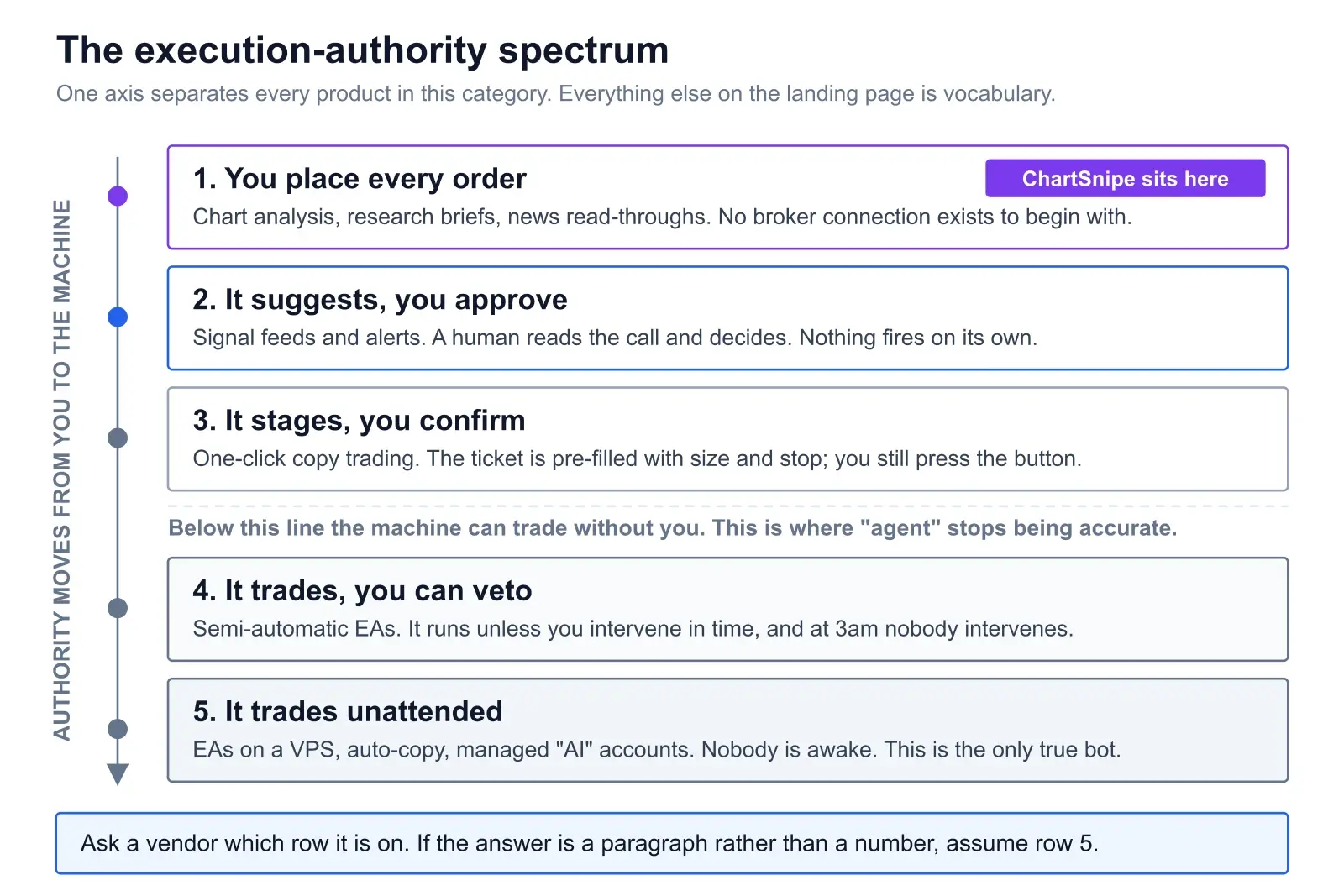
Execution authority is a plain question: can this software cause a position to open without a human doing anything? Not “does it usually ask”. Not “is there a setting”. Can it, technically, place an order on its own. The answer is binary and it is not negotiable.
In practice this collapses to an even simpler test: does it want your broker credentials? An API key, an MT4 or MT5 investor password, an OAuth connection to your brokerage, a copy-trading link. Anything that touches the account can trade the account. Software with no such connection cannot lose you money directly, no matter how wrong it is.
Why row 4 is worse than it looks
Row 4 — “it trades, you can veto” — is the row vendors love, because it sounds like a compromise. In reality it is row 5 with a delay. A veto window only exists if a human is present during it, and the whole appeal of automation is not having to be present. Semi-automatic is a description of the software, not of how it gets used.
Ask anyone who has run a semi-auto system for six months how many trades they actually vetoed. The honest number is usually two, both in the first fortnight, and neither of them was a trade that mattered.
The regulatory framing is the same framing
This is not a distinction invented by marketers. The CFTC’s fraud advisory on commodity trading systems sold on the internet has warned for years about systems that promise profits and quietly present hypothetical backtest results as if they were live trading records. That advisory is about products with execution authority, because those are the ones where the gap between simulated and real matters most. The BIS working paper on AI in the financial system puts the same idea in institutional language, listing human oversight as one of the load-bearing principles for AI in finance.
3. Axis 2 — Fixed logic vs re-derived logic
A bot’s logic is written once. An agent’s is worked out again every run. Both of those properties cut in two directions.
Take a rule like “if the 50 EMA crosses above the 200 EMA and RSI is under 70, buy one lot with a 40-pip stop”. That rule is frozen. It was written by someone with a particular market in mind, probably the market of the two years before they wrote it. It will keep firing in 2027 with exactly the same conviction it had in 2023, because it has no concept of a year, a regime, or a reason.
An agent asked the same question re-reads the situation. What is the rate path doing, what printed this morning, what is the risk regime, is this a trending or a mean-reverting tape. Then it produces a view. Tomorrow it will do that again from scratch, and the view may differ — not because it is unstable, but because the inputs changed.
| Property | Fixed logic (bot) | Re-derived logic (agent) |
|---|---|---|
| Repeatability | Perfect. Same inputs, same output, forever. | Imperfect. Same inputs can produce differently worded reasoning. |
| Adapts to a new regime | No. Somebody has to rewrite it, and usually nobody does. | Partly. It reads the new context, but it has no memory of being wrong. |
| Can be tested statistically | Yes. That is the whole point of a backtest. | Barely. There is no stable rule to test, only outputs to check. |
| You can read the reasoning | Only if you can read the source code, and usually you cannot. | Yes, in plain language — which is also how it talks you into things. |
| Speed | Milliseconds. It can react to a tick. | Seconds to minutes. Useless for anything latency-sensitive. |
Notice that neither column is the good one. Determinism is genuinely valuable — it is why a bot can be tested at all. Re-derivation is genuinely valuable — it is why an agent notices that today is a CPI day and yesterday was not. The mistake is expecting one to have the other’s properties.
The consequence people miss. Because an agent re-derives, it has no track record in the statistical sense. You cannot compute its win rate the way you compute a bot’s, because the thing producing the output is not the same thing twice. Any vendor quoting an agent’s “87% accuracy” is either measuring something much narrower than you think, or making it up.
4. Axis 3 — An order or an opinion
Look at what the software physically produces. A bot produces an order. An agent produces an opinion. This sounds obvious and it has a consequence nobody talks about.
An order is complete. Buy 0.50 lots, stop at 1.0840, target 1.0920. There is nothing left to decide, which is why it can be executed by a machine. It is also unfalsifiable in advance — there is no argument attached, so there is nothing to disagree with. You either take it or you do not.
An opinion is incomplete on purpose. “EUR looks supported into the London session because the rate path repriced on Tuesday’s statement and the calendar is empty until Thursday; this breaks if the risk regime turns.” That is not actionable as written. It requires you to supply a level, a size, a stop, and a judgement about whether you agree.
The incompleteness is the feature. A stated thesis can be argued with, and arguing with a thesis is roughly the only way anybody learns a market. A green arrow teaches you nothing, win or lose.
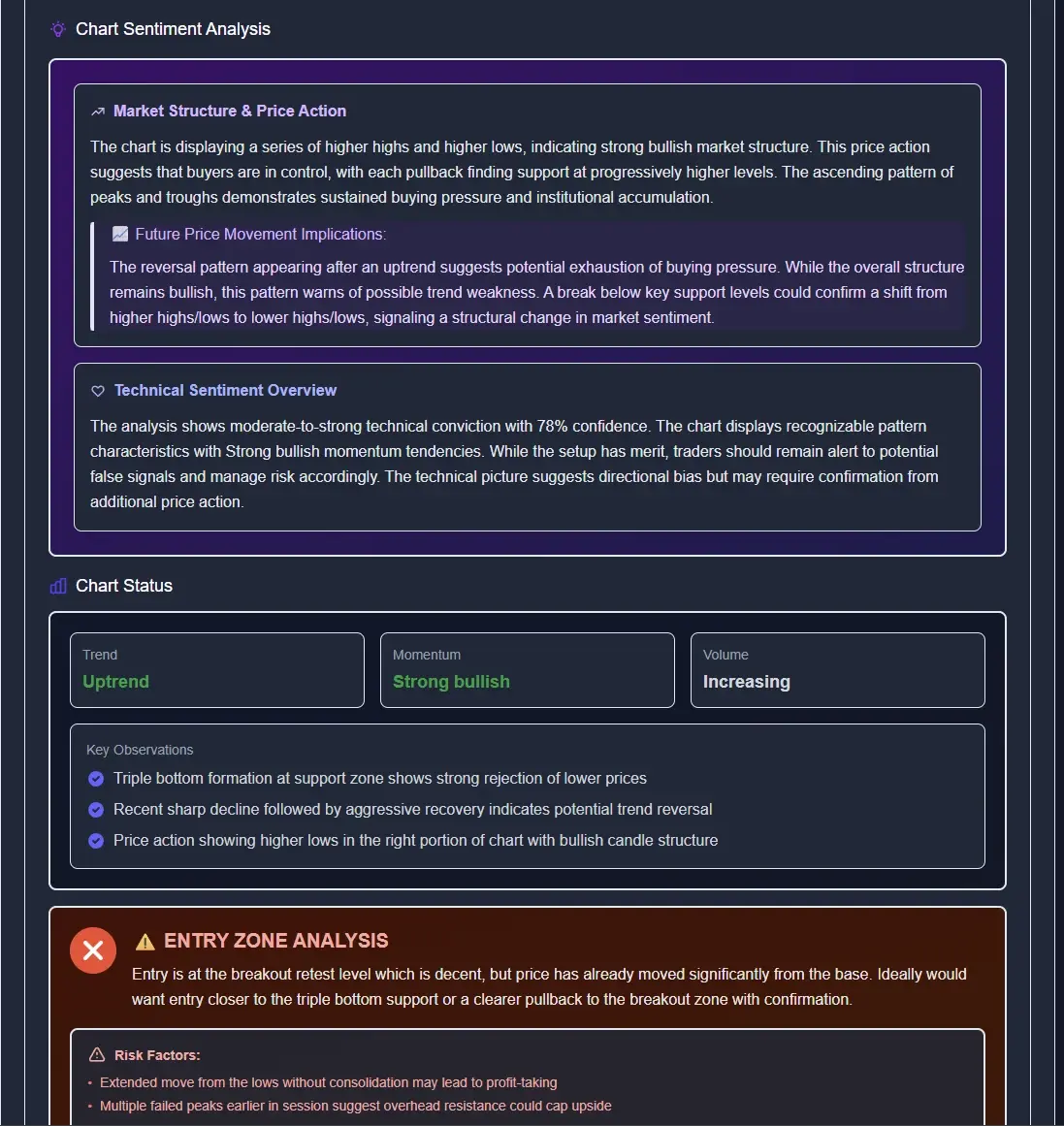
That screenshot is worth sitting with for a second, because it shows the shape of an agent output rather than the marketing description of one. There is a directional read, a confidence figure, three specific observations about structure, and then a section that pushes back on the trade. Four things you can check, and one thing you can argue with. None of them is a position.
5. Axis 4 — Two completely different failures
This is the part that actually costs people money, and it is the part almost nobody separates properly.
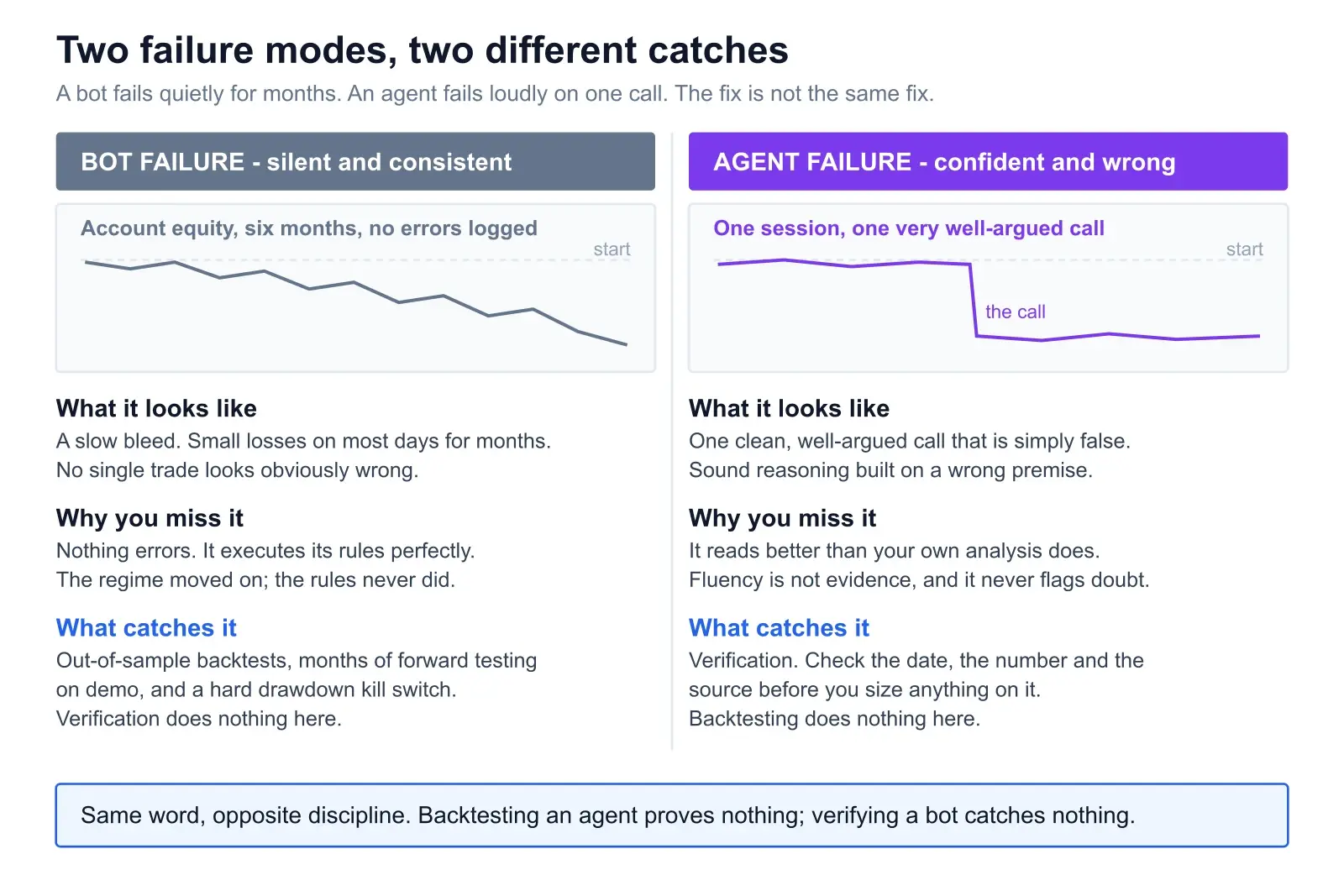
A bot fails silently and consistently. It does not crash. It does not throw an error. It executes its rules perfectly, which is precisely the problem: the rules encode a market that no longer exists. A trend-following bot in a chopping range does not know it is in a chopping range. It buys every false breakout with the same conviction, takes a small loss each time, and the equity curve grinds down by two per cent a month for eight months. Nothing in the log looks wrong, because nothing is wrong — mechanically.
An agent fails loudly and occasionally. It produces one call that is completely wrong, and it produces it beautifully. The prose is clean, the reasoning is structured, it cites a figure. The figure is from the wrong month. Everything downstream of that figure is coherent and false, and it reads more convincingly than the analysis you would have written yourself. That is the whole danger: fluency is not evidence, and there is no visual difference between a paragraph that is right and a paragraph that is wrong.
Which is worse?
For a retail account, the bot failure is usually worse in absolute terms, for a boring reason: it compounds without supervision. An agent’s wrong call costs you one trade, because you had to choose to take it. A bot’s wrong regime costs you every trade it takes for as long as the regime persists, and it takes a lot of trades.
The agent failure is more insidious per instance, though. A bad bot trade never persuades you of anything. A bad agent call can change your view of the market for a week, and you will carry that view into trades the agent had nothing to do with. Which is a cost that never shows up in anyone’s attribution.
Both categories attract the same fraud. Whichever side of the line a product sits on, the marketing failure is identical: guaranteed returns, impossible win rates, screenshots that turn out to be simulations. The CFTC’s advisory AI Won’t Turn Trading Bots into Money Machines is the cleanest short read on it. We covered the specific red flags at length in AI trading scams and how to spot them, so this article will not repeat that list.
6. Axis 5 — Backtesting vs verification
Different failure modes require different disciplines. Applying the wrong one is worse than applying none, because it produces false confidence.
A bot needs backtesting — done properly
A bot repeats the same logic thousands of times, so the meaningful question is statistical. Does this edge survive out of sample, on data the developer did not look at while building it? Does it survive live spread and slippage rather than an idealised fill? Does it survive a regime it was not designed for — a rate-hiking cycle, a volatility crush, a single geopolitical week?
- In-sample results are worthless. A curve fitted to the data it was optimised on is a description of the past, not a prediction.
- Forward test on demo for months, not weeks. The CFTC advisory above is explicit that hypothetical results routinely ignore whether the trader could absorb the drawdown or meet the margin call in real time.
- Model the costs. Spread, commission, swap, and the data subscription the vendor requires. Frequent-signal systems die on costs alone.
- Define the kill switch before you start. A drawdown number at which the bot gets turned off, written down while you are calm, not renegotiated at the time.
An agent needs verification — which is a different job
There is no distribution to test, because the reasoning is fresh each time. What you can do is check the specific claims in the specific output in front of you, and this takes about ninety seconds:
- Check the numbers. If it quotes a CPI print, a rate, or a level, confirm it against a primary source. Wrong-month data is the single most common failure.
- Check the date. Ask what session the output covers. Analysis describing yesterday is a different product from analysis published before the session it covers.
- Check the invalidation. If the output does not say what would make it wrong, it is not a thesis, it is a mood. Push back or discard it.
- Check that you disagree with something. If you agree with every line of every output, you are reading it as a verdict rather than an argument, which means you have stopped verifying entirely.
FINRA’s report on AI in the securities industry arrives at the institutional version of the same point: model output is an input to a supervised process, not a substitute for one. Retail traders get the same obligation without the compliance department.
Hyun Song Shin on artificial intelligence and the economy, published by the Bank for International Settlements. Useful here for the framing rather than the trading content: the institutional discussion has settled on models as decision support under human oversight, which is the agent side of the line, not the bot side.
7. “Agent” is often just vocabulary
Being honest about this cuts against our own category, so here it is plainly: most retail products currently calling themselves AI agents are not agents in any meaningful sense.
The word has a real technical meaning. Software that plans a task, calls tools to gather what it needs, adjusts its approach based on what it finds, and re-derives its method per task rather than following a fixed script. That describes some real systems. It does not describe a moving-average crossover with a language model writing the trade description afterwards, and a fair number of “agents” on sale are exactly that.
Regulators have noticed. The joint SEC, NASAA and FINRA investor alert on AI and investment fraud lists unregistered platforms making unrealistic AI claims as its first category, alongside AI-themed pump-and-dumps and deepfaked endorsements. The SEC has also brought settled enforcement actions against advisers for overstating their use of AI, which tells you the gap between claim and architecture is wide enough to be actionable.
Three phrases that mean nothing
“Autonomous AI agent”
Autonomous is the giveaway. An autonomous agent that trades is a bot. The word “agent” is doing PR work for the word “autonomous”, which is the part that should worry you.
“Self-learning” or “adaptive”
Ask what it learns from and how often the weights or rules change. If the answer is vague, the honest translation is “we retrain occasionally” or, more often, “we do not”. Nothing in a live retail product learns from your account in real time.
“Institutional-grade”
Unfalsifiable by construction. Institutions do use automation heavily, under compliance regimes and risk limits that no retail product replicates. The phrase borrows the credibility and none of the constraints.
For the broader question of what AI can and cannot contribute to trading in general — separate from this bot-versus-agent question — we worked through the evidence in AI trading explained: does it actually work.
8. The 3am test
Here is the whole article compressed into one question you can ask any vendor, in any sales chat, in any support ticket.
“What happens if it is wrong at 3am?”
If the answer is “nothing, until you read it”, you are looking at an agent. If the answer is “it keeps trading”, you are looking at a bot, and the vocabulary on the landing page is irrelevant.
It works because it is hard to answer evasively. A vendor can talk around architecture all day. They cannot talk around what their software does to an open account at 3am, because there are only two possible answers and one of them is “nothing”.
Three follow-ups if the answer is slippery
- “Does it need my broker credentials or API key?” Yes means execution authority exists, whatever the settings currently say.
- “Show me the raw output.” An order ticket and a paragraph of analysis do not look alike. Ask for a screenshot of the actual thing, not the dashboard.
- “What is the worst outcome if the model is completely wrong tomorrow?” For an agent the honest answer is “you read a bad idea”. Anything worse than that is a bot.
One more thing worth saying: the test is not a moral judgement. Bots are legitimate software. Institutions run enormous amounts of automated execution, competently, with risk limits and people watching. The problem is never that a bot is a bot. The problem is a bot sold as something gentler than it is, to someone who was not told they now need a kill switch.
9. If you are starting out
“Best AI trading bot for beginners” is a search with a bad premise buried inside it. There isn’t one, and the reason has nothing to do with the quality of the bots.
A bot is only as good as its supervision. Supervising one means knowing what its edge is supposed to be, recognising when the regime it was built for has ended, and reading a drawdown curve well enough to tell normal variance from a broken system. Those are not beginner skills. They are the skills you build by trading manually, badly, for a while, and paying attention.
Which means a beginner running a bot is running it unsupervised in practice, even if they check the dashboard daily. Checking is not supervising if you cannot interpret what you see.
Analysis tools are the better starting point, and not because they are safer in some vague sense. They are better because they force you to make every decision yourself while giving you something to argue with. You read a bias, you disagree with part of it, you check who was right at the end of the week. That loop builds the reference points. A bot skips the loop entirely and hands you a P&L you cannot explain.
A reasonable order of operations. Learn to read a chart and a calendar. Trade small and manually until you can explain every entry. Use analysis tools as a second opinion you are allowed to reject. Only after all that does automation become a question worth asking — and by then you will be able to evaluate a bot properly, which is the only point at which you should own one.
If you want to see how the reading-and-cross-referencing half of that works in practice, how AI actually reads financial news walks through the pipeline step by step — and makes clear how much of it is ordinary comprehension work rather than prediction.
10. Where ChartSnipe actually sits
Row 1 of the spectrum diagram, and we would rather say so directly than let the word “AI” imply something else.
There is no API and no broker connection anywhere in the product. Not disabled by default, not gated behind a plan — the integration does not exist. Nothing here can open, modify or close a position. That is a deliberate design decision and it is also a limitation: if you want software that trades for you, this is not it, and no setting will make it so.
What the chart tool does
You upload a screenshot of a chart. It returns pattern identification, trend, a probability read, and entry and risk guidance. The interaction is entirely one-directional — you send an image, you get back a written analysis, and then you decide what to do with it on your own platform.
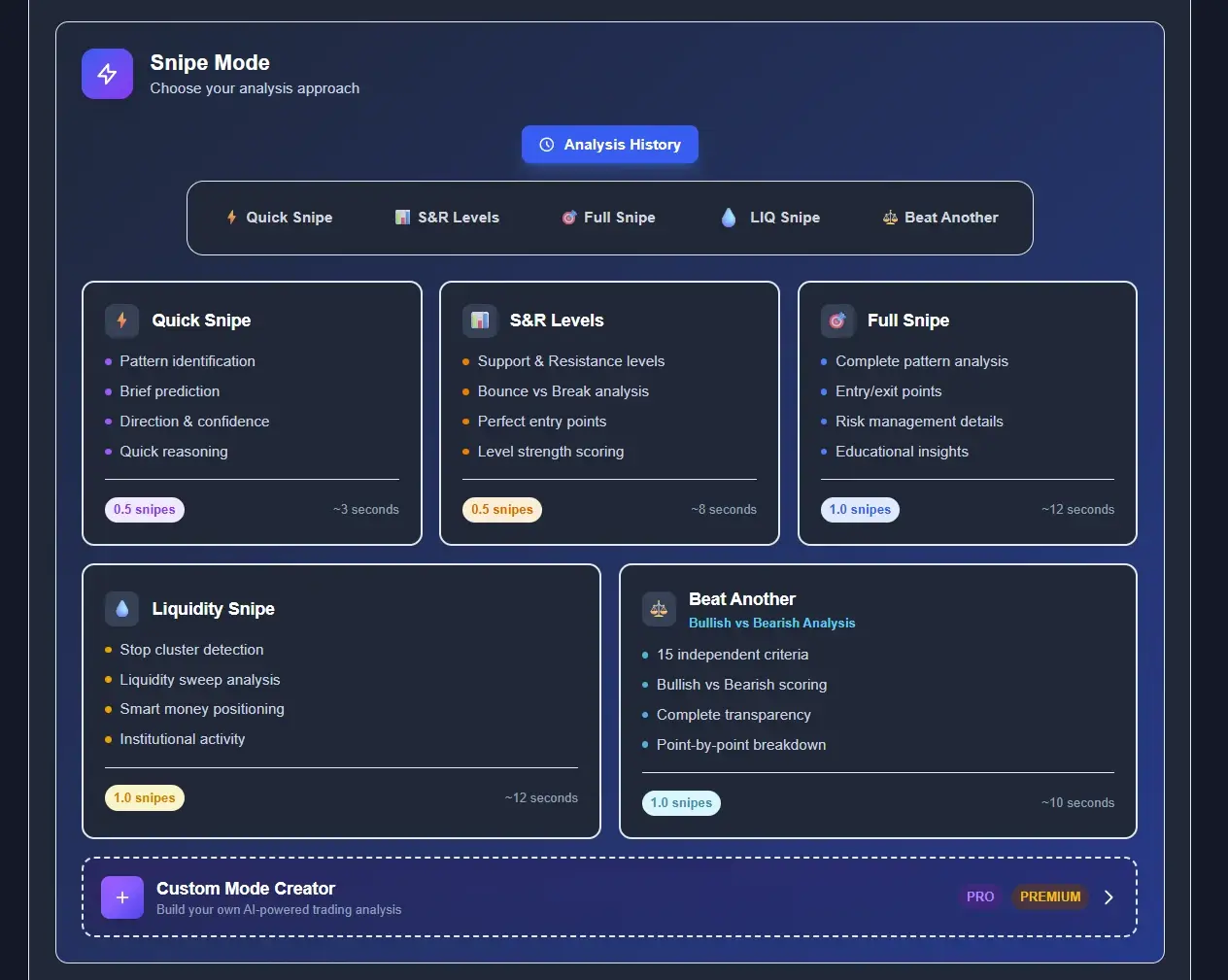
Look at what the modes are actually offering. “Bounce vs break analysis.” “Point-by-point breakdown.” “Educational insights.” Those are descriptions of arguments, not of executions. Beat Another is the clearest case — it scores a chart against 15 independent criteria and shows the bullish and bearish points separately, which is a format that only makes sense if a human is going to read both sides and adjudicate.
What the news analysis does
The News Impact analysis is the same idea at the macro level. It publishes 12 AI-ranked pairs, a “How AI Would Trade Today” write-up explaining the reasoning behind the ranking, 12 currency and instrument cards with a bias, a placement and written reasoning on each, a Risk Analysis section listing scenarios with severity, trigger, expected impact and affected pairs, a long-form Professional Analysis, an economic calendar widget and live prices across 32 instruments.
It publishes Monday to Friday between 20:00 and 23:00 UTC for the upcoming session — before it, not describing it afterwards. There is no weekend edition because there is no weekend session. It is an in-app page rather than an emailed newsletter, and the full analysis sits on the Pro and Premium plans; free accounts see an admin-featured past-day preview so you can judge the format before paying for anything.
The Risk Analysis section is the part most relevant to this article. It is a list of things that would break the day’s thesis, written down in advance. A bot has no equivalent — it cannot hold a scenario it has not been coded for. Publishing your own invalidation conditions is something only a system that expects to be argued with bothers to do.
The honest limitation. Sitting on row 1 means every discipline in section 6 lands on you. Nobody else is verifying the numbers. Nobody else is deciding whether today’s read is worth acting on. If you take an output at face value and size into it without checking, an analysis tool has all of an agent’s failure mode and none of a bot’s protections — because the only protection an agent has is the person reading it.
Frequently asked questions
What is the difference between an AI trading agent and an AI trading bot?
A bot executes. It holds a broker connection, runs fixed logic, and places orders itself — the same way every time, whether or not anyone is watching. An agent decides. It gathers context, reasons about it, produces a judgement, and hands that judgement to a human who then chooses. The cleanest test is execution authority: if the software can open a position without a person pressing anything, it is a bot regardless of what model is inside it.
Do AI trading bots actually work?
Some work in the narrow sense that they execute their rules correctly, which is not the same as making money. A bot encodes a view of the market at the moment it was written and keeps applying it after the market has moved on — which is why the typical failure is a slow, quiet bleed with no error in the log rather than a crash. The bots that survive tend to be narrow, heavily forward-tested and supervised by someone who turns them off at a pre-agreed drawdown.
Is an AI trading agent safer than a trading bot?
Safer in one specific way, not in others. With no execution authority, an agent’s worst single output is a bad opinion rather than a bad fill — it cannot empty an account overnight. But it fails in a way that is harder to notice: confidently, fluently, with reasoning that reads better than your own. A bot needs a kill switch; an agent needs you to verify the claim before you size anything on it. Neither discipline catches the other failure mode.
How can I tell if a product is really an agent or just a bot with new branding?
Ask what happens if it is wrong at 3am. If the honest answer is “it keeps trading”, it is a bot, whatever the landing page says. Two follow-ups sharpen it: does it ask for broker credentials, an API key or MT4/MT5 access — anything that connects to an account can trade the account — and what does the raw output physically look like, a filled order or a paragraph you have to read and decide about.
Should a beginner use an AI trading bot?
No, and not because bots are inherently bad — because a beginner cannot supervise one. Supervision means knowing what the edge is supposed to be, recognising when the regime it was built for has ended, and telling normal variance from a broken system in a drawdown curve. Without those reference points the bot runs unsupervised in practice. Analysis tools are the better starting point precisely because they make you decide, which is how the reference points get built.
What does “backtesting a bot, verifying an agent” mean?
They are different jobs because the two things fail differently. A bot runs the same logic thousands of times, so the useful question is statistical — does this edge survive out of sample and in live forward testing. An agent produces fresh reasoning each run, so there is no distribution to test; the useful question is factual — is the number real, is the date current, does the source say what it claims. Backtesting an agent proves nothing and verifying a bot catches nothing.
Does ChartSnipe place trades for me?
No. There is no API access and no broker connection anywhere in the product. The Chart Snipe tool takes a chart screenshot you upload and returns pattern, trend, a probability read and entry and risk guidance. The News Impact analysis publishes 12 AI-ranked pairs, a “How AI Would Trade Today” write-up, currency and instrument cards with reasoning, and a Risk Analysis scenario list, Monday to Friday between 20:00 and 23:00 UTC for the upcoming session. Every one of those outputs is a page you read.
Is “AI agent” just marketing language in trading?
Often, yes. The word has real technical meaning — software that plans, calls tools and re-derives its approach per task rather than following a fixed script — but in retail trading it gets pasted onto ordinary rule-based automation with a language model writing the copy. Regulators have noticed: the SEC, NASAA and FINRA issued a joint investor alert about AI claims in investment products, and the SEC has brought enforcement actions against firms for overstating their use of AI. The word tells you nothing; the execution authority tells you everything.
Sources & further reading
- → CFTC — Customer Advisory: AI Won’t Turn Trading Bots into Money Machines — the regulator’s direct statement that AI cannot predict sudden market changes, plus the checks to run before trusting a bot or signal provider.
- → CFTC — Fraud Advisory: Commodity Trading Systems Sold on the Internet — the clearest official explanation of why hypothetical backtest results are not evidence, and which costs vendors leave out of them.
- → SEC, NASAA and FINRA — Artificial Intelligence and Investment Fraud investor alert — the joint alert covering unregistered platforms making unrealistic AI claims, AI-themed pump-and-dumps, and deepfaked endorsements.
- → FINRA — Artificial Intelligence in the Securities Industry — how firms actually deploy AI, and the supervision expectations that come with treating model output as an input rather than an answer.
- → BIS Working Paper No. 1194 — Intelligent financial system: how AI is transforming finance — the institutional view, including transparency, accountability and human oversight as the framing principles.
Analysis you argue with, not orders you inherit
No API, no broker connection, nothing that can open a position. Upload a chart and get pattern, trend, a probability read and risk guidance back — or read the News Impact analysis before the session, with 12 ranked pairs, written reasoning and an explicit list of what would break the day. Then make the call yourself, because there is nobody else to make it.