
AI Stock Picker vs AI Forex: Why They’re Different Games
Stock AI and forex AI look like the same product from the outside. Under the hood they are built on incompatible data structures — and that is why a stock scanner bolted onto FX produces noise, while a forex-native AI produces a trade.
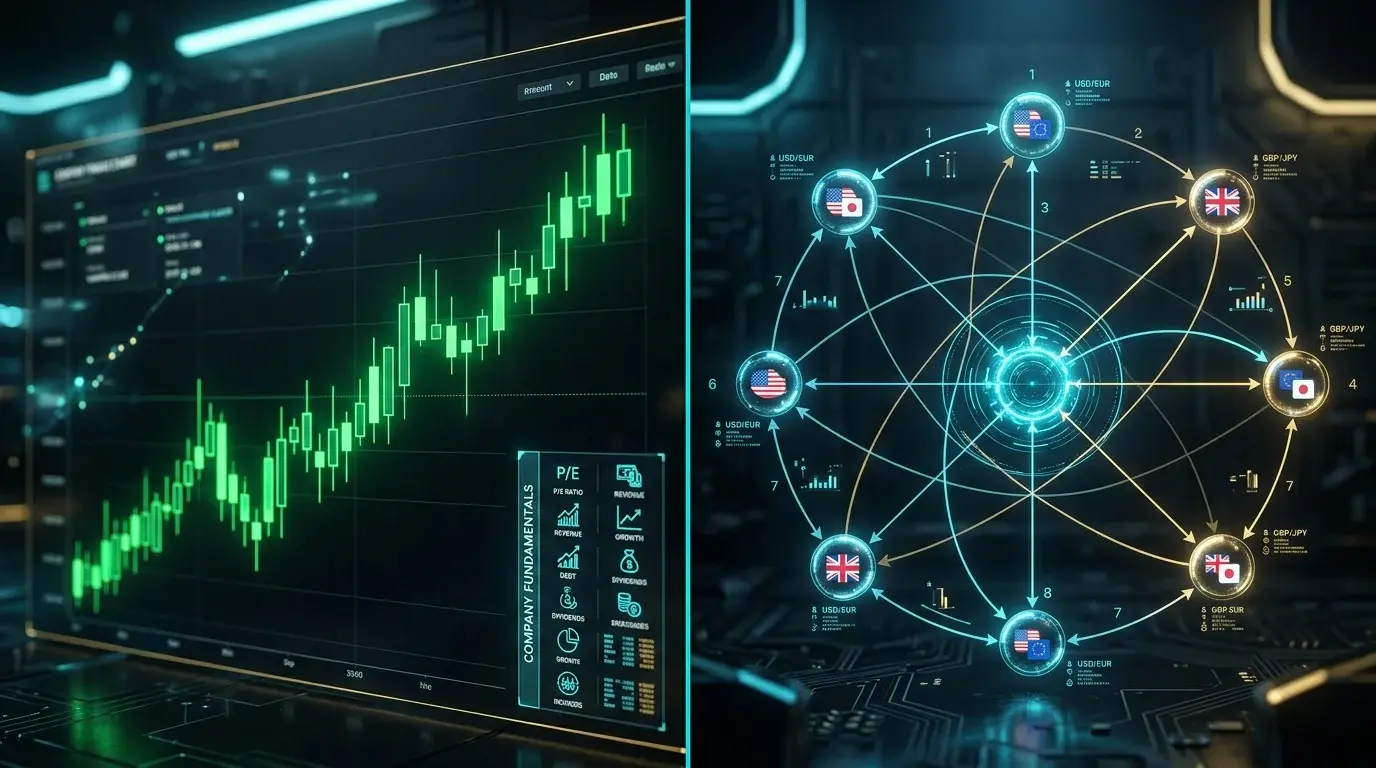
Search “best ai stock picker”, “ai to trade stocks”, or “ai stocks on robinhood” and a dozen products crowd the results — Trade Ideas, Tickeron, Tradytics, Danelfin, MarketGrader, Composer. They are real software. They work for what they were built for: scanning US equities for momentum, earnings surprises, unusual options flow and sector rotation. Retail traders look at what they do to tickers and naturally ask the next question: can I point this thing at EUR/USD or gold and get the same edge?
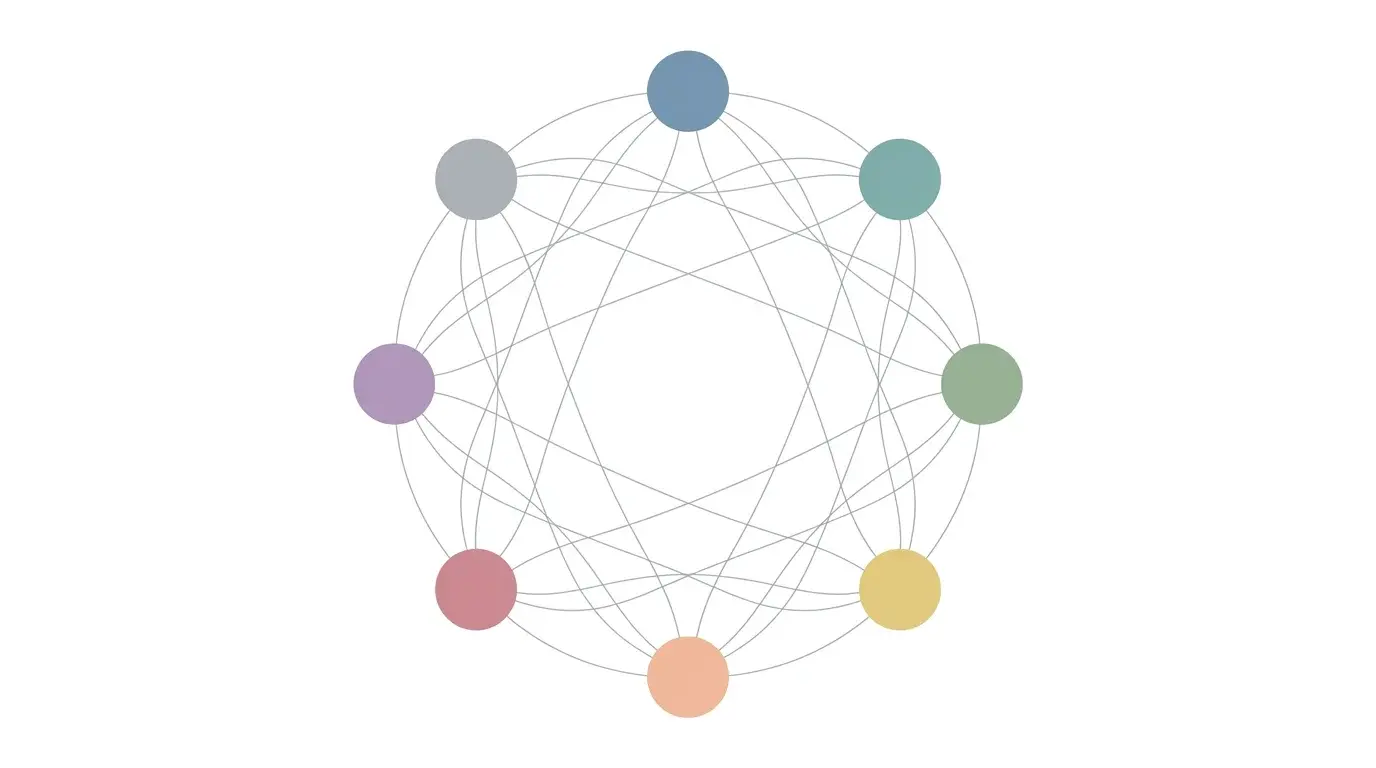
The answer is no — and not because the AI is bad. The answer is no because stocks and forex are different games built on incompatible data structures. Stock AI has fundamentals, earnings, volume and a closing auction. Forex has none of those things. Forex has eight currencies meshed into 28 pairs, three global sessions with no close, and a macro engine that does not care about any single company. Bolt a stock scanner onto FX and it screams at random. This piece explains exactly why, what FX actually needs, and where ChartSnipe sits on the map as the forex-native alternative.
Key Takeaways
- →Stock AI and forex AI solve different problems. Stocks are single instruments with fundamentals, earnings and a closing auction. Forex is relative-value pair math across 28 instruments with 24-hour sessions and no fundamentals per pair.
- →Trade Ideas, Tickeron and Tradytics are legitimate, purpose-built US equities scanners — they work because they consume EDGAR filings, earnings calendars, volume prints and options flow. None of that data exists for a currency pair.
- →FX is dominated by currency strength, central-bank positioning and cross-pair correlations. The right output for a forex AI is a ranked pair list and a strength index, not a list of tickers.
- →ChartSnipe is forex-native: live prices on 28 pairs, strength across the 8 majors, daily AI news impact on 12 instruments, and five screenshot analysis modes. It is the stock-picker shape inverted for the FX problem.
- →“Quantum AI”, “Qumas AI” and the Elon-Musk deepfake adverts are not AI stock pickers at all — they are funnels for unregulated brokers. Recognise them, close the tab.
1. Two different games, one marketing label
The phrase “AI trading” covers everything from a Tickeron equity scanner to a forex news-impact dashboard to a Coinbase bot. The phrase hides the fact that the underlying markets could not be more different. A stock and a currency pair are not two flavours of the same object — they are fundamentally different financial instruments with different data generating processes, and the AI that works well on each has to be engineered around those differences.
A stock is a claim on a company
One instrument, one balance sheet, one set of earnings, one industry sector, one regulator, one closing auction. The dominant drivers are company-specific: revenue, margins, guidance, product cycles, insider activity. Volume is meaningful — an exchange records every print.
A forex pair is a relative-value bet
Two currencies, no balance sheet, no earnings, no sector, no closing auction. Dominant drivers are macro: central bank rates, inflation, growth, geopolitics. “Volume” is mostly a proxy because FX is OTC with no consolidated tape.
Once you internalise that split, the rest of this article follows logically. A scanner that screams “TSLA up 4% on 3x average volume with a positive earnings revision” has no equivalent signal it could produce for EUR/USD. The inputs that drive equity alpha simply do not exist for a currency pair. You need a different AI.
2. How AI stock pickers actually work
The incumbents in AI stock picking — Trade Ideas, Tickeron, Tradytics, Danelfin, MarketGrader, Composer — are all built around some combination of four data inputs that are abundant in US equities and effectively absent in FX. Understanding what they feed on is the fastest way to see why the transfer to forex breaks.
The four input pillars of stock AI
- Fundamentals. EDGAR filings, quarterly financials, analyst estimates, guidance, insider transactions. A model can score a stock on P/E vs sector, revenue growth trajectory, margin compression, free cash flow, balance sheet strength. Danelfin and MarketGrader live almost entirely on this axis.
- Event calendar. Earnings dates, FDA decisions, product launches, index rebalances. Tickeron’s pattern engine explicitly weights pattern setups by proximity to earnings. Trade Ideas’ Holly AI has earnings-gap strategies hard-coded.
- Volume and tape. The exchange publishes every print. A scanner can detect unusual volume at 9:45am EST, relative volume versus 30-day average, block prints, and — via the options market — unusual options activity. Tradytics is built around this layer.
- Sector and market structure. Every US stock sits inside a GICS sector, industry group and index. A model can run pair-trade logic within a sector, track sector rotation into/out of energy or tech, and use SPY/QQQ/IWM as market-beta anchors.

What each of the big names specialises in
Trade Ideas is the longest-running AI stock picker with a real product — its Holly AI runs hundreds of simulated strategy backtests overnight and publishes a daily set of alerts. Strength: live scanning, point-and-click strategies. Weakness: equities only, noisy in regime shifts, opaque training methodology. Tickeron runs neural networks for classical chart patterns and publishes confidence scores on each signal. Strength: transparent pattern taxonomy, portfolio-level AI. Weakness: patterns produce lots of low-quality signals on low-volume names. Tradytics is options-flow-native with a clean dashboard for dark-pool prints and unusual options activity. Strength: institutional signal coverage. Weakness: options data does not exist for spot FX. Danelfin scores 15,000+ US and European equities on a fundamentals-heavy AI grade and is used mostly by long-only investors. Composer is strategy construction with AI assistance rather than a scanner.
These are legitimate products doing real work. They succeed because the US equity market publishes exactly the data they need. The problem begins when a retail trader takes the mental model of “AI picks the winner from a list of 5,000 instruments” and tries to transplant it onto forex.
3. Why stock AI fails when pointed at FX
Pretend for a moment someone ported Trade Ideas Holly directly onto the FX universe. Every signal it produces relies on an input that either does not exist, is structurally different, or is misleading in the new domain. There are five specific failure modes, and each one is enough on its own to break the product.
Failure mode 1 — no fundamentals per pair
EUR/USD does not file a 10-Q. It does not have earnings, analyst estimates, margin or guidance. It is a pair of fiat currencies, each of which reflects the macro stance of a central bank. The entire fundamentals axis of stock AI — easily half the input signal for Trade Ideas and the whole signal for Danelfin — is simply absent. Any “Fundamental score†output on a currency pair is either using a completely different model under the hood or it is marketing.
Failure mode 2 — no earnings calendar, different event clock
FX has an event calendar, but it is not a list of company prints. It is the economic calendar: Fed minutes, ECB decisions, CPI, NFP, PMIs, BoJ meetings. The same event moves every USD pair at once, and pairs can react in opposite directions depending on the dollar index. A stock scanner waiting for a per-instrument earnings catalyst has nothing to latch onto.
Failure mode 3 — DXY dwarfs any single-pair signal
US equities have SPY as a market anchor but individual stocks routinely diverge from it for company-specific reasons. In FX, the US dollar index drives seven of the eight major currencies directly by construction. A bullish EUR/USD scan means nothing if DXY is breaking higher across every USD pair at the same time — it is the same trade said seven ways. A stock scanner has no concept of “one input variable owns the whole market today”, which is how most FX sessions actually trade.
Failure mode 4 — correlations invalidate momentum signals
Long EUR/USD, long GBP/USD and long AUD/USD is three trades on paper and one trade in risk. The correlations in FX are dense and well known — the strength of USD on a given session will dictate the sign on half the majors simultaneously. A stock scanner will happily alert on all three in rapid succession because it has no correlation layer; it treats them as independent instruments. The trader who acts on all three is triple-exposed to the same bet. The forex correlation guide covers this in depth.
Failure mode 5 — 24-hour sessions, no closing auction
US equities open and close on a fixed schedule with a closing auction that sets the reference price used by index funds, ETFs, and a decade of backtests. FX has no close — just three overlapping sessions (Tokyo, London, New York) with dramatically different liquidity regimes and session-specific pair behaviour. A scanner built for a 6.5-hour cash session cannot generalise to continuous liquidity, and its concepts of “pre-market volume” and “closing ramp” do not translate at all.
4. What forex AI actually needs
If stock AI is built around four input pillars — fundamentals, event calendar, volume/tape, sector structure — forex AI has its own set of four, and they are completely different. A useful forex AI is engineered around them from the first line of code, not bolted on after.
The four input pillars of forex AI
- Live multi-pair data. A relative-value instrument cannot be analysed in isolation. You need every major pair priced to the second so the model can compute cross-pair logic. Eight majors mean 28 pairs minimum; a serious build covers metals (XAU, XAG), US indices (S&P 500, US Tech 100), and at least Bitcoin as a risk proxy.
- Currency strength. The single most useful aggregate statistic in FX — for each of the 8 majors, the average percentage move across all 7 pairs it participates in. Converts the ambiguous “EUR/USD is up 0.4%” into “EUR is the strongest, USD is the weakest, so EUR/USD is the default long.”
- Macro news impact. Central-bank statements, policy-rate decisions, inflation and jobs prints, geopolitical flow, commodity moves. The AI reads the day’s narrative and scores its directional impact on each instrument. This is the FX equivalent of the stock-side earnings calendar.
- Session awareness. Tokyo, London, New York. Different pairs own different sessions. JPY crosses come alive at the Asia open; EUR and GBP peak liquidity lands at London; the USD index trades most decisively in the NY overlap. A forex AI that ignores session is trading the same pair three different ways and pretending the vol is stable.
The natural output of a forex AI is not a list of tickers. It is a ranked pair list with directional conviction, a currency strength index telling you which leg of any candidate pair is doing the work, and a macro briefing grounded in today’s economic calendar and central-bank positioning. That is a fundamentally different UI from a stock scanner, and for good reason.
5. Feature contrast — stock AI vs forex AI
The clearest way to see how far apart the two products are is to line up their defaults side by side. Every row below is a place where the standard stock-AI design either does not translate to FX at all, or translates into something unrecognisable.
| Dimension | Stock AI (typical) | Forex AI (typical) |
|---|---|---|
| Data universe | Thousands of tickers, most of them correlated to SPY | 8 currencies meshed into 28 pairs + metals + indices |
| Primary drivers | Earnings, guidance, options flow, sector rotation | Central-bank rates, inflation, geopolitics, commodities |
| Session model | Fixed cash hours, closing auction, pre/post-market | 24 hours, three sessions, no close |
| Volume data | Exchange-verified, tick by tick, options flow available | OTC, no consolidated tape, tick volume is a proxy only |
| Correlation logic | Sector pair trades, SPY market beta | DXY dominance, same-quote-currency clustering, risk-on/off |
| Sentiment source | Earnings transcripts, social (r/wallstreetbets), news wires | Central-bank statements, Truth Social / political headlines, commodities desks |
| Typical output | Ranked ticker list + strategy backtest + alert stream | Ranked pair list + currency strength grid + macro brief |
| Representative products | Trade Ideas, Tickeron, Tradytics, Danelfin | ChartSnipe (FX + metals + indices) |
Almost every row is a redesign, not a tweak. That is why there is no single product that credibly covers both — the engineering effort to do either well consumes the whole roadmap. Picking the tool that was built for your market is the single biggest asymmetric choice retail traders make in this category.
6. ChartSnipe’s approach: forex-native from day one
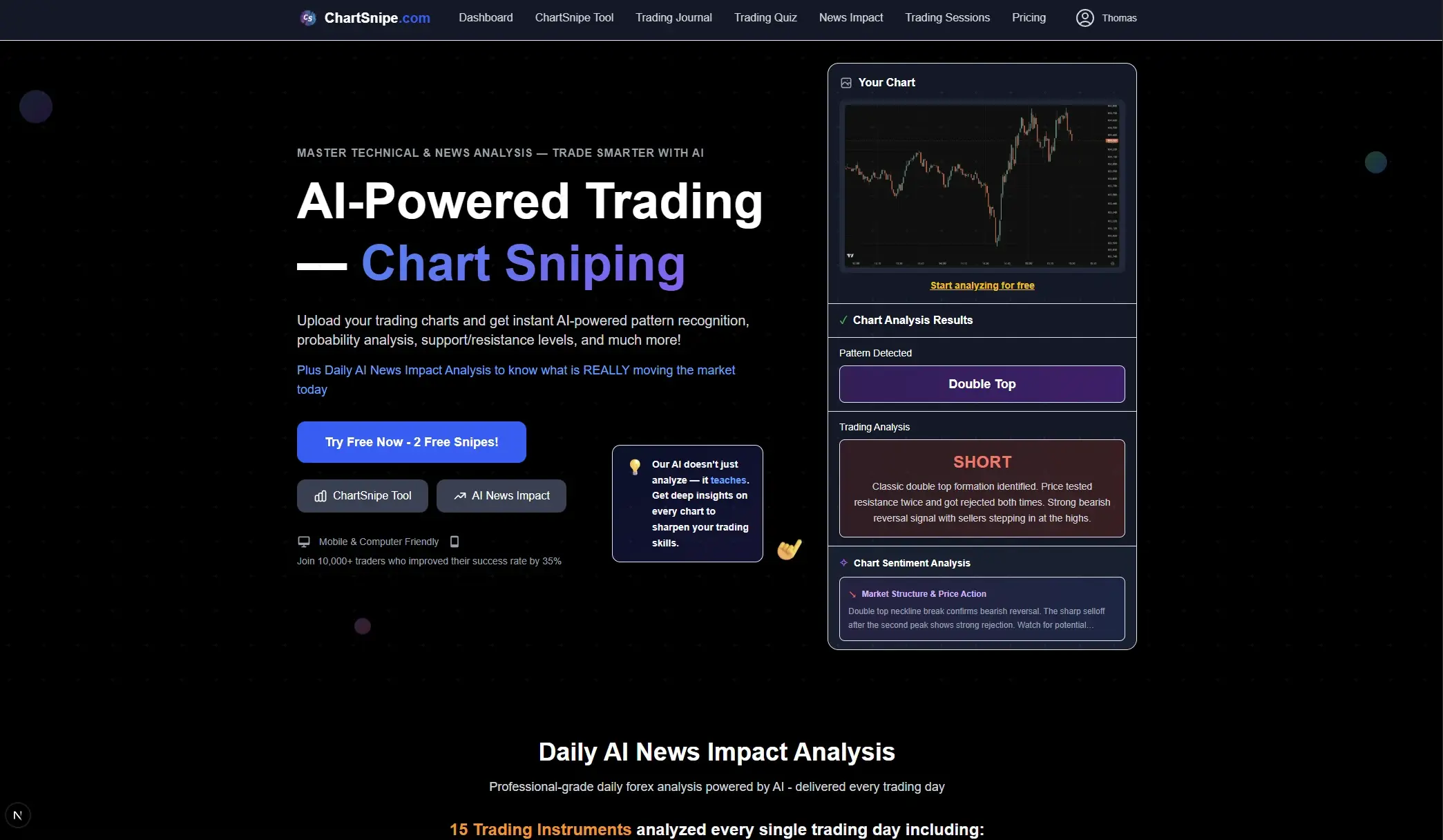
ChartSnipe is engineered for the forex, metals and indices problem — not a stock scanner with an FX tab bolted on. The architecture reflects the four pillars from section four directly: live multi-pair prices in, currency strength computed across them, a daily macro briefing on top, and screenshot-based chart reading that handles the single-instrument question once the universe has been narrowed.
28 FX pairs, live
Every major and cross priced against an institutional feed, updated every few minutes. The relative-value problem is only soluble with the full matrix.
8-currency strength index
USD, EUR, GBP, JPY, CHF, AUD, CAD, NZD strength aggregated across the 7 pairs each currency participates in. Strongest vs weakest writes your short list.
Daily AI news impact
Central banks, releases, geopolitics, commodities scored against 12 instruments with conviction, drivers, reversal triggers and a morning brief.
Five screenshot analysis modes
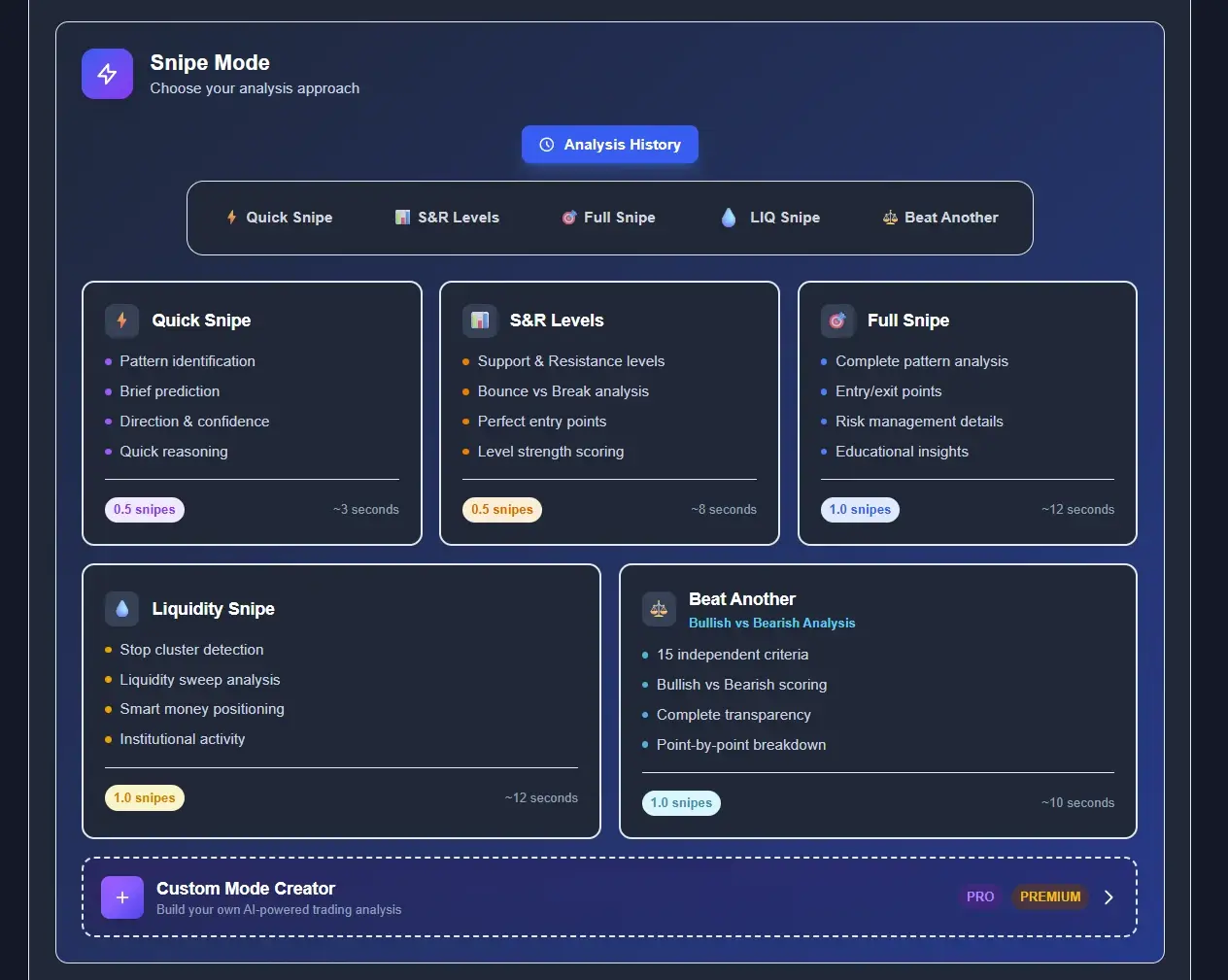
Quick Snipe, S&R Levels, Full Snipe, Liquidity Snipe, Beat Another — one AI, five trader profiles. The single-chart layer once the candidate is picked.
The philosophical move is the same one a good stock AI makes, inverted for FX. Trade Ideas rank tickers; ChartSnipe ranks pairs. Tickeron scores patterns by earnings proximity; ChartSnipe scores pairs by news-impact conviction. Tradytics reads options flow; ChartSnipe reads currency strength. In every case the output format matches the structure of the underlying market.
7. Currency strength — the FX equivalent of a stock screener
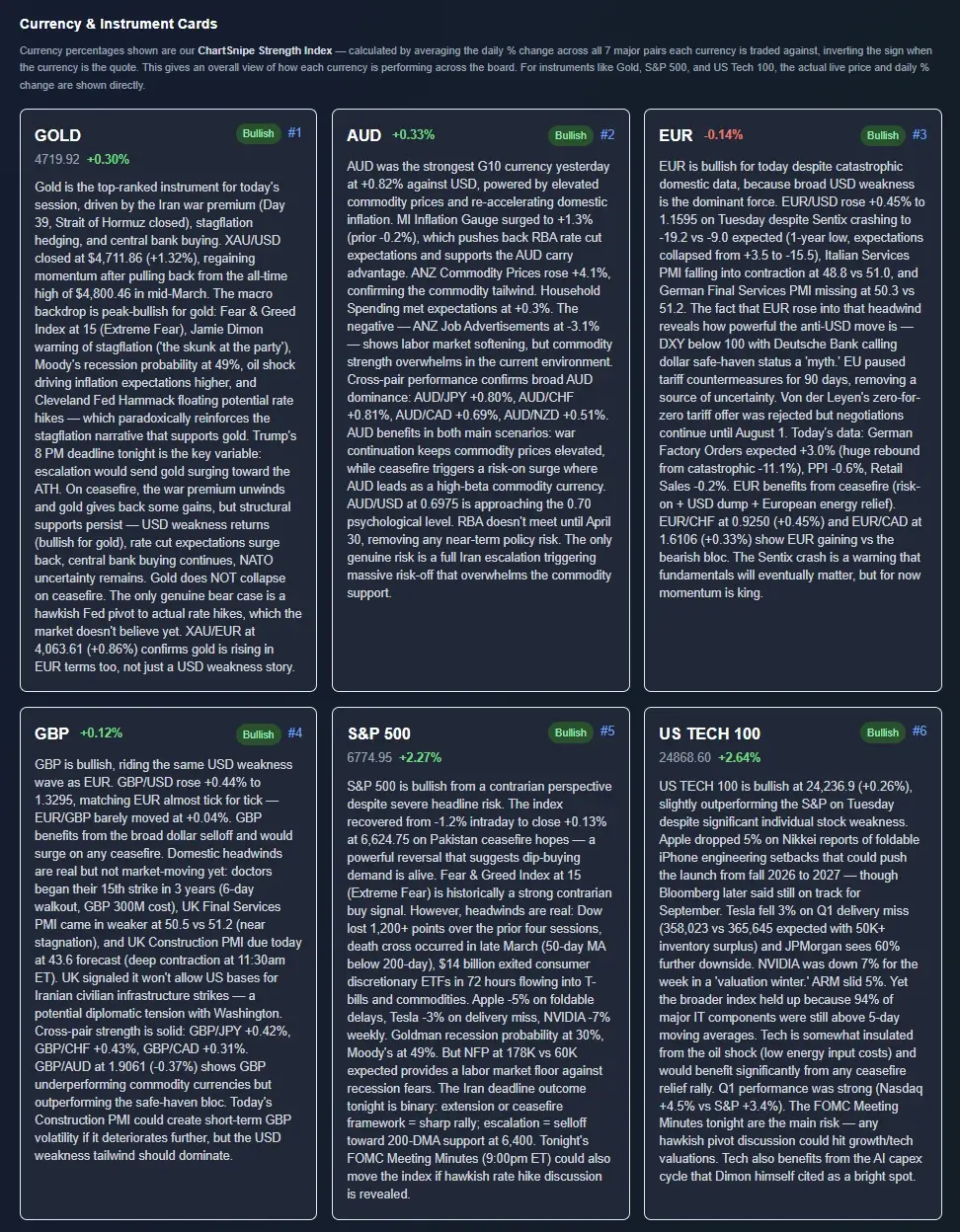
Stock AI’s flagship output is a ranked ticker list. The FX equivalent is a ranked currency strength grid — and it is built entirely on math that a single-instrument stock scanner cannot express. The basic computation is straightforward: for each major currency, average the percentage change across all pairs it participates in, flipping sign where the currency is the quote side. USD strength becomes the mean of −EUR/USD, −GBP/USD, USD/JPY, USD/CHF, −AUD/USD, USD/CAD and −NZD/USD.
The result is one number per currency that summarises the entire day of relative-value activity in FX. Strongest versus weakest writes the cleanest directional trade on the board without any pattern reading. It also tells you when not to trade — if the strength table is flat across the top four currencies, there is no clean directional asymmetry and the session is range-bound. A stock scanner simply has nowhere to put that information.
How ChartSnipe surfaces it
The News Impact dashboard renders the strength index as a live card grid sorted by aggregate move, with the news context written next to each figure. An AUD strength of +1.2% next to a card reading “RBA held at 4.10% overnight, commodity-linked bid into the session” ties the number back to the narrative. The currency strength meter guide covers the math and workflow in full.
8. Macro news impact — the layer that replaces earnings
In equities, the event calendar is company-specific: earnings dates, analyst days, FDA decisions. The best stock AIs lean on that calendar hard — Tickeron discounts pattern setups in the 48 hours before an earnings print, Trade Ideas has pre-earnings gap strategies. In FX the calendar is macro and shared: one CPI print moves every USD pair, one ECB decision moves every EUR cross, one OPEC+ headline moves CAD, NOK and oil together.
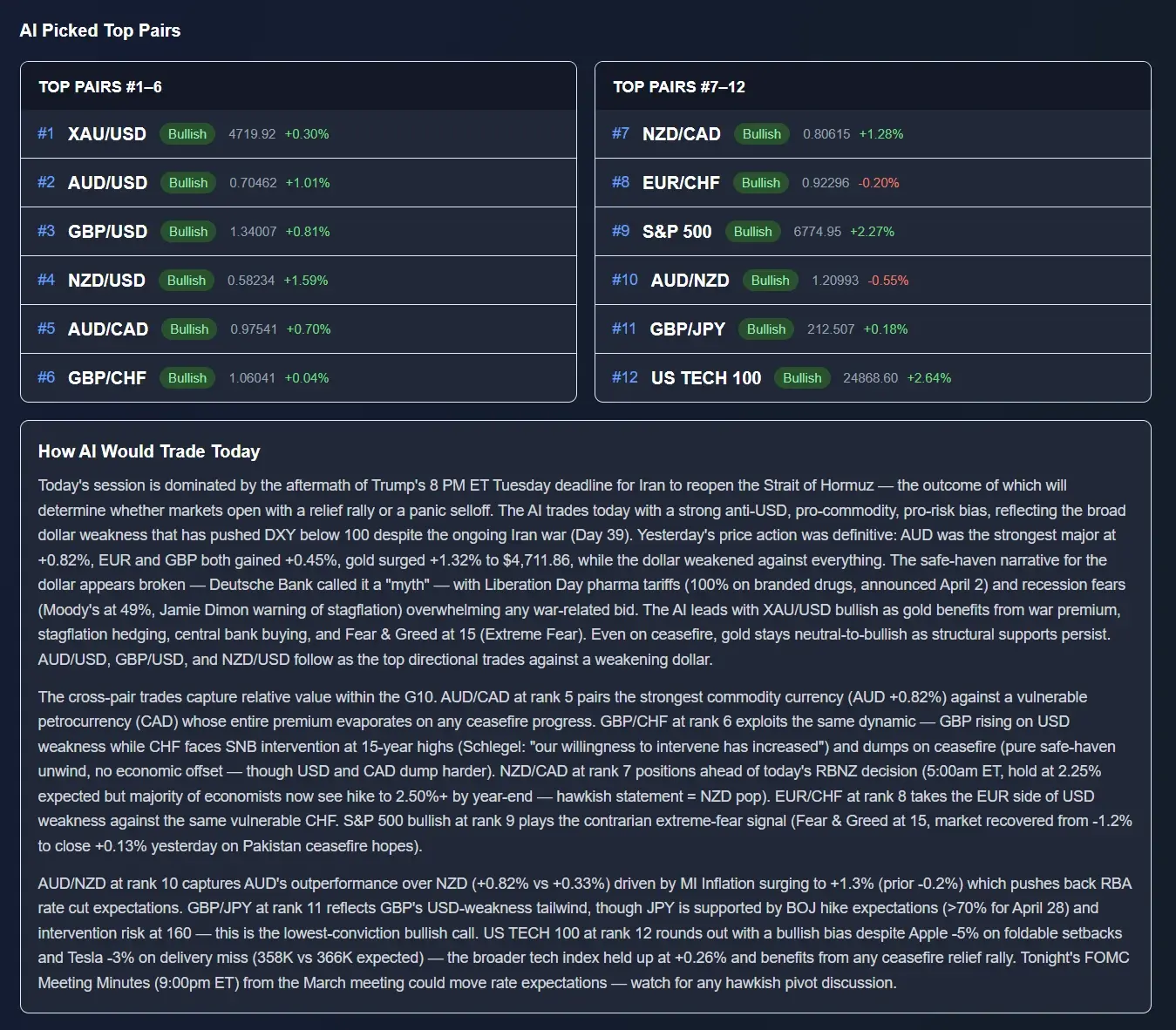
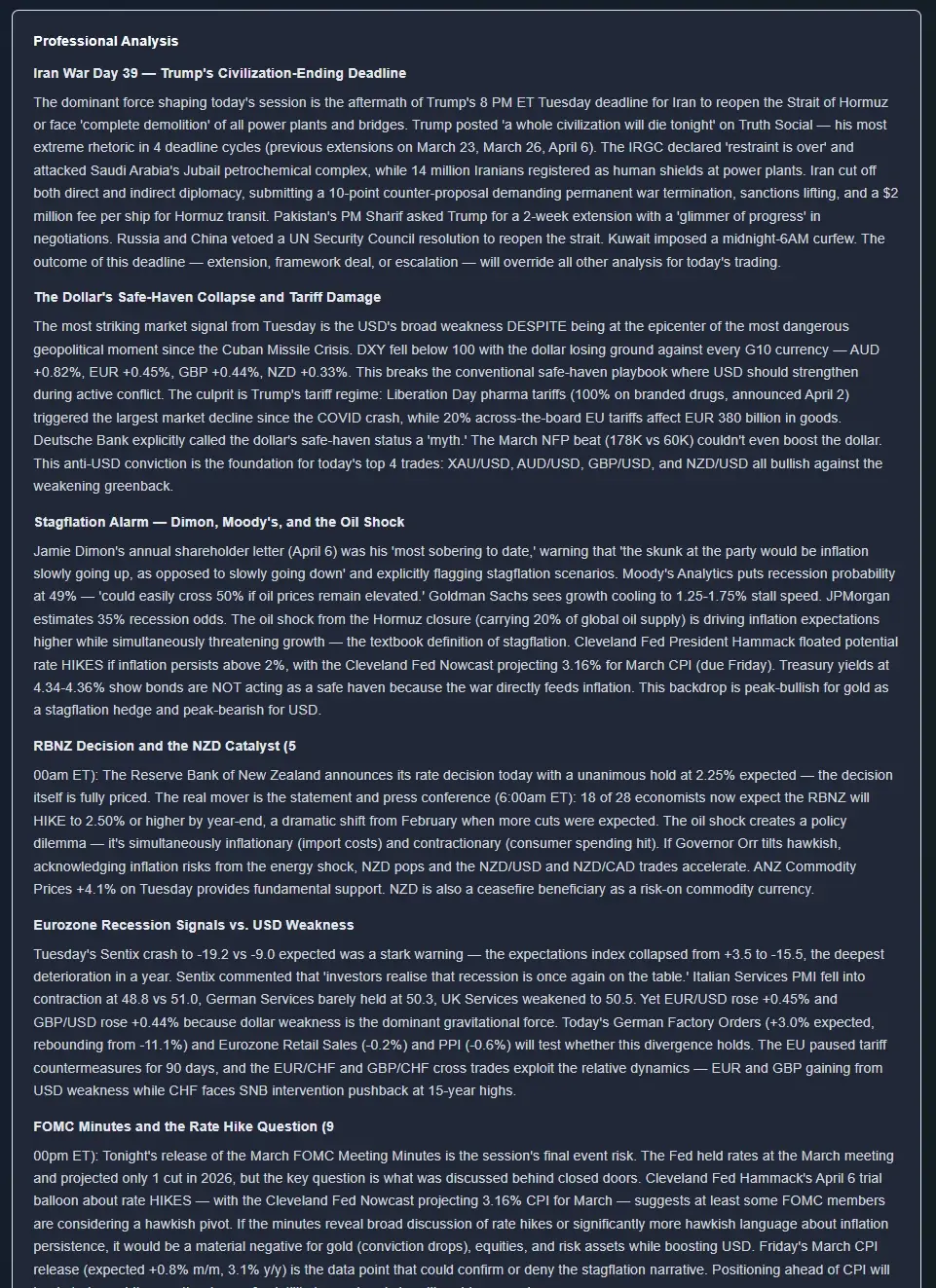
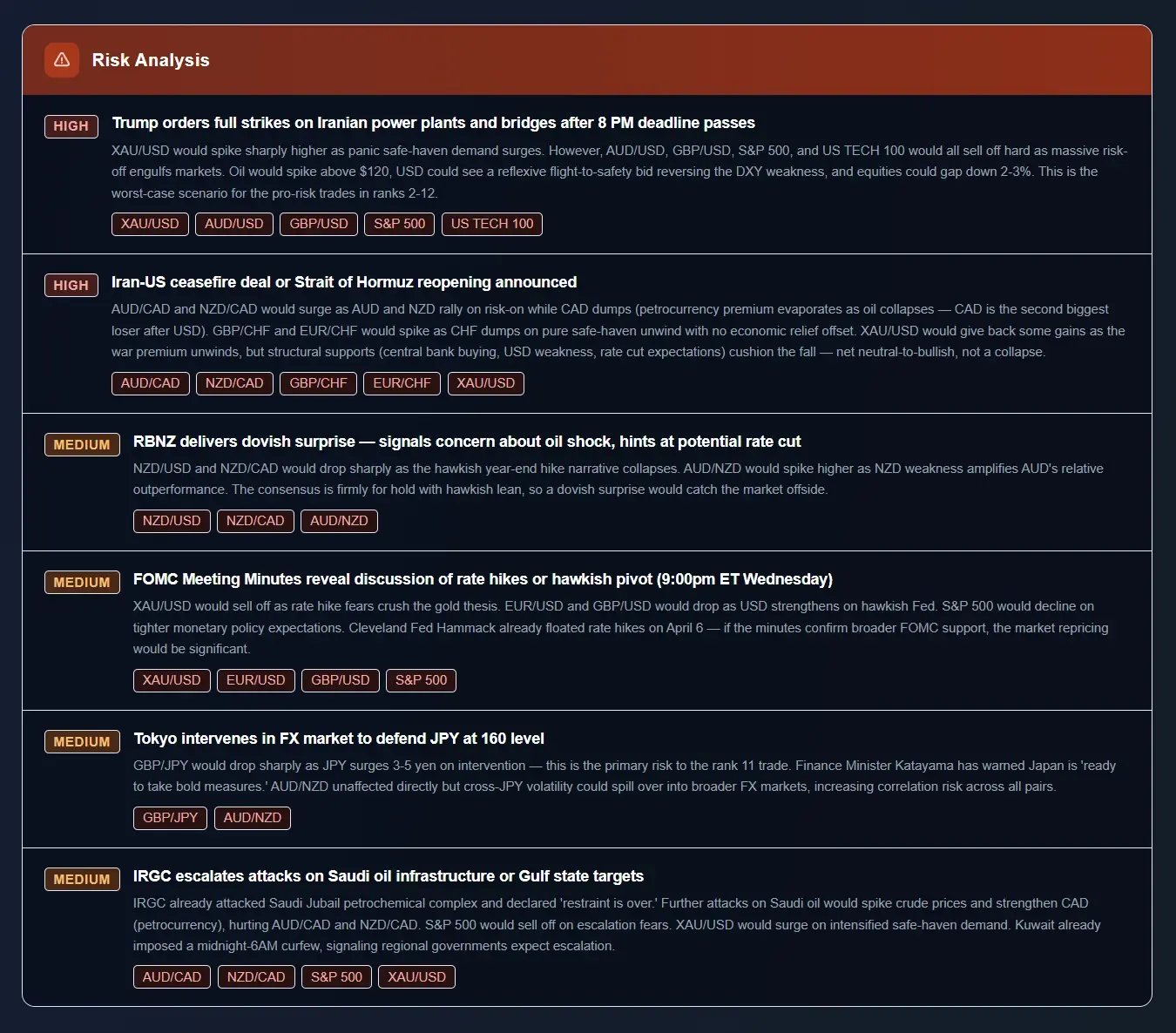
The ChartSnipe Daily AI News Impact dashboard is built specifically around that structure. Each trading day it assembles a briefing from central-bank positioning, economic releases, geopolitical flow, and commodity moves, then scores each of 12 instruments with directional conviction, three drivers, reversal triggers and a morning-brief paragraph. It is the FX equivalent of “top earnings movers tomorrow” — except the movers are currencies, indices and metals reacting to shared macro catalysts.
9. Chart reading works on both — sort of
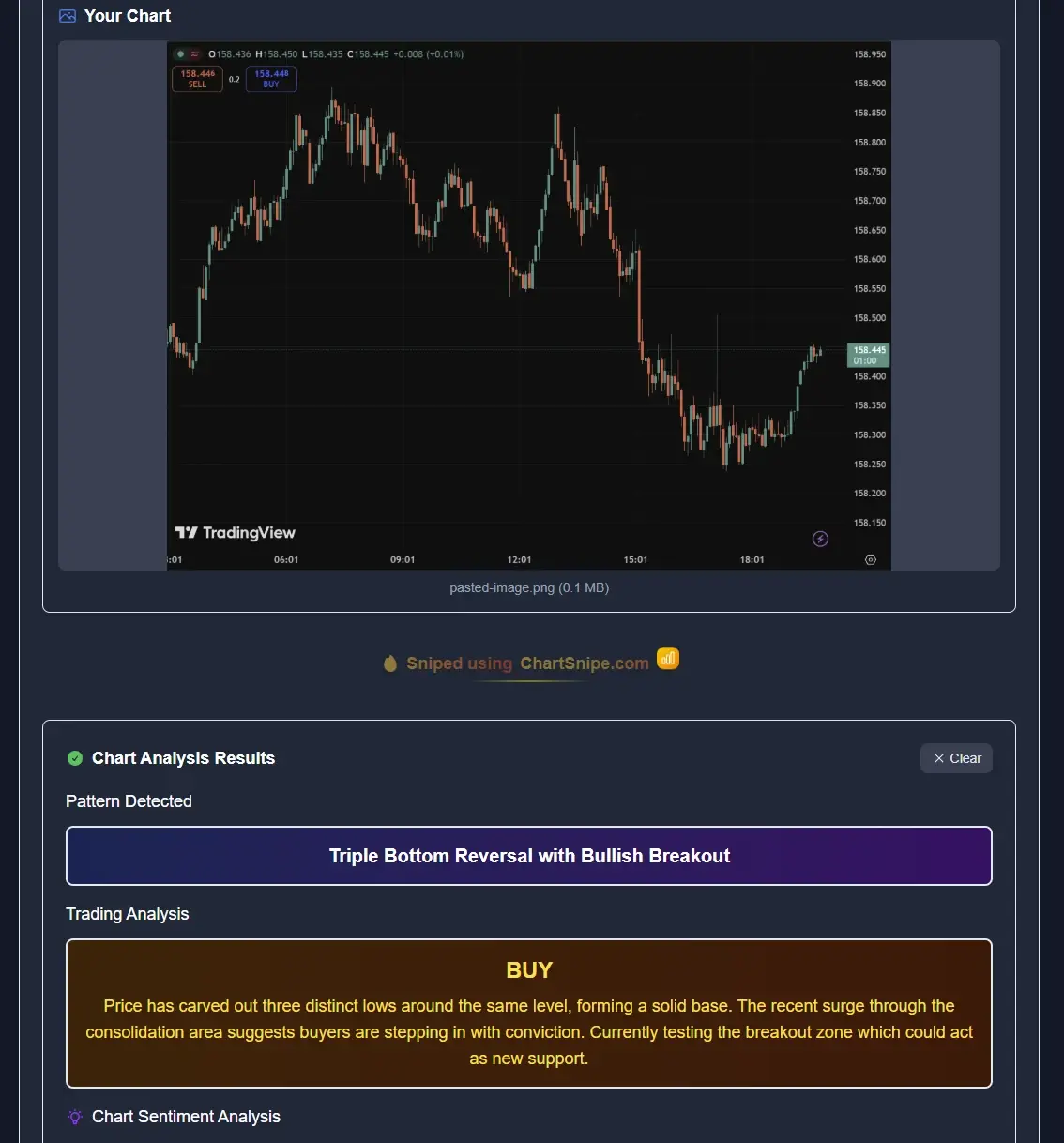
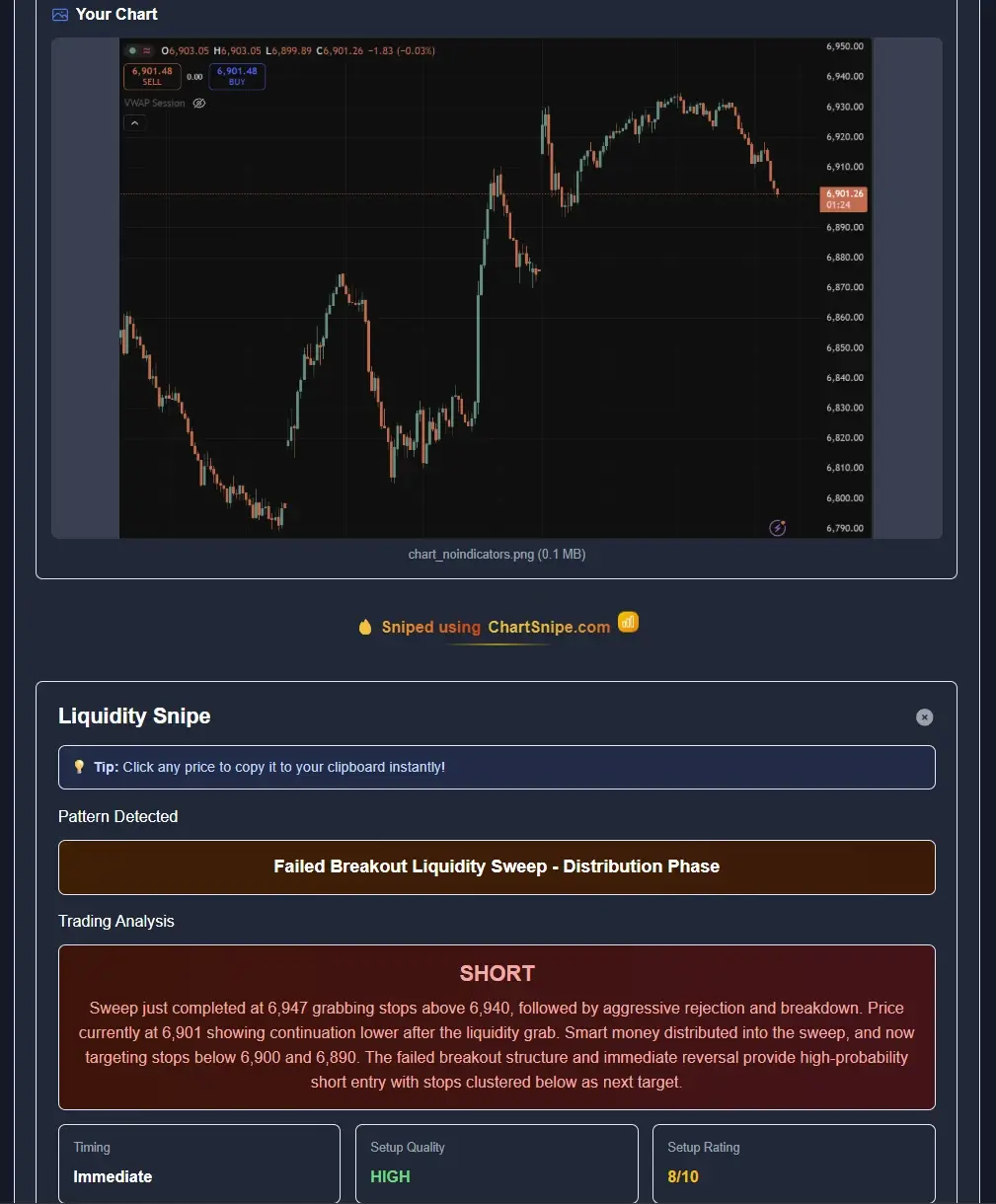
There is one layer where the stock and forex worlds meet cleanly: screenshot-based chart pattern recognition. A head-and-shoulders on AAPL looks like a head-and-shoulders on EUR/USD. A liquidity sweep on a 15-minute chart reads the same regardless of the underlying. Screenshot analysis is the most portable part of any AI trading stack — both Tickeron on the equity side and ChartSnipe on the FX side do it well.
The caveat is that chart reading in isolation is not a trade. An AI that can label patterns but has no awareness of today’s macro flow, session context or correlation structure is a geometry engine. Pattern reading only becomes actionable when it sits on top of the live data layer described in sections 4–8 — which is exactly why a stock scanner’s pattern output does not transfer to FX even though the patterns themselves do.
ChartSnipe stitches the two layers together: screenshot chart analysis returns a named pattern, direction and reasoning; the pair’s place in the currency strength grid and today’s news impact card is right there next to it. The geometry gets a macro check before it becomes a trade.
10. The “AI stock trading” adverts that are not products
Sitting parallel to both the stock AI and forex AI categories is a third wave of search results: the rolling cast of Quantum AI, Qumas AI, Bitsoft360, Immediate Edge, and a dozen rebranded siblings. They appear under searches for “AI stock trading”, “AI to buy and sell stocks” and “AI stock broker”. They are not products. They are affiliate funnels for unregulated brokers, and the UK FCA, Australia’s ASIC and Canada’s CSA have all issued explicit warnings about them by brand name.
Red flags that identify the funnel
- Celebrity endorsement — Elon Musk, Martin Lewis, Holly Willoughby, Jeremy Clarkson. All of these are deepfakes.
- Fixed daily returns — “$1,500 a day”, “97.8% win rate”, “the AI trades for you while you sleep”.
- You cannot see the product until you deposit. No public screenshots, no free tier, no docs.
- Withdrawals require a “verification fee” or a minimum trading volume nobody can hit.
- A pushy “personal account manager” phones you within an hour of the deposit.
- Domain less than 12 months old; brand name on no regulator register anywhere.
Legitimate AI stock pickers and forex AI tools look boring next to this marketing. Transparent pricing, a free tier, named team pages, no promises of fixed returns, and no celebrity endorsements. Trade Ideas, Tickeron, Tradytics and ChartSnipe all fit the legitimate profile. The adverts with the blue Tesla and the countdown timer do not.
11. Which tool for which trader
The entire point of this article is that there is no single answer — the right tool depends on which market you actually trade. Here is the straight, vendor-specific call for the three most common retail buckets.
If you trade US equities — Trade Ideas, Tickeron, Tradytics
Three legitimate products, different strengths. Trade Ideas for live scanning and Holly AI strategy packs. Tickeron for neural-network pattern recognition and portfolio-level AI. Tradytics if you want dark-pool prints and unusual options activity front and centre. None is a silver bullet; every one is built around the data US equities actually publishes.
If you trade forex, metals, or indices — ChartSnipe
Forex-native from the architecture up. Live prices on 28 FX pairs, an 8-currency strength index, daily AI news impact on 12 instruments, and five screenshot analysis modes. Free tier to try the chart analysis on your own setups, Pro from $20/month for the News Impact dashboard and 120 chart analyses.
If you trade both — run both tools
There is no credible single product that covers equities and FX at the same depth. Traders who do both tend to run a dedicated stock scanner on the US cash session and ChartSnipe for the Asia/London macro window — it is less overhead than it sounds because the workflows land at different times of day.
Frequently asked questions
Is AI better for stocks or forex?
Neither is strictly better — they are different games and the AI that wins each is built around different data. Stock AI leans on fundamentals, earnings and options flow. Forex AI leans on relative-value math, currency strength and central-bank positioning. Pick the AI built for the asset class you trade.
Can I use a stock AI like Trade Ideas for forex?
Not productively. Trade Ideas, Tickeron and Tradytics are engineered around US equities — earnings, sector rotation, volume prints, options flow. None of those data sources exist for a currency pair, and FX correlations break single-instrument momentum logic. Use an FX-native tool for FX.
What is the best AI for stock picking in 2026?
For active US equities the longest-running name is Trade Ideas with its Holly AI strategies. Tickeron is strong on pattern-based neural networks with confidence scores. Tradytics owns options flow and dark-pool prints. Danelfin leans fundamentals-heavy for longer holding periods. No silver bullets — but legitimate professional tools for their domain.
Why is forex AI harder than stock AI?
FX is relative-value with eight currencies meshed into 28 pairs. A move on any single pair is ambiguous until you know which leg did the work. Add 24-hour sessions, no closing auction, dense cross-pair correlations and a macro-dominant event clock — and a stock-style scanner has nothing to grip.
Does ChartSnipe work for stocks?
The screenshot chart analysis reads any chart you upload — equities, ETFs, commodities, crypto — and returns a pattern label, direction and reasoning. The live-data layer (28 FX pairs, 8-currency strength, macro news impact) is forex-native. For single-name US equity research, a dedicated stock AI like Trade Ideas or Tickeron is the better fit.
Is there an AI that does both stocks and forex well?
Not in practice. Products claiming coverage across everything are usually chart-screenshot LLMs with no live data behind them — fine for learning, unreliable for execution. Serious AI tools specialise. Trade Ideas / Tickeron own US equities; ChartSnipe owns forex, metals and indices. Run the right tool for each market.
Trading forex, metals or indices? Use the AI built for them.
Stock AI tools were never meant for FX. ChartSnipe is — 28 live FX pairs, 8-currency strength index, daily AI news impact on 12 instruments, and five chart analysis modes. Two free snipes to test on your own setup.