
What Is a Funded Account? How Payouts Work
A funded account is the account a prop firm hands you after you pay a fee and pass its rules. Here is what you actually get, how the payout is calculated, why drawdown type decides who survives, and what passing really costs.
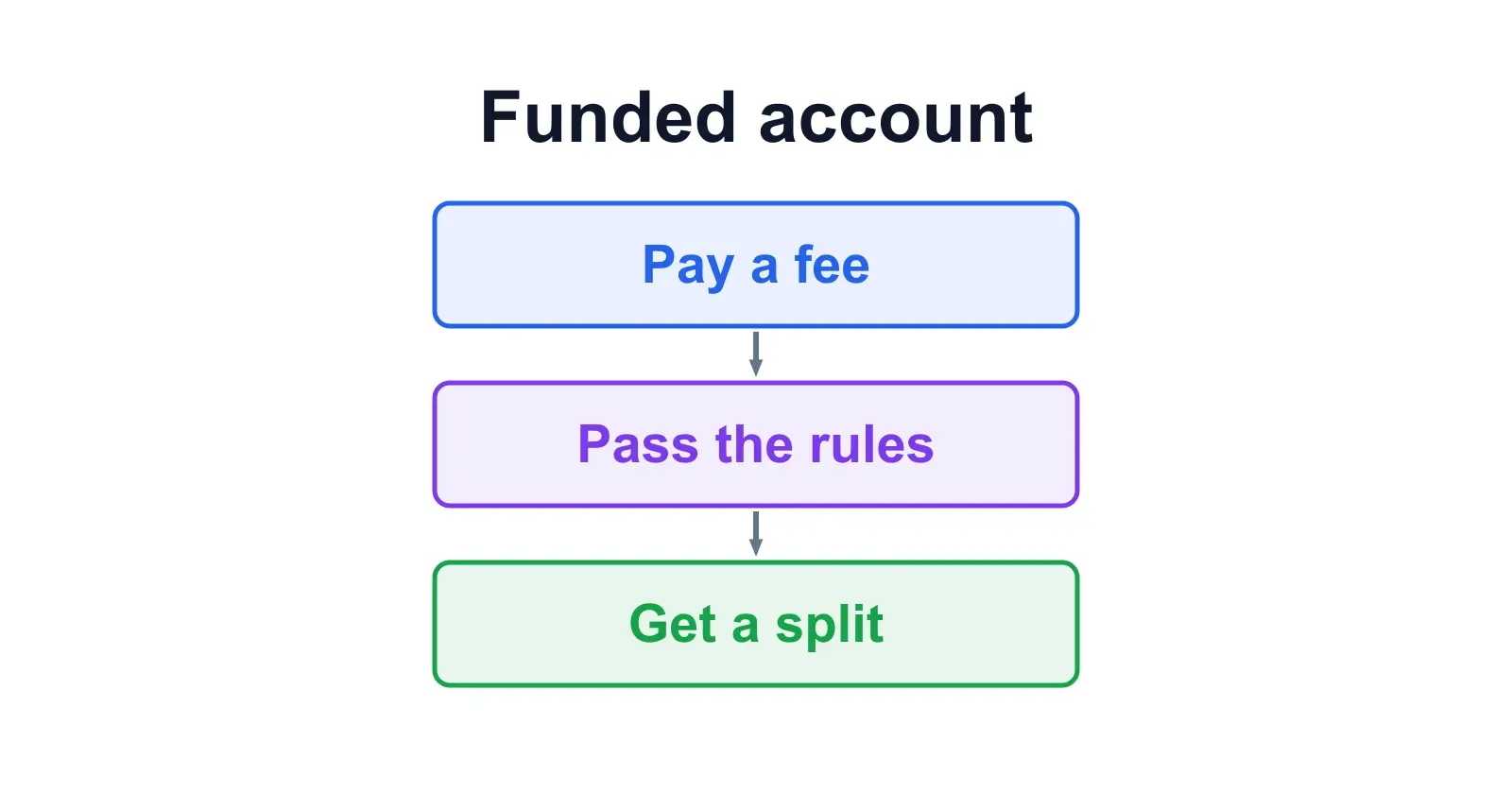
A funded account is a trading account a proprietary trading firm gives you after you pay an evaluation fee and meet its rules. You trade it, and you keep an agreed share of the profit, usually 70% to 90%. What most ads leave out is that at many retail prop firms the account is simulated. The money you can withdraw is a payout from the firm, not your trades being settled in a real market.
That does not make it a scam, and it does not make it a gift. It is a paid test with a prize attached, and the prize only arrives if you stay inside the loss limits the whole way. This post covers how a funded trader gets there, which rules do the damage, the difference between static and trailing drawdown, and a payout worked through to the dollar. If you want the industry-level question of whether the whole model is worth your money, read are prop firms worth it in 2026 alongside this.
Key Takeaways
- →A funded account is a paid test with a payout attached. At many retail firms it is simulated, so you earn a payout rather than trade the firm's real capital.
- →Three paths exist: instant funding, a 1-step evaluation and a 2-step evaluation. Cheaper routes usually come with more steps, and faster routes usually come with stricter rules.
- →On a $100,000 account, one equity path survives a static 10% limit and fails a trailing one. Read which type your firm uses before you pay.
- →An 80% split on a $6,000 profit pays $4,800. After $1,500 of fees across three attempts you keep $3,300.
- →Expected fees per funded account equal the fee divided by your pass rate. At a hypothetical 1 in 10, a $500 fee costs $5,000 per pass.
1. What is a funded account?
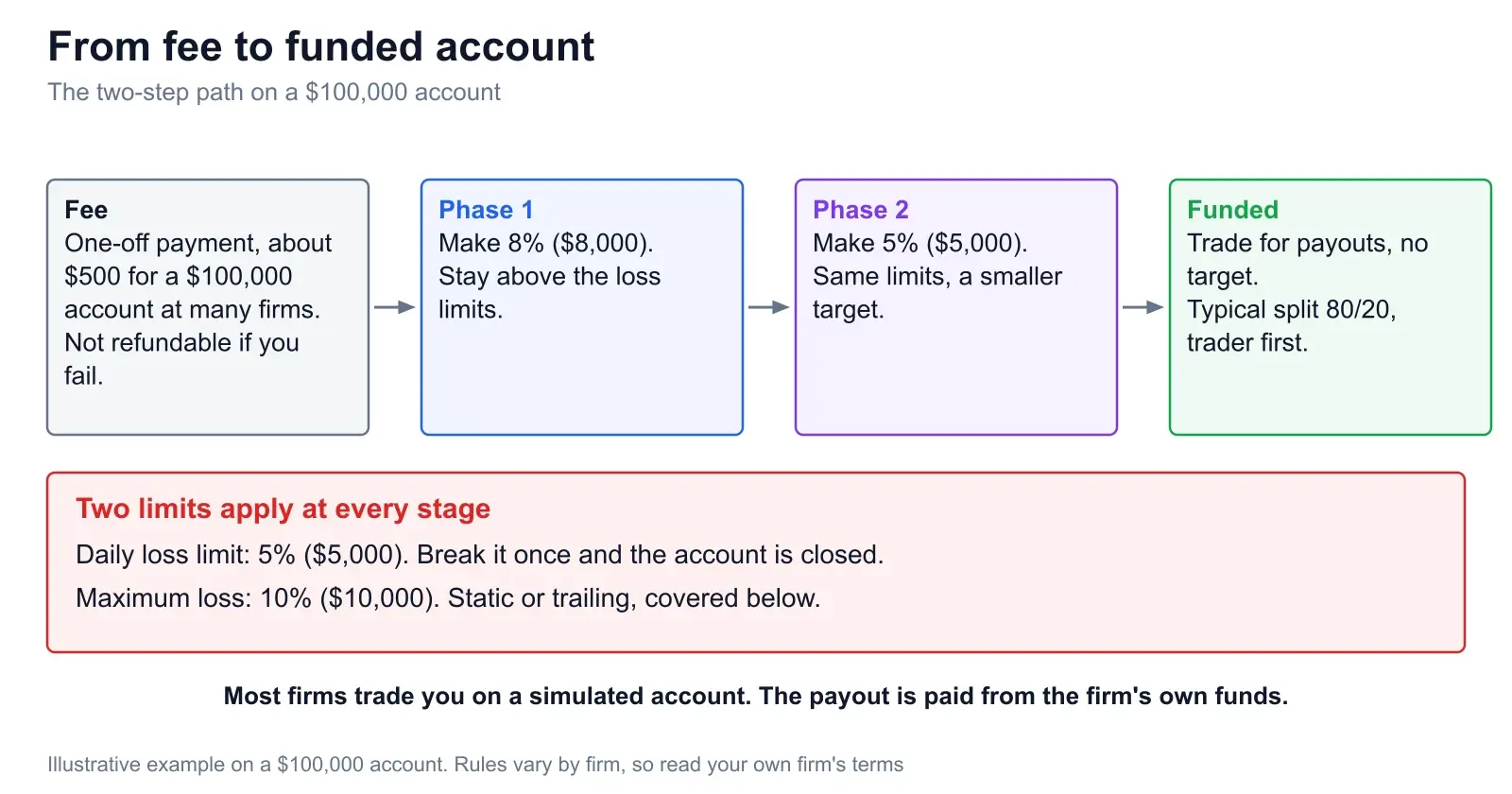
Strip away the marketing and the deal has three parts. You pay a fee. You prove you can make a set return without breaking the firm's risk limits. In return you get a larger account than you could fund yourself, and a share of whatever you make on it. A funded trader is simply someone who has passed that test and is trading the resulting account.
The account size is the headline. Firms sell accounts from $10,000 up to $200,000 and beyond, which is why the model is popular with traders who have a few thousand dollars at most. The fee for a $100,000 account is commonly a few hundred dollars. Compare that with the capital you would need to place a meaningful position in forex or futures yourself, and the appeal is obvious.
Investopedia defines proprietary trading as a firm trading with its own money for its own profit, not its clients'. That is the traditional meaning, and it is worth keeping in your head because the retail version is a different business. A traditional prop desk hires traders and pays salaries or a cut. A retail funded trading account is a product you buy.
2. Is the money real?
This is where precision matters, because both camps online get it wrong. One camp says funded accounts are fake and the firms are casinos. The other says you are trading the firm's capital. The usual truth sits between them.
At many retail firms, the evaluation account and the funded account are both simulated. Your orders execute on a demo feed. The firm pays you a profit split from its own revenue when you request a withdrawal. Some firms state that they copy funded traders into live markets or hedge against them, and some do not. Terms rarely give you a way to verify which applies to your account, so treat any claim of live capital as the firm's statement, not a fact you have checked.
The payout is real money in your bank account either way. The risk you carry is that the firm refuses, delays or voids it, which is why the rules and the company behind them matter more than the size of the account. The CFTC, the U.S. regulator for futures and forex, publishes a Learn and Protect hub on spotting fraud and unregistered offers. It is general guidance, not a review of any particular prop firm, so read it as a checklist for any firm that promises easy money from trading.
3. Instant, 1-step and 2-step funded trading accounts
A funded trading account reaches you by one of three routes. The names are common across firms and the numbers shift by firm, but the pattern is consistent: you trade ease of entry against price and rule strictness.
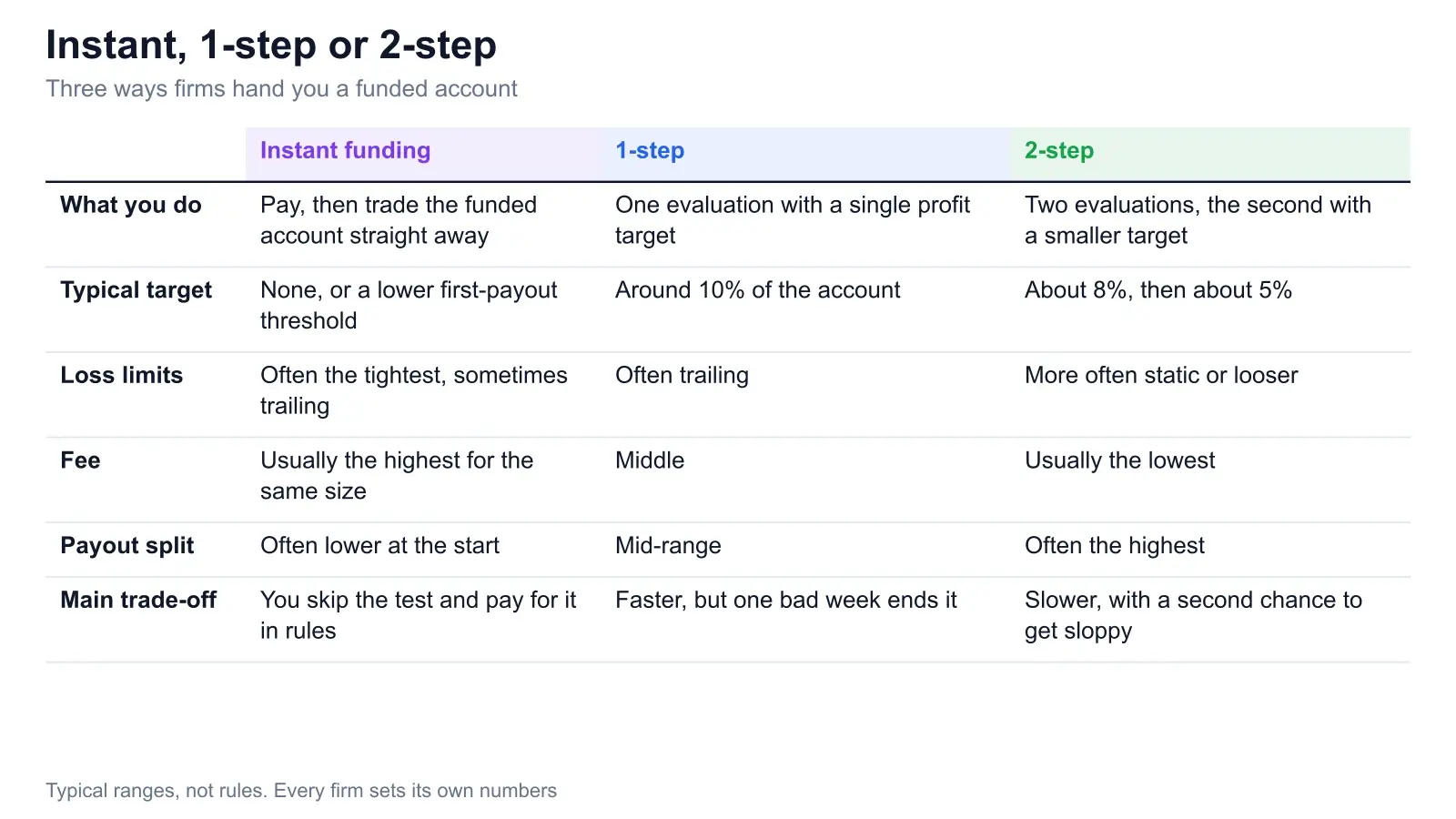
Instant funding skips the test. You pay and trade the funded account straight away, often with a lower split and tighter drawdown, and a first-payout threshold instead of a profit target. 1-step has one evaluation, usually around a 10% target. 2-step has two, commonly 8% and then 5%, and it tends to carry the lowest fee and the loosest limits because the firm filters you twice.
My view: the 2-step route is the better default for a trader with a plan. Two targets sound slower, but with 0.5% risk per trade an 8% target is 16R and the 5% second phase is 10R. The route to avoid is the one that matches your worst habit. If you overtrade, a 1-step with a trailing floor will punish you. If you hate waiting, instant funding will charge you for it in rules.
4. The rules that decide your account
Funded accounts are lost on rules, not on bad analysis. Six of them do nearly all the damage.
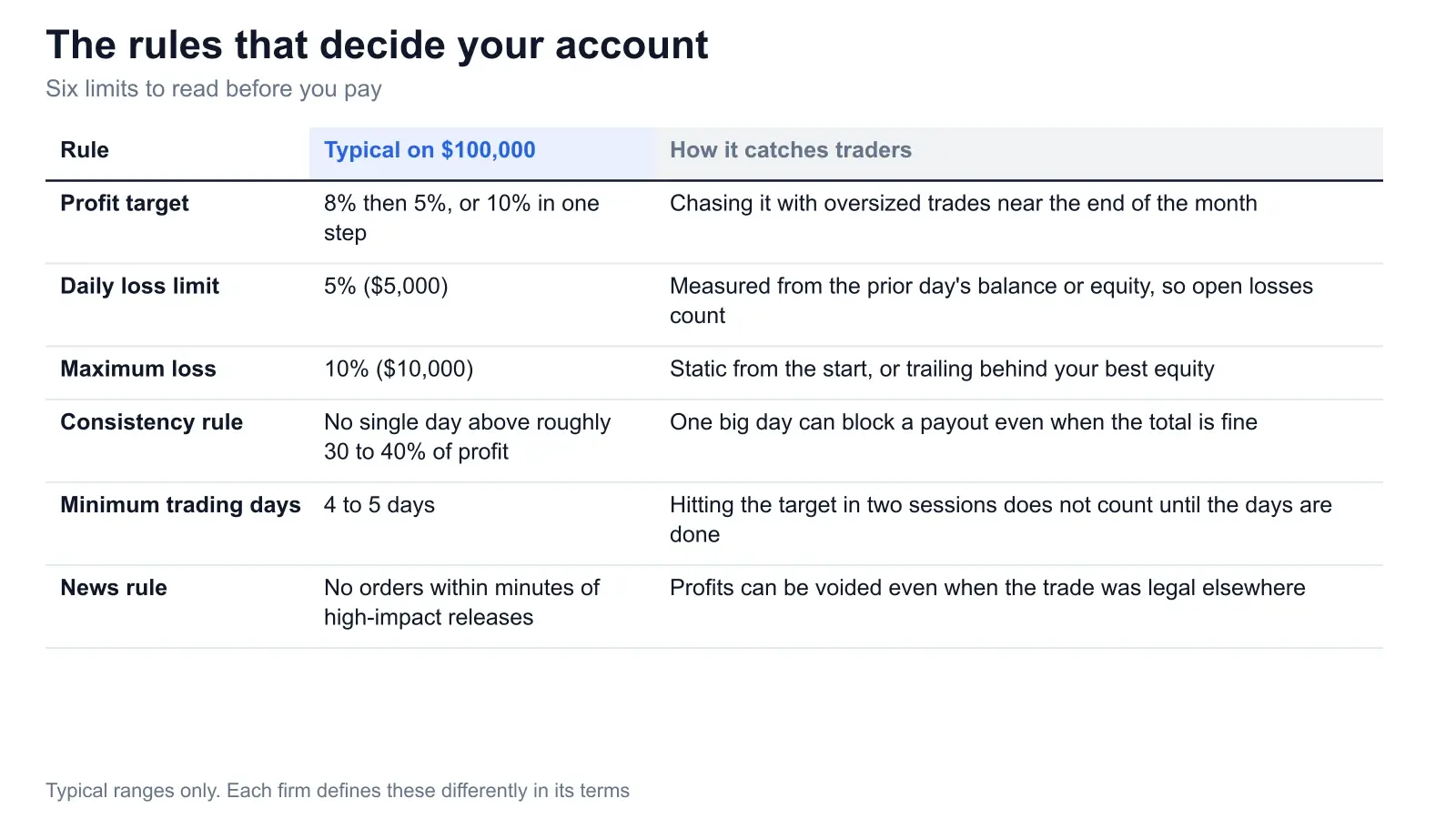
The daily loss limit is the one that ends accounts fastest. On $100,000 at 5%, you have $5,000 to lose in a day, and many firms count floating losses on open trades, not just closed ones. If you risk 1% ($1,000) per trade, five losers in a row closes the account for the day. Risk 0.5% and you have ten. The same arithmetic applies to the 10% maximum loss: twenty consecutive losers at 0.5%.
Consistency rules are the quiet one. A common form says no single day may account for more than a set share of your total profit, with figures in the 30% to 40% range. A $9,000 profit where one day produced $4,500 fails a 40% rule even though the total is fine. News rules stop you from placing or holding orders around high-impact releases and can void profits made inside the window. We cover the variations in detail in prop firm news trading rules.
The practical habit is to turn each limit into a number before the first trade. On a $100,000 account the firm's daily limit is $5,000, so your own daily stop should sit well under it, say $2,000. The firm's limit is the wall. Your own limit is the one you trade by. For placing the stop itself, our stop-loss placement guide covers structure stops and buffers.
5. Static versus trailing drawdown
Investopedia describes drawdown as the decline from a peak to a trough. Funded accounts turn that into a hard limit, and the two ways of measuring it are not equivalent.
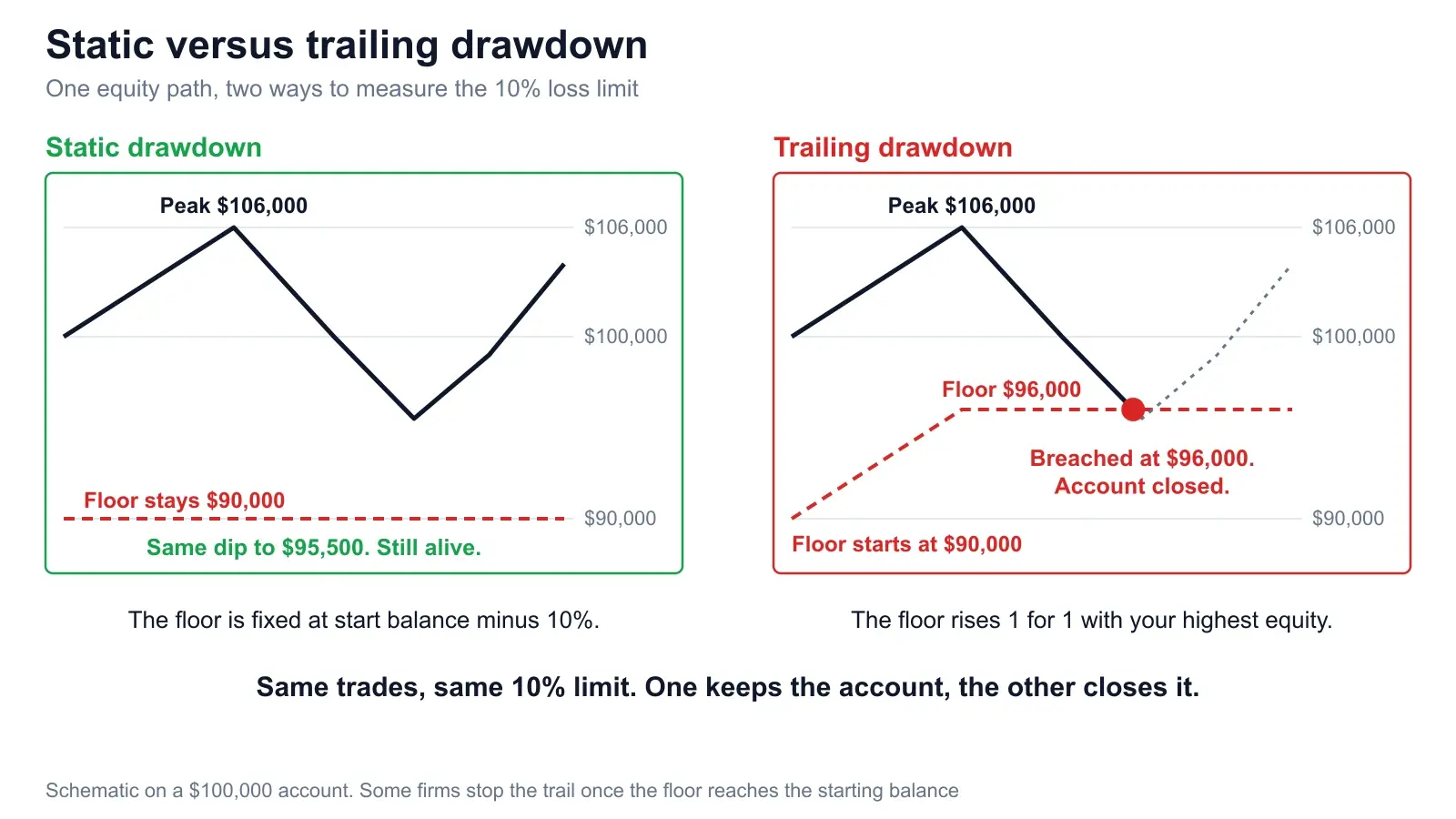
With static drawdown the floor is fixed at your starting balance minus the limit: $90,000 on a $100,000 account, for good. With trailing drawdown the floor follows your highest equity. Make $6,000, reach $106,000, and your floor moves to $96,000. Your cushion is still $10,000, but it is now measured from the peak, so the profit you thought was a buffer is gone.
Two details change the picture. First, whether the trail uses balance or equity. An equity-based trail follows floating profit, so a trade that spikes in your favour and comes back can raise your floor without you ever banking a dollar. Second, many firms stop the trail once the floor reaches the starting balance. In our example, a $110,000 peak would lock the floor at $100,000 and stop it climbing. Read the exact wording, because the same sentence from two firms can behave differently.
6. How do funded accounts work? Payouts and profit split
Once you hold the funded account, there is no profit target. There is a payout schedule, commonly after a minimum number of trading days and then every two weeks or monthly, and a profit split. Eighty percent to the trader is a typical starting split, with tiers up to 90% at some firms for traders who scale or keep getting paid.
Here is a worked example. You hold a $100,000 funded account and finish the first payout period with $6,000 of profit. The split is 80/20.
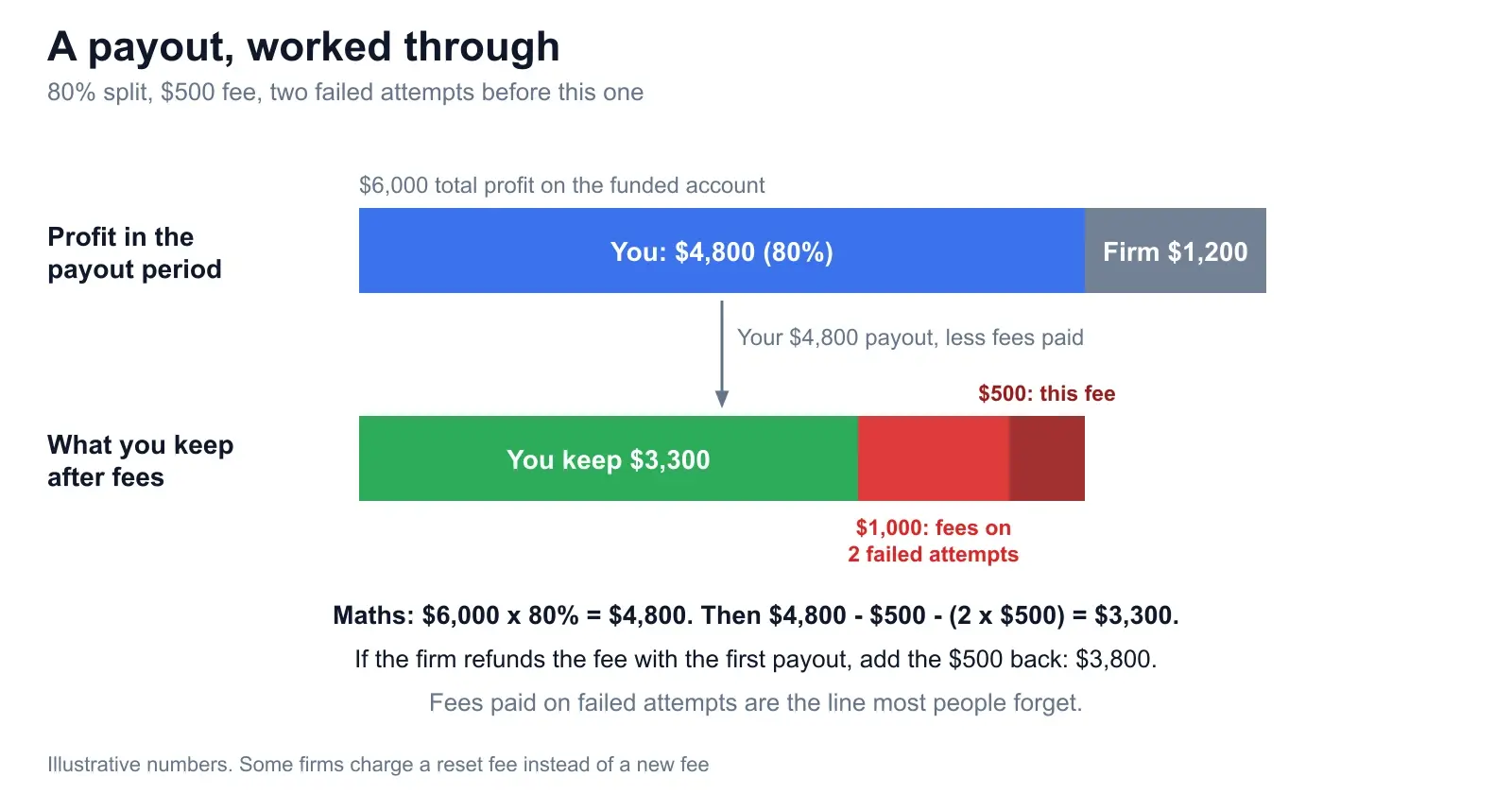
- Profit: $6,000, which is 6% of the account.
- Your share: $6,000 x 80% = $4,800. The firm keeps $1,200.
- This account's fee: $500, paid before you started.
- Earlier attempts: two failed evaluations at $500 each = $1,000.
- Net result: $4,800 - $500 - $1,000 = $3,300.
Some firms refund the evaluation fee with your first payout, which would put $500 back and lift the net to $3,800. Others charge a monthly subscription, or a reset fee instead of a new purchase after a breach. None of that is bad, but it belongs in the arithmetic. A payout is not your profit until you have subtracted what you spent to earn the chance.
Payout tax is its own subject. In the US, these payouts are generally reported as self-employment income, and the details are in our guide on how to file prop firm taxes.
7. What passing really costs
The question that decides whether this is worth it is how often traders pass, and nobody can give you a trustworthy single number. Firms rarely publish audited pass rates, and the figures you see online come from firms, affiliates or small surveys. I will not quote one. What I can give you is the maths, so you can plug in your own honest estimate.
If you pass with probability p, you expect to buy 1 divided by p attempts per funded account. At a $500 fee, a 1-in-5 pass rate costs $2,500 in fees per funded account, 1 in 10 costs $5,000, and 1 in 20 costs $10,000. That is before refunds and before the second phase of a 2-step.
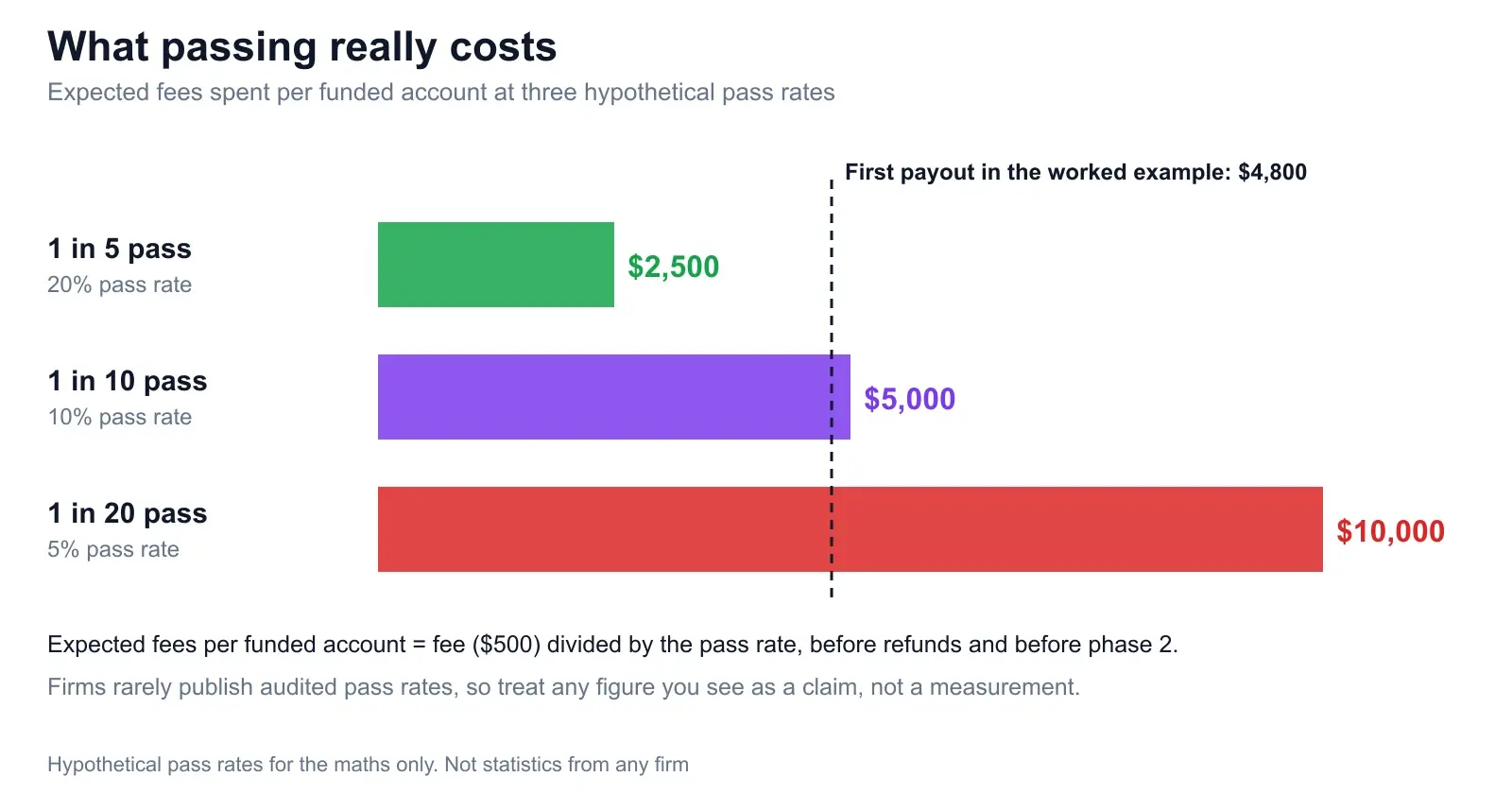
Notice where the dashed line falls. At a 1-in-10 pass rate you spend more in fees than the first payout earns. That is not a case against trying. It is a case for knowing your own number: count your own attempts, or run a demo of the exact rules first. The traders who come out ahead are the ones whose personal pass rate is well above the crowd's, and they know it because they tracked it. Our prop firm fine-print breakdown goes into the industry-level picture and what changed after the 2024 shakeout.
8. Scaling plans
A scaling plan raises your account size when you hit milestones. The common shape: reach a net profit target over a set period, usually with a minimum number of payouts, and the firm increases your account by a fixed percentage. Your profit target and loss limits grow in dollars as the account does.
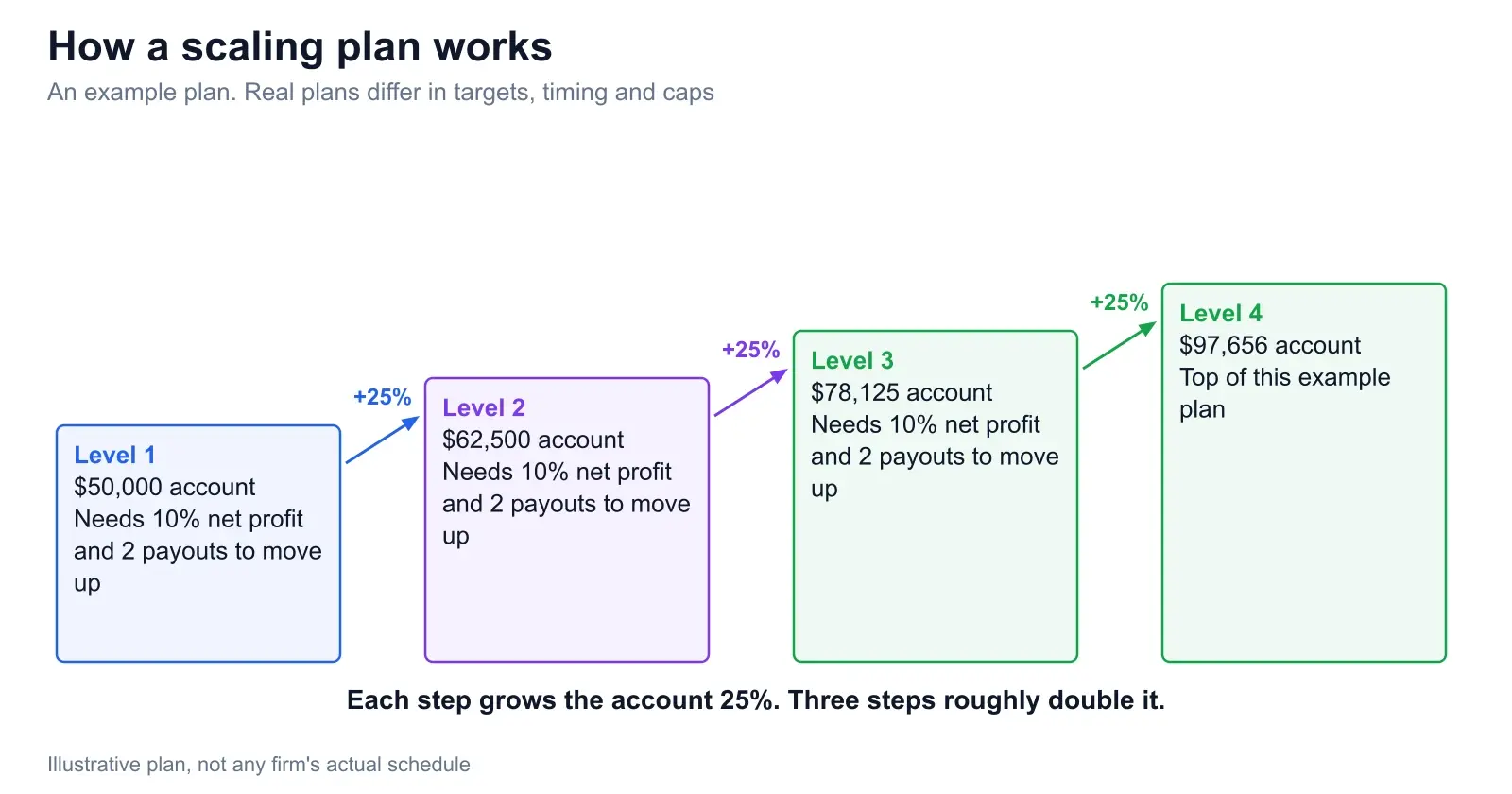
The compounding looks generous on paper, and it is. The catch is that the larger account does not change the percentage rules, so a 5% daily limit is $2,500 at Level 1 and $4,883 at Level 4. The dollars you can lose in a day nearly double. Your mistakes scale with your account. The traders who benefit most keep the same fixed risk per trade at every level, which means their growth comes from payouts, not from sizing up.
9. Red flags
Some firms are well run and some are not, and the marketing looks the same. These are the six warning signs I would check before paying any firm.
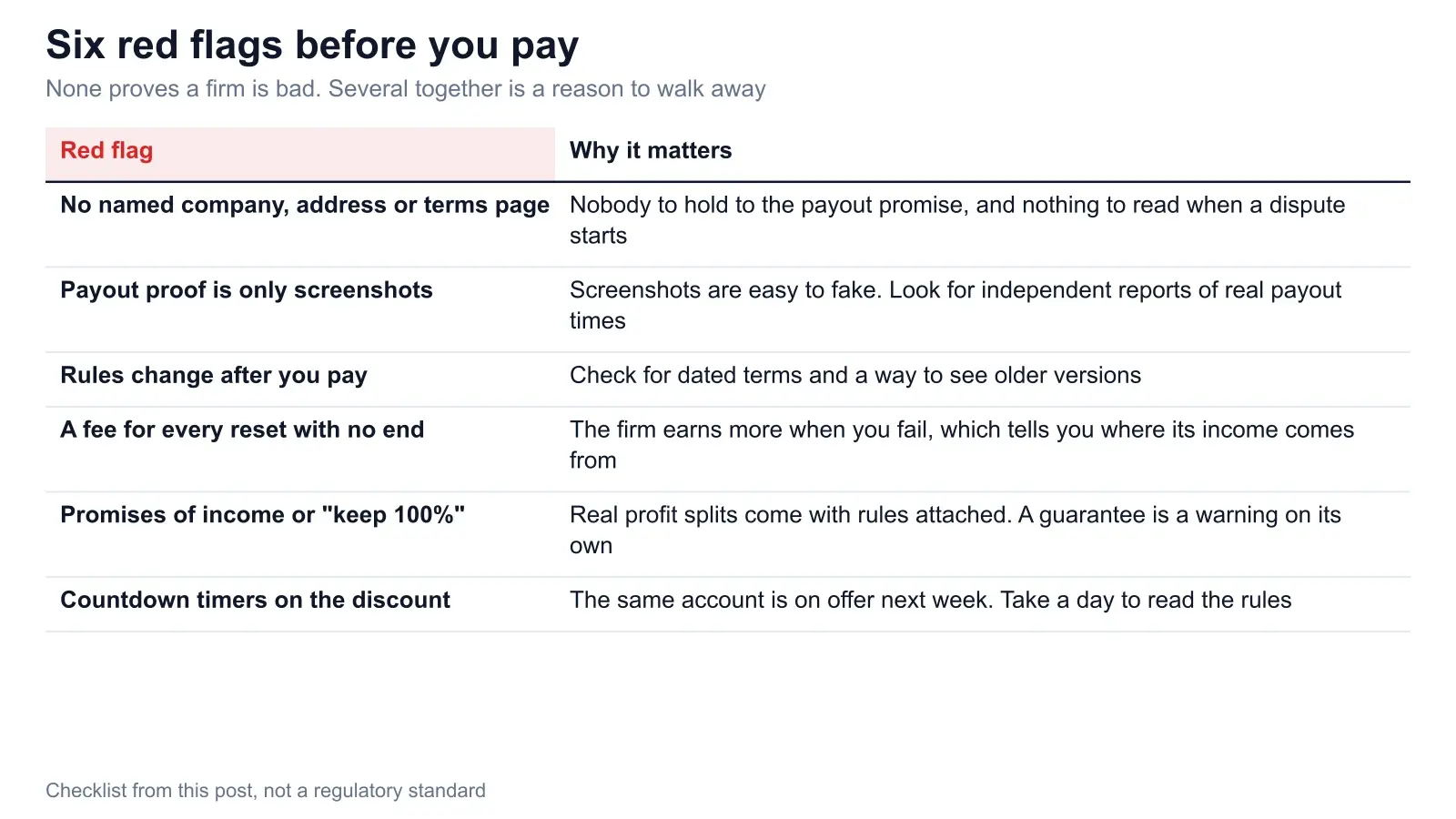
The most reliable one is the money flow. If a firm's income depends on traders failing and buying resets, its incentives and yours point in opposite directions. Reputable firms pay out and can show it, and their rules read the same after you have paid as before. FINRA's investor education pages give general guidance on evaluating any offer that promises returns, and it applies here.
10. Trading a funded account with a plan
The traders who keep a funded account treat the loss limits as the real account size. They write the daily stop in dollars before the session, risk a fixed fraction per trade, and skip the trade when the reward to risk is below 1.5. Our risk-reward ratio examples show how much win rate each ratio needs, and 12 trading psychology mistakes that drain accounts covers the revenge trading that hits the daily limit.
If you want a second read on a setup before you commit a trade against a limit, screenshot the chart and run it through the Chart Snipe tool. It reads the screenshot for trend, patterns and key levels and gives entry and risk guidance. It is not a signal service and it cannot know your firm's rules, so check any stop it suggests against your daily limit. Log every trade in the trading journal, because your own pass rate is the number that decides whether this is worth paying for.
Frequently asked questions
What is a funded trading account?
A funded trading account is an account a prop firm gives you after you pass its evaluation, so you can trade the firm's account size and keep a share of the profit instead of risking your own savings. At many retail prop firms the account is simulated, and the payout is paid from the firm's own funds. You still pay an evaluation fee and you still have to follow the loss limits.
How do funded accounts work?
You pay a fee, trade an evaluation account until you hit a profit target without breaking the daily loss or maximum loss limit, and then receive the funded account. Profits on it are split with the firm, commonly 80% to you, and paid out on a schedule. Break a loss limit and the account closes.
Is a funded account real money?
Usually not in the way people assume. Many firms run evaluation and funded accounts in simulation, and the money you receive is a payout from the firm's revenue. Some firms say they copy or hedge funded traders with real capital, some do not, and the terms rarely prove which. The payout can be real money even when the trading account is not.
How much of the profit does a funded trader keep?
Common splits run from 70% to 90% for the trader, with 80% a typical starting point and higher tiers unlocked by scaling or consecutive payouts. On a $6,000 profit an 80% split pays $4,800. Check whether fees, reset costs or a minimum payout threshold apply before you count that number as yours.
What is the difference between static and trailing drawdown?
Static drawdown puts the loss floor at a fixed level, such as $90,000 on a $100,000 account. Trailing drawdown moves the floor up as your equity reaches new highs, so the room you have shrinks relative to your peak. Many firms stop the trail once the floor reaches the starting balance. Trailing is the stricter of the two for the same percentage.
Can you lose money on a funded account?
At most firms you cannot lose more than the fees you pay, because the account is not your capital and there is no margin call on your savings. You can lose all of those fees quickly, though. Failed evaluations, reset fees and monthly subscriptions add up, and with a low pass rate the fees spent per funded account can exceed your first payout.
Sources & further reading
- → Investopedia: proprietary trading, the traditional meaning of trading a firm's own capital.
- → Investopedia: drawdown, the peak-to-trough decline that funded-account limits are built on.
- → CFTC: Learn and Protect, general guidance on fraud and unregistered offers in futures and forex.
- → FINRA: investor education, general guidance for evaluating any offer that promises returns.
All account sizes, fees, splits and pass rates in this post are illustrative. Rules differ by firm, so read your own firm's terms. Nothing here is financial advice or a promise of profit.
Sizing up a trade against your daily limit?
Upload a chart screenshot to the Chart Snipe tool and see where it puts the trend, the key levels and the risk. Then check the stop against your firm's loss limit before you place the order.