
How to File Prop Firm Taxes
A US trader's guide to prop firm payouts: how they are generally treated, which forms they land on, what the 2026 deadlines are, and a worked self-employment tax example with every step shown.
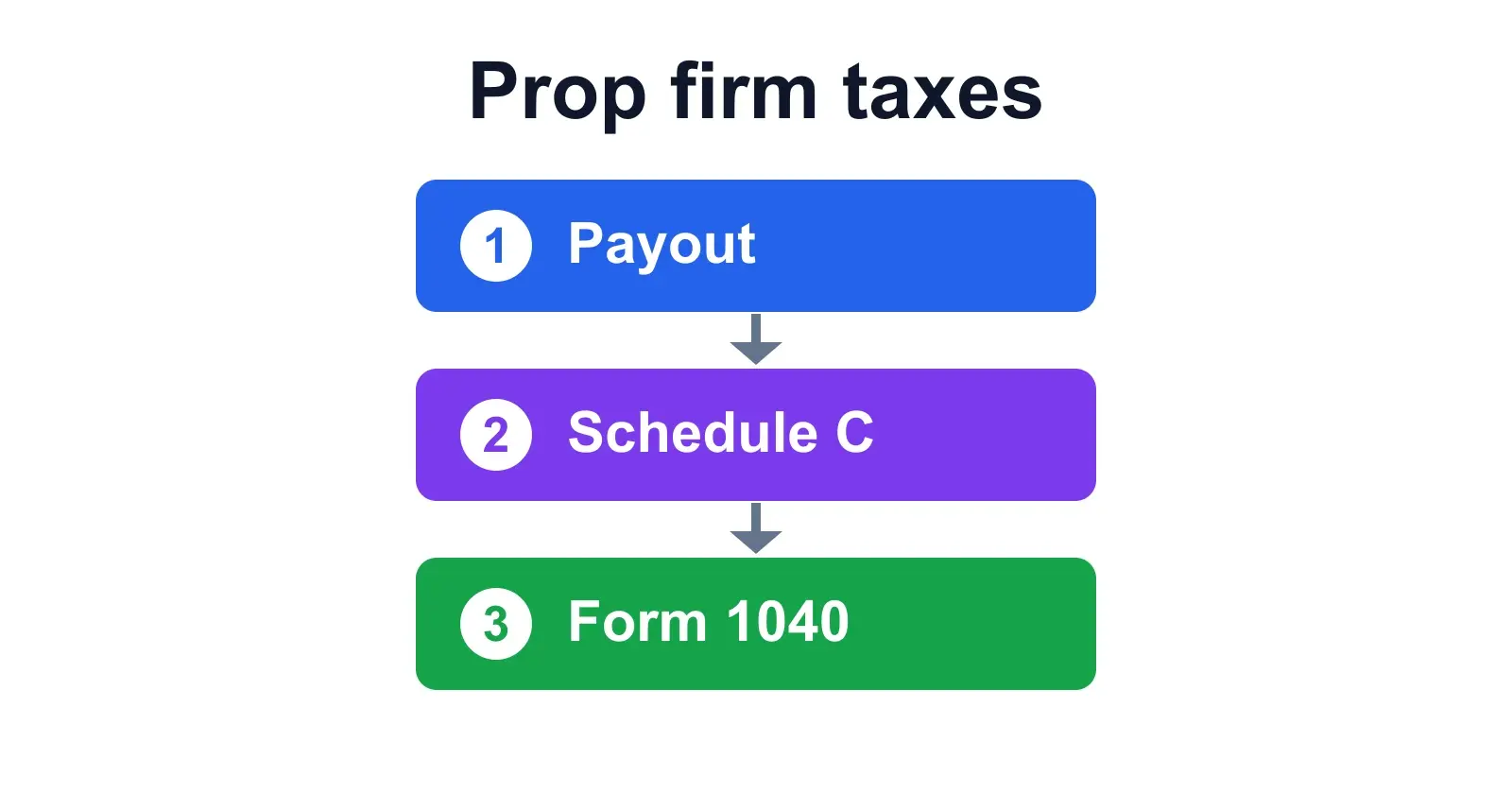
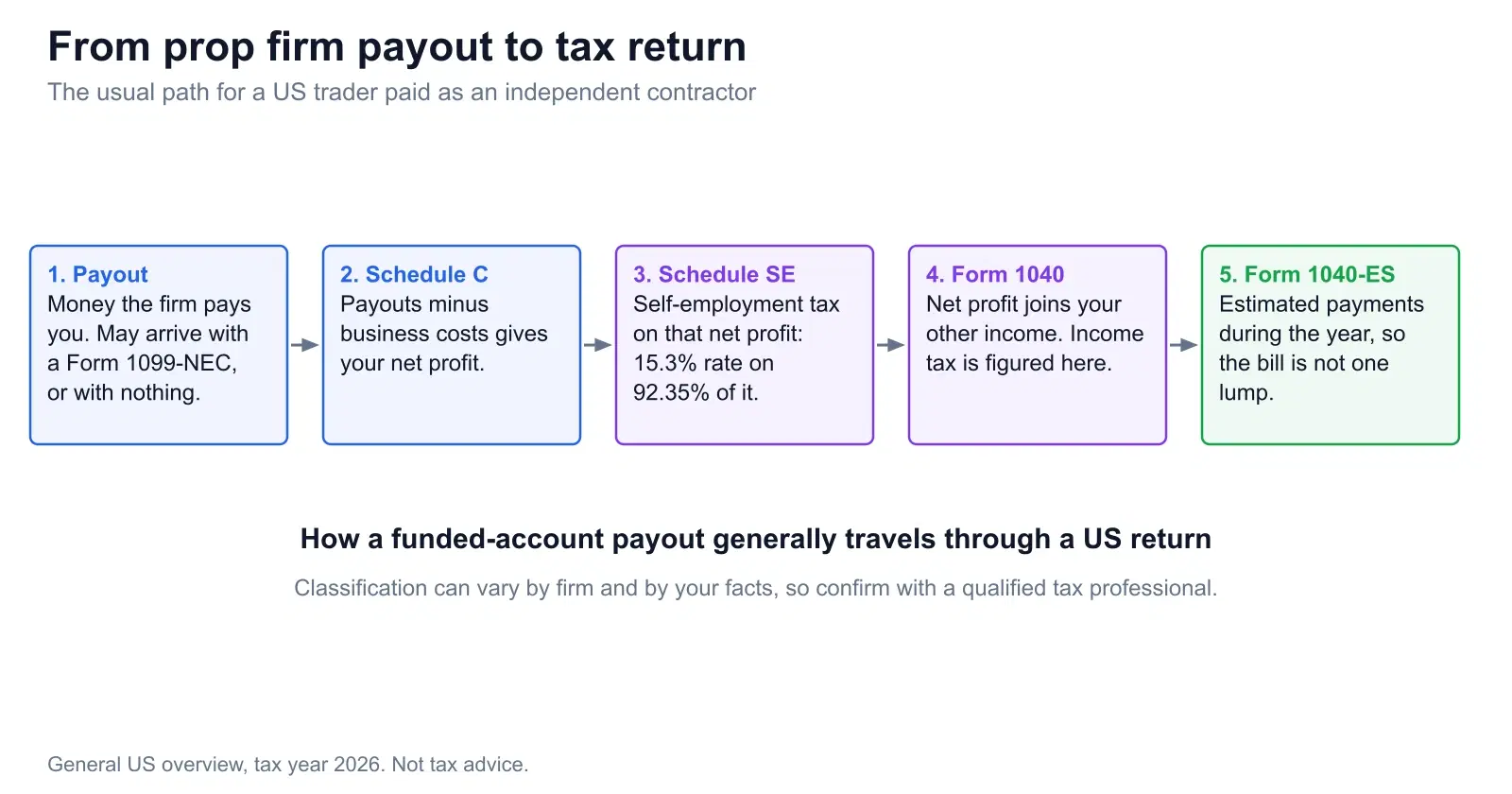
Yes, prop firm payouts are taxable, and for a US trader the general treatment is business income, not capital gains. You report the payouts on Schedule C, subtract your costs, pay self-employment tax of 15.3% on 92.35% of the net profit through Schedule SE, and pay estimated tax during the year instead of waiting for April. This post is written for the 2026 tax year.
Whether a 1099 shows up has no bearing on whether you owe. A US firm may send a Form 1099-NEC, an offshore firm may send nothing, and both payouts are reportable. Below is the reasoning, the forms, a worked example, and the places where the answer is not settled.
General information, not tax advice. This post covers US federal rules for the 2026 tax year and cannot account for your state, your other income or how your firm structures your payouts. A qualified tax professional should confirm anything you act on.
Key Takeaways
- →Payouts are generally treated as self-employment income reported on Schedule C, not capital gains, because you are paid for trading the firm's money, not your own. That is the common professional reading, not an IRS ruling on prop firms.
- →Self-employment tax is 15.3% on 92.35% of net profit. On an example $18,500 net profit that is $2,613.97, before any income tax.
- →A payer must file a 1099-NEC for contractor payments of $2,000 or more made after December 31, 2025 (it was $600). The income is reportable with or without the form.
- →Estimated tax dates for 2026 are April 15, June 15, September 15 and January 15, 2027.
- →The IRS writes trader tax status and the Section 475(f) election around trading your own account. Our reading is that they are not the lever for funded payouts, but the IRS does not say so.
1. Are prop firm payouts taxable?
Yes, generally. The IRS tells business owners to report all of their business income, including income not reported to you on a Form 1099, in Publication 334. Individuals generally report income in the year they receive it, so a payout is income in the year it reaches you. Our reading is that you are taxed on payouts received, not on profit showing inside a funded account or on its balance.
The question that decides everything else is what kind of income it is. Get that wrong and you either overpay or file the wrong forms, so the next section spends time on it. If you are still deciding whether funded trading is worth it at all, our breakdown in are prop firms worth it in 2026 puts payout rules and costs side by side.
2. How are funded trader payouts taxed?
The general treatment is self-employment income. The reasoning is simple. Capital gains come from selling an asset you own at a profit. When you trade a funded account, the capital belongs to the firm. You are not realising a gain on your own money, you are being paid a share of results for performing a service. Tax-preparer and trader-tax commentary generally describes payouts as business income rather than capital gains. That is the reasoning behind this post, and it is commentary, not an IRS position.
Self-employment income goes on Schedule C. Per the IRS, you usually must pay self-employment tax if your net earnings were $400 or more, at a rate of 12.4% for Social Security plus 2.9% for Medicare, 15.3% in all. The tax applies to 92.35% of your net earnings. For 2026 the Social Security part stops at the first $184,500 of earnings, so most prop traders will not reach that cap.
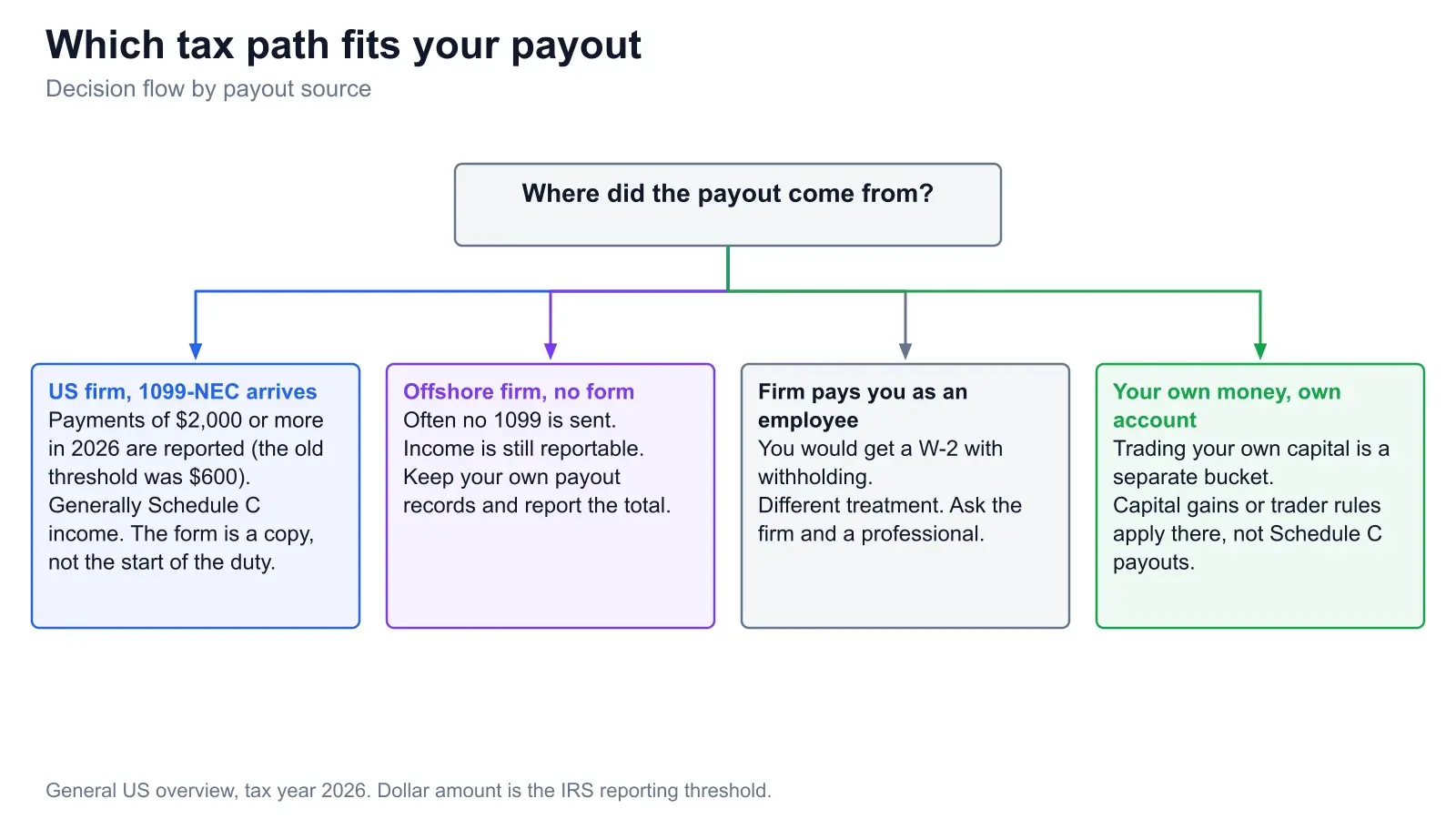
Where this is not settled. To our knowledge the IRS has not issued guidance that addresses prop firm payouts by name. The self-employment treatment is the common professional reading, not settled law, and it depends on how the firm structures the relationship. If a firm pays you as an employee you would get a W-2 and be taxed as one. If your arrangement has unusual features, such as profit splits that look like you are trading a share of your own deposit, the answer can change. Cases like that are what a CPA is for. State taxes are a separate layer that this post does not cover.
3. Do prop firms send a 1099?
It depends on the payer. The form for this kind of payment is the 1099-NEC, which the IRS says is filed by payers for nonemployee compensation of $600, or $2,000 for payments made after December 31, 2025. So for payments made in 2026, a payer that pays you for services in the course of its business has to report them once they total $2,000 or more in the year. The payer files it, you do not. Whether a given firm counts as that kind of payer is for the firm and your preparer to settle.
Offshore firms often issue nothing. No form does not mean no tax. The 1099 is a reporting mechanism for the payer, not what creates your obligation. If you got $1,500 from a firm that sent no paperwork, it is still income, and it goes into the same Schedule C total as every other payout. Keep your own payout log and add it up yourself. A firm that does send a 1099-NEC is a check on your records, so match the form against your total. If the numbers differ, find out why before you file.
One form to be careful with is the W-8BEN. The IRS describes it as a certificate of foreign status that foreign persons give to a payer, while a W-9 is how a payer gets a taxpayer ID from a US person. This is our reading, not IRS guidance on prop firms: if a firm asks you to sign a W-8BEN and you are a US citizen or resident, ask which form applies and check with a professional before signing. This post does not say what any specific firm does, so read your firm's payout terms. Our prop firm news trading rules guide shows how much firms differ on other rules.
4. Can you deduct evaluation fees?
Often, yes. If payouts are business income, the costs of earning them are generally business expenses on Schedule C. The IRS test in Publication 334 is that an expense is ordinary, meaning common and accepted in your field, and necessary, meaning helpful and appropriate. An evaluation fee, a reset, a data feed and a charting subscription all plausibly pass. Net profit is payouts minus those expenses, which also lowers your self-employment tax.
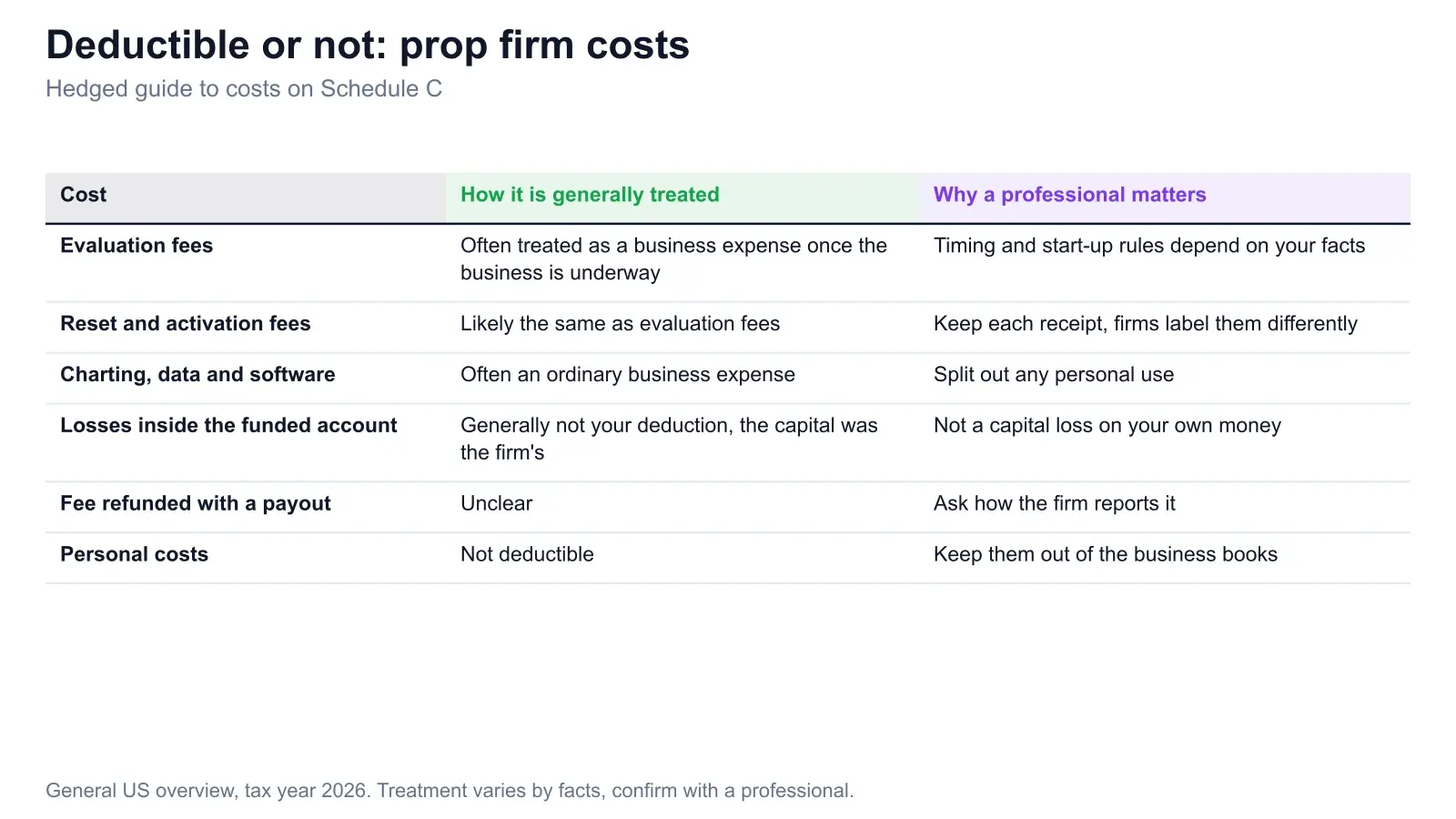
Two cautions. First, timing. IRS Publication 583 defines start-up costs as expenses you incur before you actually begin business operations, and lets you elect to deduct up to $5,000 of them, with the rest amortized. Whether an evaluation fee paid before your first payout counts as a start-up cost, an ordinary expense, or something else is a judgement call, and so is where fees for an evaluation you fail belong. Ask your preparer how to treat the first year. Second, a loss inside a funded account is generally not your capital loss. It was not your capital.
Trader tax status and Section 475 do not work the way people assume. A lot of the internet says full-time traders can elect mark-to-market accounting and deduct more. The IRS's Topic 429 describes a trader as someone in the business of buying and selling securities for your own account, and says that if you do not meet those conditions you are an investor for federal income tax purposes. It also says the Section 475(f) election is due by the return due date for the year before it takes effect, and that late elections are generally not allowed. Our reading is that funded payouts are compensation for a service rather than gains on your own securities trades, so this framework is probably not the lever. That is an inference: the IRS has not applied these rules to prop firm payouts, so do not assume anything here without a professional. If you also trade your own capital, that activity is a separate bucket and trader status is a real question for it.
5. How to file, form by form
Here is the sequence. Add up all payouts for the calendar year. Subtract your business costs to get net profit on Schedule C. Carry that to Schedule SE to figure self-employment tax. The IRS lets you deduct the employer-equivalent half of that tax when figuring adjusted gross income, which goes on Schedule 1. The net profit also becomes part of the income on page 1 of Form 1040, where income tax is figured. Self-employment tax and income tax together are what you prepay with estimates.
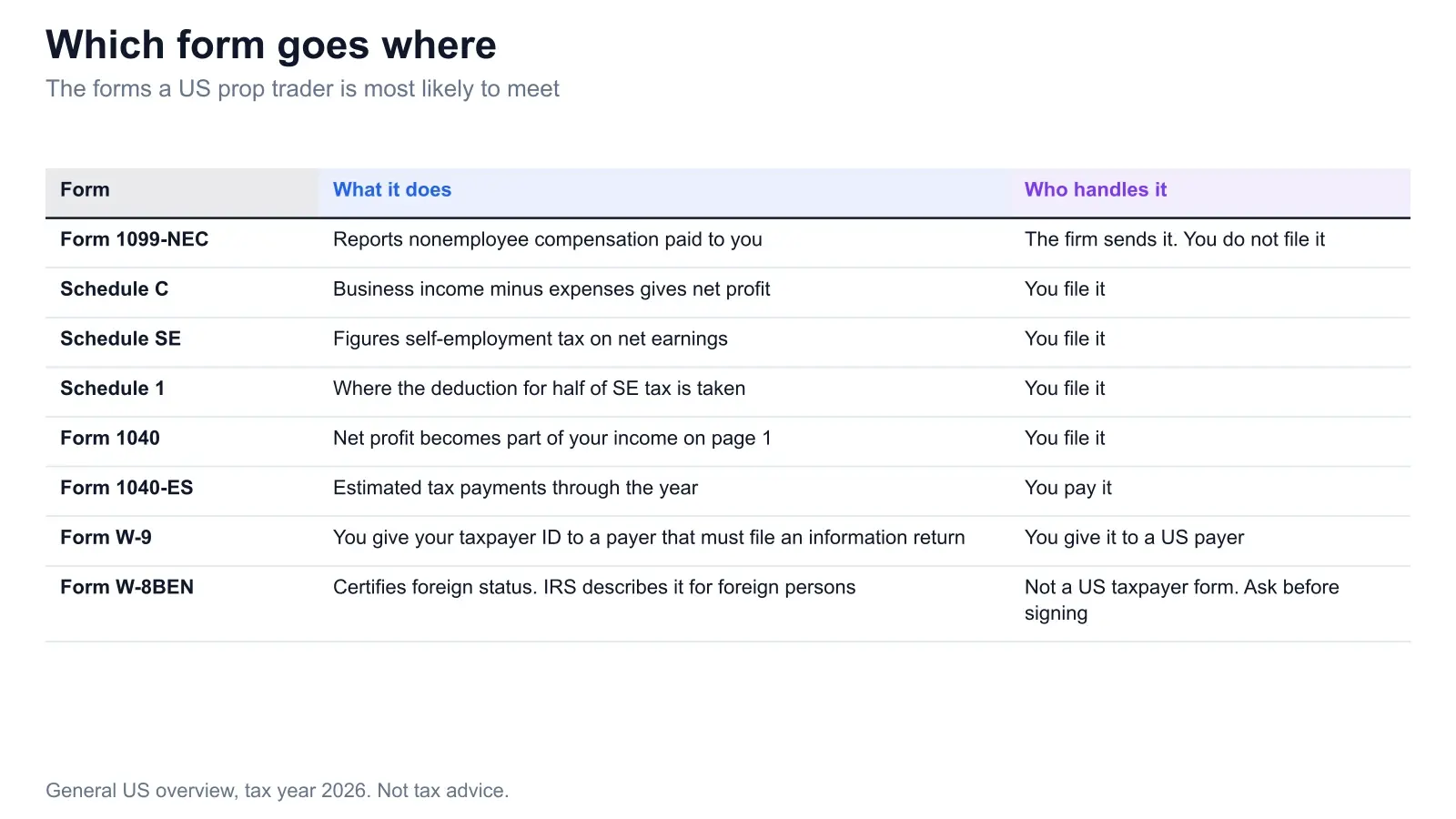
Most people use tax software or a preparer for this. Schedule C is short, but it is where your categories and records get tested. If you get paid by more than one firm, they all go on the same Schedule C, not one per firm.
6. Estimated payments and a worked example
Contractor payouts generally arrive with no tax withheld. The IRS pay-as-you-go system means you generally owe estimated tax if you expect to owe $1,000 or more when your return is filed. To avoid an underpayment penalty you generally need to pay at least 90% of this year's tax, or 100% of last year's, whichever is smaller. Form 1040-ES raises the prior-year figure to 110% if your 2025 adjusted gross income was over $150,000. These are the general rules. Your own safe harbor depends on your return.
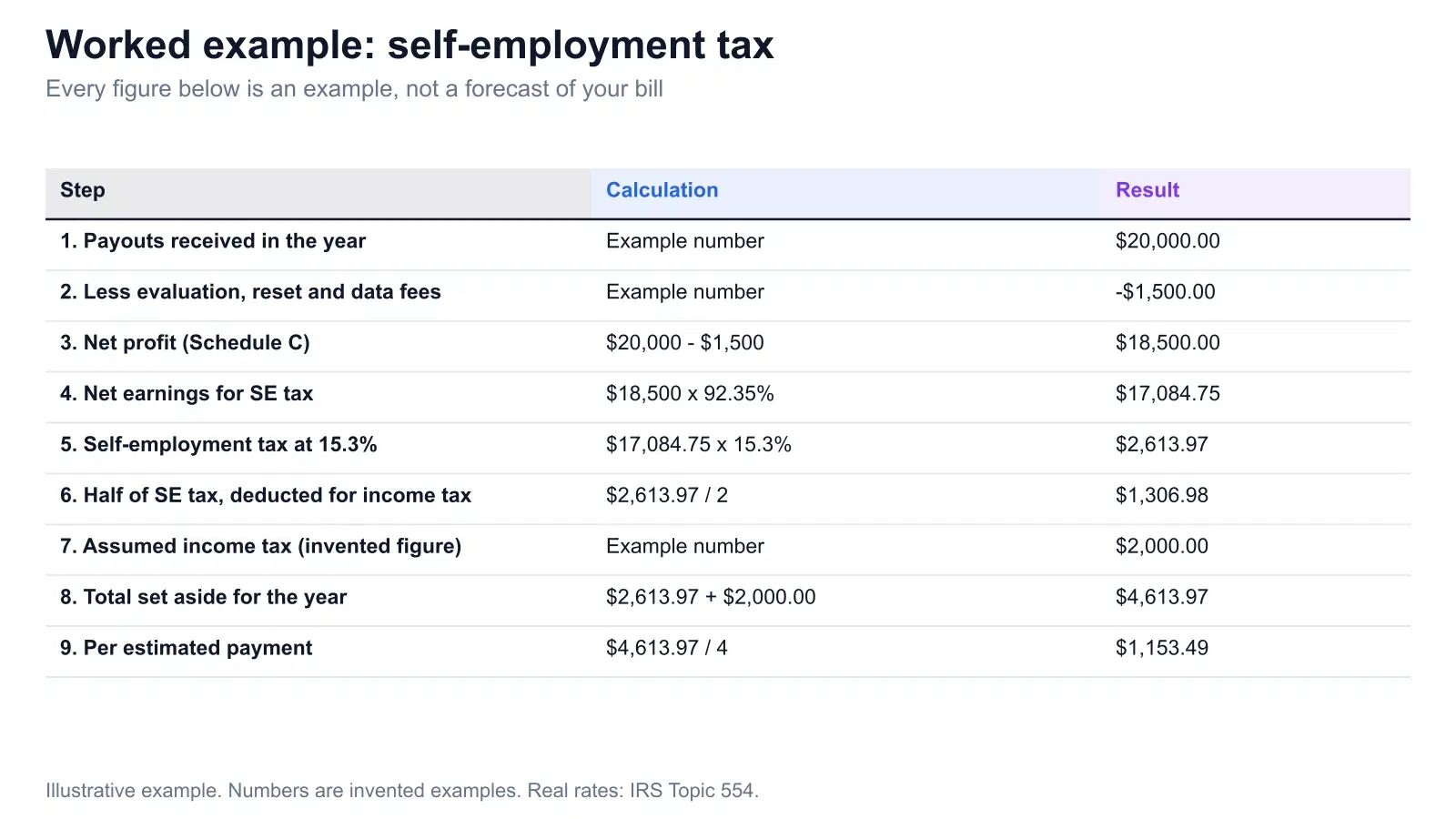
Here is a worked example. Every number is invented, including the income tax line. Say you collect $20,000 in payouts in 2026 and paid $1,500 in evaluation, reset and data fees, treated as deductible.
- Net profit: $20,000 − $1,500 = $18,500.00
- Net earnings for self-employment tax: $18,500 × 0.9235 = $17,084.75
- Self-employment tax: $17,084.75 × 0.153 = $2,613.97. Split, that is $2,118.51 Social Security (12.4%) plus $495.46 Medicare (2.9%).
- Half of it, $1,306.98, is deducted when figuring income tax.
- Income tax depends on your bracket and your other income. We assume $2,000.00 purely for illustration.
- Total to prepay: $2,613.97 + $2,000.00 = $4,613.97, or about $1,153.49 per payment over four payments.
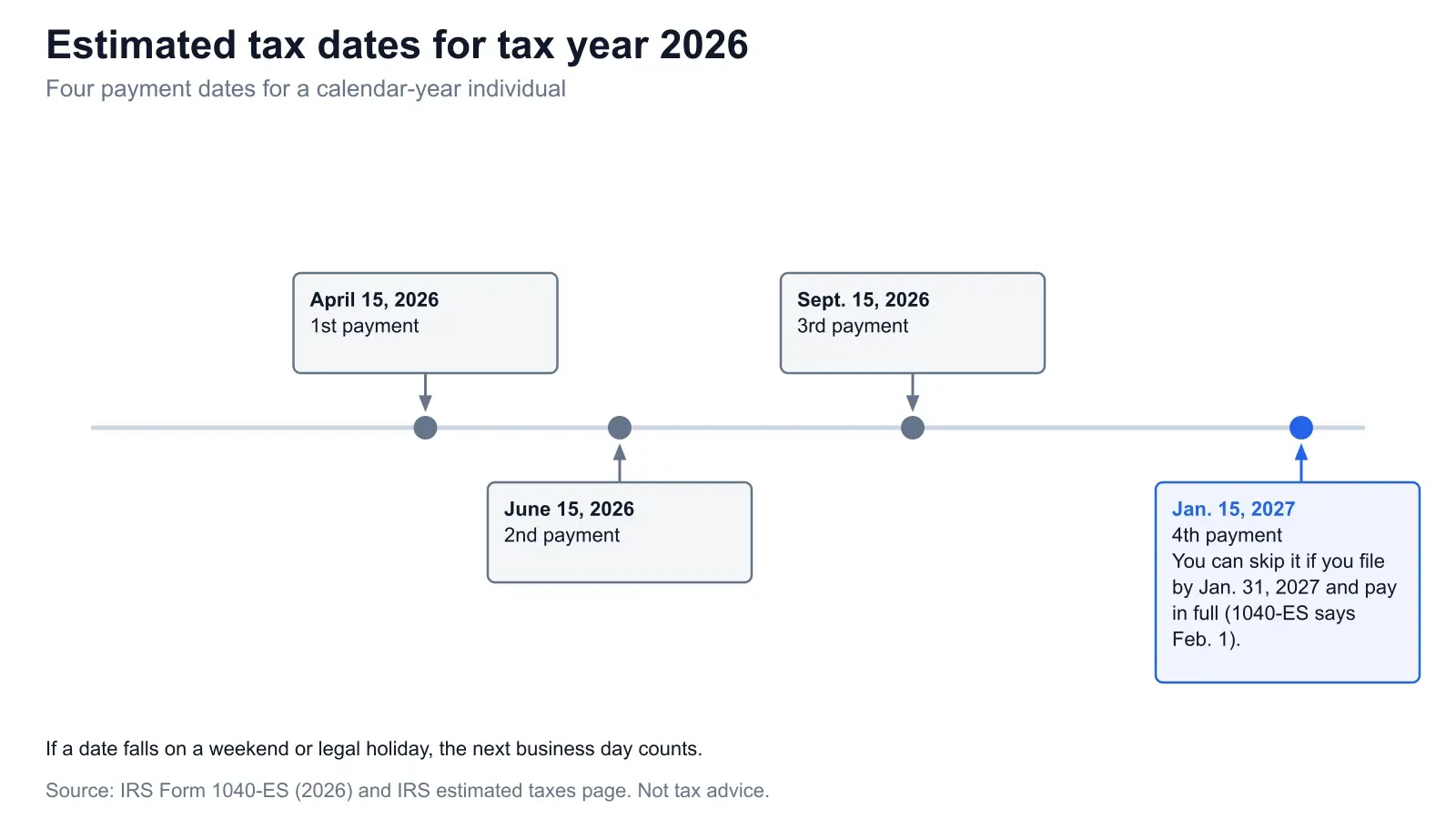
The dates are not even quarters. Form 1040-ES lists April 15, June 15 and September 15, 2026, and January 15, 2027. You can skip the January payment if you file your 2026 return early and pay the full balance with it. Form 1040-ES says file by February 1, 2027, while Publication 505 says January 31, 2027, which is a Sunday. Filing by January 31 satisfies both, so use that date. If a date lands on a weekend or holiday, the next business day counts. If you have taken payouts all year and paid nothing, the practical move is to work out the total now, pay what you can before the deadline, and talk to a professional about penalties. The IRS also says the annualized method may help when income is uneven, which fits prop traders whose payouts come in lumps.
7. Records to keep
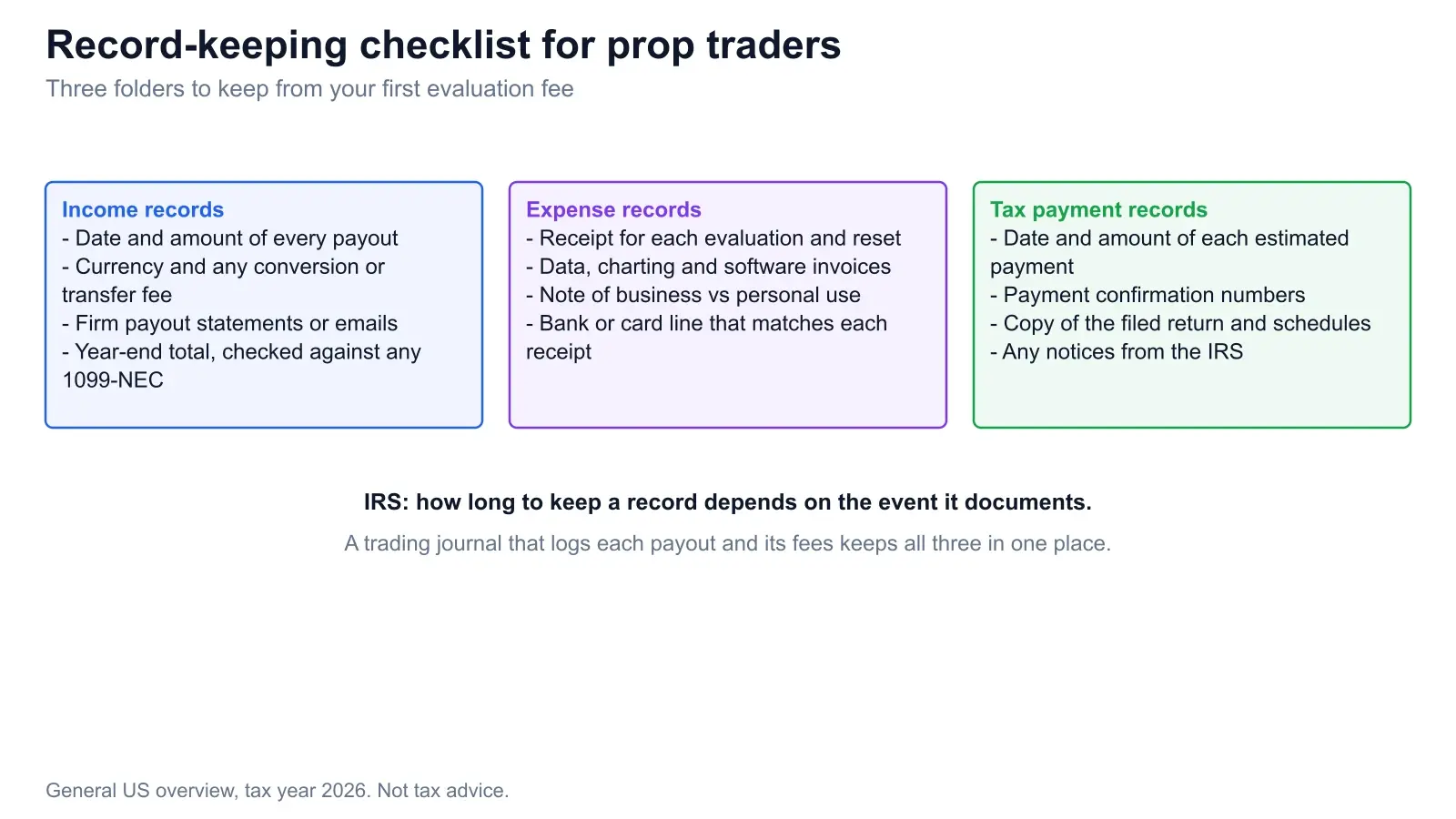
The IRS says any recordkeeping system suited to your business is fine as long as it clearly shows income and expenses, and that how long you keep a record depends on the event it documents. For prop trading that means three folders: every payout (date, amount, currency, any conversion cost), every expense receipt, and every tax payment you make.
A trading journal makes this easier than a pile of emails, because each payout sits next to the trading that earned it. The ChartSnipe trading journal is one place to log trades alongside notes, and a plain spreadsheet works just as well. The only wrong system is the one you will not keep up.
8. If you are outside the US
Everything above is the US federal system. Other countries tax funded trader income under their own rules, and they can differ on whether it is business income, how expenses are treated and when to pay. This post does not state any country's rules. Check your local tax authority's website, or ask an adviser who has handled funded trader income.
Frequently asked questions
How do I file prop firm taxes?
For a US trader paid as an independent contractor, payouts are generally reported as business income on Schedule C, with your costs subtracted to reach net profit. Schedule SE then figures self-employment tax, the net profit also flows into Form 1040, and you generally pay estimated tax through the year with Form 1040-ES. A qualified tax professional can confirm how your own payouts should be classified.
Are prop firm payouts taxable?
Yes, generally. Business income is reportable whether or not you receive a Form 1099, and IRS Publication 334 says to report all income you receive from your business. In our reading, tax applies to the payouts you receive, not to the balance of a funded account.
Do prop firms send a 1099?
Some do and some do not. A payer must file Form 1099-NEC for nonemployee compensation of $2,000 or more for payments made after December 31, 2025 (the threshold was $600 before that), but whether a given firm is such a payer is not something the IRS page settles. Offshore firms often send nothing. Either way, the income is still reportable.
How are funded trader payouts taxed?
Generally as self-employment income rather than capital gains, because the capital is the firm's and you are paid for trading it. That means ordinary income tax plus self-employment tax at 15.3% on 92.35% of net profit. To our knowledge the IRS has not published guidance on prop firm payouts specifically, so this is the general professional view rather than settled law.
Can you deduct prop firm evaluation fees?
Often, as a business expense on Schedule C, if the activity is a business. The IRS test is whether an expense is ordinary (common in your field) and necessary (helpful and appropriate). How and when evaluation and reset fees are deducted depends on your facts, so ask a tax professional.
I do not live in the US. What applies to me?
Tax rules differ by country, and this post covers only the US federal system. Check your own tax authority, or a local adviser who has handled funded trader income, before you file.
Is this tax advice?
No. This is general information for the 2026 US tax year. It is not tax advice. Consult a qualified tax professional about your own situation.
Sources & further reading
- → IRS Topic 554: Self-employment tax, the $400 threshold, the 12.4% and 2.9% split and the 92.35% base.
- → IRS Topic 429: Traders in securities, trader status and the Section 475(f) election.
- → IRS Publication 334: Tax Guide for Small Business, ordinary and necessary expenses and reporting all business income.
- → IRS Form 1040-ES (2026), payment dates, safe harbors, the 110% rule and the $184,500 Social Security base.
- → IRS: Estimated taxes, who must pay and the $1,000 rule.
- → IRS: Form 1099-NEC and independent contractors, the $600 and $2,000 thresholds.
- → IRS: About Form W-8BEN and Form W-9.
- → IRS: Recordkeeping, any system suited to your business is acceptable.
- → IRS Publication 583: Starting a Business and Keeping Records, start-up costs.
- → IRS Publication 505: Tax Withholding and Estimated Tax, the January 31, 2027 date for skipping the last estimated payment.
- → IRS: Self-employed individuals tax center.
Keep your payouts and trades in one log
Good tax records start with good trading records. Log each trade and note in the trading journal, and use the Chart Snipe tool for a second read on your charts. Neither replaces a tax professional.