
ChatGPT Trading in 2026: Everything It Can and Can't Do
Millions of retail traders opened ChatGPT in 2025 and asked it for trade ideas. The honest answer is split down the middle — it is a brilliant assistant for the right tasks and completely wrong for the ones most traders try first. Here is the full map.
Ask any trader under forty how they research a setup and ChatGPT will be in the answer. It has become the default second brain for chart reading, strategy design, journal review, plan drafting, and macro summarisation. It is also the default source of confidently wrong price levels, fabricated support zones, and trade ideas that dissolve the moment a real calendar is checked.
The split is real and the line is sharp — and this guide walks through every task a trader might hand to ChatGPT in 2026, separating the ones it does well from the ones it breaks on. If you want the deeper chart-reading case study, we covered that separately. This piece is the full map: chatgpt trading, chatgpt day trading, chatgpt stock trading, openai trading — one consolidated take.
Key Takeaways
- →ChatGPT is a probabilistic text model. It does not know today's price, today's calendar, or today's session. Those are structural constraints, not version-number problems.
- →It is genuinely useful for concept explanation, plan drafting, journal review, code for backtests, and turning central bank statements into bullet points.
- →It is unreliable for chart levels, intraday timing, correlation reasoning, and anything time-sensitive. It will hallucinate clean round numbers with confidence.
- →Claude, Gemini and Grok share the same fundamental limits. Differences are vision quality, context window, and refusal behavior — not access to markets.
- →Serious traders pair ChatGPT with a trading-native tool. ChartSnipe provides the live half — 28 FX pairs, currency strength, daily AI news impact, and screenshot chart analysis grounded in real data.
1. What ChatGPT actually is (and what that means for trading)
Before arguing about whether ChatGPT trading works, it is worth being specific about what ChatGPT is. It is a large language model — a very large neural network trained on a snapshot of the internet to predict the next token of text. Not a market simulator, not a quote feed, not an execution engine.
Three properties follow from that definition and they are the root cause of every failure mode later in this article:
Probabilistic
It generates the most likely continuation, not the correct answer. When facts are uncertain it still writes fluent sentences — this is the source of hallucination.
Knowledge-cut-off
The base model stops at a training date months to years before today. Browsing tools help but introduce their own lag and reliability issues.
Stateless per request
It has no continuous feed of the world. Every answer is composed from what you gave it in the prompt plus its training. There is no ticker behind the scenes.
Read those three properties next to any trading task. Estimating where EUR/USD closes today requires a live tick feed — property two and three rule that out. Calling a named pattern on a screenshot is a vision task, not a numerical one — the model will describe it but cannot measure it. Explaining what an inverse head-and-shoulders means requires no market feed at all — here the model is on home turf.
That triangulation is how the rest of this article is built: tasks that depend on live market state go in the “can't” column, tasks that depend on written knowledge go in the “can” column, and tasks in the middle get a clear workflow.
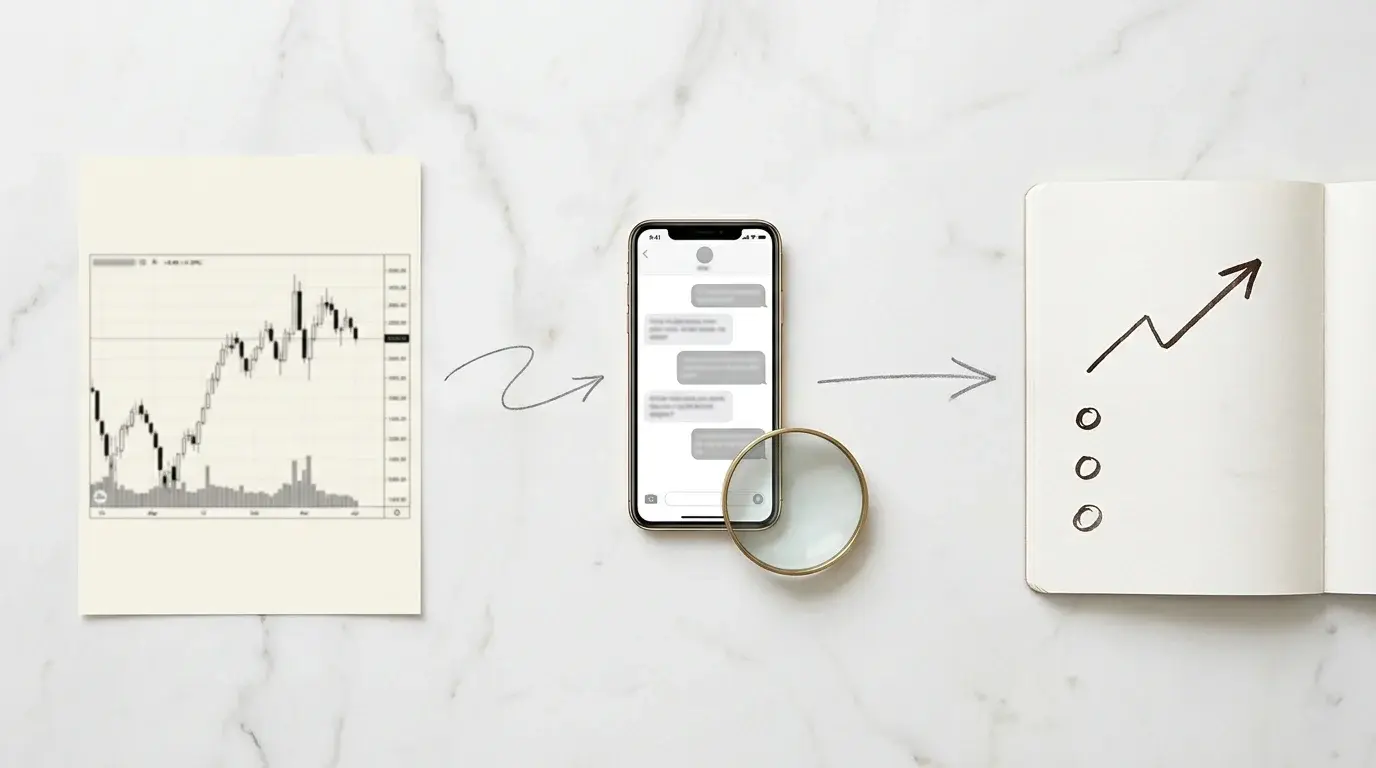
2. What ChatGPT can do well in trading
Start with the wins. ChatGPT earns its subscription on five specific trading tasks, and each of them is a task where written language is the output and no live number is required.
Explaining concepts
This is the single strongest use case. Ask it how a bull flag invalidates, what the difference is between an order block and a supply zone, how Bollinger Band squeezes relate to implied volatility, or why USD/JPY tracks the 10-year yield spread — and you get a well-written explanation with examples, caveats and a taxonomy. This is the same content that used to take an afternoon of Babypips and Investopedia reading, compressed into a three-turn conversation.
Drafting a trading plan
Give it your capital, markets, session preferences, risk tolerance, and hold-time constraints, and ask for a plan outline. You will get a plausible structure — entry rules, exit rules, risk per trade, journaling cadence, weekly review — that you can sharpen into your own. The plan is a starting point, not a strategy, but it is a better starting point than a blank page.
Journal review
Paste your last month of trades as a table and ask for patterns. The model is excellent at summarising structured data: best and worst sessions, recurring mistakes, statistically skewed setups, emotional triggers flagged by your own notes. This is cognitive offload on a task you would procrastinate on anyway.
Summarising Fed statements and central bank speeches
Paste the full FOMC statement or a Lagarde press-conference transcript and ask for five bullet points plus the hawkish / dovish shifts relative to the last meeting. Under 30 seconds to a clean read. This is the replacement for reading 45 minutes of wire coverage.
Code for backtests and tools
Python for backtests on Yahoo Finance data, Pine Script for TradingView indicators, simple MT4/MT5 EAs, stats scripts on your own trade journal — this is where chatgpt algo trading as a search term becomes legitimate. The LLM is writing the code, not trading. A developer who can read and test the output gets real leverage here.
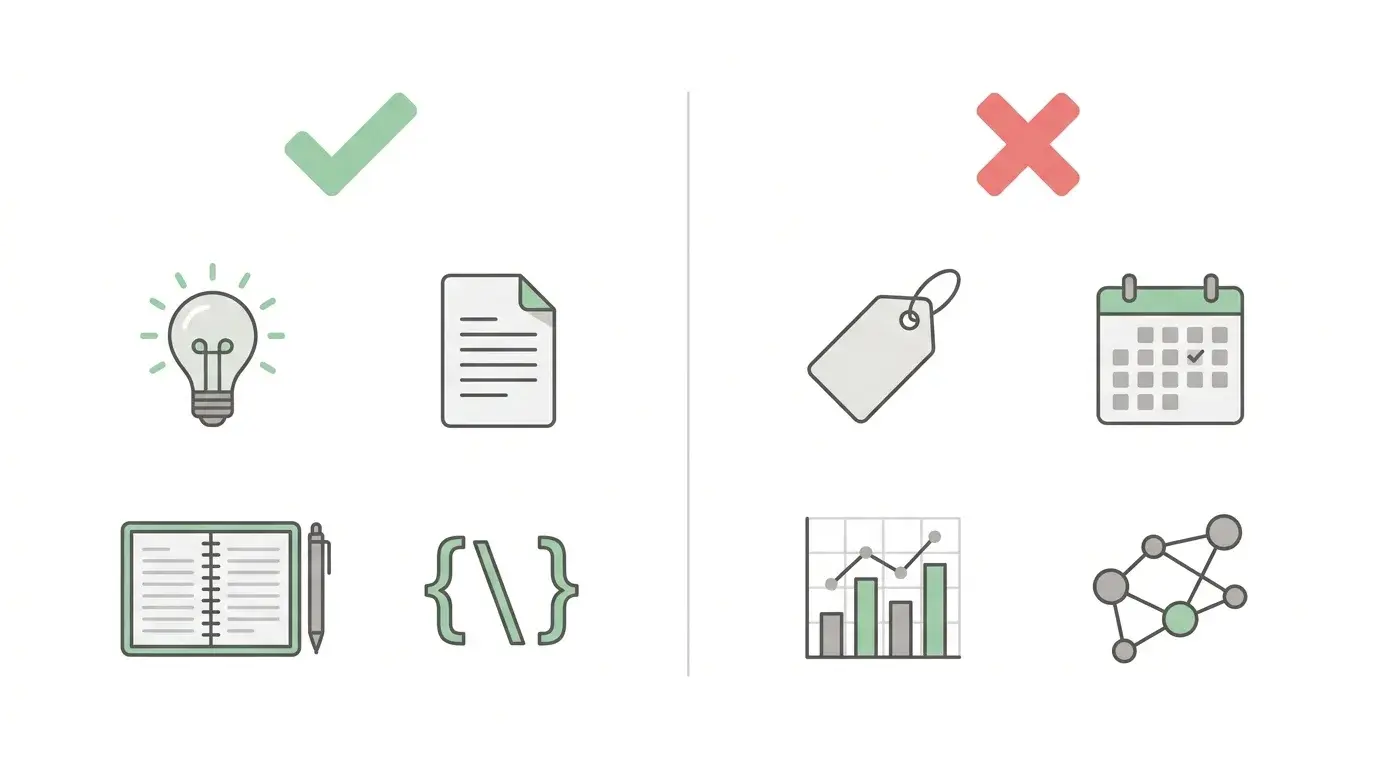
3. What ChatGPT cannot do — the structural limits
These are not edge cases or engineering to-dos. They are consequences of what a language model is. A larger model, a faster model, a model with a longer context window — none of them fix the list below.
Live prices
ChatGPT does not have an internal ticker. With the browsing tool it can scrape a page, but the latency, source quality and occasional caching make the answer unreliable for trading. “EUR/USD is trading around 1.08” is the kind of sentence the model will confidently produce even when the pair is at 1.12.
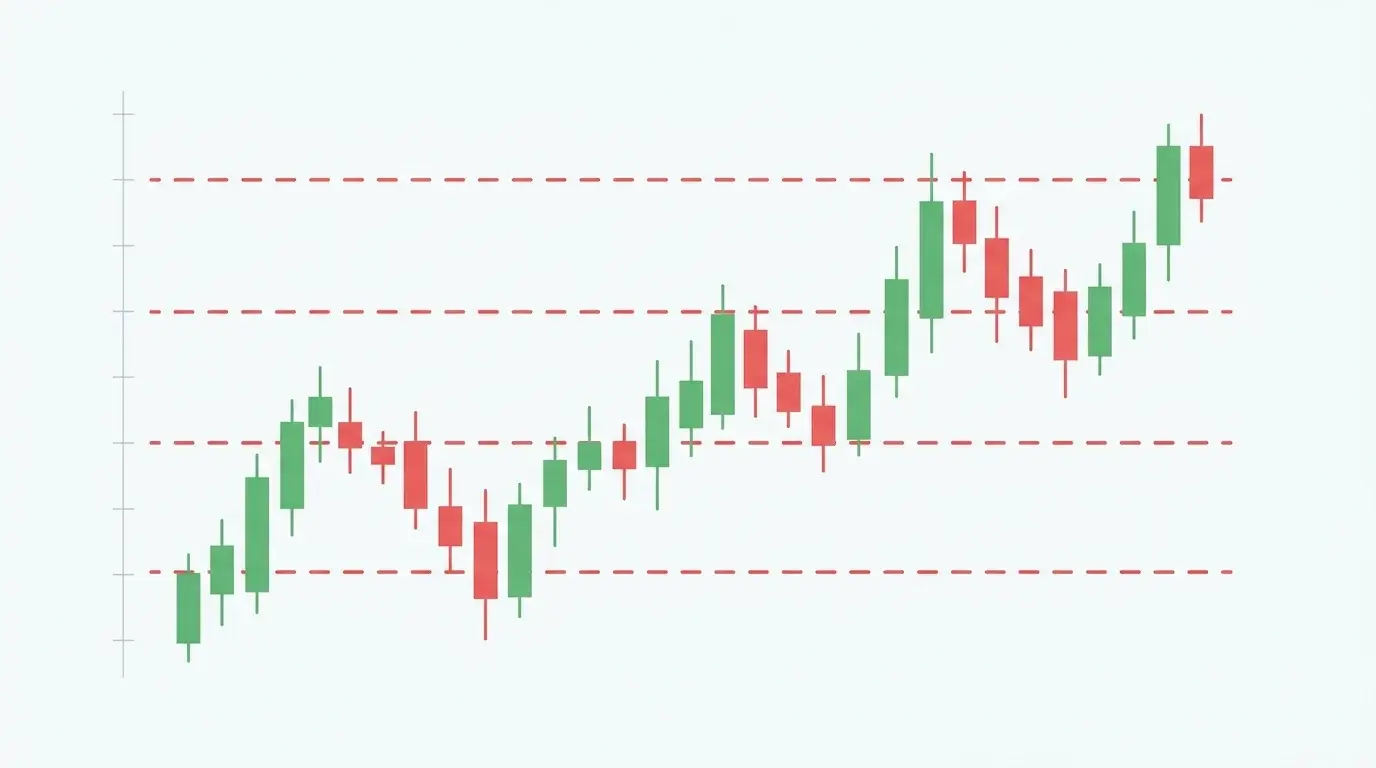
Hallucinated chart levels
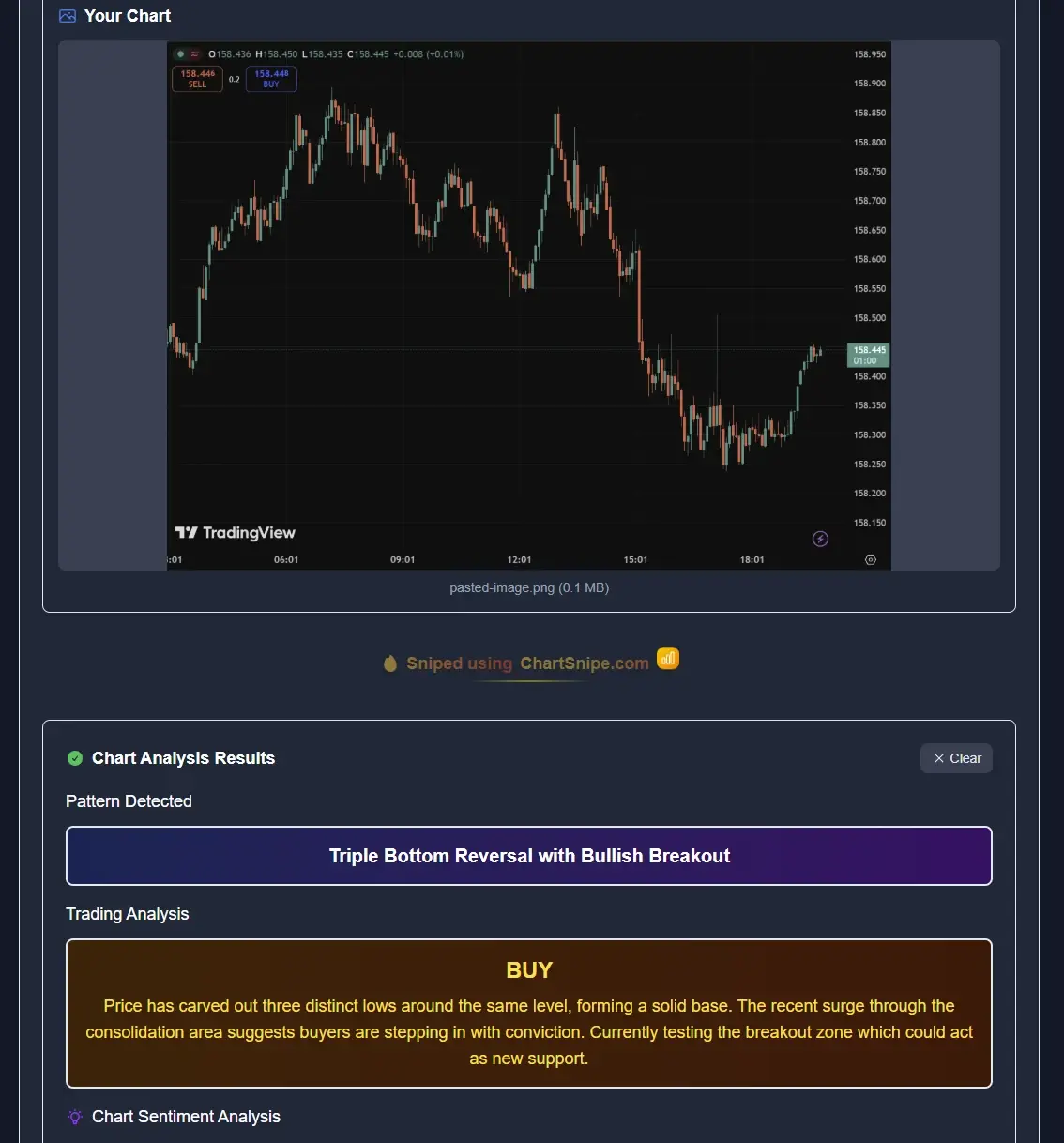
Upload a chart and ask for support and resistance. A general-purpose vision-language model will frequently invent clean round numbers — 1.1000, 1.1050, 1.1100 — even when the visible axis shows 1.0837, 1.0892 and so on. It is a pattern-completion behavior: “support/resistance” in the training data is usually rounded, so the model rounds.
No economic calendar
It does not know that CPI prints in four hours, that OPEC+ meets tomorrow, that the BOJ has a rate decision at Tokyo open, or that Friday is NFP. Without that context a technical read is just geometry.
No correlation awareness
Ask it for a long GBP/JPY setup. A strong read on one chart might be invalidated by USD ripping across the whole board — GBP/USD, EUR/USD and AUD/USD all moving in the same direction tell you the JPY leg is not the driver. The LLM cannot see those other charts unless you paste them all, and even then it cannot compute an aggregate strength number. That is what a live currency strength index is for.
No session awareness
A setup on GBP/JPY looks different mid-Tokyo than it does at the London open. A chatbot with no concept of what time it is, where liquidity is sitting, and which session opens next cannot reason about this. “Wait for the London open” is the correct answer on roughly 30% of pre-session setups — and the LLM will not give it to you unless you explicitly prompt for it.
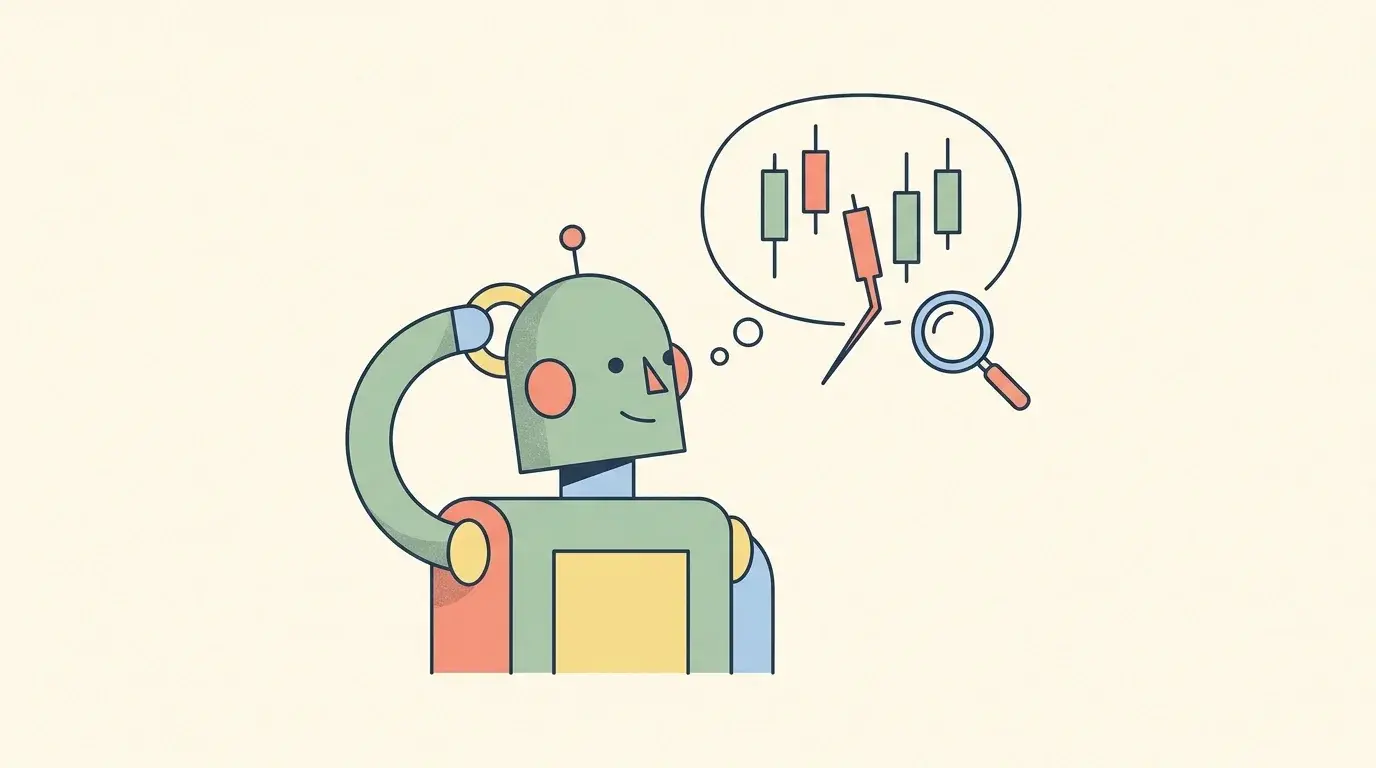
4. ChatGPT alone vs ChatGPT + a real trading tool
The honest frame on “trading with ChatGPT” is not alone-versus-other, it is alone-versus-paired. Side by side, the pairing wins on every dimension a retail trader cares about.
| Task | ChatGPT alone | ChatGPT + ChartSnipe |
|---|---|---|
| Current EUR/USD price | Unknown / stale | Live, tick-updated |
| Chart level detection | Rounded, hallucinated | Anchored to visible price |
| Which pair to even look at | No idea | Currency strength ranked |
| Today's macro driver | If you paste it | AI news impact daily |
| Concept explanation | Excellent | Excellent (ChatGPT does it) |
| Plan drafting | Good | Good, with live context |
| Backtest code | Good | Good |
| Position size calculation | Manual | Built-in calculator |
The message is not “stop using ChatGPT” — it is “stop using it for the jobs it is bad at”. Keep it for the language tasks, pair it with a trading-native tool for the market tasks, and the combined workflow beats either half.
5. ChatGPT vs Claude vs Gemini for trading research
All three are language models. None of them have a live market feed by default. The differences are real but narrower than the marketing implies, and most of them come down to personality rather than capability.
Vision quality on uploaded charts
Claude's vision model has a reputation for reading candle structure more literally, and will more often flag uncertainty instead of inventing a level. ChatGPT tends to write more confidently and produces cleaner-looking reports, which is why it ships more often in screenshots online — and also why it gets caught hallucinating more often. Gemini sits between the two, with strong OCR on chart axes but weaker pattern reasoning. All three are still ceilinged by the absence of live data.
Context window
Claude currently ships with the largest usable context window and is the default for pasting a full journal export or six months of trade history for review. ChatGPT handles big prompts but truncates more aggressively on the free tier. For journal and statement review, Claude has an edge.
Refusal behavior
Both models refuse to give fixed trading recommendations by default — this is correct behavior, not a bug. Claude tends to refuse more quickly on anything that sounds like direct financial advice; ChatGPT is looser but still refuses outright “should I buy TSLA” queries. The right frame for both is “explain” and “analyse”, not “recommend”.
The full head-to-head is in Claude vs ChatGPT vs ChartSnipe — chart analysis face-off. Short version: for research assistance the two general models are roughly tied with personality differences. For chart analysis with a real directional call, neither is the right tool.
6. Prompt engineering for trading — 5 templates that actually work
The best-performing prompts for trading are the ones that ask the model for something it can actually do — explanation, structure, summarisation — not prediction. The five templates below all sit on the “can do” side of this article.

Template 1 — Concept drill
You are an experienced trading educator. Explain <concept> to an intermediate retail trader with 2 years experience on forex and indices. Cover: the mechanics, a worked example, the three most common mistakes, and how it interacts with session timing and news. Do not give price predictions.
Good for: liquidity sweeps, order blocks, CVD, ICT concepts, Wyckoff phases, options Greeks.
Template 2 — Plan draft
Draft a week-one trading plan for: capital <amount>, markets <pairs/instruments>, available session <hours>, max risk per trade <%>, max daily drawdown <%>, target hold time <minutes/hours>. Include entry filters, exit rules, a daily pre-session checklist, and a weekly review structure. Return as a numbered list, not prose.
Good for: funded challenge prep, new-strategy onboarding, switching from swing to intraday.
Template 3 — Journal review
Here are my last 40 trades as a CSV: <paste>. Analyse as follows: (1) win rate and average R, split by pair and by session; (2) three recurring mistakes visible from the notes column; (3) the session / pair combination with the worst expectancy; (4) one concrete process change for next week based only on the data shown. Do not invent results that are not in the data.
Good for: monthly and quarterly review — this is the single highest-value prompt on this list.
Template 4 — Fed / central-bank summariser
Here is the full <FOMC/ECB/BOJ> statement and press conference transcript: <paste>. Return: (1) five bullet points on the current policy stance; (2) specific language that shifted relative to the previous meeting; (3) a hawkish / dovish / neutral label for the overall message; (4) the three data releases the market will now watch most closely based on the language used.
Good for: decision-day prep. Replaces 45 minutes of wire reading.
Template 5 — Backtest code
Write a Python backtest using pandas and yfinance for the following idea: <rules in plain English>. Requirements: vectorised where possible, include transaction costs as a parameter, output equity curve CSV and summary stats (CAGR, max DD, Sharpe, hit rate, average R). Handle missing data gracefully. Use only standard libraries plus pandas, numpy, yfinance.
Good for: chatgpt algo trading in the real sense — testing an idea before you put real capital behind it.
What to never prompt for
- “Where will EUR/USD close today?” — prediction, not explanation.
- “Which stock should I buy tomorrow?” — same.
- “Give me exact entry, stop and TP for this chart” — fabricated levels.
- “Is now a good time to buy Bitcoin?” — needs a live quote the model does not have.
7. “OpenAI trading” products — real vs fake
Search openai trading or openai stock trading and half the first page is ads for products that OpenAI does not publish. A clear separation:
Real
- ChatGPT — the consumer web and mobile apps at chat.openai.com
- The OpenAI API — GPT-4 / GPT-5 models accessed via code
- Custom GPTs — author-built assistants on ChatGPT Plus/Pro
- Whisper, DALL-E, and related OpenAI products (not trading-related)
Not real (or not OpenAI)
- “OpenAI Auto-Trader” — funnel for unregulated broker
- “GPT-4 Stock Bot” — usually a GPT wrapper with no edge
- “ChatGPT Trading System” with fixed daily returns — fraud
- Elon Musk / Sam Altman endorsement ads on Facebook and YouTube — deepfakes
OpenAI itself does not make trading products. Anything with “OpenAI” in the name that promises returns is marketing, not a product. The UK FCA, Australia's ASIC, and Canada's CSA have all issued public warnings about this category of brand by name.
8. What serious traders use instead (or alongside)
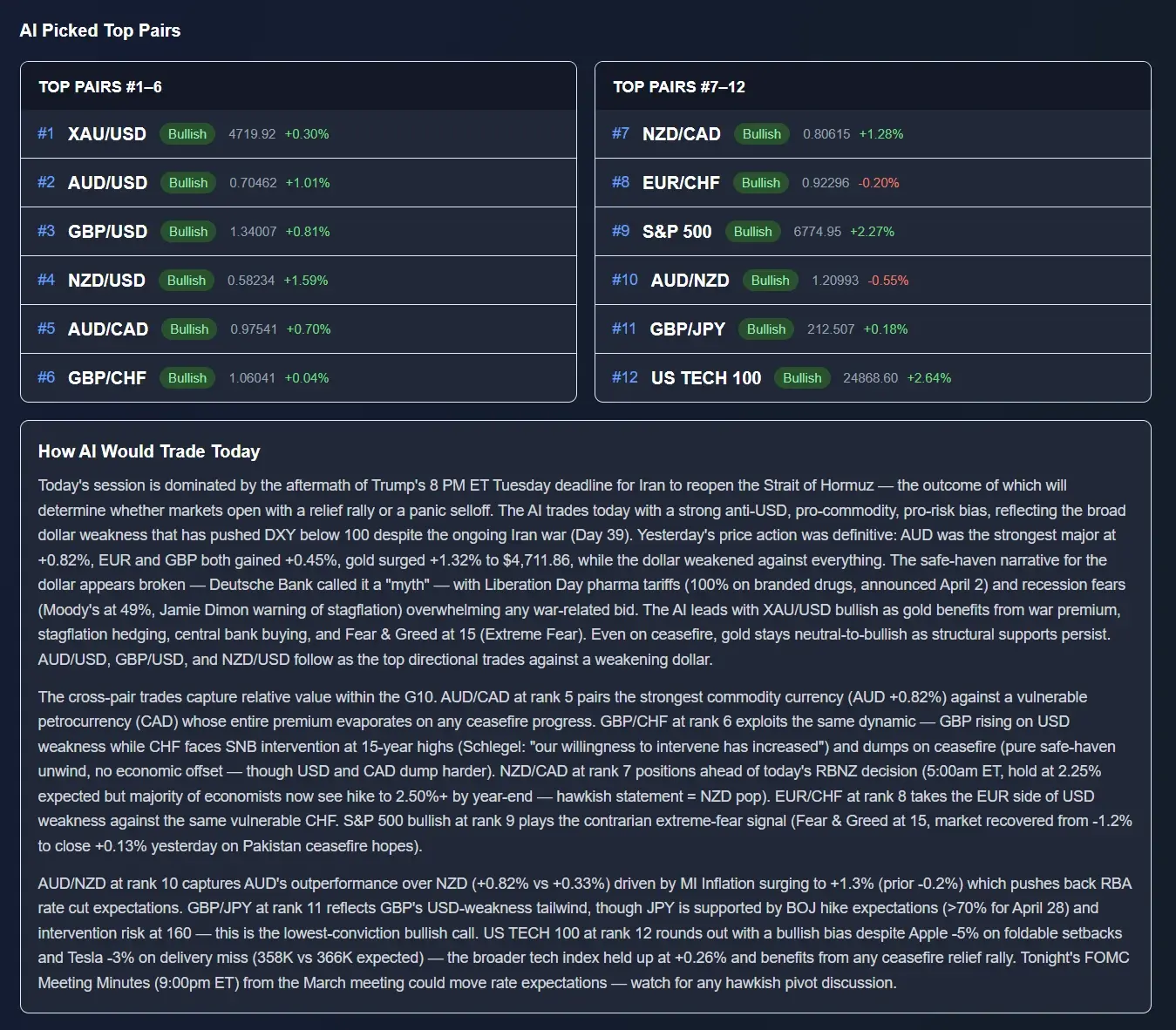
The working pattern in 2026 is: ChatGPT for research and writing, a trading-native AI for live chart reads and news impact. ChartSnipe is built specifically to be the second half of that pairing.
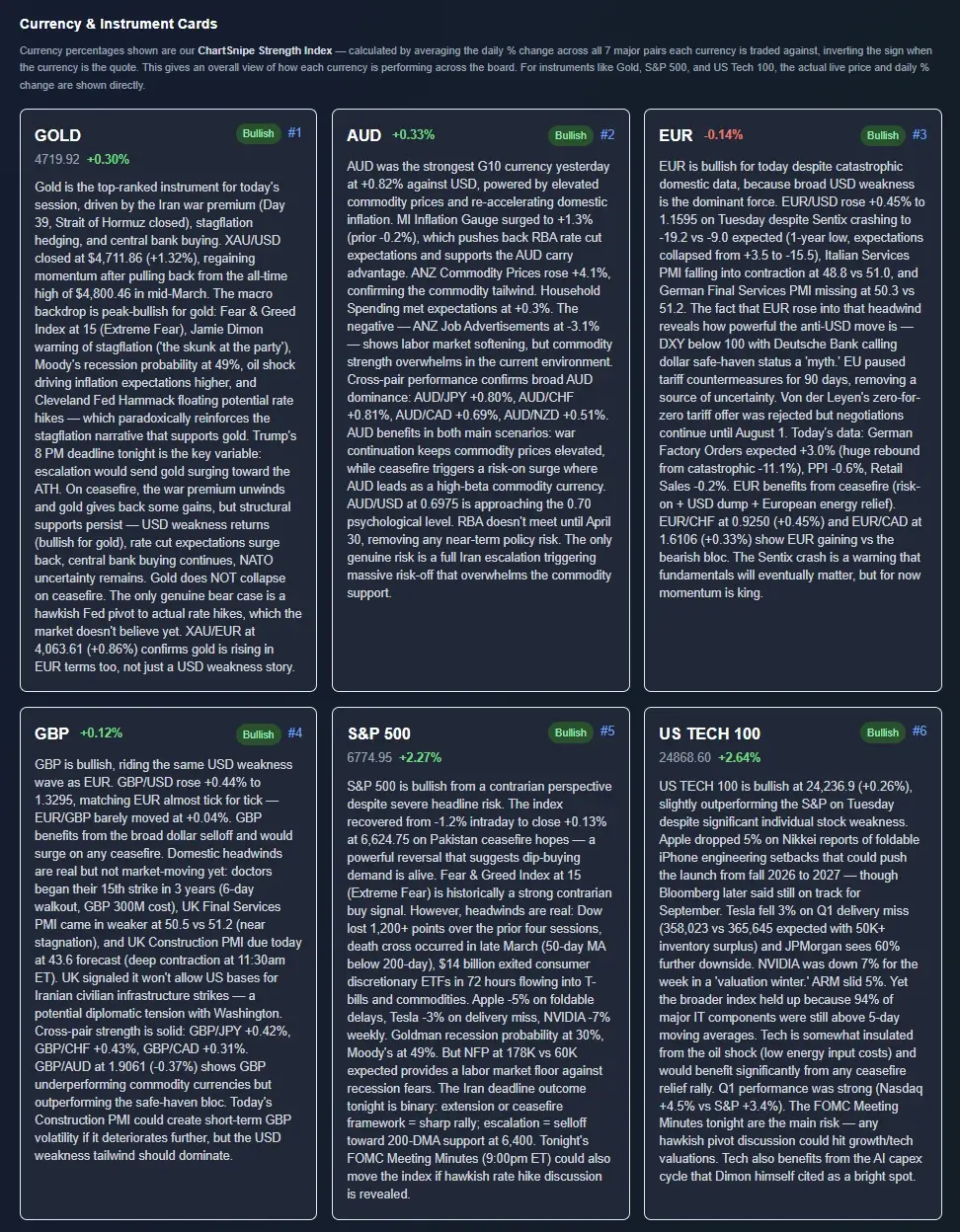
28 live FX pairs
All major and cross pairs on an institutional feed, tick-updated every five minutes with realtime WebSocket push.
Currency Strength Index
USD, EUR, GBP, JPY, CHF, AUD, CAD and NZD strength aggregated across 28 pairs in real time. Tells you the pair to look at before you open a chart.
Daily AI News Impact
Every trading day the AI assembles a macro briefing — central banks, releases, geopolitics, commodities — and scores the impact on 12 instruments with conviction, drivers and reversal risks.
Screenshot chart analysis
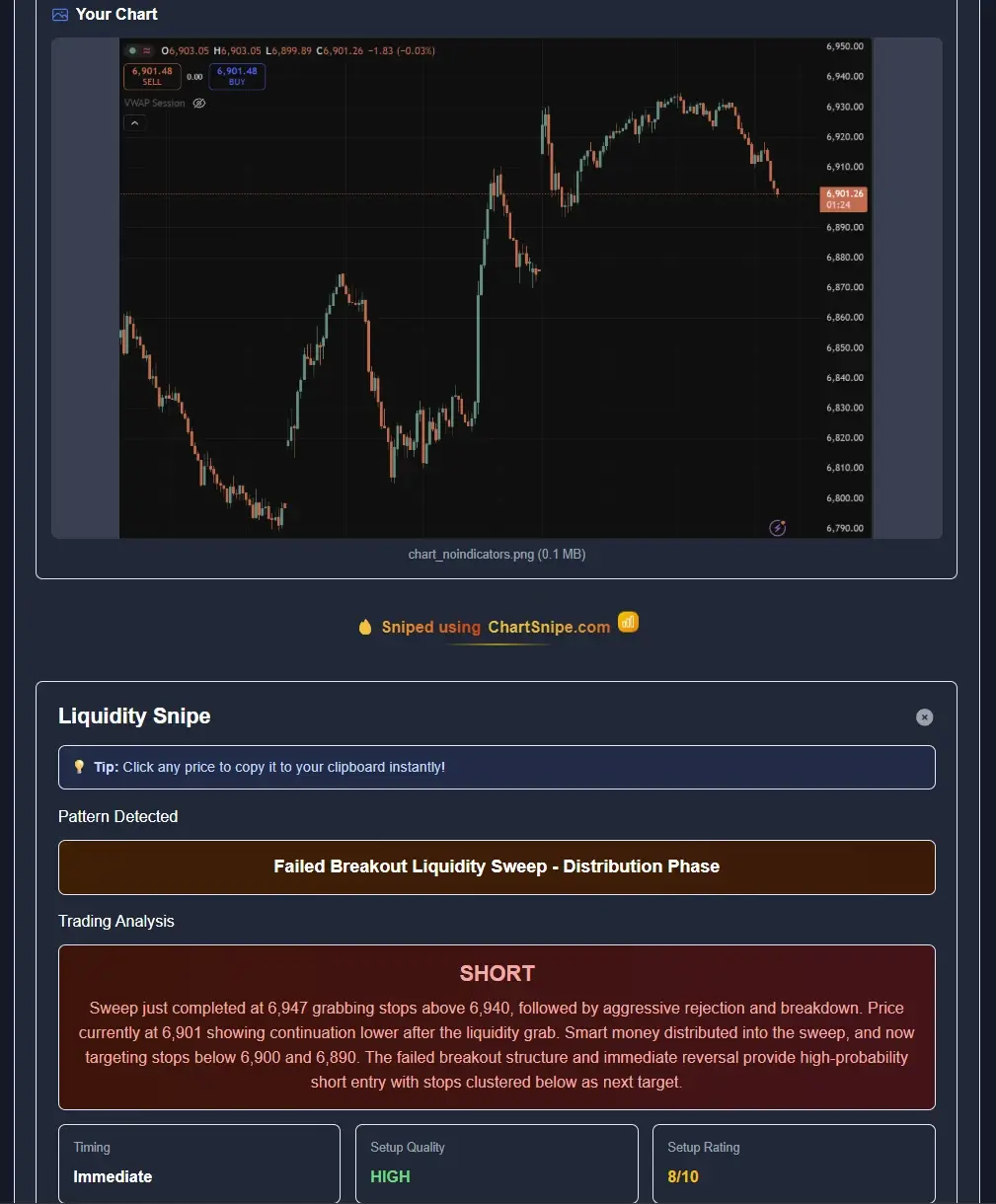
Upload a TradingView or MT4 chart. Get a named pattern, directional bias, entry / stop / target, and reasoning grounded in the actual price action — not invented round numbers.
9. A daily workflow that actually uses ChatGPT correctly
The pairing works because each tool is used on its strengths. Here is the routine — roughly seven minutes of prep, with ChatGPT handling the language half and ChartSnipe handling the live half.
Macro read — ChartSnipe (90 seconds)
Open News Impact. Read the top bullish / bearish pairs and the professional analysis block. You own the story of today.
Strength scan — ChartSnipe (60 seconds)
Scan the 8 currency strength cards. Strongest vs weakest writes your candidate short list.
Chart read — ChartSnipe (120 seconds)
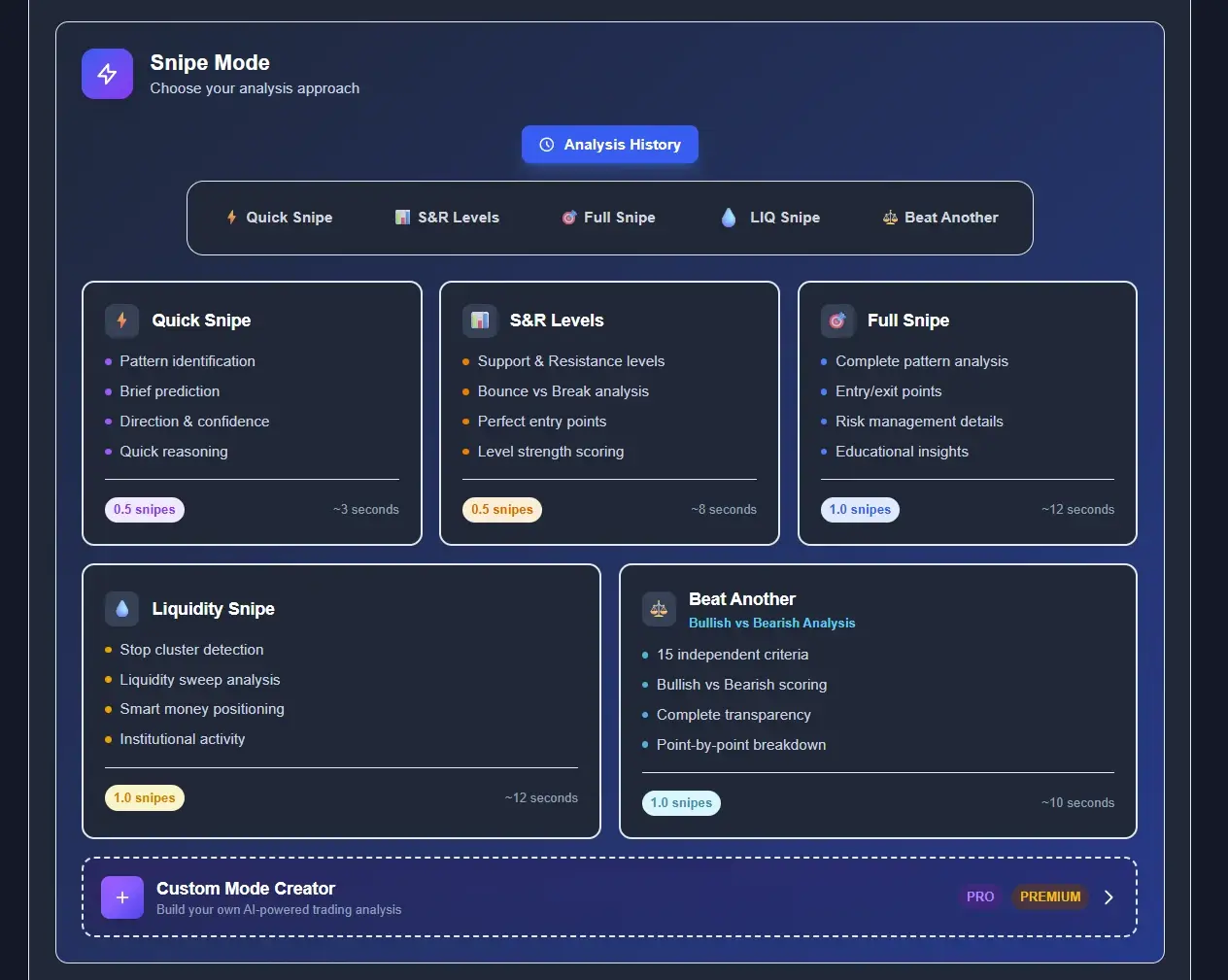
Drop the candidate pair into the ChartSnipe tool on Full Snipe mode. Check the pattern, direction and reasoning against your own read.
Concept sanity check — ChatGPT (60 seconds)
If the pattern is unfamiliar, ask ChatGPT to walk you through how it invalidates. This is the concept-drill prompt from section 6.
Journal review — ChatGPT (end of week)
Paste the week's trades into ChatGPT. Use the journal-review prompt. Adjust next week's plan based on what it surfaces.
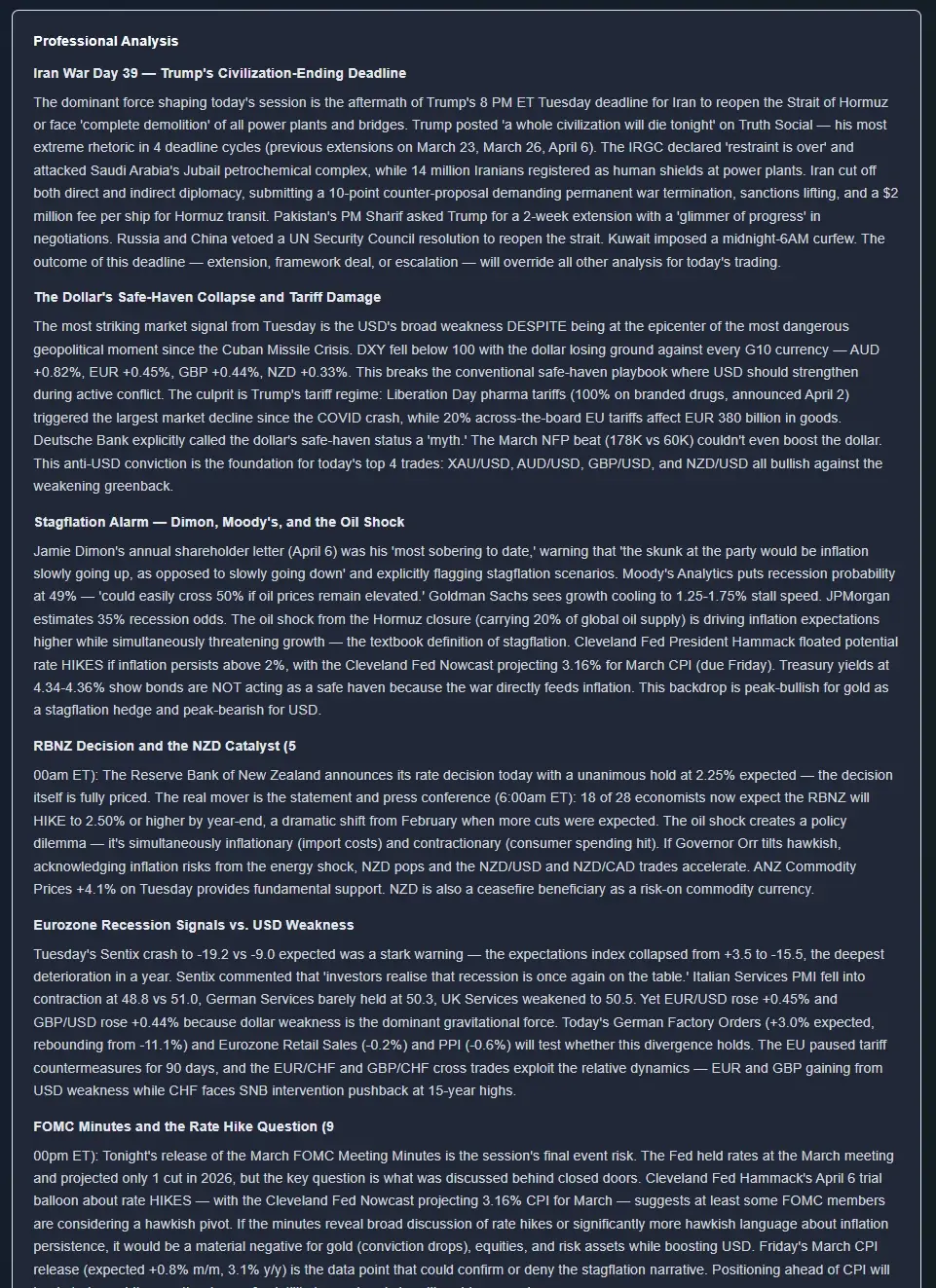
That is what trading with ChatGPT looks like when it is done right — a language model doing language work and a market tool doing market work, in the same workflow.
Frequently asked questions
Can ChatGPT predict stock prices?
No. ChatGPT is a language model — it writes plausible next tokens, not forecasts. It has no training data from after its cut-off, cannot see today's price action by default, and cannot model a fundamentally random process. Any “prediction” you get is fluent text, not an edge.
Can ChatGPT trade for me?
No. It has no broker connection, no execution layer, and no account custody. Anything advertised as a “ChatGPT trading bot” or “OpenAI auto-trader” is a third-party product, not an OpenAI one — most are affiliate funnels for unregulated brokers.
Is ChatGPT good for day trading?
Not for live execution. It cannot see current prices, does not know today's calendar, and has no session awareness. It is genuinely useful before and after the session — pre-market plan drafting, post-session journal review, central bank statement summarisation — but the intraday decisions need a tool wired to a live feed.
Which is better for trading charts — ChatGPT or Claude?
Both share the same structural limits — no live data, no calendar, hallucinated levels. Claude tends to flag uncertainty more readily; ChatGPT writes more confidently. For research tasks they are roughly tied. For a real directional chart call with levels that match the price axis, neither is the right tool — that is a trading-native-AI job.
Does ChatGPT 5 know current stock prices?
Not reliably. Even with the browsing tool enabled, accuracy depends on which source the model scrapes in that session. Delayed quotes, after-hours values, and cached data all leak through. For latency-sensitive trading decisions you need a dedicated feed, not a browsing-augmented chatbot.
Can I use ChatGPT to automate trades?
Via the OpenAI API plus a broker API — technically yes, but the LLM is the weak link. It cannot see markets and will invent clean reasoning for trades with no edge. The working pattern is to code the strategy separately and use the LLM only for narrative generation, journal summarisation, or code assistance. Never put the language model in the decision loop for live orders.
Pair ChatGPT with a trading tool that can actually see the market
28 live FX pairs. Currency strength index across 8 majors. Daily AI news impact scoring 12 instruments. Screenshot chart analysis with levels that match the price axis. Two free snipes to try it on your own chart.