
Can AI Predict How Markets React to News?
That is three questions wearing one coat, and they get three different answers. AI cannot predict the print. It can often read the direction. It cannot see the thing that decides the size.
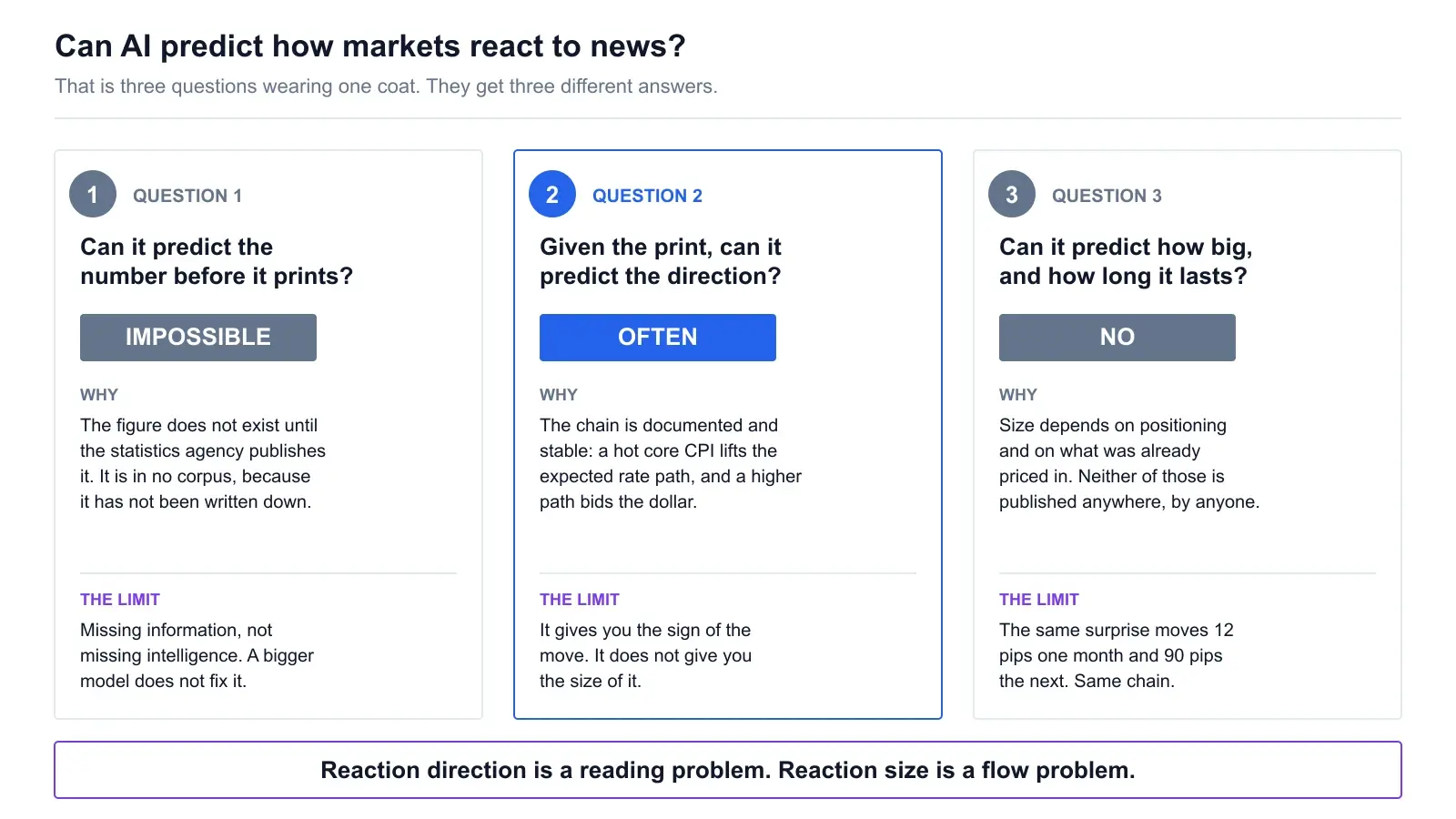
Ask ten traders whether AI can predict how markets react to news and you will get ten confident answers that contradict each other, because nobody agrees on what the question means. One person is thinking about a model that tells you US CPI will print at 0.3%. Another is thinking about a model that says “if CPI runs hot, the dollar goes bid.” A third is thinking about a model that says “EUR/USD will be at 1.0850 by Friday.”
Those are three different problems with three different answers, and the answers are no, often, and no. The middle one is the only place any real capability lives, and the reason it works there and nowhere else is not about model size or training data. It is about which information has been written down.
This piece takes the three apart, grades each one honestly, and then looks at the one piece of hard evidence on AI versus human performance that actually says something interesting — and it does not say what the headlines say it says.
Key Takeaways
- →Predicting the print is not hard, it is impossible. The number does not exist in any corpus until it is published.
- →Predicting the direction of the reaction given the print often works, because transmission channels are documented and change slowly.
- →Predicting magnitude and persistence does not work, because both are set by positioning and by what was already priced — neither is published.
- →Reaction direction is a reading problem. Reaction size is a flow problem. Language models are built for the first one.
- →In 222 million Polymarket trades, retail picked the winning outcome slightly more often than the bots — 51.3% against 49.9% — and lost anyway, because they were late.
- →That makes the AI edge an execution edge, not a forecasting one. It is a much narrower claim than the marketing suggests.
- →The honest form of a prediction is conditional: trigger, impact, affected instruments. A point forecast sells better and dies faster.
1. One question that is really three
“Can AI predict how markets react to news” collapses three separate problems into one sentence. Pulled apart, they look like this:
- Can it predict the print? What will core CPI actually be, before the release.
- Given the print, can it predict the direction of the reaction? If core comes in at 0.4% against a 0.2% consensus, does the dollar go up or down.
- Can it predict the magnitude and persistence? How far, and does it hold into the next session or get fully retraced by the London close.
People arguing about AI and markets are almost always answering different numbers on that list. The optimist is thinking about (2), where models genuinely do work. The skeptic is thinking about (1) and (3), where they genuinely do not. Both are right and the argument never ends, because nobody said which question they were on.
The dividing line, stated once: AI is good at the parts of this problem that exist as text somewhere, and useless at the parts that do not. Question 2 is text — it lives in central bank statements, minutes and public research. Questions 1 and 3 are not text. One does not exist yet, and the other is locked inside private books.
2. Question 1 — can AI predict the print? No.
This one is not a difficulty problem. It is a category problem.
Nonfarm payrolls for a given month does not exist as a number anywhere in the world until the Bureau of Labor Statistics publishes it, at a scheduled minute, under lockup conditions designed specifically to stop it leaking. A language model trained on the entire public internet has read every article ever written about payrolls and not one word of next Friday’s figure, for the excellent reason that nobody has written it down.
What a model can do is aggregate the forecasts other people have made. That is not prediction, that is reading the consensus, and the consensus is already sitting in the calendar column next to the event on Trading Economics where anyone can see it for free. Repackaging the consensus as a forecast is one of the more common tricks in this category of product, and it is worth learning to spot: if the “AI prediction” for CPI is suspiciously close to the published survey median every single month, that is because it is the published survey median.
There is a narrow exception worth being fair about. Some releases are partly reconstructable from components that publish earlier — a euro area flash inflation number is heavily constrained once the large member states have reported, and some US inflation components can be nowcast from private-sector price data. Regional Fed nowcast models do this openly and reasonably well. But that is econometrics on published inputs, not a language model divining an unpublished figure, and the error bars are wide enough that it never gets you a tradeable edge on the print itself.
The thing to internalise: this is missing information, not missing intelligence. A model ten times larger does not get closer, because the gap is not reasoning capacity. It is that the number has not happened yet. Any product that implies otherwise is either selling you the consensus with extra steps, or lying.
3. Question 2 — can it predict the direction? Often, yes.
Here is where the answer flips, and it flips for a boring reason: the mechanism is written down.
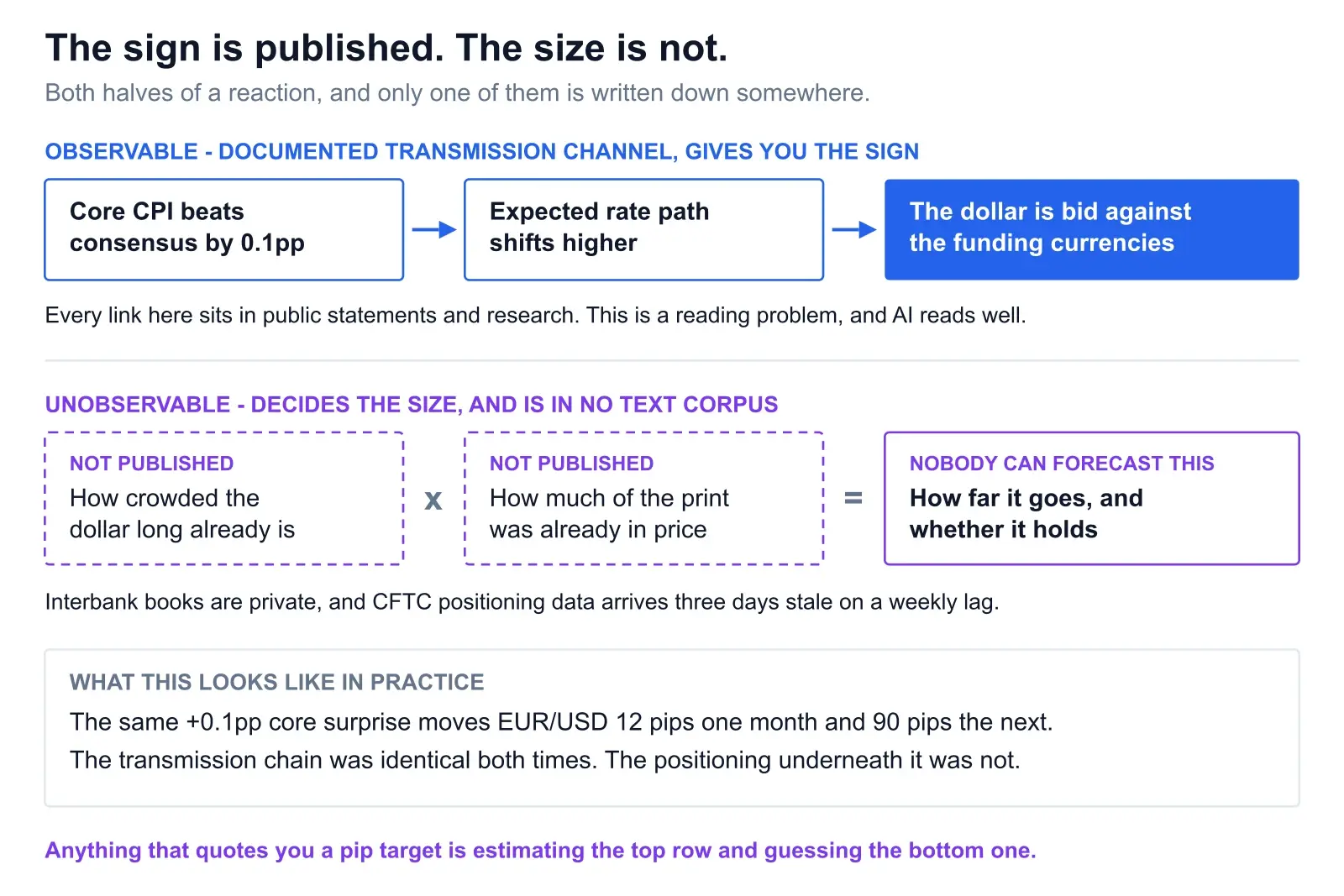
The chain from a data surprise to a currency move is not mysterious. A hot core CPI print raises the expected policy rate path. A higher expected path pulls capital toward that currency and away from the funders. The dollar goes bid against JPY and CHF, gold gets sold on higher real yields, rate-sensitive equity sectors underperform. Every link in that chain sits in public documents — FOMC statements, minutes and projection materials, speeches, decades of research on how policy expectations transmit into FX.
That is a reading and mapping problem, and it is exactly the shape of task a language model handles well. It has read the corpus. The relationships are stable across cycles. And critically, this is a conditional question — it starts with “given the print” — so the impossible half of question 1 has already been handed to it.
Where the direction call still goes wrong
“Often” is doing real work in that heading. Three situations reliably break the direction read, and none of them are model failures — they are cases where the mapping itself stops applying:
- The market is trading a different variable. There are months where nobody cares about inflation because everyone is watching employment, or where a banking wobble makes every release a risk-sentiment proxy. The textbook channel is intact and irrelevant.
- Good news becomes bad news. A very strong growth print during a growth scare is currency-positive. The same print during a stagflation scare can be currency-negative, because it hardens the case for policy staying restrictive into a slowdown. Same number, opposite sign, and the difference is regime, not data.
- The trade was already full. A hawkish surprise into an already-crowded long produces nothing, or a fade. This one is really question 3 wearing a question 2 costume, and it is the most common way a “correct” direction call still loses money.
We went through the machinery of how a pipeline gets from a headline to a ranked instrument list in how AI reads financial news for trading — ingestion, entity extraction, surprise calculation, cross-asset mapping. That piece deliberately stops at the mapping. This one is about what happens after.
The ECB Governing Council press conference of 11 June 2026, published in full by the European Central Bank. This is the raw material for the direction half of the problem — the guidance on the path is what a model is actually reading when it maps a print to a currency.
4. Question 3 — can it predict the size? No, and this is the one that costs money.
Getting the direction right and the size wrong is not a partial success. It is a losing trade with a good explanation attached.
You called the dollar higher on a hot CPI. You were right. It went twenty pips, ran into a wall of profit-taking from people who had been long the dollar for three weeks, and gave it all back by the New York close. Your stop was thirty-five pips away because that is what the structure required. Correct direction, wrong size, negative expectancy.
Two things set the size, and both are invisible:
1. How much was already priced
Markets trade the gap between the print and the expectation, but “the expectation” is not just the survey median. It is the whisper, the positioning that built ahead of the number, the way the rates market moved in the two sessions before it. A print can match consensus exactly and still be a shock because the market had quietly leaned the other way. Nobody publishes the whisper.
2. How crowded the position already is
A hawkish surprise into a market that is already maximally long the currency has nobody left to buy it. The same surprise into a flat or short market produces a stampede. The difference between those two sessions is fifty pips or five hundred, and it is decided by information sitting in private interbank books.
The scale of what is hidden here is easy to underestimate. The BIS triennial survey work on FX market structure puts daily turnover in the trillions, dominated by inter-dealer and financial-institution flow rather than anything with a public paper trail. The best positioning proxy retail traders have is the CFTC Commitments of Traders report, which is weekly, covers futures rather than the much larger spot and swap market, and arrives three days after the snapshot date. It is genuinely useful for spotting extremes and completely useless for predicting what a print does this afternoon.
This is why the same +0.1pp core surprise can move EUR/USD twelve pips one month and ninety the next with an identical transmission chain underneath. The reading was right both times. The flow was different. Our breakdown of which pairs move most on CPI works with historical ranges for exactly this reason — a distribution of past outcomes is an honest thing to give you, and a single pip target is not.
The one positioning report that arrives on time: the first two minutes of price action after the release. A genuinely strong number that produces no follow-through is telling you the trade was already full. That is real positioning information, delivered in real time, and it is available to everyone — but only after the print, which is precisely why no model can hand it to you in advance.
5. AI versus human traders: what the data actually says
Everything above is mechanism. It is fair to ask whether the mechanism shows up in outcomes, and there is now one dataset large enough to say something useful.
Prediction markets are an unusually clean laboratory for this. Every contract resolves to a known truth, every trade is on-chain, and humans and bots trade the same instruments side by side. In Who Profits from Prediction? Execution, not Information, Joshua Della Vedova examined 222 million resolved Polymarket trades and separated two things that normally get bundled together: whether you picked the right side, and what price you got.
The result is the opposite of the story people tell about AI and markets:
| Group | Directional accuracy | Collective outcome |
|---|---|---|
| Retail (human) traders | 51.3% — better than the machines | Lost roughly $79 million |
| Automated (bot) traders | 49.9% — essentially a coin flip | Earned roughly $133 million |
Humans forecast slightly better and lost. Machines forecast no better than chance and won. Della Vedova’s own summary of it is worth quoting flat: “Retail traders lose not because they are wrong, but because they are late.”
That is an execution result, not a forecasting one. The machines were not better at knowing what would happen. They were better at getting a price before the information was fully reflected, and at posting liquidity rather than paying for it. Which is exactly what the three-question split predicts: question 2 is the readable part and humans are not obviously worse at it, while the parts that decide profit — timing, price, what was already in the market — are where speed wins.
On the number you have probably seen. A widely-repeated statistic says over 37% of AI agent wallets on Polymarket run positive P&L against 7–13% of humans. It traces back to a CoinDesk piece from March 2026, and it is worth knowing where each half comes from: the 37% is performance data supplied by the team behind one specific agent product, and the human comparison figure is quoted without attribution. Treat it as vendor-flavoured. The 222-million-trade study is the one to build a view on, because it is independent, it covers the whole venue, and it reports the uncomfortable finding rather than the flattering one.
One caveat before anyone maps this straight onto FX: Polymarket is not the currency market. Contracts resolve to a binary truth, liquidity is thin in most markets, and the latency game in five-minute crypto-direction contracts has no real analogue in a EUR/USD swing trade. What transfers is the decomposition — the finding that picking the right side and making money are close to independent skills, and that most retail damage comes from the second one.
6. Will AI replace traders?
It already replaced one job, and it was not the one people worry about.
Being the fastest reader in the room is gone. Nobody is out-parsing a machine on a headline at 13:30:00.000, and nobody has been for years — that race was over before language models arrived, decided by co-located systems reading structured feeds. If your entire edge was reacting quickly to a number, it was already gone.
What has not been replaced is everything on the far side of the reaction. Whether a move is worth taking given how much of it already happened. Whether the setup is one you know how to manage. Whether your account survives being wrong twice in a row. Whether you can actually be at a screen when the release lands. None of that is a prediction problem, and none of it gets solved by a better model.
The Della Vedova result sharpens this in a useful, slightly deflating way. It suggests that the human contribution — judging what is likely to happen — is not where humans are losing. The losses come from arriving late and paying badly. That is a process problem, and it is fixable without becoming a better forecaster: prepare before the event instead of during it, know which instruments you would touch before the number lands, and stop taking the first price you see two seconds after a print.
Which is a longer way of saying the division of labour is AI for context, human for judgement. We graded that split component by component for macro work in can AI do fundamental analysis for forex — the pattern there is the same one showing up here, arrived at from a different direction.
7. The honest form of a prediction is conditional
If question 1 is impossible and question 3 is unobservable, then anything useful has to be built entirely out of question 2 — and question 2 always starts with “given the print.” That word given is not a hedge. It is the whole structure.
A point forecast — “EUR/USD will trade at 1.0850 by Friday” — attaches no condition. It cannot tell you what to do if the print differs from whatever it quietly assumed, it states no invalidation so it is never quite wrong on the record, and it silently prices the magnitude, which is the half nobody can see. It is a prediction you cannot trade.
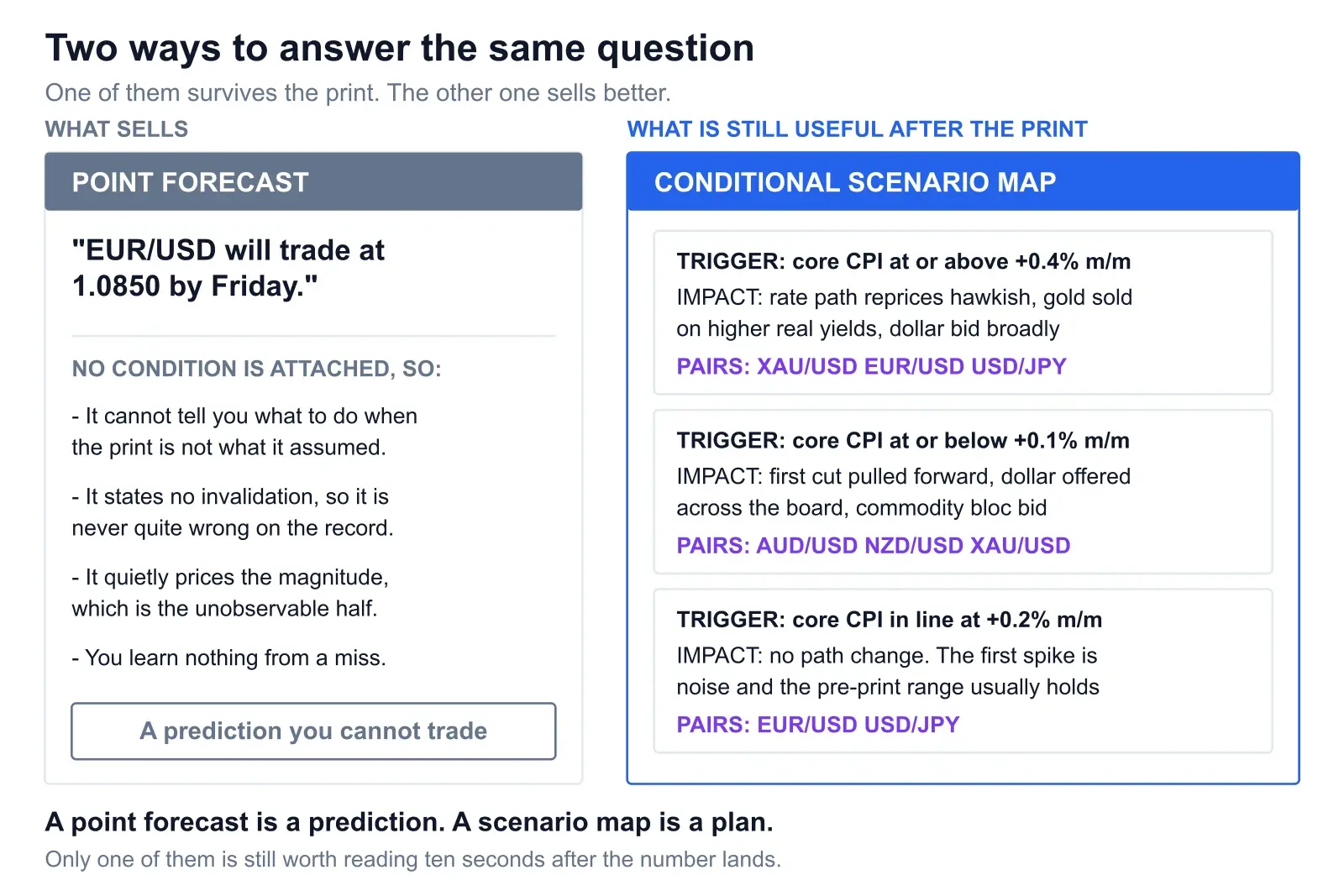
A conditional scenario is a different object. It names a trigger, an impact, and the instruments affected. It does not claim to know which branch fires. It claims to have mapped the branches, which is the only claim the information actually supports.
What that looks like as a product
This is the shape the Risk Analysis section of the News Impact analysis is built in, and it is deliberate. Each scenario carries a severity tag, the trigger that would set it off, a paragraph on the expected market impact, and the affected instruments as tags.
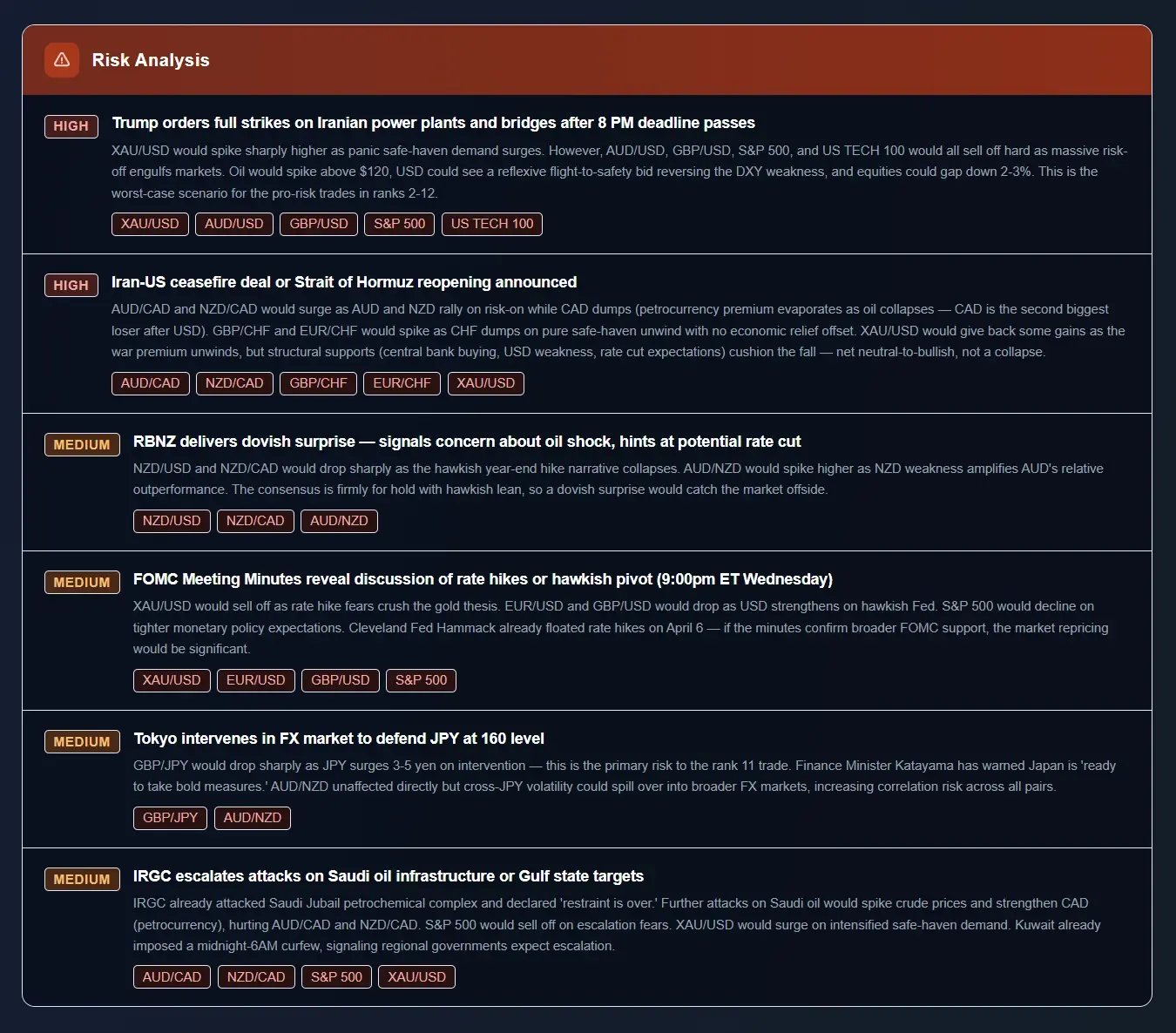
Look at what that panel refuses to do. It does not say which way the Iran situation resolves. It says: here is the trigger, here is what breaks, here are the instruments that carry it, and here is the other branch with its own row. When the headline lands at 03:00 you are reading a page you wrote while calm, rather than improvising while a position moves against you.
The same discipline runs through the long-form Professional Analysis, which is where the reasoning is exposed rather than compressed into an arrow.
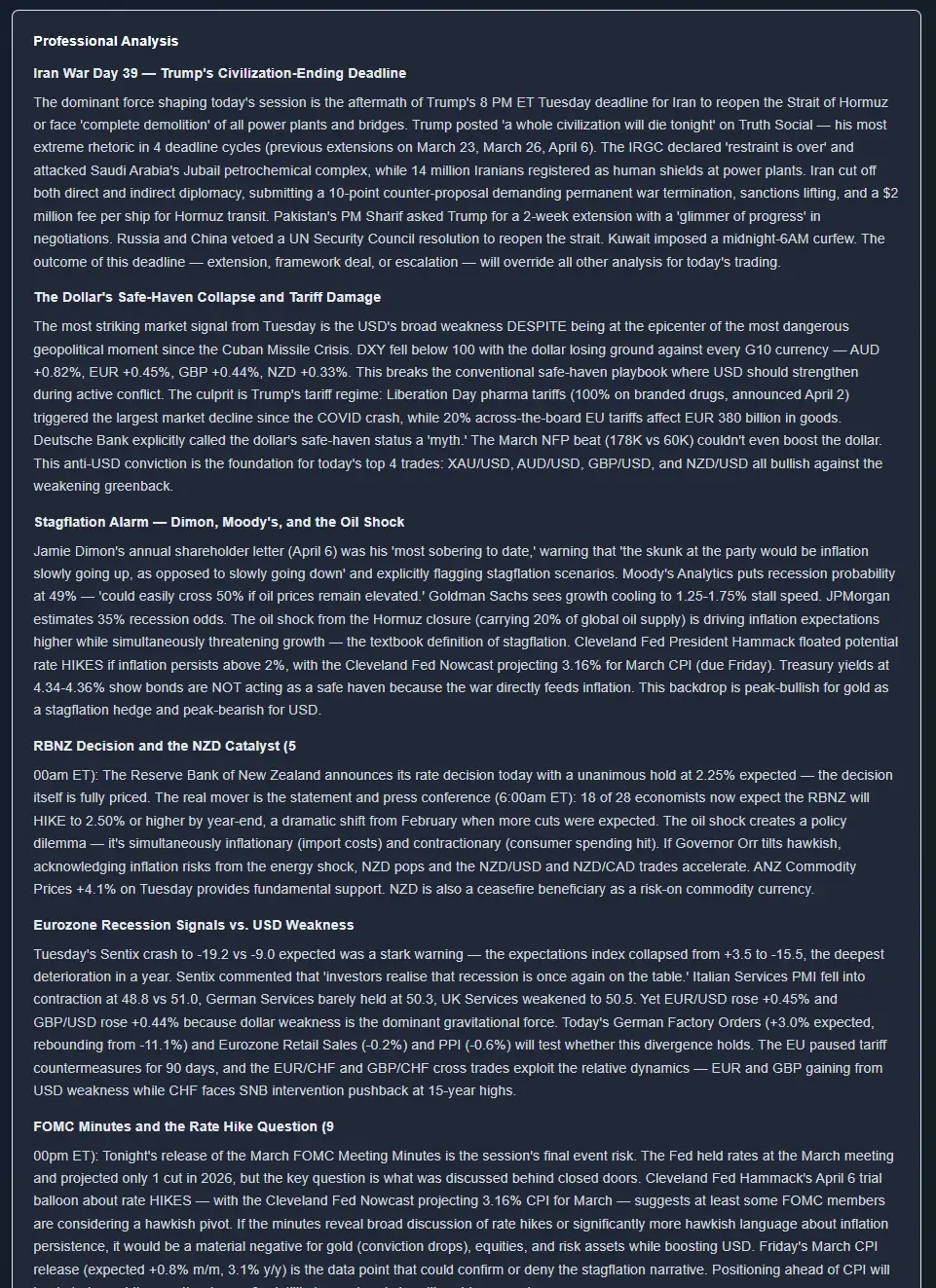
For completeness on what the tool is: 12 AI-ranked pairs, a “How AI Would Trade Today” write-up, 12 currency and instrument cards with bias and reasoning, the Risk Analysis scenarios above, a calendar widget and live prices across 32 instruments. It publishes Monday to Friday between 20:00 and 23:00 UTC for the upcoming session, and there is no weekend edition because there is no weekend session. The full analysis sits on the Pro and Premium plans; free accounts see an admin-featured past-day preview, which is enough to judge the format before paying for it.
8. Does any of this change for stocks?
“Can AI predict the stock market” is the same three questions with different nouns, and the answers come out identically.
The print becomes the earnings number, and it is under the same embargo logic — it does not exist publicly until it is filed. The direction of the reaction is again a documented mapping: an earnings beat with soft guidance is usually a sell, a rate-sensitive sector reacts predictably to a hawkish shift, defensives outperform in a growth scare. Readable, stable, and the sort of thing a model handles competently.
And the size is again invisible, arguably worse than in FX. Equity reaction magnitude depends on short interest, on option dealer hedging flows around large open interest strikes, on passive fund mechanics and index rebalancing, and on whether a name is a crowded hedge fund holding. Some of that is partially observable if you pay for the data; none of it is in a text corpus a language model has read.
Which is why the same rule survives the change of asset class. Ask what an AI read is claiming. If it names a level and a date, it has quietly answered questions 1 and 3, and it cannot have. If it names a condition and a consequence, it is working inside what the information supports.
9. How to use a reaction read without turning it into a forecast
None of this makes AI news analysis useless. It makes it useful in one specific way, and being clear about which way is most of the benefit.
- Read it before the event, never during. The value is in arriving prepared. Reading an analysis while a position is open is not research, it is looking for someone to agree with you.
- Take the mapping, not the call. The useful output is “this release transmits to these instruments through this channel.” The directional label on the end is the least valuable line on the page.
- Write down what would break it. If the analysis does not state an invalidation, add your own before the print. A view with no failure condition cannot teach you anything.
- Let the first two minutes tell you about the flow. Strong number, no follow-through means the trade was full. That is the positioning read nobody could give you in advance, and it is free.
- Size on structure, never on conviction. A confident-sounding paragraph is not a reason to trade bigger. Stop distance sets size; the analysis only decided you were looking at the pair at all.
- Grade the read separately from the trade. Direction right and trade lost is a normal outcome and it means something completely different from direction wrong. Mixing the two scorecards teaches you nothing about either.
The event-specific mechanics — the spread blowout, the first-candle trap, why the retrace at the fifteen-minute mark matters — are in our guide to trading NFP, CPI and FOMC. And if you want a second opinion on the chart itself that has not been influenced by any of this, the Chart Snipe tool reads a screenshot and returns pattern, trend, a probability read and entry and risk guidance — useful mostly because it does not know what you want to hear.
10. The verdict
Can AI predict how markets react to news? Here is the whole thing in three lines.
The print: no, and not because the models are not good enough. The number does not exist yet. This does not improve.
The direction of the reaction: often, because the transmission channels are documented, stable, and written in the sort of language a model reads well. This is the real capability, and it is narrower than the marketing but genuinely worth having.
The magnitude and persistence: no. Both are decided by positioning and by what was already priced, and that information is inside private books. A better model does not get closer, because there is nothing to read.
Reaction direction is a reading problem, and AI reads. Reaction size is a flow problem, and AI is blind to flow. Everything sensible you can do with these tools follows from taking that sentence seriously.
And the most useful thing in the whole discussion is still the finding that humans were slightly better at picking outcomes and lost money anyway. Whatever you were worried AI was about to take from you, it was probably not your judgement. It was your speed — and you were never going to win that race, so you may as well stop entering it and get better at the part where being right actually pays.
Frequently asked questions
Can AI predict how markets will react to news?
Partly, and which part matters enormously. It cannot predict the data itself — a CPI print does not exist anywhere until the statistics agency releases it, so no training data contains it. Given the print, AI is often decent on the direction of the reaction, because the chain from a data surprise to a rate-path repricing to a currency move is documented in central bank communication and public research. What it cannot do is say how far the move goes or whether it holds, because that depends on positioning and on how much was already in the price, and neither is published.
Can AI predict the stock market?
Not as a point forecast, for the same reason as in FX. A price level requires knowing both the news and the flow that responds to it. AI can read the news at scale and map it to plausible sector and index effects; it cannot see who is already positioned, who is forced to sell, or where option hedging flows sit. Anything quoting a specific index level on a specific date is estimating the readable half and inventing the rest.
Why can AI predict the direction of a reaction but not the size?
Direction is a reading problem, size is a flow problem. The chain from a hot core CPI to a higher expected rate path to a bid dollar is written down in statements, minutes and research — it is text, and language models handle text. Size is set by how crowded the position already was and how much of the print was already priced. Interbank books are private, options exposure is scattered, and CFTC positioning arrives on a weekly lag. The same 0.1pp core surprise can move EUR/USD twelve pips one month and ninety the next on an identical chain.
Are AI traders better than human traders?
The best evidence says the split is not where people assume. Joshua Della Vedova’s study of 222 million resolved Polymarket trades found retail traders picked the winning outcome slightly more often than automated ones — 51.3% against 49.9% — and still lost around $79 million collectively, while bots earned roughly $133 million on near coin-flip accuracy. His summary: retail traders lose not because they are wrong, but because they are late. That is an execution advantage, not a forecasting one.
Will AI replace traders?
It already replaced one job — being the fastest reader in the room. Nobody out-parses a machine on a headline at 13:30:00. What has not been replaced is the judgement about whether a move is worth taking given what is priced, how crowded the trade is, what your account survives, and whether you can be at the screen. The honest division is AI for context and coverage, human for the decision, and the execution evidence suggests being late costs more than being wrong.
What is the difference between a point forecast and a conditional scenario?
A point forecast says “EUR/USD will trade at 1.0850 by Friday”. It attaches no condition, so it cannot tell you what to do if the print differs from whatever it assumed, and it states no invalidation, so it is never quite wrong on the record. A conditional scenario says “if core CPI comes in at or above 0.4% m/m, the rate path reprices hawkish, gold gets sold on higher real yields, and these are the pairs it hits.” The second is still useful ten seconds after the number lands, because it was written as a map rather than a bet.
Can AI tell you how many pips a news event will move a pair?
No, and anything quoting a pip target for an unreleased event is presenting a guess as an estimate. Historical average ranges are genuinely useful for sizing and stop placement — knowing CPI typically produces a 60 to 90 pip session range in EUR/USD tells you something real. But that is a distribution, not a forecast, and the month you are trading can land anywhere inside it depending on positioning going in.
How should you use an AI news read without treating it as a prediction?
Read it before the event, not during it, and read it for the mapping rather than the call. What you want is: which instruments are exposed to this release, through what channel, and what would have to happen for the expected reaction to fail. Then let the price action after the print tell you about the flow, because the first two minutes is the only positioning report you get in real time. If a strong number produces no follow-through, the trade was already full — information no model could have handed you in advance.
Sources & further reading
- → Joshua Della Vedova — Who Profits from Prediction? Execution, not Information — the 222-million-trade Polymarket study behind the 51.3% versus 49.9% accuracy split and the finding that retail lose by being late rather than by being wrong.
- → CoinDesk — AI agents are quietly rewriting prediction market trading — the origin of the widely-quoted 37% figure, useful mainly for seeing that the number is vendor-supplied.
- → Federal Reserve — FOMC calendar, statements and projections — the primary text behind the direction half of the problem, free and complete.
- → Bureau of Labor Statistics — news release schedule — the release calendar for CPI and the employment situation, and a reminder that the number is under lockup until the minute it publishes.
- → BIS — Sizing up global foreign exchange markets — on turnover, market structure and how much FX flow leaves no public trail at all.
- → Trading Economics — economic calendar — consensus forecasts and historical series, so you can check whether an “AI prediction” is just the survey median in a new coat.
Get the conditional map, not the point forecast
News Impact ships the honest version: 12 AI-ranked pairs, a written “How AI Would Trade Today” thesis, 12 currency and instrument cards with reasoning, and Risk Analysis scenarios that pair every trigger with its impact and the instruments it hits — including both branches of a binary event. Published Monday to Friday between 20:00 and 23:00 UTC for the upcoming session.