
Trade Management: 10 Techniques to Protect Forex Profits
Entries make noise, exits make money. The ten techniques that turn a decent signal into a closed winner — from breakeven stops at 1R to confluence-cluster exits at the final target.
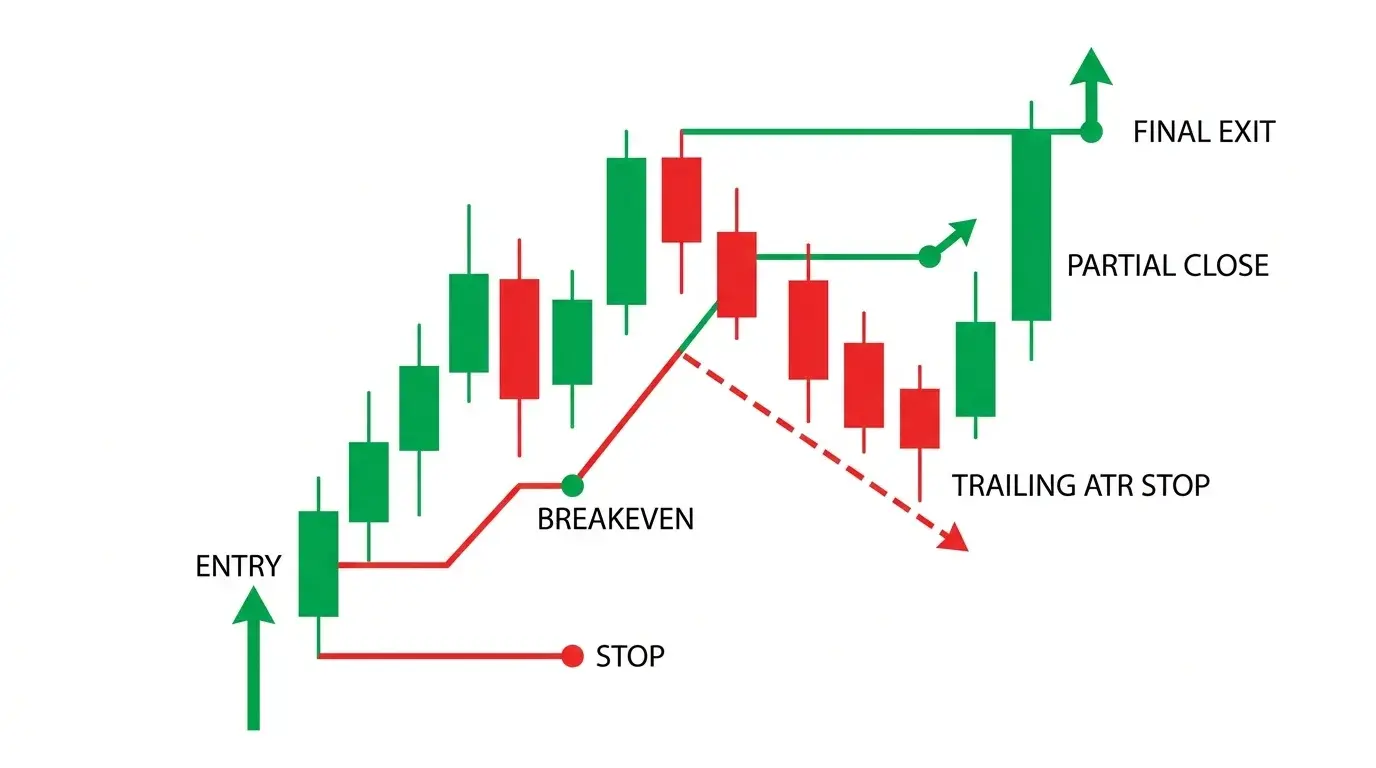
Ask a hundred retail traders what they obsess over and ninety-five will say "my entry." They hunt setups, refine pattern rules, backtest signal filters, and argue about which EMA combination gives the cleanest cross. Then they take a textbook entry, watch price move 40 pips in their favour, and exit with 8 pips because they panicked on the first retrace. Entries make noise. Exits make money.
Trade management is the unglamorous middle layer between click-to-buy and click-to-close. It is where most retail P&L is actually decided — and where most retail traders leak the majority of their edge. This guide walks through the ten trade management techniques real professionals use, when each one applies, and the specific mistake that turns each technique into a fresh way to lose money. Pair it with a solid stop loss placement method and a realistic risk-reward framework and you have a complete post-entry system.
Key Takeaways
- →Moving the stop to breakeven at 1R converts a risky trade into a free option — it is the single highest-impact management move a retail trader can learn.
- →Partial closes at 1:1 lock in a guaranteed winner while leaving runners to chase the tail — the cure for "I gave it all back" trades.
- →ATR-based trailing stops adapt to volatility regimes in a way fixed-pip trails never do.
- →Time stops, news stops, and opposing-signal exits are all forms of "the thesis is no longer true" — close the trade, do not argue with price.
- →Pyramiding winners is the most underused technique in retail trading and the reason some pros compound at speeds that look impossible.
1. Move Stop to Breakeven at 1R
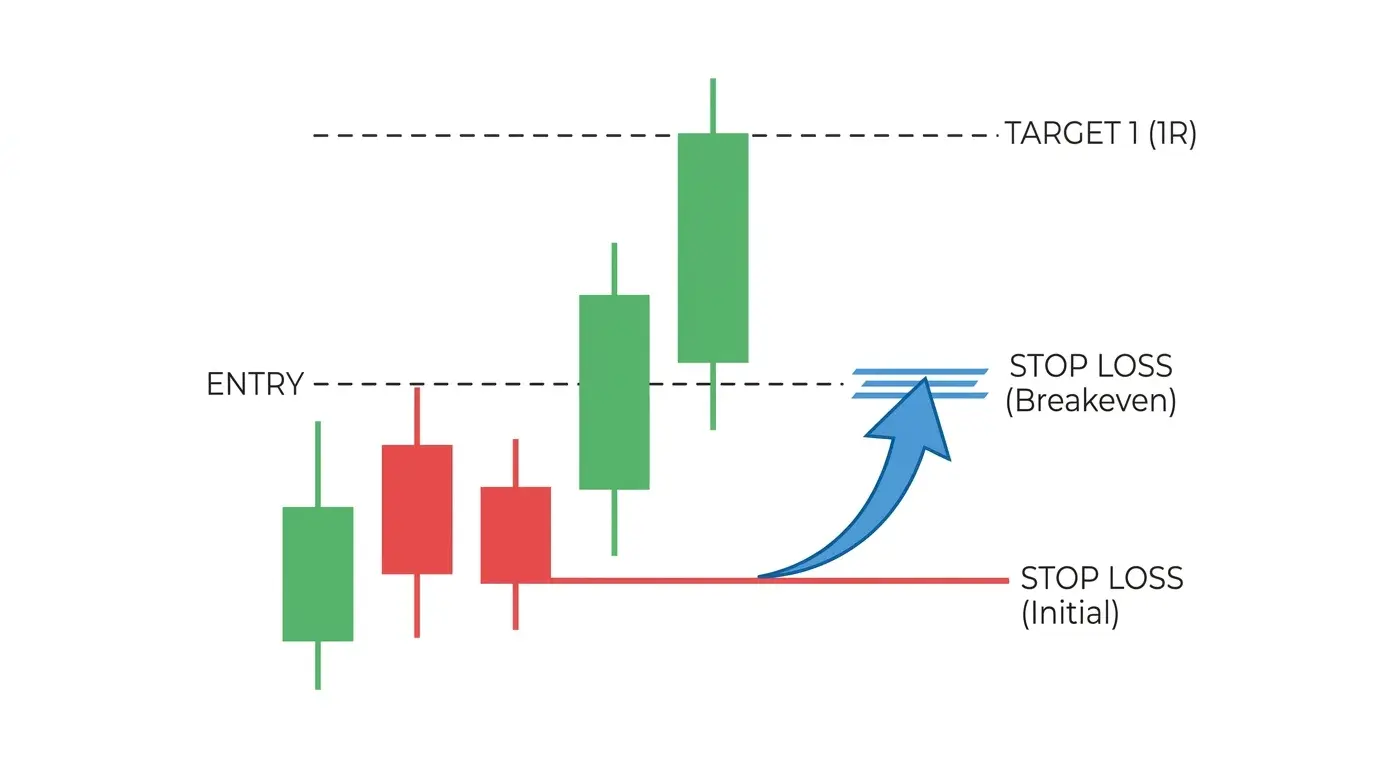
The mechanic. Once price has moved a full 1R in your favour (the same distance as your initial stop), slide the stop from its original level up to your entry price. If you risked 20 pips to make 60, the moment price has advanced 20 pips you close the risk window. From that point on you can only break even or win. The trade is, for free, now a long-optionality structure.
When it applies. Almost always — this is the most universally applicable technique on this list. It works on scalps, intraday swings, multi-day positions, and even news trades provided 1R is reached with a reasonable rejection candle behind it. The only time to skip it is when the natural market structure (last swing low on a long) sits a few pips above entry and moving to breakeven would stop you out on ordinary noise.
The common mistake. Moving to breakeven too early — at 0.3R or 0.5R — because the trader is scared of giving back an unrealised gain. Price then retraces normally, hits the tight stop, and reverses exactly to the planned target. You turned a +2R winner into a breakeven scratch because you could not sit in the seat. Wait for 1R. Full R. Nothing less.
2. Partial Close at 1:1
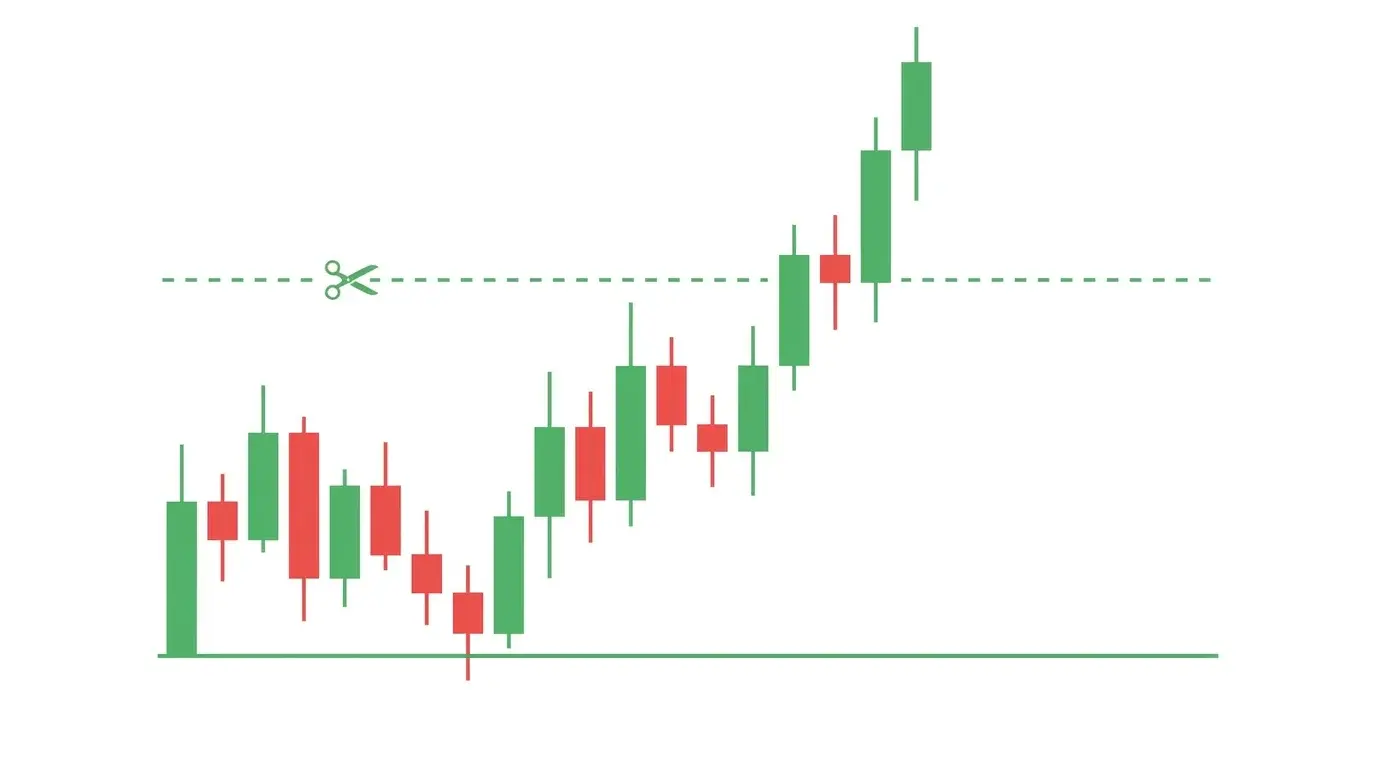
The mechanic. Split the position into two equal halves. When price reaches the 1R mark (a 1:1 reward-to-risk ratio), close 50% at market. Move the stop on the remaining 50% to breakeven. Now you have locked in a guaranteed 0.5R winner on the trade as a whole, and your runner is a free half-position aiming at the full target.
When it applies. Any setup where the final target is 2R or further, and where the price path between 1R and the target is not obviously vertical. It is particularly useful around session boundaries, major S/R levels that tend to reject at least once, and event windows where headline risk can snap price back the other way before the real leg completes.
The common mistake. Closing 80% or 90% at 1:1 instead of 50%. That is not trade management — it is surrender. A 10% runner does not meaningfully capture the tail. The whole point of scaling out is asymmetric upside on the back half; if you cut your runner down to a dust position, you are paying the commissions of a partial close without keeping any of the convexity.
3. ATR-Based Trailing Stop
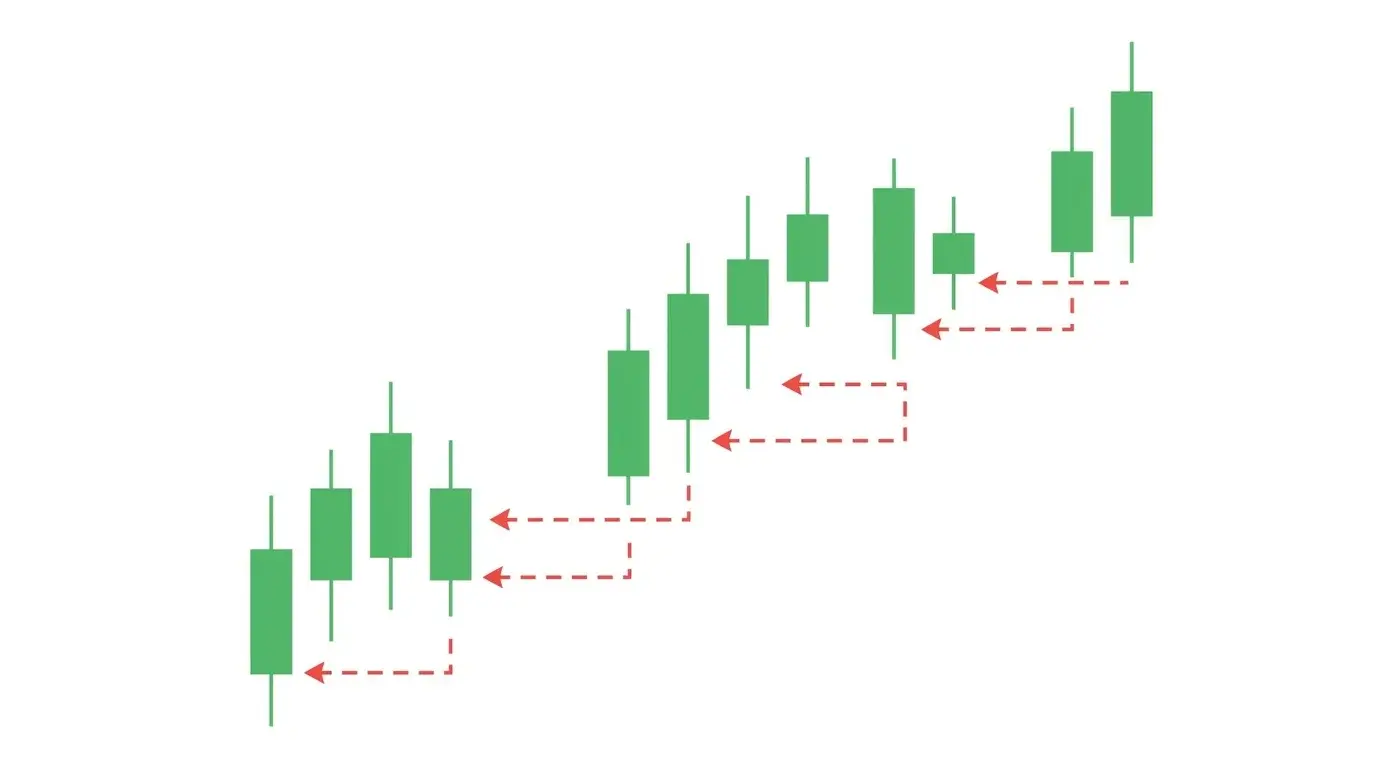
The mechanic. Trail the stop a multiple of Average True Range behind price — typically 1.5 to 3 ATRs depending on the timeframe. On an H4 chart where ATR reads 40 pips, a 2-ATR trail keeps the stop 80 pips behind the highest closed candle. As ATR expands the trail widens automatically; as ATR contracts the trail tightens. It is a volatility-adaptive version of a simple pip trail.
When it applies. Trending trades on the H1 and higher — anywhere you want to ride a move as far as it naturally wants to go. ATR trails are particularly strong on JPY crosses and commodity FX during clear trend days because the volatility signature is consistent enough that the trail sits outside normal pullback noise while still catching legitimate reversals.
The common mistake. Using a fixed-pip trail (e.g. "always 30 pips") on every pair and every session. 30 pips is a rounding error on GBP/JPY during London, but 30 pips is a whole session range on EUR/CHF in Asia. Your trail should match the instrument's volatility profile, not your personal comfort zone. ATR does that math for you.
4. Pyramiding Into a Winner
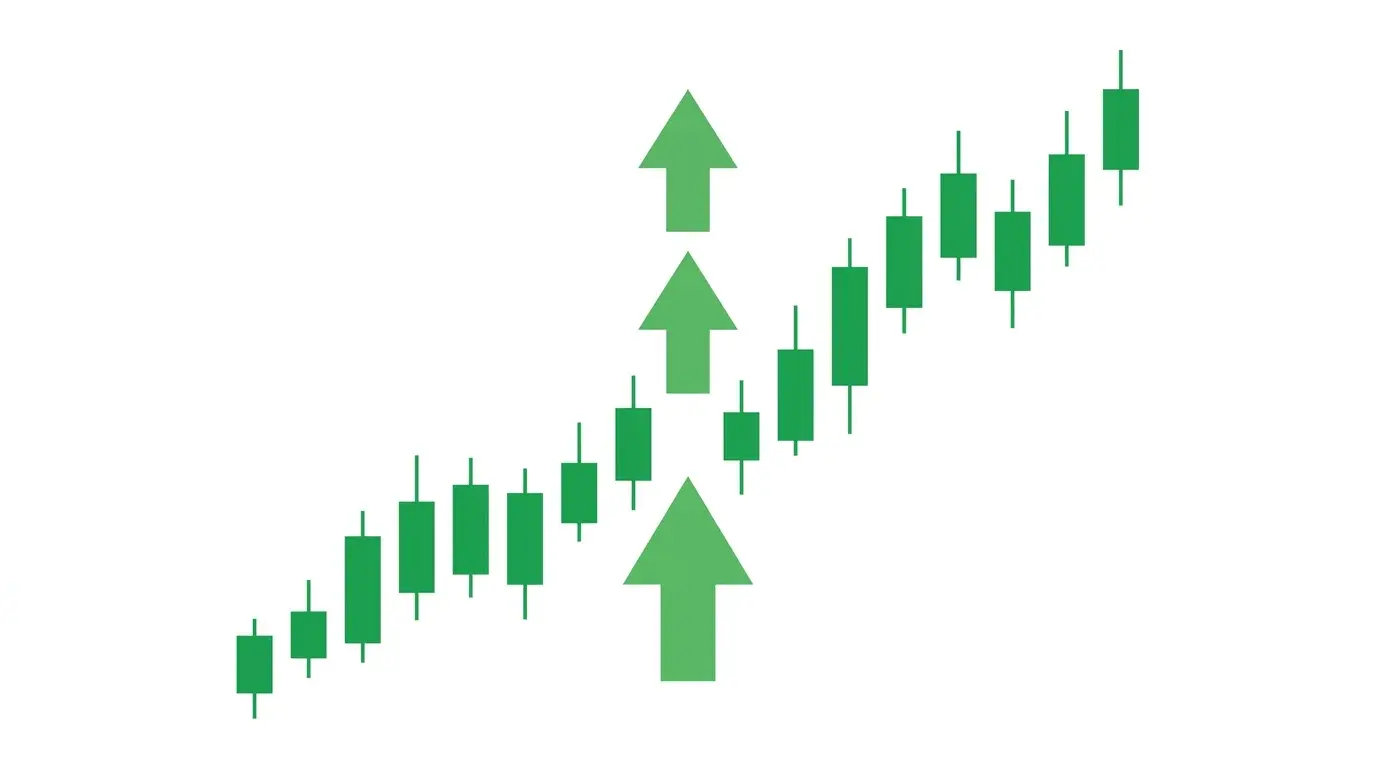
The mechanic. When your initial trade is already +1R or more, add a second, smaller tranche at the next pullback to a defined structure point (higher low, EMA, order block). Then a third, smaller again. Each add-on has its own stop placed just below the new swing, and the aggregate stop is trailed so the combined position never risks more than 1R of account equity at any moment.
When it applies. Strong trend days with clean structure — NFP continuation legs, CPI-driven USD trends, BoJ intervention unwinds. Pyramiding is how traders turn a +3R standalone trade into a +8R portfolio-level move. It does not apply in range-bound tape; adding in chop just amplifies chop losses.
The common mistake. Pyramiding with equal or larger size on each add. That inverts the risk profile — your largest position is now the one with the shortest cushion, and a normal retracement liquidates the whole stack. Real pyramids get narrower at the top. If the first add is half the original, the second should be a quarter, not the same size as the first.
5. Scaling Out at Multiple Targets
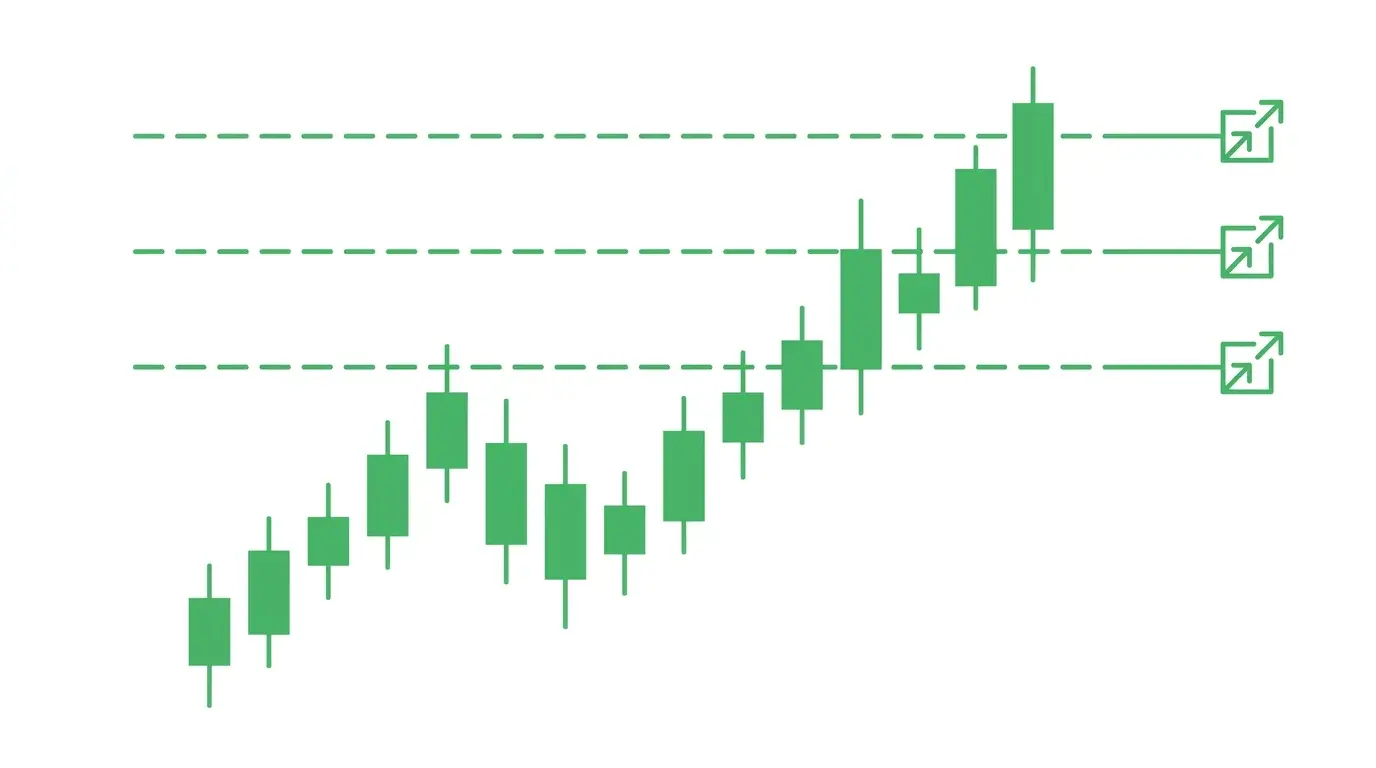
The mechanic. Instead of a single "close it all at 2R" exit, divide the position into three equal thirds and close one at 1R, one at 2R, and one at 3R or higher. After the first partial the stop moves to breakeven; after the second, it moves to just above the 1R target. The final third rides on a structural or ATR trail. Average exit sits around 2R, but with a fatter right tail than a clean TP ladder.
When it applies. Swing trades where the chart has two or three distinct obvious resistance levels stacked above entry — prior highs, round numbers, VWAP bands, weekly pivots. Scaling out lets you bank liquidity at each of those levels rather than hoping price vaults through them in one clean bar.
The common mistake. Scaling out without any basis for the target levels. If 1R, 2R, and 3R are just arbitrary distances with no underlying structure, the first scale frequently happens on the exact retrace wick before the real leg fires. Your target ladder needs to be anchored to real prior highs, gaps, or key levels — not drawn on round multiples of your stop.
6. Bracket Order Laddering
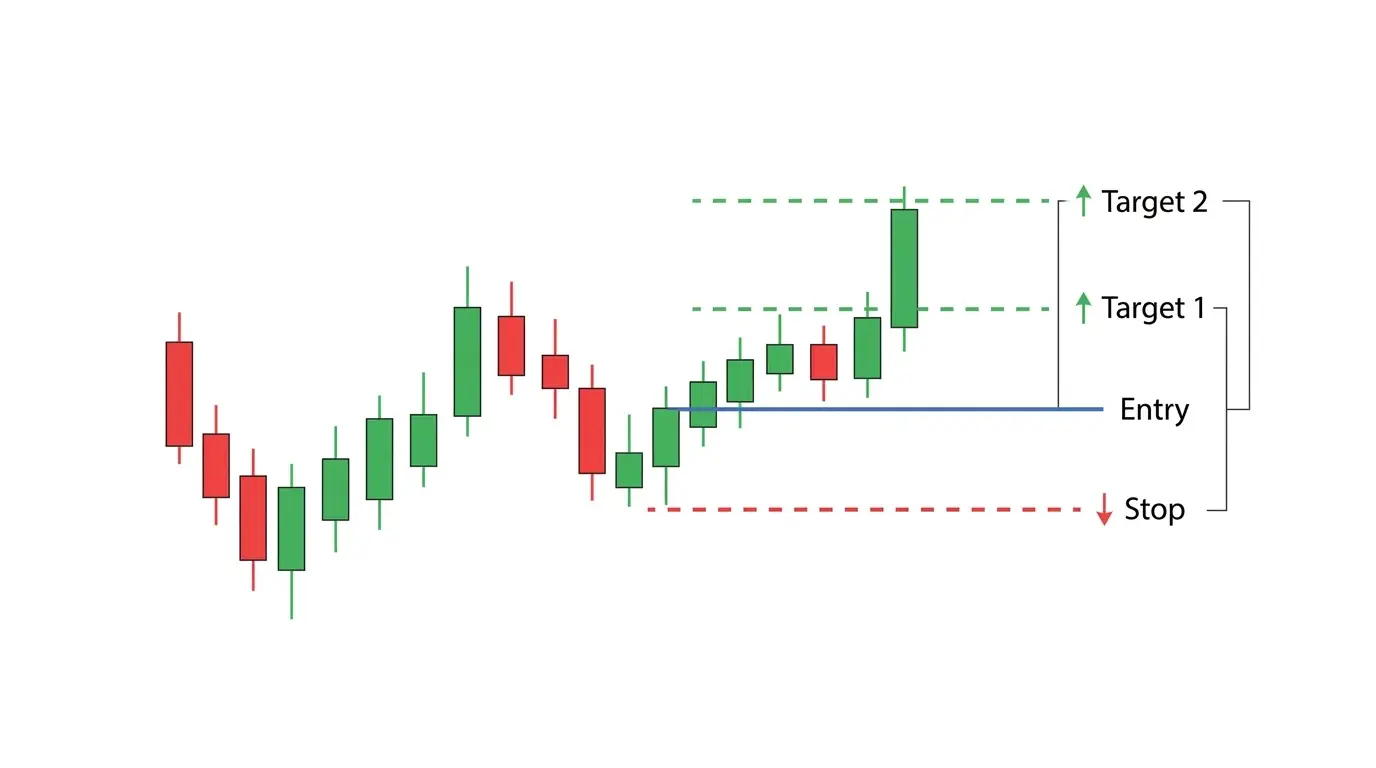
The mechanic. Most good brokers let you attach a stop loss plus multiple take-profit levels to a single entry. When the TP1 fires, the software automatically cancels a third of the stop-loss contracts; when TP2 fires, another third cancels. Your entry, stop, and all three targets sit on the exchange before you even get filled — no manual adjustment required during the trade.
When it applies. Any time you intend to scale out (Section 5) but cannot babysit the chart. Bracket laddering is how traders with day jobs still run multi-target structures without staring at the screen. It is also how professional execution desks run size — no discretionary clicking, just pre-committed orders.
The common mistake. Submitting the bracket and then immediately manually overriding it 20 minutes later because price "looks weak." The whole point of a bracket is to remove discretion mid-trade. If you cancel TP2 to "protect gains" and the real move is the one from TP2 to TP3, you just deleted the trade's convexity by hand. Submit the ladder. Walk away.
7. Time-Based Stop-Out
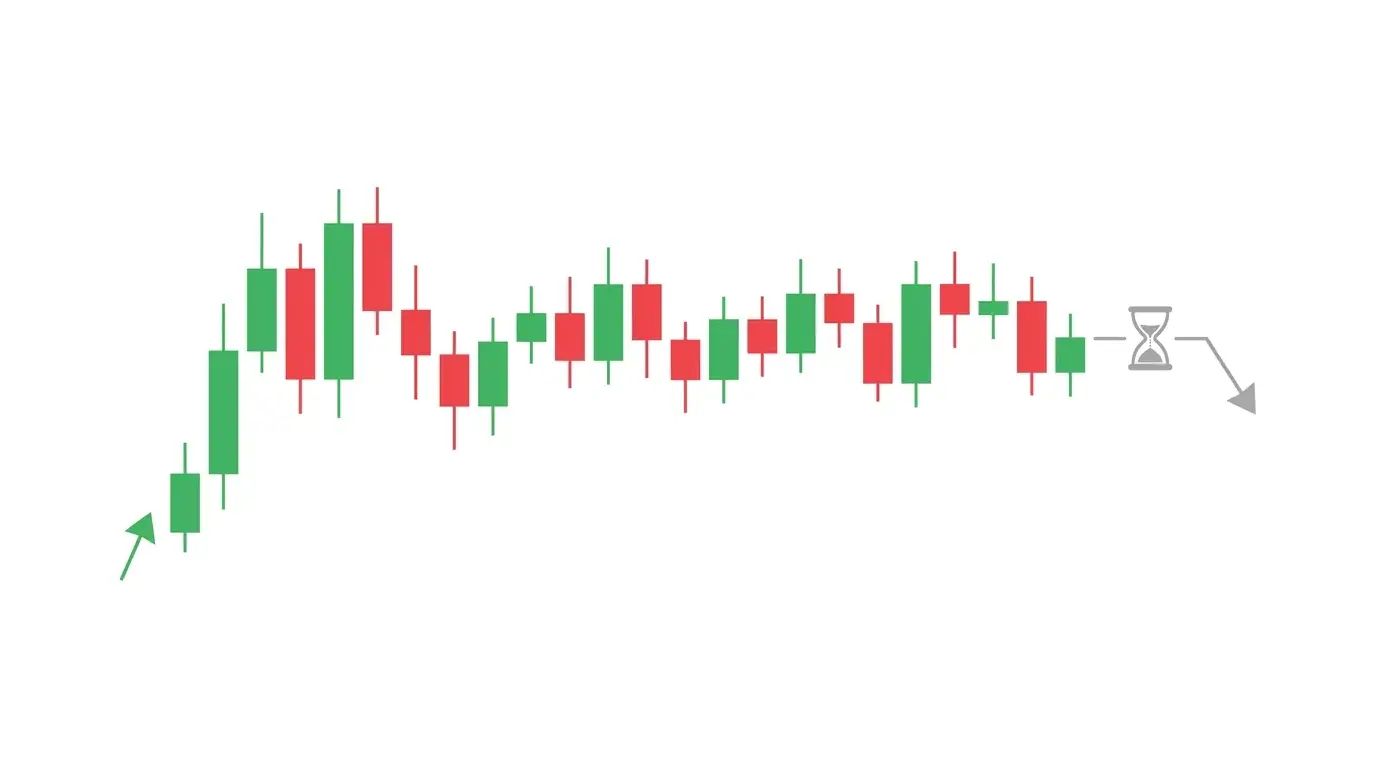
The mechanic. Pre-commit to closing any trade that has not reached at least 1R of progress within a fixed number of candles on your entry timeframe — typically 5 to 10 candles for intraday, 3 to 5 for scalps, 10 to 20 for swings. If the trade has not worked in that window, the structural edge has evaporated regardless of whether price is still slightly in profit or slightly red.
When it applies. Momentum setups, continuation patterns, and anything you entered because you expected immediate follow-through. A flag-break that is still sitting on the flag midline three hours later is a failed flag, not a slow-moving flag. Time stops catch trades that are bleeding slowly instead of obviously — the worst kind to carry because they tie up margin and mental capital.
The common mistake. Skipping the time stop because the trade is "not actually losing yet." A trade that is flat when you expected it to be at 1R is already a losing trade; price is just kind enough not to hand you the bill yet. Closing at flat frees up the slot for the next live setup. Leaving it on is a tax you voluntarily pay.
8. News-Triggered Stop
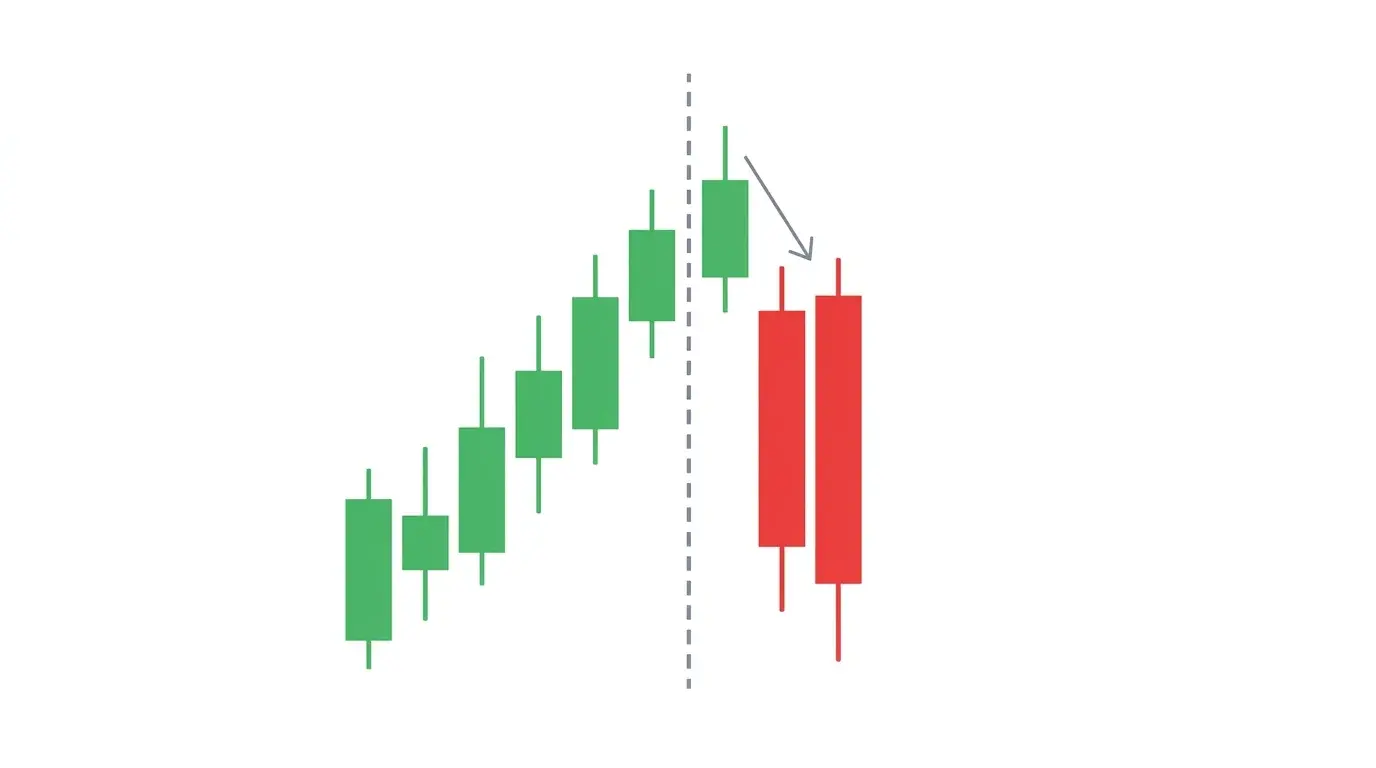
The mechanic. If a high-impact release is due on a currency involved in your open position, close the trade (or reduce it heavily) 15 to 30 minutes before the print. Re-enter only after the initial volatility has resolved and the directional interpretation is clear — usually 30 to 60 minutes after the release for US data, longer for central-bank pressers.
When it applies. NFP, CPI, FOMC, ECB, BoE, BoJ, and any scheduled speech by Powell, Lagarde, or Bailey. A useful cross-check is the ChartSnipe AI News Impact dashboard, which pre-ranks the day's events by severity and lists which instruments are in the blast radius — exactly the pairs where a news stop earns its keep.
The common mistake. Holding through "just to see what happens" and hoping the stop is wide enough to absorb the spike. It is not. News spikes regularly tear through stops at non-guaranteed levels with 10+ pips of slippage. The math on a single bad slip outweighs ten clean news-stop re-entries. Close it, wait, re-engage.
9. Opposing-Signal Exit
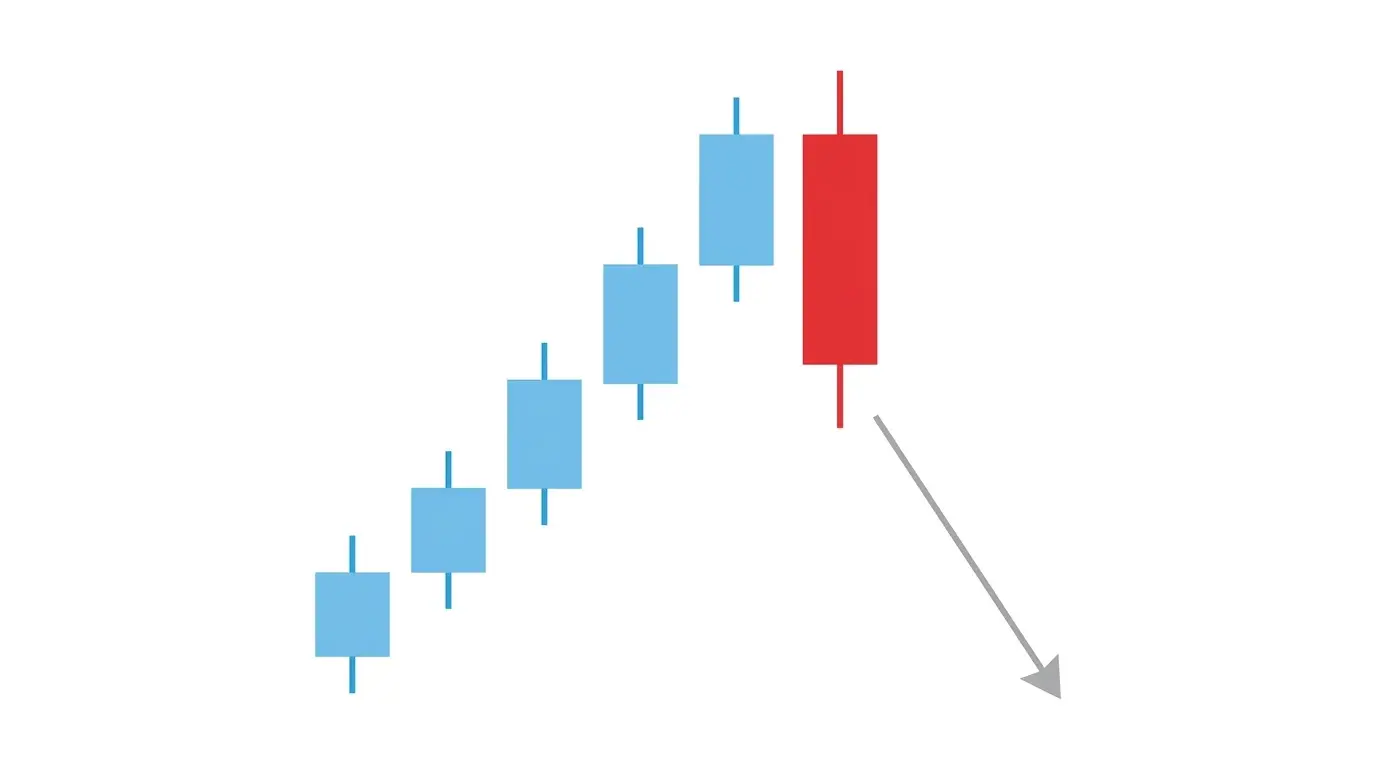
The mechanic. Close the current trade the moment your own system — the same rule set that got you in — produces a qualified signal in the opposite direction. If you entered long on a higher-low + bullish engulfing at an order block, and the chart now prints a lower-high + bearish engulfing at resistance, exit immediately. Do not wait for the original stop to hit; the setup that justified the trade is gone.
When it applies. Systematic and semi-systematic traders who trade a defined playbook. If your entries are rule-based, your exits can be rule-based too. Opposing-signal exits are particularly clean on the higher timeframes (H4, D1) where signal density is low enough that an opposite print is genuinely meaningful rather than noise.
The common mistake. Overriding the rule because you "feel" the opposite signal is a fakeout. If you trust the signal enough to enter on it, you have to trust it enough to exit on it. The asymmetric version — taking entries on the system but discretionarily ignoring exit signals — is a slow path to zero. Rules in both directions or rules in neither.
10. Target Cluster / Confluence Exit
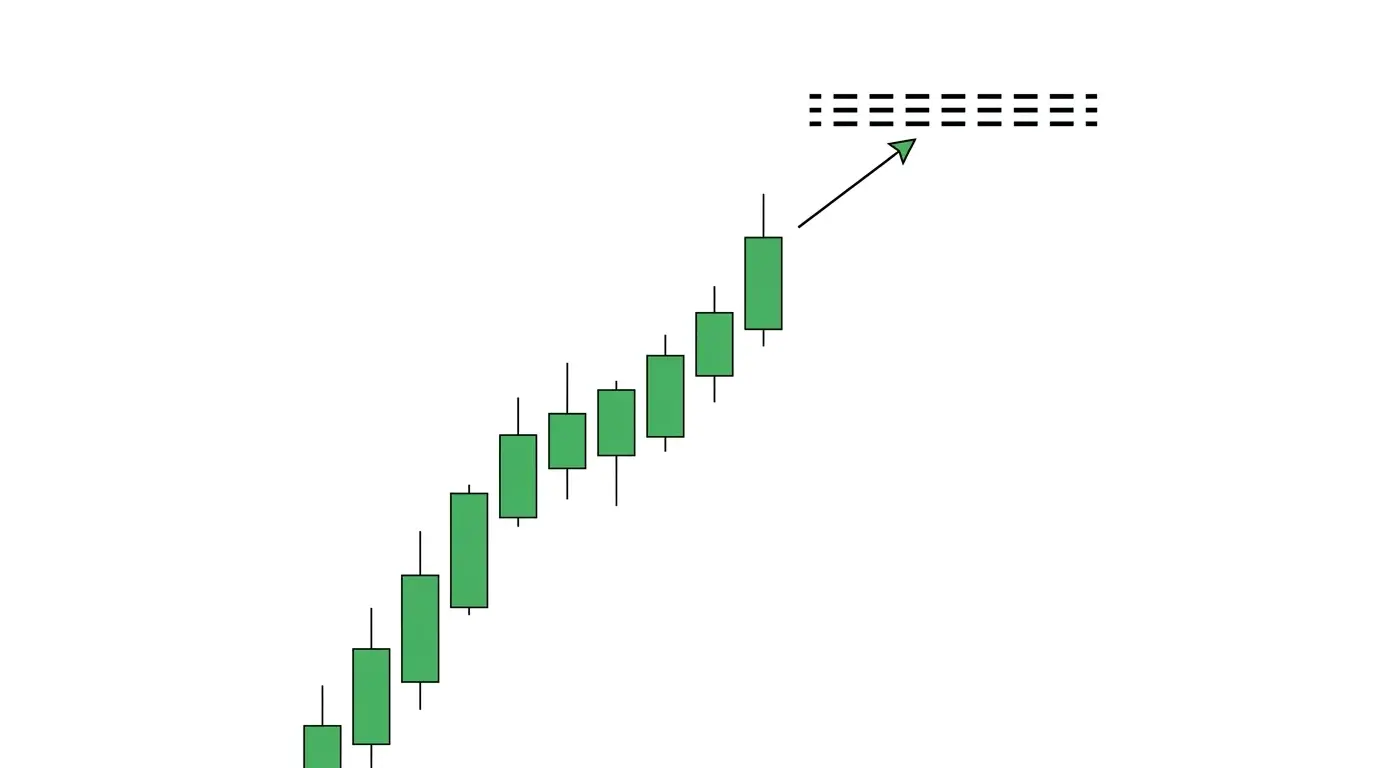
The mechanic. Identify the zone where multiple independent levels collide — prior swing high, weekly pivot, 200-period EMA, Fibonacci 1.618 extension, psychological round number. When price enters that zone, close the position regardless of what the current candle looks like. Cluster rejection is the single highest-probability event in retail-accessible chart reading.
When it applies. Swing and position trades on H4/D1 where levels have had time to build confluence. It also applies to multi-day trend rides — if your runner from Section 5 is approaching a four-level stack, that is your cue to hit the ask and lock in the full run, not to hold for an extra 10 pips.
The common mistake. Waiting for a reversal candle to "confirm" the rejection at the cluster. By the time the bearish engulfing prints on the H1, you have given back 40% of the move. Confluence zones work specifically because the rejection is sharp, fast, and often rejected on the wick rather than the body. Treat the cluster as the target, not a trigger for a reversal signal chain.
The Bottom Line
The traders who consistently compound are rarely the ones with the sharpest entries. They are the ones who manage winners ruthlessly and losers mechanically. Move to breakeven at 1R. Bank partials at 1:1. Trail the runner on ATR. Pyramid into clear trend days. Ladder bracket orders when you cannot babysit. Time-stop the setups that do not work on schedule. Flatten into news. Exit on opposing signals. And take the money when price hits a real cluster.
Every technique on this list is a rule you can pre-commit to — which is the entire point. The reason management is where retail bleeds P&L is that the moment is emotional and the rules are optional. Write them down. Stick to them. Let the next trade decide itself.
See the day's highest-conviction FX, gold, and index setups
Daily AI news impact across 32 instruments — know which pairs deserve a trail, which need a news stop, and which should stay flat.
Open News Impact DashboardRelated Articles
10 Stop Loss Placement Methods
ATR, structural swing, percent risk, order blocks, liquidity pools and more — the ten ways real traders place stops.
Risk-Reward Ratio: Trading Examples
Why 1:2 is not always better than 1:1, how winrate and R multiple interact, and how to size targets that actually get hit.

12 Trading Psychology Mistakes
FOMO, revenge trading, tilt, sunk-cost, confirmation bias — the twelve psychological errors that quietly drain accounts.

Written by the ChartSnipe Team
ChartSnipe is an AI-powered chart screenshot analysis tool and daily news impact platform for forex, gold, Bitcoin, S&P 500, and Nasdaq traders. Our team combines deep experience in technical analysis, AI vision models, and live market data across 32+ instruments to deliver actionable trading insights.